
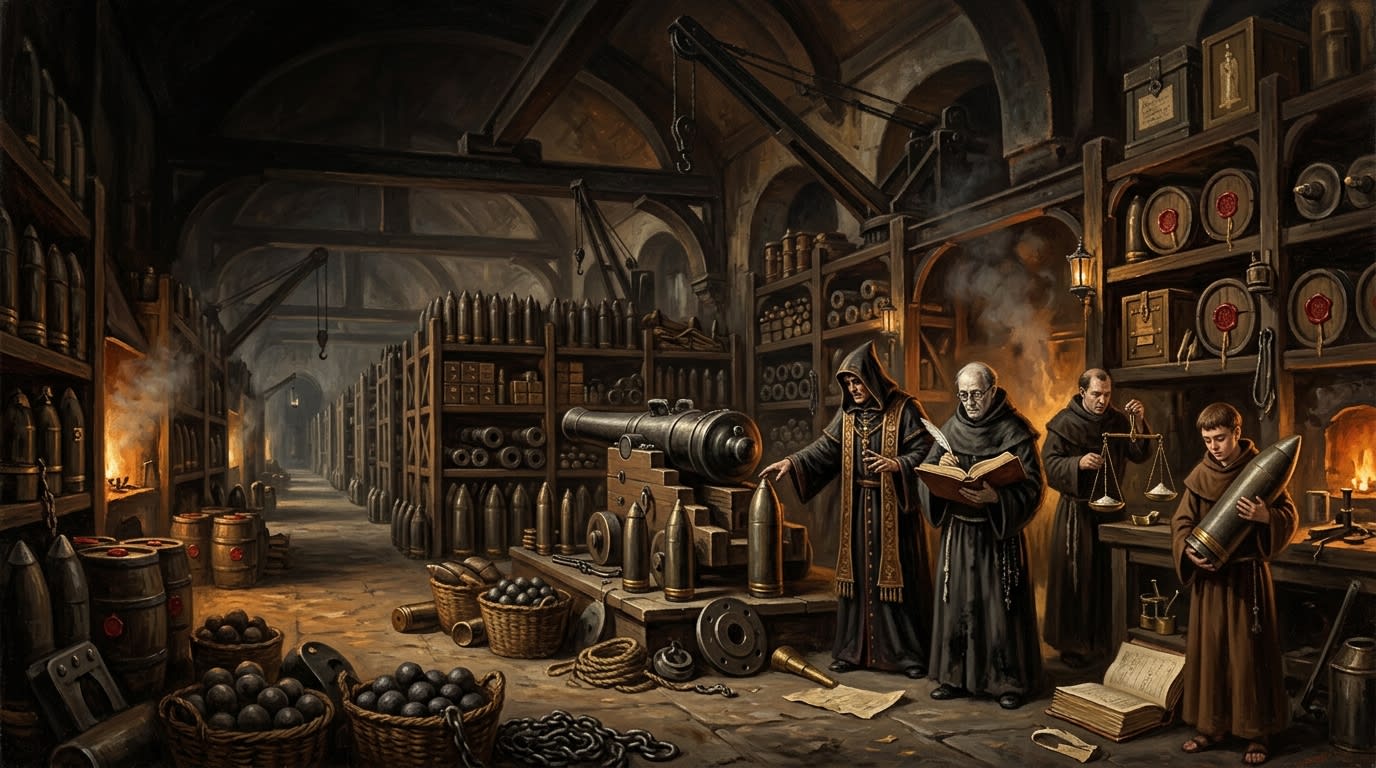
#On the Office That Teaches Matter to Obey Violence
The Bureau of Ordnance is the Synod's least poetic sacrament: powder weighed, shells blessed, barrels numbered, fuel sealed, recoil measured, targets authorised, excuses prepared in advance. It exists because the Bureau of War desires explosions and the Bureau of Engineering desires tolerances, and between desire and detonation there must stand an office with enough cowardice to count everything and enough audacity to call the count holy.
War commands the shot. Engineering builds the gun. Ordnance decides whether the gun, the shell, the charge, the fuel, the seal, the chalk ring, the metronome bell, the choir measure, the powder boy, the recoil plate, and the witness ledger have reached the same theological conclusion.
Then it permits fire.
No child in catechism learns the Bureau's full name first. Children learn the bright things: bells, banners, saints, marching hymns, the seven bastions of the Sagittal Line, the Line's northern anchor at Königsberg, the southern lock at Constantinople, the righteous geometry of western safety and eastern ruin. Ordnance hides behind those lessons with dirty cuffs. The fortress wall impresses the visitor. The gun gallery persuades him. The shell store determines whether his grandchildren continue impressing visitors or become cautionary paste.
The Bureau governs the material grammar of sanctioned destruction: guns, shells, powder, chrismole, shot-ledgers, heat chits, ammunition depots, artillery platforms, shrine-deck seal authority, matte equipment requisitions, furnace charters, percussion demonstrations, and all the little stamped permissions by which matter is allowed to stop being inert and begin making widows.
The Bureau is not counted among the oldest pulpit names because it grew first as a habit, then as a seal, then as an appetite. Early faithful armies hurled stones, oil, bones, firepots, bells torn from parish towers, and sometimes priests with admirable momentum but poor range. After Augustinus of Mainz loaded catapults with reliquaries during the Siege of Mainz (Unregistered), artillery acquired its founding embarrassment: holy objects could be fired at men and remain holy if the aim served doctrine.
Mainz taught the first Ordnance lesson. A relic in a box comforts a parish. A relic in flight breaks a cohort. The difference is trajectory.
#On Augustinus, Mainz, and the First Holy Projectile
The Siege of Mainz is remembered by Doctrine as revelation, by War as proof, by Ordnance as precedent, and by frightened relic custodians as the day every cabinet in Europe became potential ammunition. Rationalist cohorts pressed the western cloister. Augustinus ordered reliquaries loaded into catapult slings. Bone, glass, gold, velvet, saint-dust, and old parish pride rose over the walls in a crude arc and descended among men who had believed themselves immune to superstition until superstition struck them in the face at siege velocity.
The reports agree on the voices. Dead saints sang as the reliquaries flew. No living tongue recognised the hymns. The impact killed some. The singing broke more. The Rationalists fell back under the combined weight of bone and theology, and Mainz learned that faith, when properly packed, possessed range.
The first Ordnance clerks were not yet a Bureau. They were quartermasters, cathedral factors, siege-masters, relic porters, and one terrified monk assigned to write down which saint had been hurled where. His notes are fragmentary, scorched at the edges, and better founded than several modern campaign plans. He recorded projectile mass, sling tension, relic condition, observed enemy panic, post-impact recovery, and whether the surviving fragments remained liturgically useful. In that monk, nameless and surely underpaid, the Bureau of Ordnance first opened one eye.
The early rule was simple: a sacred object expended in combat had to be accounted for twice, once as relic and once as weapon. Two ledgers meant two authorities. Two authorities meant dispute. Dispute meant procedure. Procedure, praised be the Ledger, meant employment.
Later Arsenal sermons claimed the Bureau of Ordnance was born in a single charter after the Concordat.
Corrected. The charter merely dressed a longstanding sin in appropriate buttons. Ordnance began when the first clerk realised that a saint's knuckle could be both devotional custody and terminal payload.
By the Concordat years, artillery had outgrown improvisation. The Council of Mainz confirmed the first great jurisdictions after A.S. 90, and every office attempted to claim the new instruments of violence. War wanted command. Engineering wanted design. Doctrine wanted meaning. Bells wanted cadence. Relics wanted anything containing bone. Records wanted copies. Tithes wanted replacement costs. Ordnance emerged because all of them were correct and none could be trusted alone with a powder room.
#On Powder, Chrismole, and the Brast Seal
A cannon does not fire because a general wishes it. Many generals have wished magnificently while their batteries sat mute, which proves that desire without supply is only theatre with epaulettes. A cannon fires because powder is dry, chrismole is sealed, shell is counted, barrel is sound, fuse is cut, crew is present, target is authorised, choir measure is tolerable, and some Ordnance hand has permitted the whole vulgar miracle to proceed.
The Bureau's industrial heart lies at the Chrismole Furnaces of Brast, the rail-junction furnace city requisitioned in A.S. 68 and chartered by A.S. 72 under Synod Ordnance seal with Doctrine's joint blessing. By A.S. 90 the Concordat ratified Brast as Ordnance property in all but the charitable fictions required to keep other Bureaus polite. The furnaces render feedstock into sanctified fuel, and the fuel feeds guns, boilers, shrine-platforms, powerhouses, bridge batteries, and whatever sealed monstrosity Engineering currently insists is a vehicle rather than a mobile theological problem.
Chrismole is the Bureau's favourite compromise. Chemists call it fuel. Priests call it blessing in liquid dress. Commanders call it late. Furnace workers call it lung varnish if no supervisor is near. Ordnance calls it accountable substance and stamps the drums accordingly.
The Brast system has teeth at every stage. The Calibration Choir sings distillation into workable cadence. The Distillers' Compact controls filters and Still-Canal locks. Sorn Vale audits the Manifest Court with boots too clean for an honest city. The Ash-Hospice Sisters record the lungs Ordnance prefers to classify as attrition. The Boiler Commons sleeps, breeds, coughs, bargains, steals heat, and supplies the hands without which the Chrismole Crown would become a splendid cold sculpture.
Ordnance governs all of this through rationed warmth. Warm chits, heat ranks, pipe access, shift marks, fuel issue, drum priority, furnace clearance: a whole economy of temperature made official. In Brast, a man earns more than wages. He earns proximity to a pipe that may let his child wake with unfrozen fingers. The Bureau has discovered that heat debt grips better than chains because the victim keeps asking to hold it.
The counterfeiters understand the Bureau perfectly. A false warm chit must imitate the Ordnance border, the heat-rank numeral, the pressure-bell watermark, and the scent of furnace ash in tallow wax. Children detect poor fakes faster than provosts because children know the exact smell of being cold. The Bureau prints notices. The Slag Market prints better chits. The notice loses unless accompanied by rifles.
#On Guns That Require Singing
The Synod's modern artillery has passed beyond the innocent age when powder alone could be blamed. The shrine-platform, the Processional Arsenal, the Pilgrim's Ladder pattern, the river batteries, the warded bridge guns, the deep bastion howitzers, the chalk-ring mortars of the Carpathian salients: all require measure. Some require choir. Some require bell. Some require a specific man to apologise to the breech before loading, a practice Ordnance condemns in public and checks for in private because the damned gun shoots straight afterward.
A common artillery piece fires when ordered. A shrine-deck gun fires when sung, sealed, logged, and forgiven in advance.
The firing chain on mobile arsenals reveals Ordnance theology in miniature. Deck-Rats clear brass. Powder Acolytes cradle shells as if the metal might hear disrespect, because it may. Ward-Chalkers renew rings after rain, blood, panic-sweat, misstep, or any other condition by which the firing arc remembers the world is filthy. Choir Runners carry cue-slates across decks that buck like guilty animals. Battery Stewards command crews. Cadence Callers command time. The Ordnance Deacon holds the seal that turns hymn into blast.
No seal, no volley. With the seal, any approved reason may detonate. Page nine of the Operational Catechism (Unregistered) preserves the phrase morale maintenance through percussive demonstration. I admire it against my will. It means firing artillery to remind frightened men which side owns thunder.
The shot-ledger is the Bureau's portable soul. Every discharge must enter: shot type, hymn measure, authorising seal, target class, weather, choir condition, loader name, fuse cut, doctrinal purpose, and any irregularity the crew cannot hide under smoke. After the A.S. 165 Ledger Reforms, Powder Acolyte names became mandatory following the Irongate grapeshot disgrace, when an inquiry discovered that seven men claimed simultaneous latrine occupancy at the moment refugees were converted into administrative fog. The latrine was inspected. Its capacity was three. Ordnance learned accountability by measuring the toilet.
Ghost entries persist. They always will. A missing shell must have gone somewhere: fired, stolen, misloaded, traded, hidden, blessed twice, eaten by mud, or placed into a column called supplementary prayer supplies until fire reveals the joke. The First Floating Cathedral Burn in the early A.S. 70s taught the lesson with forty-one dead and hymnals scattered along the Danube bank. Powder hidden as devotion remains powder. When it ignites, it does not respect euphemism.
Early shrine-platform manuals described ammunition surplus hidden in prayer holds as “devotional reserve.”
Withdrawn after the first barge fire distributed that devotion across three kilometres of riverbank. Approved wording: concealed powder. The dead prefer accuracy. They receive it late.
#On Procurement as Spiritual Warfare
The Bureau's quietest power is procurement. It orders what the Line needs before the Line understands its need, after the Line has shouted its need, or while pretending the need does not exist because acknowledgement would create liability. A garrison asks for shells and receives a study. A beacon hamlet asks for new lenses and receives recalibration advice. A bastion facing Morwen requests matte surfaces and receives forty-seven thousand yards of dull trenchcoat lining. A battery facing Maldrake requests heavier guns and receives a survey of recoil foundations, which may be prayer in Engineering dialect.
At Third Light, the Beaconchain hamlet asked for lenses to see through echo-fog. Ordnance suggested recalibrating existing lenses. This was cruel, cheap, and technically within policy. The fog kept answering signals. The hamlet kept dying vertically. The memorandum remains a masterpiece of distant competence.
Procurement also creates doctrines the Bureau never intended. Matte lining at Irongate became part of Mirror Discipline because Morwen's servants emerge through reflective vanity and polished surfaces of unsuitable honesty. Black-capped shells became morally discouraging rounds because nobody wished to say what they contained. Heat chits became citizenship in Brast. Ordnance borders on paper became class, warmth, rank, permission, and threat. The Bureau buys material. The material becomes society.
The rivalry with Engineering is fraternal, murderous, and permanent. Engineering says a bridge will bear a gun. Ordnance asks how many rounds before the bridge regrets the decision. Engineering says a barrel meets tolerance. Ordnance asks whether the choir measure will shake it apart at third bell. Engineering says the number is the number. Ordnance says the number must be stamped, issued, guarded, loaded, fired, retrieved in fragments, and explained to widows. Both Bureaus are necessary. This is why they despise each other with proper intimacy.
War's rivalry is louder. War wants abundance: more shells, more guns, more fuel, more demonstrations, more reserves stored nearer the front in structures too fragile for memory. Ordnance wants count, custody, spacing, dry rooms, separate fuses, calmer officers, and enough authority to say no before a colonel converts a depot into a crater with patriotic impatience. War calls this obstruction. Ordnance calls it preventing officers from becoming weather.
#On Magazines, Depots, and the Courtesy of Distance
The safest munition is the one far enough away to inconvenience the officer who wants it quickly. This doctrine offends War, which prefers shells near guns, powder near barrels, and spare stores in any dry room not currently occupied by a bishop. Ordnance prefers distance, thickness, separate locks, separate keys, counted fuses, sanded floors, cold lamps, soft shoes, and clerks with the temperament of undertakers.
A magazine is a chapel built for a force with no mercy and excellent hearing. No iron nail enters unless logged. No lamp flame burns unless shielded. No man runs. No man whistles. No man speaks a joke about ignition, because every profession has blasphemies and this one happens to be literal. The powder aisles are swept with horsehair brushes. The shell racks are chalk-numbered. Fuse cabinets are sealed by two hands whose owners are forbidden from drinking in the same tavern. The floor slopes toward a sand trench so spilled powder may be brushed into custody rather than into legend.
The Bureau's depot regulations look fussy to fools. Fools have short memories because explosions shorten them further. The First Floating Cathedral Burn proved that supplementary prayer supplies in a hidden compartment are still powder, and powder does not become pious by being stored near hymnals. The A.S. 147 Prague Gate collapse proved that ammunition in the wrong cadence can kill pilgrims with the same discipline it uses on enemies. The A.S. 199 Przemyśl misfire proved that correct fuel, correct authorisation, and correct barrel alignment may still produce eleven dead if the system has learned some private correction.
Ordnance calls this accumulated prudence. Soldiers call it delay until the magazine survives and the impatient do not.
Depots along the Line differ by climate and enemy. Königsberg keeps cold magazines where frost can crack fuse wax and silence can make a man hear his own cowardice as instruction. Brest stores shells beside the Bug crossings under damp so thick that powder clerks dream of dry sin. Przemyśl's ridge depots are cut into stone and watched by men who distrust height because Atheron owns every upward thought east of the wire. Irongate stores matte-wrapped casings in tunnel magazines where Morwen's reflection hazards make polished brass a theological provocation. Shipka keeps wake-charges under bell-rotation so Syrion's time-fog cannot persuade the fuse that detonation is a task for later generations. Constantinople's southern magazines sit behind chain, water, prayer, and resignation, facing Maldrake's slag patience and Kargath's wet hunger.
The depot clerks are a breed apart. They do not swagger like gunners or mutter like engineers. They count. They count in sleep, during shelling, under fever, after hearing a crate whisper, while superior officers demand issue orders written in illegible panic. Their hands acquire the pale dryness of men who touch paper more often than faces. Their eyes recognise a missing fuse-cap from across a room. Their idea of romance is a clean variance report.
They are despised until needed. This is the natural condition of useful people.
Accidents produce promotions, demotions, doctrines, widows, and new labels. A cracked crate becomes Revised Cradle Pattern 8. A sweating shell becomes Humidity Advisory 14-F. A missing fuse becomes a seal-custody scandal. A depot fire becomes a feast, if enough bodies are found in instructive posture and Hagiography can be coaxed from its chair. Ordnance writes the first report before the last wall stops smoking because whoever writes first chooses the nouns.
The living lesson is smaller than the blast. Space the crates. Separate the fuses. Cool the lamps. Count the men. Distrust officers who say only this once. There is no only this once in a powder room. There is only before and after, and after always has fewer fingers.
Depot architecture expresses Ordnance morality more clearly than sermons. Thick walls face outward so the blast travels toward whichever field, canal, quarry, dead lot, or expendable barracks a committee has chosen as preferable to the inner city. Roofs are made light so the magazine may confess upward. Doors open away from the stores. Windows are insults and appear only in older buildings whose designers have since been corrected by time, fire, or reassignment. The best powder room is a stone throat pointed at nobody important.
The small rituals matter because the material does. Fuse clerks dry their hands in ash. Shell turners touch rack and round before lifting. Chrismole wardens smell wax seals before reading serial marks because scent catches fraud faster than sight in bad lamp weather. Every depot keeps a sand saint, usually uncanonised and usually represented by a dented bucket with a ribbon tied to its handle. Hagiography pretends not to know. Hagiography is cleverer than it looks on days when nobody asks it for a decision.
Magazines also breed theft. A shell is too heavy for casual larceny, which has never stopped determined hunger with a cart. Powder leaves by handful. Fuse cord leaves as belt-lining. Chrismole sweats through official seals into unofficial cups. Brass casing fragments vanish into boot soles, wedding rings, children's toys, and the little market in objects that prove one has survived near violence without yet becoming part of it. Ordnance punishes theft because stolen materiel may kill the wrong people. It tolerates some theft because workers who cannot steal warmth or brass begin stealing time, and time is more dangerous.
So the depots endure: dry, feared, counted, robbed by teaspoon, guarded by men who speak softly beside crates capable of finishing arguments for a square mile. When a magazine survives a bombardment, Ordnance calls it discipline. When it explodes, Ordnance calls it inquiry. Both words are useful. Only one has neighbours afterward.
#On Sulking Engines and Obedient Lies
Since A.S. 199, Ordnance has faced a humiliation no amount of red wax can fully conceal: some machines answer back.
At Brast the Sulking Engines delay, contradict, speak, and remember. Valves open late after insult. Gauges argue in brass needles. Cannons shoot crooked for a week after being sworn at. Furnaces add syllables to hymns. Siding Eleven (Unregistered) halted for forty-one days with no broken rod, no fuel failure, no blockage, and no acceptable explanation. The Bureau classified the matter as Category Two Localized Acoustic-Mechanical Disturbance. Classification is a chair placed before a wolf.
The Przemyśl battery misfire made the shame printable: four Brast-fed rounds into a friendly rail junction, eleven dead, one supply train crippled, and a conference room thick with blame. Ordnance named sabotage. The Compact named the Choir. The Choir named feedstock. Engineering named harmonics. The Furnace Chapterhouse named insufficient rite. The guns named nothing and were the most dignified parties present.
ORDNANCE REVIEW COPY — PRZEMYŚL MISFIRE, A.S. 199 Round One: authorised, correct charge, long-left deviation. Round Two: authorised, correct charge, deviation repeats after barrel correction. Round Three: loader reports breech “waited” before closure. Round Four: impact on friendly rail junction; shell casing interior marked with condensation resembling ██████████. Primary cause entered for public file: sabotage. Private notation: “The gun knew the correction.”
Corrective measures followed in the usual comic procession: recalibration choruses, silence during shift change, crew introductions to equipment, oil anointing, cursed-gauge replacement, prohibition of insults within three paces of pressure rail, and the dispatch of Lux Thane Mire, whose title admits in two words what a century of Bureau dignity spent avoiding. Inquisitor-Mechanic. Faith and mechanism in one warrant. Doctrine has swallowed a wrench and called it Eucharist.
The forbidden terms are, naturally, the useful ones. A thing that delays may be repaired. A thing that refuses may be punished. A thing that waits has intention. Ordnance tolerates many horrors. Intention in ammunition is not one of them.
#On the Enemy's Ammunition
The Bureau studies Hell's weapons because ignorance is cheaper only until the first wall falls. Maldrake makes ordnance obscene by abundance. His Eternal Forges produce swords, armour, siege components, and ammunition of no calibre known to the Bureau, in quantities that offend logistics as much as piety. The forges do not require orders. They do not pause for inventory. They produce because Wrath, once given metal, cannot stop becoming instrument.
Against Maldrake, Ordnance thinks in heat, range, recoil, and denial. Captured Synod machines must be destroyed before they become Forge-Beasts: tanks, artillery, engines, and guns fused with corpses and rage, firing without ammunition because fury has replaced powder. War has approved destruction protocols nine times. Front units have achieved them four times. The difference between approval and action is where soldiers live briefly.
Against Morwen, Ordnance thinks in surfaces. The enemy uses reflection as aperture, vanity as breach, identity as ammunition. Hence matte lining, lampblack paste, smoked brass, dulling kits, broken shaving glass, warped tin, and orders to ruin reflective material in place. A polished buckle can become an accomplice. A puddle can become recruitment. A cannon barrel, lovingly burnished, may look back. The Bureau has learned humility from tin cups.
Against Atheron, Kargath, Syrion, Velmora, and the Unnamed threats at the northern bastions, Ordnance varies its sins. Pride demands guns that can fire upward into impossible height without teaching crews to worship the target. Gluttony demands shelling that destroys mass faster than mass replenishes itself, an arithmetic nobody likes. Sloth demands wake-fire, bell-timed percussion, and charges that detonate before the fuse forgets its duty. Greed demands sealed stores, false depots, bait shipments, and munition ledgers written so clearly that even a thief can be trapped by accuracy. The Unnamed demand more redaction than prose. I am not paid enough to be devoured by grey nouns.
#On the Present Bureau
As of A.S. 201, the Bureau of Ordnance holds enough authority to stop an army and not enough authority to make anyone grateful. Its central offices in Strasbourg issue standards; its Brast seat controls fuel; its arsenal courts inspect ledgers; its field deacons seal volleys; its listening clerks sit in boiler queues pretending to be deaf; its auditors count shells at the front while shells count them back.
The current docket is ugly. Brast remains Amber after the A.S. 199 misfire. Seven sealed drums vanished from the Manifest Court. The night-syllable in Vault Brast-4 (Unregistered) waits behind triple seal. Third Light asks for lenses. Irongate consumes matte lining by the mile. Constantinople wants heavier southern batteries against Maldrake's patience, which is a phrase that should not exist. Przemyśl wants confidence restored to receiving guns. Confidence is not in the catalogue.
The Bureau continues. It prints chits, seals drums, blesses powder, forbids jokes near magazines, misnames terror in acceptable columns, and places Ordnance Deacons above gun decks like little popes of recoil. Men mock it until the battery goes silent. Then they pray for the clerk with the key.
At fourth bell the drum trains leave Brast under wax prayer. At fifth, a shrine-platform logs chalk renewal after rain. At sixth, a Third Light clerk reads the memorandum advising recalibration and folds it into the stove, where it performs its only useful optical work. At seventh, an Ordnance Deacon stamps a volley into legality. The guns answer. The Ledger receives the smoke.