
#On the Station Called Third Light
"Light three times. Speak once." — Painted on the lintel of Beacon Tower Three, origin unknown, paint refreshed quarterly by standing order.
I have climbed to Third Light once. Once is enough. Once is, in fact, more than enough — the Bureau of Doctrine dispatched me in the winter of A.S. 197 to inspect the signal logs for "procedural fidelity," which is to say, someone in Strasbourg suspected the Beaconchain was lying and wanted a man of sufficient rank, sufficient vanity, and sufficient expendability to go up there and confirm it. I was flattered by two of those qualifications and insulted by the third, and I went, because I am obedient, because the altitude pay is excellent, and because I wished to see for myself the place that decides whether convoys live or die on the ridge passes.
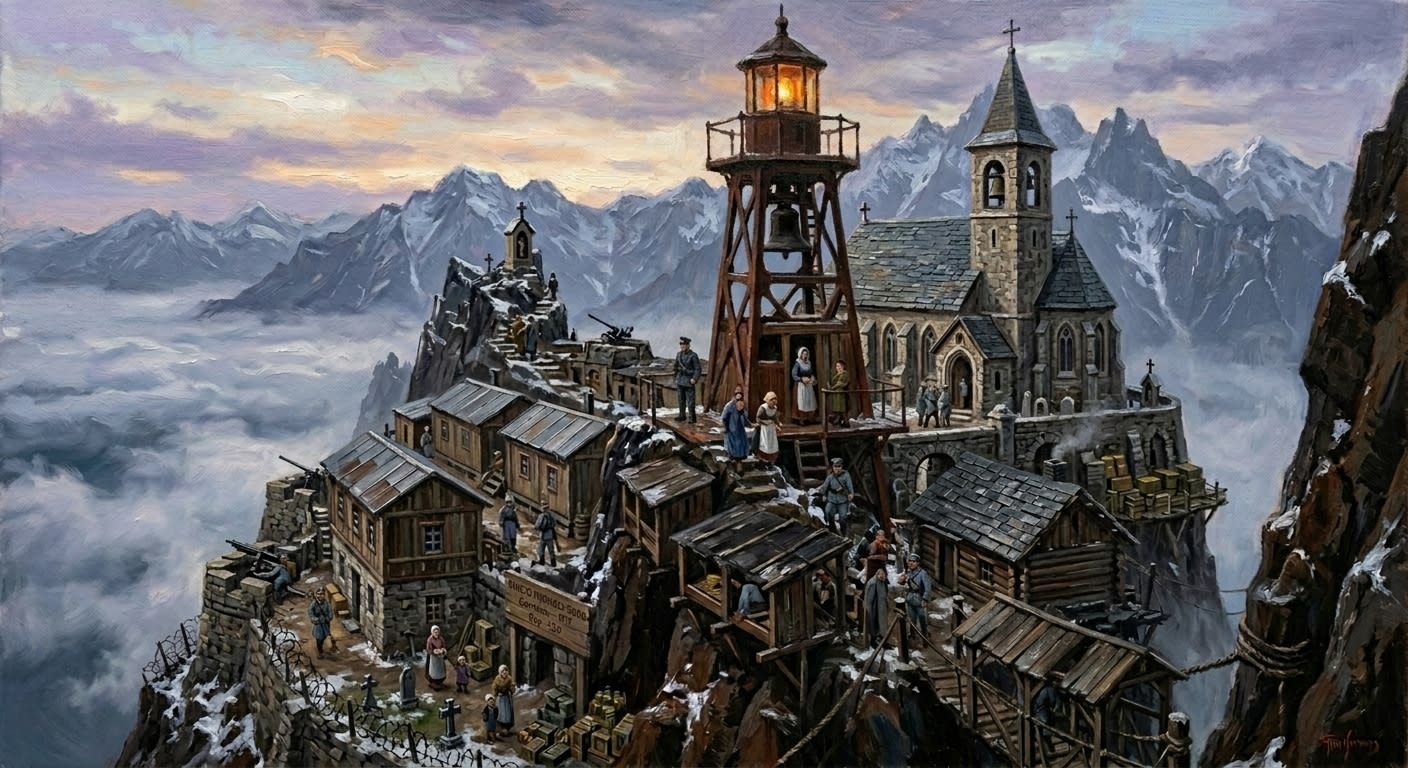
Third Light is a hamlet of four hundred and thirty souls perched on a basalt knife-ridge in the high Carpathians, at approximately 47°N latitude, 22°E longitude, where the air is thin enough to make a clerk's hand shake and cold enough to freeze ink in the nib before it touches slate. It is the third station of the Beaconchain — that chain of iron signal towers which steps from peak to peak like a rosary of rust, stitching the ridge passes into a single nervous system of light, bell, and stamped paper. Each station relays convoy permissions, route clearances, storm warnings, and timing signals to the next. Each station depends upon every other. And Third Light — Third Light is the one that matters, because Third Light is the one that can see both ways.
#On the Founding and the Third Tower
The Beaconchain was born from a disaster. In the winter of A.S. 72 — seven years after the Sagittal Line solidified from desperate entrenchments into continental fortification — a supply convoy of eleven wagons and three hundred mules departed the low valley staging grounds bound for Bastion-Przemyśl through the Carpathian passes. The convoy carried grain, lamp oil, and fourteen crates of consecrated ammunition stamped with the triple seal of the Bureau of War. It vanished. The fog took it, or the passes took it, or the passes and the fog collaborated, which in these mountains amounts to the same admission. Search parties found the mules three weeks later, alive, standing in a circle on a ridge shelf. The wagons were gone. The men were gone. The grain was gone. The stamps were found, scattered on the scree like autumn leaves, every seal unbroken.
The Bureau of War filed the loss as "terrain-induced attrition" and immediately commissioned a survey of the ridge passes. The survey recommended signal towers. Two were built by A.S. 74 — the First Light at the northern crest, the Second Light at the mid-ridge saddle. Both functioned. Both saved convoys. Both burned down in the same lightning storm in A.S. 76, a storm that arrived from below the ridgeline, which is not, the Bureau of Alchemical Standards would later note with admirable restraint, how storms work.
The Third Light was built in A.S. 77, on higher ground, with grounding chains sunk forty feet into the basalt. It was built to replace what the lightning had destroyed. It was built to anchor the Beaconchain at its most critical relay point — the sightline nexus where the northern passes and the southern switchbacks are both visible on a clear day. The Synod Signal Office standardized the log procedures in A.S. 82. Bell-signets were introduced in A.S. 89. Oath-collars for clerks followed in A.S. 94, after a signal clerk named Pell Oster sold three weeks of forged clearance windows to a smuggling ring operating out of the Lowvale. Oster was hanged from his own bell-cage. The Bureau of Records filed his execution under "equipment maintenance."
#On the Geography of the Ridge
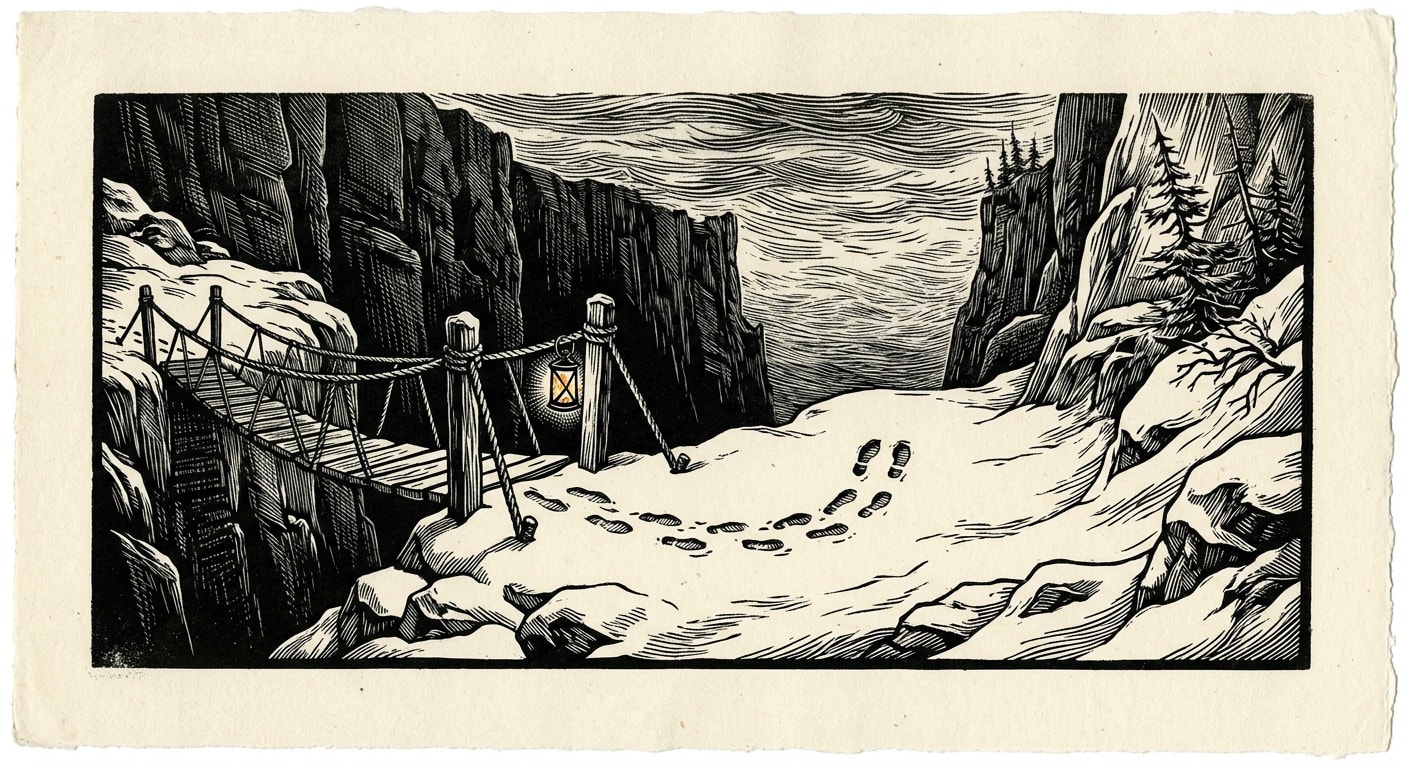
The hamlet clings to a spine of basalt that rises from the fog sea like the dorsal fin of something drowned. The ridge is perhaps six hundred yards long and never wider than forty at its broadest shelf. Everything is vertical. The Sleeping Stack — four tiers of bunks bolted to the cliff face — hangs over a drop that the Bureau of Engineering has measured at three hundred and twelve feet and the locals have measured at "enough." The Ropewalk spans the gap between the main ridge and the eastern spur on cables of tarred hemp, each cable replaced every eighteen months, each replacement logged, each log countersigned by the Beaconmaster and the Gate Provost jointly, because a snapped cable has killed more people at Third Light than any enemy action.
Below the ridge, the fog.
The fog at Third Light behaves like a tide. It rises in the morning, floods the basins, laps at the switchback trails, and retreats — sometimes — by the third bell-cycle. Sometimes it does not retreat. Sometimes it stays for days, and the hamlet becomes an island in a white sea, and the only things that move are the lantern beams sweeping through the murk and the rope-hum vibrating through the catwalks like the pulse of something vast and patient beneath.
The weather at Third Light arrives uphill-first, which is to say it arrives wrong. Storms crawl up the slopes from the valleys, gathering force as they climb, so that the garrison sees them coming from below — a luxury that ought to provide warning but in practice provides dread. Lightning is the principal killer. It strikes the chains, the towers, the bell-cages, and on three documented occasions the clerks themselves. The Bureau of Doctrine has classified lightning strikes on Beaconchain personnel as "divine adjudication" and left it at that.
#On the Beacon and the Bell
Beacon Tower Three is a fifty-foot column of rust-iron riveted to the ridge's highest point. It holds a relic-lantern at its crown — a lens of consecrated glass, cracked twice, repaired thrice, the cracks themselves now sanctified as "signs of endurance" by the Bureau of Doctrine — and a bell-cage of cast bronze. The bell has no name. It has a number: Relay Seven, Subsignet Three, Classification Restricted. The Bureau of Bells has a name for it somewhere in the filing system, a name given at the casting, a name that has been classified since A.S. 94 and the reason for the classification has itself been classified since A.S. 96.
The bell is struck to mark the beginning and end of each signal cycle. A cycle lasts four hours. Six cycles per day. Each cycle produces a bell-signet — a wax impression of the bell's tone pattern, pressed into the log at the exact moment of the strike and compared against the master timing wheel in the Loghouse. The bell-signet is the proof that the beacon was lit at the correct time, that the lantern was aimed at the correct bearing, that the signal was received by Fourth Light and acknowledged, and that all of this happened in the correct sequence. The bell-signet cannot be forged. This is the official position of the Synod Signal Office. The bell-signet can, in fact, be forged. This is the unofficial position of everyone who has ever served at Third Light. The difference between official and unofficial, in a hamlet where the entire economy runs on stamped paper, is the difference between a clerk's career and his grave.
#On the Loghouse and the Slate Pages
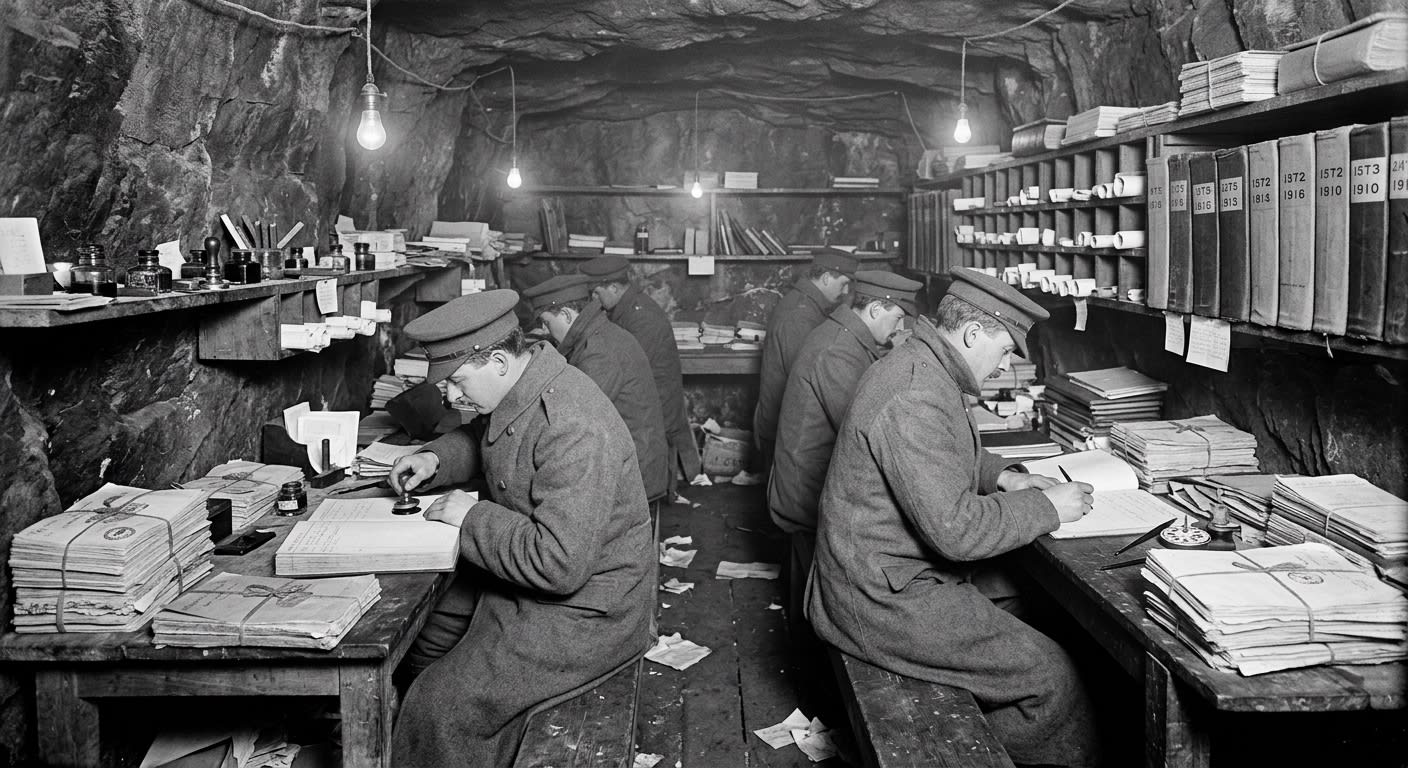
The Loghouse of Slate Pages sits thirty yards below Beacon Tower Three, built into the cliff face behind walls of dressed slate chosen for its resistance to damp, fire, and truth. Every signal cycle is recorded here. Every convoy clearance. Every storm warning. Every route permission granted, denied, or — the most interesting category — "held pending clarification," which in the vocabulary of the Beaconchain means "someone is paying someone and we are waiting to see who pays more."
The logs are the law at Third Light. A convoy that moves without a logged clearance does not exist. A clearance that is not logged did not happen. A storm that is not logged was not a storm. The tautology is the point. The Synod Signal Office has built an entire civilization on the principle that writing something down makes it true, and at Third Light — where the consequences of a false entry can kill three hundred men in a fog-bound pass — the principle is enforced with an enthusiasm that borders on the theological.
Errors confessed in the Loghouse are confessed under a silence hood — a canvas sack placed over the head, ostensibly to prevent the penitent from reading the other logs on the table, practically to prevent the other clerks from seeing who is confessing. The confessions are stored. They are always stored. At Third Light, your errors are your career, your leverage, and your burial shroud, and the Loghouse keeps all three in the same filing cabinet.
#On the Inhabitants and Their Miseries
Four hundred and thirty souls inhabit Third Light at any given count, though the number is "collapsing," which is the Signal Office's term for a population that is dying faster than it can be replaced by conscription from the valley towns. The attrition is mundane: burns from lightning strikes, falls from the catwalks, hypoxia from the altitude, frostbite in winter, and a slow spiritual corrosion that the Bureau of Mercy has diagnosed as "altitude melancholia" and the garrison calls "rope-stare" — the tendency to stand on the Ropewalk and look down for too long.
The class hierarchy is rigid and simple. At the top: the Synod Signal Office staff, who control the logs and therefore the truth. Below them: the Gate Provosts, who control the permits and therefore the passage. Below them: the Lanternwright mechanics, who control the lenses and therefore the light. Below them: the tenders, porters, mule-masters, and fog-debt labourers, who control nothing and are controlled by everything above.
Three names govern Third Light, and all three are afraid.
Beaconmaster Jorren Quill commands the Signal Office. His gloves are immaculate — white kidskin, replaced weekly, paid for from his own salary, which is not large. The gloves are his vanity and his declaration: clean hands, clean logs, clean conscience. He is terrified of blank pages. A blank page in the log means a missed cycle, and a missed cycle means a gap in the record, and a gap in the record means a question from Strasbourg, and a question from Strasbourg means an answer, and answers, at this altitude, are fatal. Quill has not missed a cycle in eleven years. This is admirable. It is also suspicious.
Sister-Mechanic Vey Sable maintains the relic-lanterns in the Lantern Shed — a low stone building that smells of oil and old glass and the particular metallic sweetness of consecrated optics. She sings calibration hymns under her breath while she works, a flat-sung drone that keeps the lenses "obedient," which is her word and not the Bureau's, and the Bureau has not corrected her because the lenses work and the Bureau is practical about its superstitions. Sable never looks at the fog. She has not looked at the fog, she told me, since A.S. 194. I did not ask what she saw in A.S. 194. Her hands, I noticed, were steady. Her eyes were not.
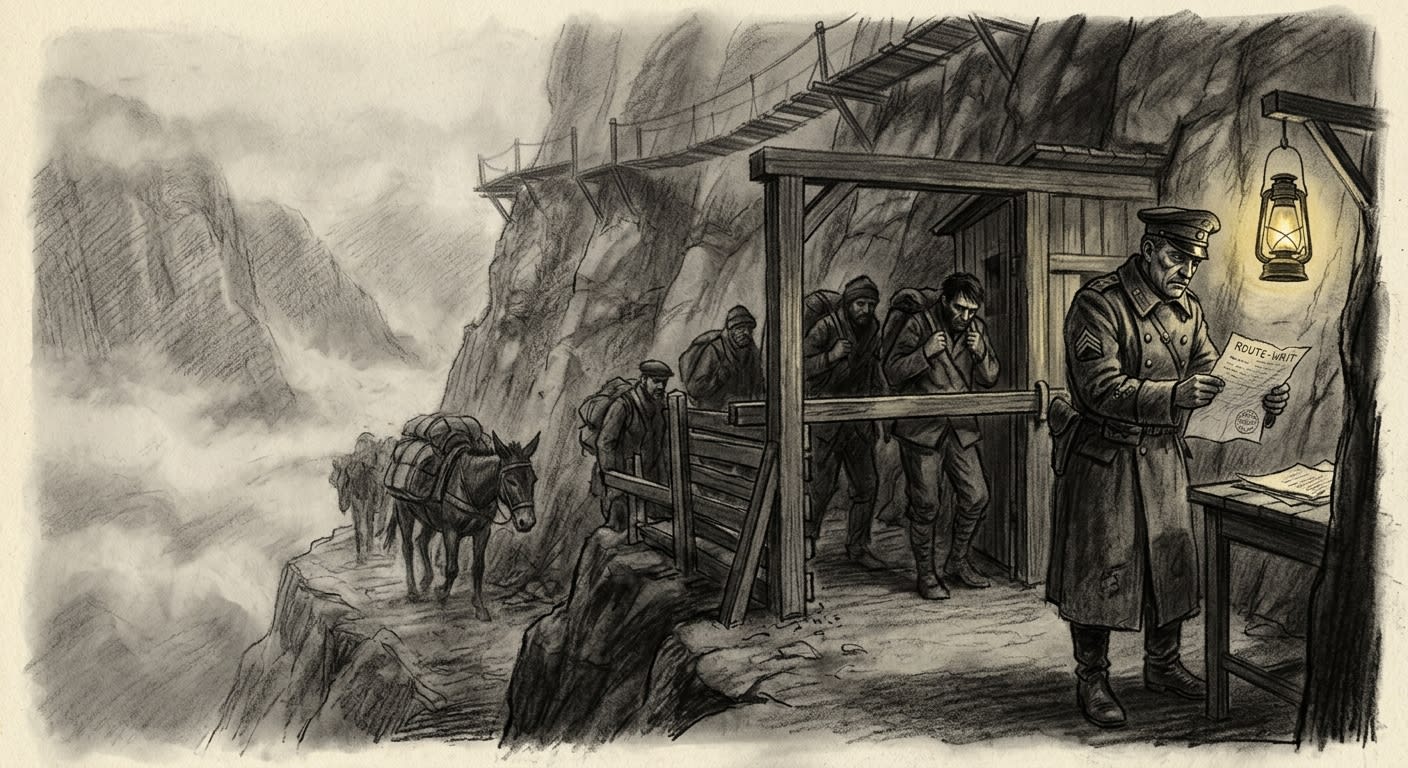
Gate Provost Harn, called "Nail" by the garrison and "Sir" by everyone else, controls the Switchback Gate — the only viable approach to Third Light from the valley below. Every mule, every porter, every conscript, every sealed message passes through Nail's checkpoint. He counts his bribes like prayers, and his prayers like bribes, and the mathematical equivalence between the two is, at Third Light, the closest thing to honest theology the hamlet possesses. Nail is afraid of the fog's "third answer" — a signal echo that returns from the fog basin carrying information that was never transmitted. He has heard it twice. He has reported it zero times.
#On the Answering Fog
The fog at Third Light answers.
This is not metaphor. This is the operational assessment of the Synod Signal Office, Classification Restricted, filed under "Anomalous Signal Behaviour — Station Three — Ongoing," a file that has been "ongoing" since A.S. 194 and shows no sign of becoming anything else.
The phenomenon presents as follows: a bell-signet is struck; the signal relay fires; the lantern sweeps the bearing toward Fourth Light. The signal arrives. It is acknowledged. And then — between seventeen seconds and four minutes later — a second acknowledgment arrives. From the fog basin. From below. From a direction in which there is no station, no relay, no tower, no lens, and no bell. The second acknowledgment matches the first in every particular. Timing, bearing, frequency, tone. It is perfect. It is too perfect, which is, as I have observed, the defining characteristic of everything at Third Light.
Countermeasures exist. Grounding chains sunk into the basalt to dissipate whatever frequencies the fog carries. Salt lines laid on the catwalks — a practice the Bureau of Doctrine has neither sanctioned nor forbidden, which at the Bureau means "continue until someone dies." Flat-sung calibration choruses performed by the Lanternwright Knot at the beginning of each cycle, a drone of twelve voices holding a single note until the lenses settle and the rope-hum drops to its baseline frequency.
The countermeasures work. Sometimes. The grounding chains discharge, the salt lines remain unbroken, the flat-sung choruses stabilize the instruments, and the fog does not answer. For a day, for a week, for a month. And then it answers again. And the answer is always correct.
The Bureau of Alchemical Standards sent a team in A.S. 199. They brought instruments. They measured frequencies, atmospheric pressures, barometric anomalies, and what they called "acoustic refraction indices." They stayed for three weeks. They filed a report. The report is four pages long. Three pages are redacted. The fourth reads: "Further study recommended. Team reassigned."
#On the Silent Notch and the Grounding Field
Two places at Third Light deserve particular mention, and both deserve it for the same reason: they are places where the rules break down.
The Silent Notch is an acoustic dead zone on the eastern spur of the ridge, approximately forty yards from the Ropewalk terminus. Bells do not carry there. Voices do not carry there. The flat-sung calibration choruses, which stabilize the instruments everywhere else on the ridge, produce in the Silent Notch a silence so absolute that Sister-Mechanic Sable has described it as "the sound of God holding His breath." Personnel are forbidden from entering the Notch alone. Personnel enter the Notch alone regularly, because the Notch is the only place on the ridge where a man can stand without being heard, watched, or logged, and privacy at Third Light is worth more than oil.
The problem with the Silent Notch is the footprints. They appear in fresh snow. They lead into the Notch from the Ropewalk side. They do not lead out. This has been documented seven times since A.S. 195. In four of those seven instances, the footprints matched personnel currently on duty elsewhere on the ridge. In one instance — A.S. 198, the 3rd of Argent — the footprints ended midstep, as if the walker had been lifted vertically from the snow. The Bureau of Records logged this as "environmental anomaly, no personnel unaccounted for." All personnel were indeed accounted for. The footprints were Beaconmaster Quill's boot-pattern. Quill was in the Loghouse at the time, three hundred yards away, witnessed by two clerks and a provost. The Bureau of Records has not revised its assessment.
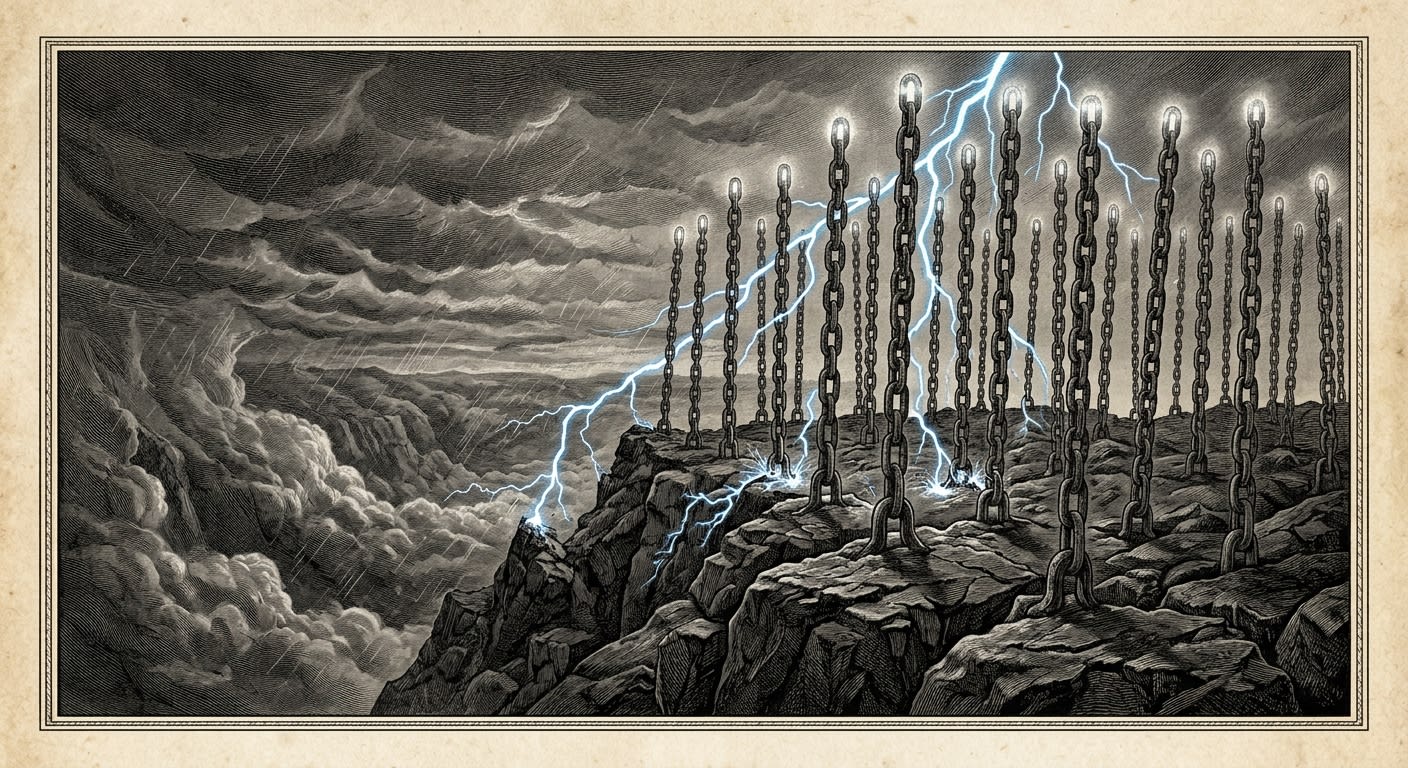
The Grounding Field is a grove of iron chains planted upright in the basalt at the western end of the ridge — forty-seven chains, each fifteen feet tall, each sunk ten feet into the rock, each designed to draw lightning away from the tower and the bell-cage. During storms, the chains sing. The pitch changes with atmospheric pressure, which is normal. The pitch also changes, according to the garrison, "with truth" — a claim that the Bureau of Doctrine has classified as superstition but that the Gate Provosts use routinely when conducting oath-hearings at the field's edge. A man who lies in the Grounding Field, the garrison believes, changes the pitch of the nearest chain. The Bureau of Doctrine calls this folklore. The Bureau of Doctrine also holds its own interrogations at the Grounding Field. The Bureau of Doctrine has not explained why.
#On the Factions and Their Quarrels
Five factions contest Third Light, and all five pretend to be one.
The Synod Signal Office controls the logs, the timing wheel, and the authority to declare a signal cycle valid or void. They are the law. Their power is absolute in matters of record, which at Third Light means their power is absolute in matters of reality. A convoy that the Signal Office declines to log has, by definition, never moved. A storm that the Signal Office declines to record has, by definition, never fallen. This authority is exercised with the scrupulousness of men who know that their own logs can be audited from Strasbourg at any moment, and with the corruption of men who know that Strasbourg audits Third Light once every three years at best.
The Lanternwright Knot controls the lenses, the oil, and the mechanical soul of the beacon. They are a craft guild in the old style — apprentice, journeyman, master — and they hoard their specifications with a jealousy that the Bureau of Records would admire if the Bureau of Records were capable of admiring anything other than its own filing system. The Lanternwright Knot sells "selective blindness" — the ability to angle a lens so that a particular convoy is not illuminated, a particular signal is not relayed, a particular movement is not seen. The price is oil, always oil, because oil at this altitude is life.
The Ropewalkers' Brotherhood controls the cables that connect Third Light to the outer spurs, the lower switchbacks, and the neighbouring stations. They are smugglers. Their cargo moves on hooks clipped to the underside of the span cables — packages no larger than a man's fist, travelling at rope speed, invisible from above and inaudible from below. The Ropewalkers call their smuggling "the undersong." The Bureau of Purity has investigated the Ropewalkers twice. Both investigations concluded with the investigators requesting transfers to lower altitudes for health reasons.
The Fog-Scouts do not officially exist. They are unlicensed guides who descend into the fog basin below the ridge to map what moves there, to guide contraband through the whiteout, and to answer the question that no one at Third Light will ask aloud: what is in the fog? The Fog-Scouts claim the fog has rules. It moves on schedules. It opens "clear windows" — pockets of visibility that last exactly one bell-cycle, no more, no less — and the windows open in patterns that can be predicted if you are willing to spend enough time below the ridge to learn them. The Bureau of Doctrine classifies the Fog-Scouts as heretics. The Gate Provosts hire them regularly.
The Gate Provosts are the militia. They search, they tariff, they beat, they extort, and they provide the only armed authority between the Switchback Gate and the fog basin. Nail commands them. Nail is honest about his dishonesty, which is the highest virtue available at Third Light. The Provosts monetize passage: a route writ from the Signal Office costs one thing; the Provost's willingness to let you through the gate with that writ costs another. The economy of the ridge runs on this double-tithe. The Bureau of War is aware of it. The Bureau of War considers it efficient.
#On the Present Condition
Third Light is dying. The population has been "collapsing" — the Signal Office's word — for three years. Attrition claims six to ten souls per season: lightning, falls, rope-stare, the slow hypoxic decline that the Bureau of Mercy classifies as "environmental fatigue" and the garrison classifies as "the ridge eating you." Conscription from the valley towns — primarily from Lowvale Tallytown, one day's descent on the switchbacks — replaces the dead with the unwilling. The unwilling become the competent or they become the dead. There is no third category.
The answering fog grows more precise. In A.S. 199, the echoed signals began arriving with altered timing — half a beat late, then a quarter beat, then exact. The Bureau of Alchemical Standards team departed in A.S. 200. Since their departure, the fog has echoed seven signals with timing that the master wheel cannot distinguish from a legitimate relay. Seven signals that appeared in the log as valid Fourth Light acknowledgments, and were entered as such, and were only identified as anomalous when Fourth Light reported that it had not, in fact, received those signals at all.
Someone — or something — is learning the Beaconchain's protocols. Someone is using false clear windows to move ridge-to-ridge in the fog. And someone, Beaconmaster Quill suspects, wants Third Light blind.
Prior editions of the Bureau of Alchemical Standards assessment classified the answering fog as "acoustic refraction consistent with atmospheric layering" — a natural phenomenon requiring no doctrinal intervention.
This classification has been suspended. The suspension was not announced. This erratum is the announcement. Further study has been recommended. The team assigned to further study has been reassigned. The reassignment was not announced either.
Quill has requested reinforcements. He has received paperwork. Sable has requested new lenses — lenses ground to specifications that the Lanternwright Knot claims will "see through the echo." She has received a memorandum from the Bureau of Ordnance suggesting she recalibrate the existing lenses. Nail has requested nothing, because Nail understands that requests travel downhill and decisions travel uphill and at Third Light there is nothing above you but the bell-cage and the lightning and the Creator who, according to the Bureau of Doctrine, is paying attention.
The hamlet stands. The beacon burns. The bell strikes. The fog answers. The logs record everything, and everything the logs record is true, and everything that is true is stamped, and everything that is stamped is sealed, and the seal is the end of questioning.
Light three times. Speak once.