
#On the Cathedral's Present Charge
This plate records the survey of A.S. 201. It covers one corner of Lyon Cathedral: the north ambulatory, where the Church keeps Saint Theophania in stone, her oil in vials, and her petitioners in something close to a line. The nave, the towers, the chapter, the bells and whichever prelate currently believes the building belongs to him are outside the commission. I was sent to inspect a shrine, and I inspected a shrine. Anyone who wants the rest of the cathedral may petition for a plate of their own and wait, as I did, for the stamp.
Lyon sits on the Rhône in Zone 1, the Western Heartlands / Rhône Corridor. It is Synod-held, rich and devout, and it is watched with the care one gives a gifted nephew who has been handed the cellar keys. Its river wards keep ash bowls. Its Mercy houses keep whistle registers. Its cathedral keeps oil. Among the city's relic custodies this one is the quietest. In Lyon that only means nobody has yet sold tickets to it at a profit the Bureaus could detect.
#On the North Ambulatory
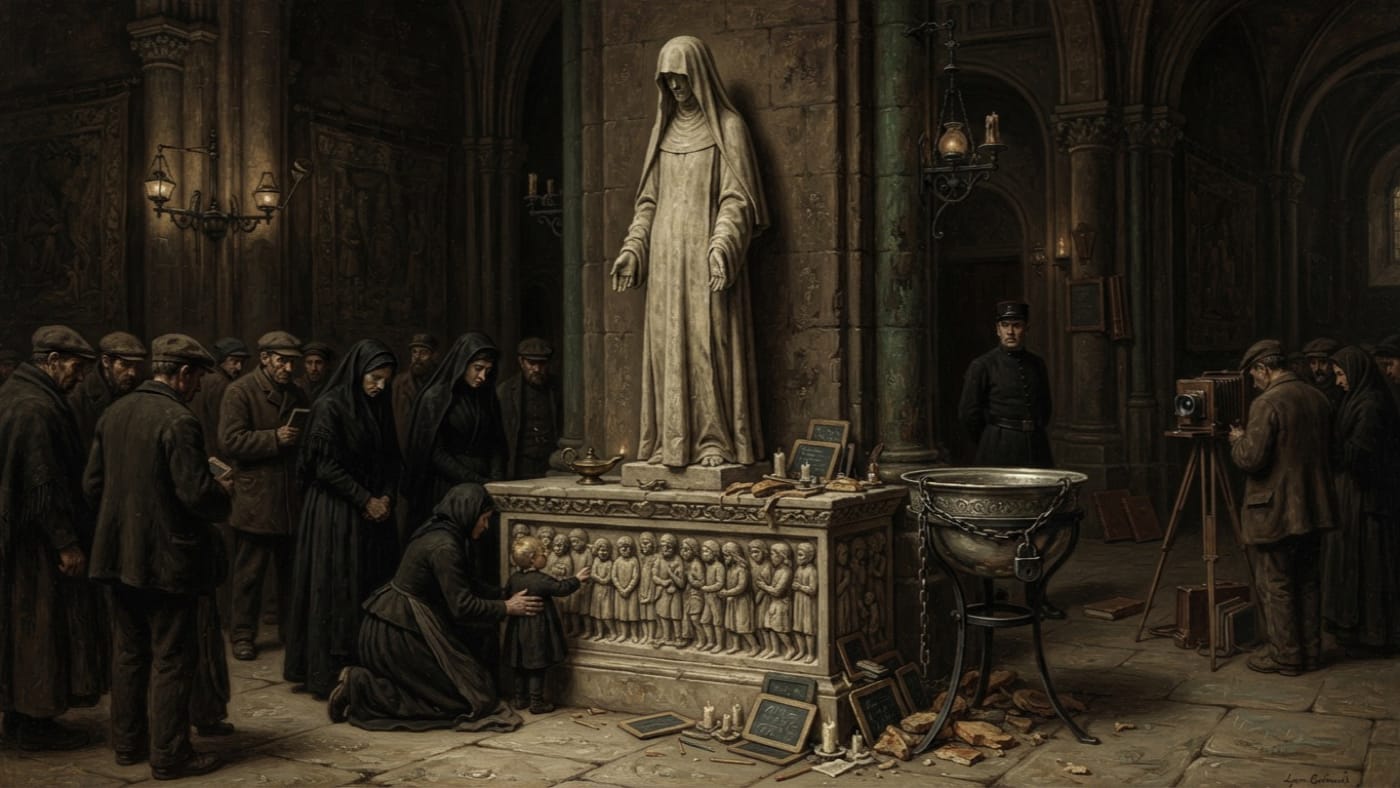
The statue has a veiled head and plain hands. An oil lamp stands at its left foot, and seventeen children are carved in low relief around the plinth. That is the published description. I give it in that order because that order is correct.
The veil comes first, since a widow is known by what she covers. The hands come next. They are empty of ring, crozier, book or key, empty of every instrument a sculpted saint normally holds up to announce rank. Then the lamp, set low beside the foot where a cellar lamp belongs, with its light at floor level and its use practical. The children come last. They circle the base in a single band of relief, small enough that a kneeling child meets them eye to eye and a standing clerk must stoop. I have watched several clerks stoop. It improves them.
Provincial pilgrims keep asking where the other sixteen statues are. There are none. The seventeen are carved into the plinth as one band of stone, a crowd that cannot be dispersed, which is more than the Bureau of Purity can say of most crowds.
The published account names no sculptor, gives no measurements, identifies no stone and quotes no inscription, and this survey supplies none of them. A surveyor who invents a sculptor will soon invent a fee, and after that a widow to collect it.
The silver basin stands in the ambulatory and is kept locked. The ambulatory is a controlled devotional area. Pilgrims approach, kneel, touch the plinth and withdraw, under the eye of persons whose number, rank and hours I did not record because nobody gave them to me in writing.
#On the Woman Recalled in Stone
The iconography makes sense only once you know whose it is. Theophania was a widow of Lyon and a lay catechist who taught the faith in cellars while the Rationalist Republic held power and treated a recited prayer as a disciplinary matter. Her house stood near the old silk quarter. The dossier gives the rest: whispered instruction, a hidden prayer niche, and children kept out of the Republic's hands while their parents could not keep them. Her account numbers those children at seventeen. The plinth carves seventeen. I record the agreement and leave the arithmetic of Providence to the people who are paid for it.
Those children have no names in this survey and no later lives either. The dossier gives them none, and I will not draft seventeen biographies to make a plinth look busy.
She held no office of any kind. She took no vows, held no abbey and received no ordination, and no Bureau commissioned her catechism. She did the work first, and the Church produced the forms for it afterwards. That is the usual order of things, though the Church rarely admits it in writing. Several accounts of her death survive and they disagree. A survey of a plinth is the wrong place to settle a martyrology.
#On the Oil and Its Custody
The cult of Lyon holds that the statue wept for nine consecutive days. The tears were oil, clear and warm, with a smell the devout compare to lamp smoke and old linen. That is the tradition as it is told at the plinth and kept on the saint's own page. It carries no date, and I have not given it one. A tradition that comes without a year should be filed without one. Any clerk who wants to give it a year should first explain where he found it.
Three kinds of statement need to be kept apart here, and Lyon has spent generations mixing them up.
The first is what the tradition reports: nine days of warm oil from a stone face. The second is what officials did. They sealed the oil into vials, locked the basin, and turned a corner of the ambulatory into a supervised zone, so that devotion arriving on foot left as a recorded cult. The third is what this survey establishes. The vials are held at the cathedral. The basin is locked. The face is dry.
On the cause, this plate makes no ruling. I have read no proof of a miracle and no chemist's acquittal, and I trust neither kind of document when it shows up uninvited. The Bureau of Records keeps what is kept, and its function is to hold the vials in inventory and the petitions in order. The Bureau of Doctrine decides what may be said about what is kept. Neither Bureau consulted me before doing its work. Both will receive this plate.
Earlier civic and devotional abstracts placed a living founder of the Synod in the north ambulatory during the weeping and said the oil ran faster when he crossed the threshold.
Withdrawn. No chronology accepted by the Bureau of Records allows that witness to have been present. The visit is struck from this plate. Nobody else has been put in his place, and no date has been put in place of the visit. The weeping stays in the cult tradition, and the dead stay where they are.
The withdrawal will upset certain Lyonnais pamphleteers, who preferred a miracle with a famous man in the audience. A miracle with no witness list is harder to sell, though it is easier to believe.
#On Present Devotion
Mothers bring their children to touch the plinth. A child presses a palm to one of the carved children, sometimes to several, and is lifted away again before the next mother's patience runs out. Some of them say the stone is warm. The claim is noted as a report and handed to Doctrine, which receives such reports in quantity and certifies very few, so that Grace does not come to be traded like a commodity.
Widows come on their own. So do catechists, who still teach the Creed in rooms too small for the purpose. So do parents who once hid a child, or who were hidden as children themselves. These are her patronages, and the cult attributes them to her by long use: widows, hidden children, cellar catechists. Each comes for a different reason, and all of them kneel at the same band of stone.
The offerings are what any orderly mind would expect from that congregation. School slates are left at the plinth, along with stubs of pencil and crusts of bread, and sometimes a slate with a child's name scratched into its corner. Coin is scarce. Pencils pile up. The ambulatory staff clear the offerings at intervals I was not told, by a method I did not see, to some destination I can only hope keeps records.
The statue is dry. The pilgrims find this disappointing. They come up the Rhône with travel permits and expectations, wanting fresh oil, fresh tears and proof that Heaven keeps hours like a ferry office. What they get is a dry stone face, a locked basin, an inventory of vials and a plinth worn smooth at the height of a child's hand. The cathedral offers them nothing else, and the survey finds nothing else to offer.