
#On the Founding of What Should Never Have Been Founded
"They called it a Republic. They called it a New Dawn. They called it the future. It lasted fifteen years." — Bureau of Doctrine, Catechism Supplement 14-F
The Rationalist movement was an idea. Ideas can be burned, buried, beaten from the skulls of their carriers, and the Bureau has demonstrated all three methods with professional thoroughness. The Rationalist Republic was something worse. It was a state — with borders, with treasury, with laws, with tax collectors and court magistrates and a postal service that delivered pamphlets on the appointed Tuesday. An idea is a contagion; a state is a machine, and the Rationalist Republic was a machine of singular efficiency, designed to grind Faith to dust and sweep the dust into the Danube.
The Treaty of Regensburg consolidated institutions already governing in some territories. The Sundering broke their central command, while western offices survived unevenly. Between those landmarks lie fifteen years of continental supremacy and the conviction that the Creator was unnecessary — until something else came through.
#On the Structure of the Republic: The Concordats of Governance
The Republic's architecture was the work of the Council of Nine — nine men whose names the Bureau has sealed under triple lock, whose faces survive in no portrait, whose cipher correspondence required forty years and three apostate code-breakers to crack. They governed from Vienna, in the old Imperial palace, from which they had evicted the Archbishop at swordpoint and from whose balcony they had proclaimed the Treaty's ratification to a crowd that cheered with the enthusiasm of people who had been informed that cheering was expected.
Their instrument of governance was the Concordats of Governance — a body of constitutional law that replaced every crown, every diocese, every ducal charter, and every feudal arrangement on the European continent with a single, rationalized administrative framework. The Concordats were, by any honest assessment, a remarkable document. They were also heresy committed in triplicate with notarial seals, and the Bureau considers the two observations compatible.
Under the Concordats, Europe was divided into Philosophical Prefectures — administrative districts governed not by princes or bishops but by Prefects of Reason, each appointed by the Council of Nine, each answerable to the Academy system, each required to hold a degree in natural philosophy or face removal. The old maps were burned. The old borders were erased. In their place: thirty-seven prefectures, numbered with the ruthless tidiness of men who believed that even geography could be improved by committee. The Prefecture of the Rhine. The Prefecture of the Danube. The Prefecture of the Alps. Names stripped of history, saints, and memory — because memory, in the Rationalist calculus, was the enemy of progress. A river named after a saint was a river that might remember the Creator. Better to number it, and forget.
The Prefects administered everything. Courts. Schools. Hospitals. The census. The postal service. The markets. The mills. Every institution that had previously operated under the authority of crown or cloister was absorbed into the prefectural system and subjected to what the Rationalists called "the Governance of Measurement" — the principle that any activity which could be measured could be administered, and any activity which could be administered could be improved. They measured grain yields. They measured infant mortality. They measured the average distance a citizen walked to his nearest courthouse. They measured, with particular enthusiasm, the decline in church attendance, which they charted on graphs displayed in every prefectural office and which showed, with satisfying clarity, that superstition was dying.
The graphs were accurate. Superstition was dying. What was growing in its place, beneath the soil, behind the measurements, in the spaces between the census columns — that, the Rationalists did not chart.
#On the Instruments of Rule: Edicts, Censuses, and the Ironmouth
The Republic governed by edict. The Council issued them; the Prefects enforced them; the Republican Guards — those secular soldiers in their blue tunics with the Broken Cross on their breast pockets — ensured compliance with bayonet and brand.
The Edict of Ironmouth was the Republic's foundational instrument of suppression. Issued from the Prefecture of Paris — the Republic's second city, its cultural engine, the seat of the Academy of Sciences that the Council had elevated to quasi-governmental status — the Edict declared Faith a form of treason. Prayer, spoken aloud or in the hearing of witnesses, was punishable by the removal of the tongue. The logic was Rationalist to its marrow: if superstition spread through speech, then speech must be curtailed; if the tongue was the instrument of infection, then the tongue must be extracted. The Edict's preamble, preserved in the Forbidden Stacks at Strasbourg, begins: "Whereas the human voice has been demonstrated to be the primary vector of irrational belief..." The rest reads like an autopsy report written by men who had confused the patient with the disease.
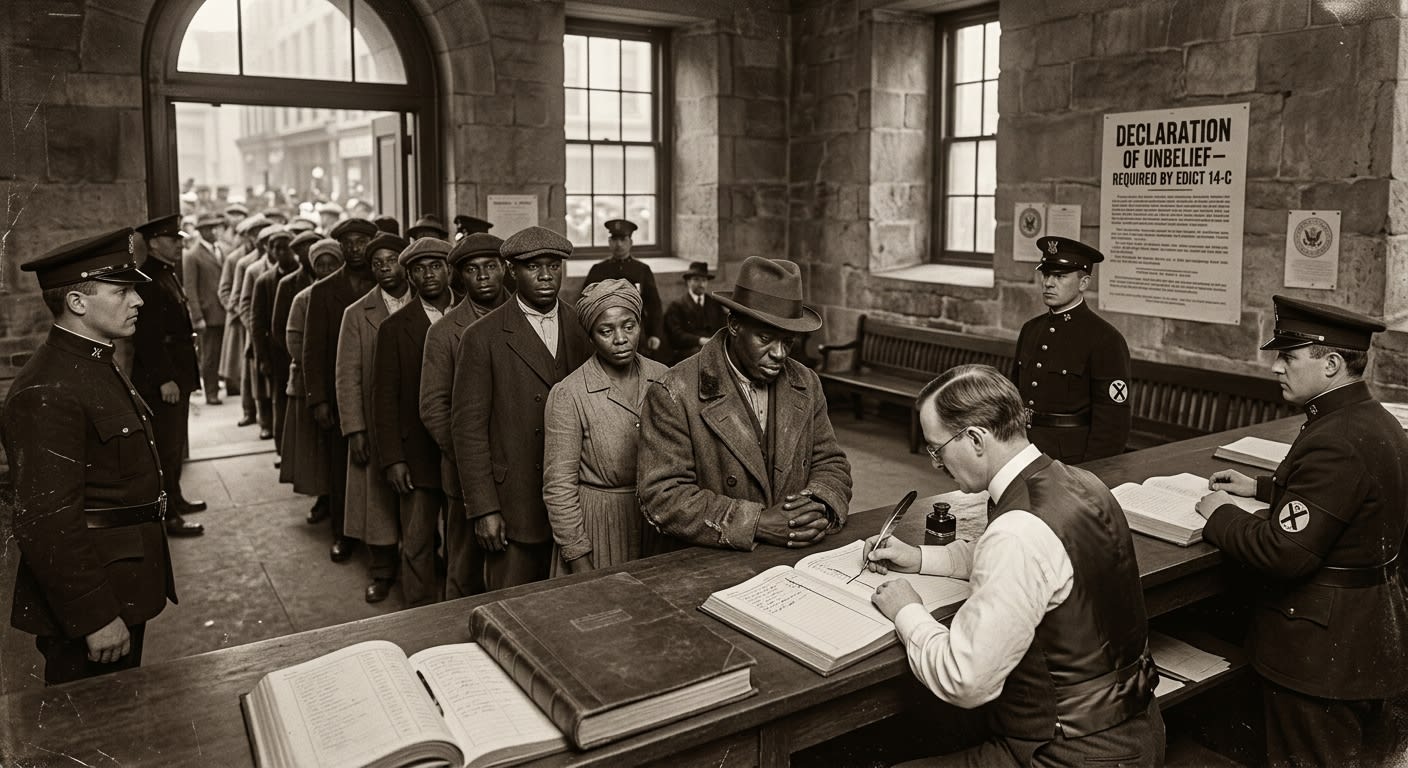
The First Black Census was the Republic's masterwork of administrative cruelty. Every citizen was required to present themselves at the nearest prefectural office and make a formal declaration of unbelief. Those who declared faith were removed from the register. Removal from the register preceded removal from the world — sometimes by days, sometimes by hours, depending on the enthusiasm of the local Prefect. Villages vanished between one census page and the next. Families ceased to exist in the filing cabinets before they ceased to exist in the flesh. The Rationalists had understood what every efficient tyranny understands: that a man who does not exist on paper can be made not to exist in practice with considerably less fuss.
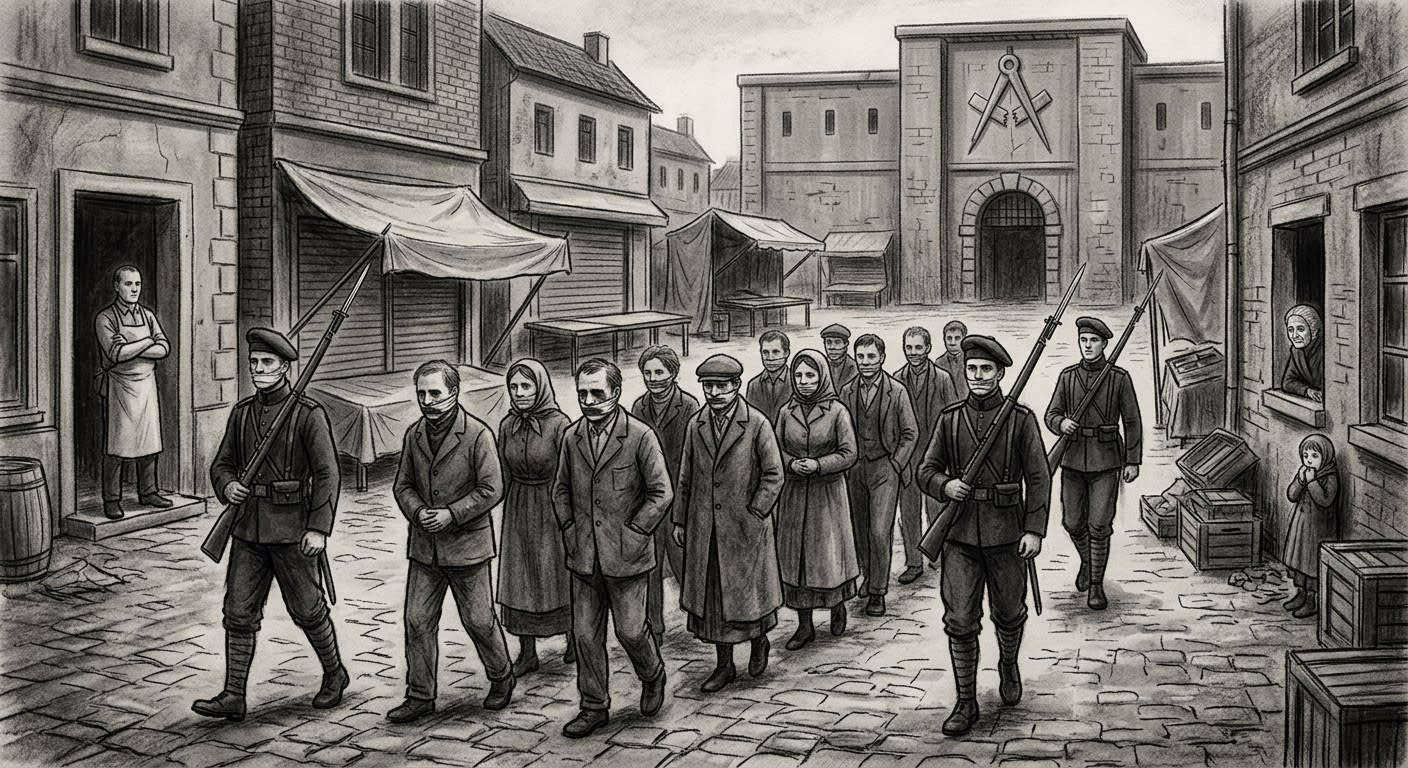
The Procession of Silence was the Edict's theatrical companion. Public pilgrimage was banned — and those who defied the ban were seized, had their tongues slit, and were paraded through the market squares of their own towns as living proof that superstition had been rendered mute. The Rationalists filmed these processions (by which I mean depicted; the Republic's engravers were as prolific as their executioners) and distributed the prints to every prefectural office. "See," the prints declared. "Silence is progress." The Bureau of Purity later adopted the Procession of Tongues for its own purposes, with theological justification and proper documentation, which the Rationalists lacked and which makes, the Bureau insists, all the difference.
Earlier editions attributed the Edict of Ironmouth to the full Council of Nine.
Interrogation records recovered from the Vienna archives (A.S. 92) indicate the Edict was drafted by a sub-committee of three — the Triumvirate of Public Instruction — and presented to the Council for ratification. The Council approved it in a single session. The minutes record no dissent. The Bureau of Doctrine considers the absence of dissent proof of collective guilt; the Bureau of Shadows considers it proof that the other six members were afraid. Both interpretations serve.
#On the Economy: Taxation Without Saints
The Rationalists did not merely govern bodies and tongues. They governed purses — with a thoroughness that the Bureau of Tithes has studied and, in certain restricted professional memoranda, described as "structurally instructive."
The Republic's economy was built on confiscation. The Church's wealth — accumulated across a millennium of tithes, donations, bequests, and the profitable traffic in relics — was nationalized wholesale under the Edict of Rational Allocation. Monastery lands were redistributed to prefectural management. Cathedral treasuries were melted and recast as secular coin. Reliquaries of gold and silver were inventoried, weighed, assessed for precious-metal content, and liquidated. The Republic minted its own currency: the Lumen, stamped with a compass on one face and the motto "RATIO SOLA" on the reverse. The irony of stamping currency with a motto — of placing faith in a coin that proclaimed the abolition of faith — was lost on the Rationalists. It was not lost on the Bureau.
The Republic taxed everything. Grain. Cloth. Iron. Salt. Labour. The Rationalists taxed activities the old crowns had never thought to tax — they taxed education, charging fees for attendance at the Academies that were now the Republic's cathedrals; they taxed publication, requiring every pamphlet to carry a prefectural stamp; they taxed silence, which is to say, they fined citizens who failed to attend the mandatory Secular Gatherings that had replaced Sunday worship, on the principle that absence from Reason was as culpable as dissent from it.
The Republic's treasury swelled. And swelled. And the Council of Nine, ensconced in the Imperial Palace at Vienna, spent it — on academies, on artillery, on prefectural offices of mahogany and brass, on the great Observatory of Vienna (which cost more than the cathedral it replaced and produced measurements of stars that the stars, one suspects, did not request). The Rationalists built as men build who believe they are building for eternity. Their buildings lasted fifteen years. Some of them still stand — repurposed by the Synod, reconsecrated where possible, demolished where not. The Observatory at Vienna stands empty. Its telescope points at a sky that, since A.S. 45, has not always been a sky.
#On the Culture of the Republic: Lecture Halls in Cathedrals
The Republic remade the continent's culture with the same systematic energy it applied to governance and economy. Cathedrals were converted into lecture halls. Monasteries were converted into barracks. Seminary libraries were emptied, their contents sorted into "useful" (anatomy, mathematics, astronomy) and "heretical" (scripture, hagiography, theology), with the latter consigned to the Bonfires of Purification — those public incinerations that the Rationalists staged with liturgical precision, complete with printed programmes and assigned seating, because the Rationalists had not abolished ceremony; they had merely stolen it and filed off the cross.
The Republic's educational programme was compulsory, universal, and free — three words that, in the Rationalist vocabulary, meant mandatory, inescapable, and funded by confiscated Church property. Every child above the age of seven was required to attend the nearest Academy, where they received instruction in natural philosophy, mechanical arts, rhetoric (a word the Rationalists used to mean the ability to argue against the Creator with confidence), and civic duty. Theology was absent from the curriculum. History was present, but rewritten — the long centuries of the Church compressed into a chapter titled "The Age of Superstition," to be studied with the same clinical detachment one brought to the study of disease.
The Republic produced a generation of educated atheists. Literate. Numerate. Competent in mechanics, hydraulics, and the construction of clockwork artillery. Ignorant — by design, by law, by the careful amputation of memory — of everything that might have warned them what was coming. A generation that could measure the tensile strength of brass but could not recognize a portent when the sun failed to rise for forty days.
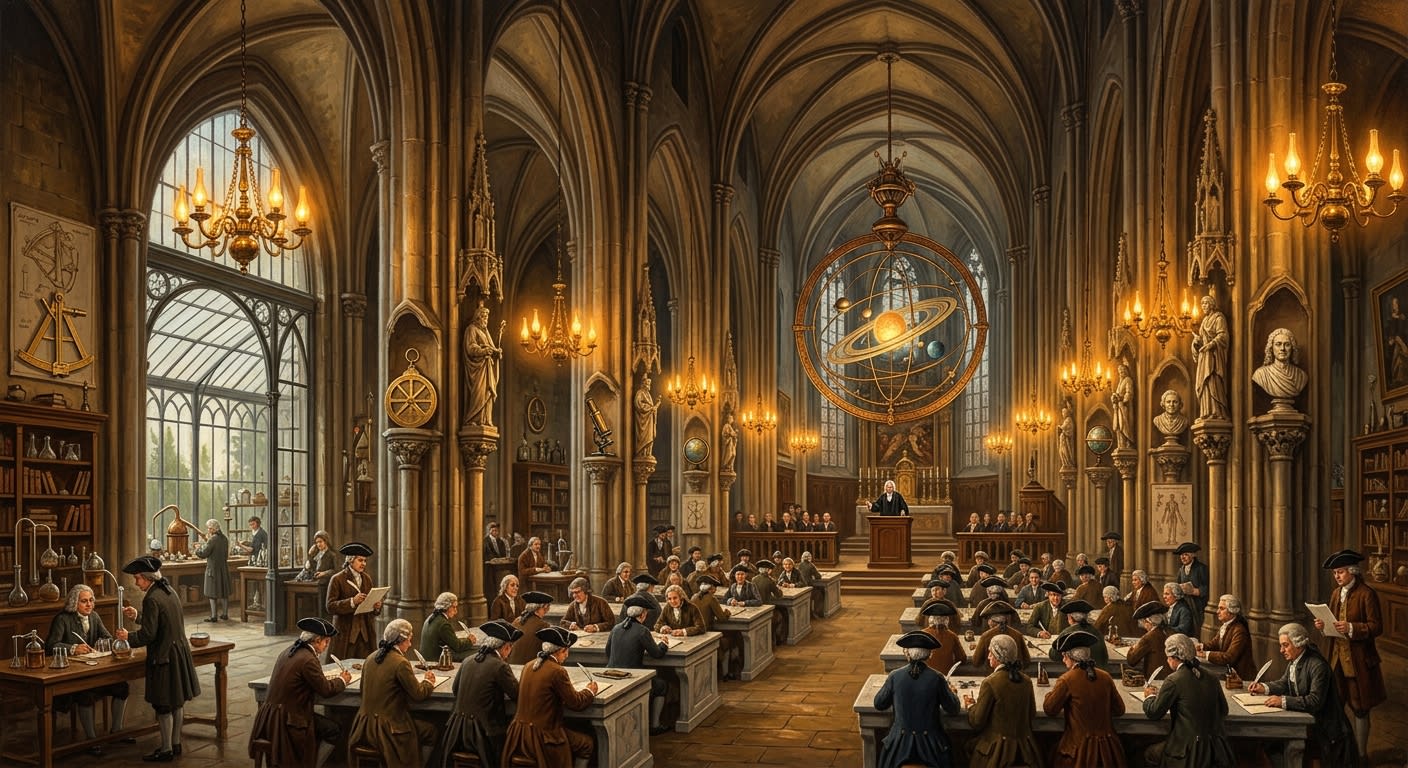
The Academies were magnificent. The Bureau concedes this without pleasure. Marble halls, glass roofs, laboratories stocked with instruments of measurement that the Bureau of Engineering has since requisitioned and repurposed. The Academy of Vienna — the Republic's crown jewel, its intellectual capital — occupied the former Cathedral of Saint Stephen, stripped of its altars, its nave filled with lecture podiums and demonstration tables. The Rationalists had placed their central Academy inside a cathedral because they understood symbolism, even if they professed to despise it. They wanted every student to look up and see, where the crucifix had hung, a brass orrery depicting the solar system in mechanical motion. The message was precise: the universe operates on gears, and gears do not pray.
The orrery was still turning when the Sundering struck. What happened to it thereafter is filed under Seal Amber in the Forbidden Stacks, and the Bureau's filing note reads, in its entirety: "The gears stopped. Something else moved."
#On the Republic's Law: Courts Without the Creator
The Republic's legal system was, from a technical standpoint, the most sophisticated judicial apparatus Europe had produced. This is the professional assessment of the Bureau of Oaths, whose archivists have studied the Republic's court records with the careful attention of men examining the construction of a scaffold they may one day need to rebuild.
Under the Concordats of Governance, every prefectural court operated according to the Code of Rational Jurisprudence — a body of law that replaced canon law, customary law, and divine law with a single unified code predicated on the principle that all disputes could be resolved through evidence and measurement. Oaths sworn on relics were abolished. Testimony given under religious compunction was inadmissible. The concept of sanctuary — the ancient right of a man to claim protection within a church — was declared void, on the grounds that churches no longer existed in any legal sense, having been reclassified as "Public Instruction Facilities."
The courts were efficient. They were fair — within the Rationalist definition of fairness, which excluded the concept of mercy on the grounds that mercy was theologically contaminated. Sentences were calculated by formula: severity of offence, multiplied by likelihood of recidivism, divided by the social utility of the offender. A clockmaker convicted of heresy received a lighter sentence than a beggar convicted of the same, because the clockmaker was useful. The Republic had replaced divine justice with actuarial justice, and the actuaries were, I am told, very precise.
The Republic also maintained a secret judiciary — the Tribunal of Clarity — which operated without published schedule, without defence counsel, and without appeal. The Tribunal's jurisdiction covered "crimes against Reason," a category broad enough to encompass prayer, pilgrimage, the possession of relics, the recitation of scripture from memory, and the refusal to attend Secular Gatherings. The Tribunal's records are incomplete; what survives suggests a conviction rate of ninety-seven per cent. The three per cent acquitted were, in most cases, dead before the verdict was delivered — not from execution, but from the interrogation methods that preceded the trial. The Rationalists called these methods "Clarification." The Bureau of Purity has, with characteristic institutional honesty, borrowed the word.
#On the Republic's Army: The Republican Guards and the Clockwork
The Republic maintained a standing army of approximately four hundred thousand men — the Republican Guards, organized into thirty-seven prefectural regiments, each uniformed in the Republic's blue, each carrying the Broken Cross on tunics and banners. They were, by the standard of any military historian, formidable. Well-drilled. Well-supplied. Equipped with the finest clockwork artillery that Reason's forges could produce — brass-barreled cannon on spring-loaded carriages, capable of four rounds per minute, a rate of fire that the Bureau of War has since adopted, blessed each barrel with holy oil, and renamed "the Ordained Repeater."
The Guards enforced the Edicts. They conducted the Processions. They manned the prefectural borders and the coastal fortifications and the Alpine garrisons, where they stood watch against enemies that their philosophy permitted — foreign crowns, dynastic claimants, pirates, smugglers — and ignored the enemy that their philosophy could not accommodate. The Rationalist military doctrine was built for wars between men. It was magnificent for wars between men. It was worthless against wars between men and the things that men, by stripping away every spiritual defence, had invited through the door.
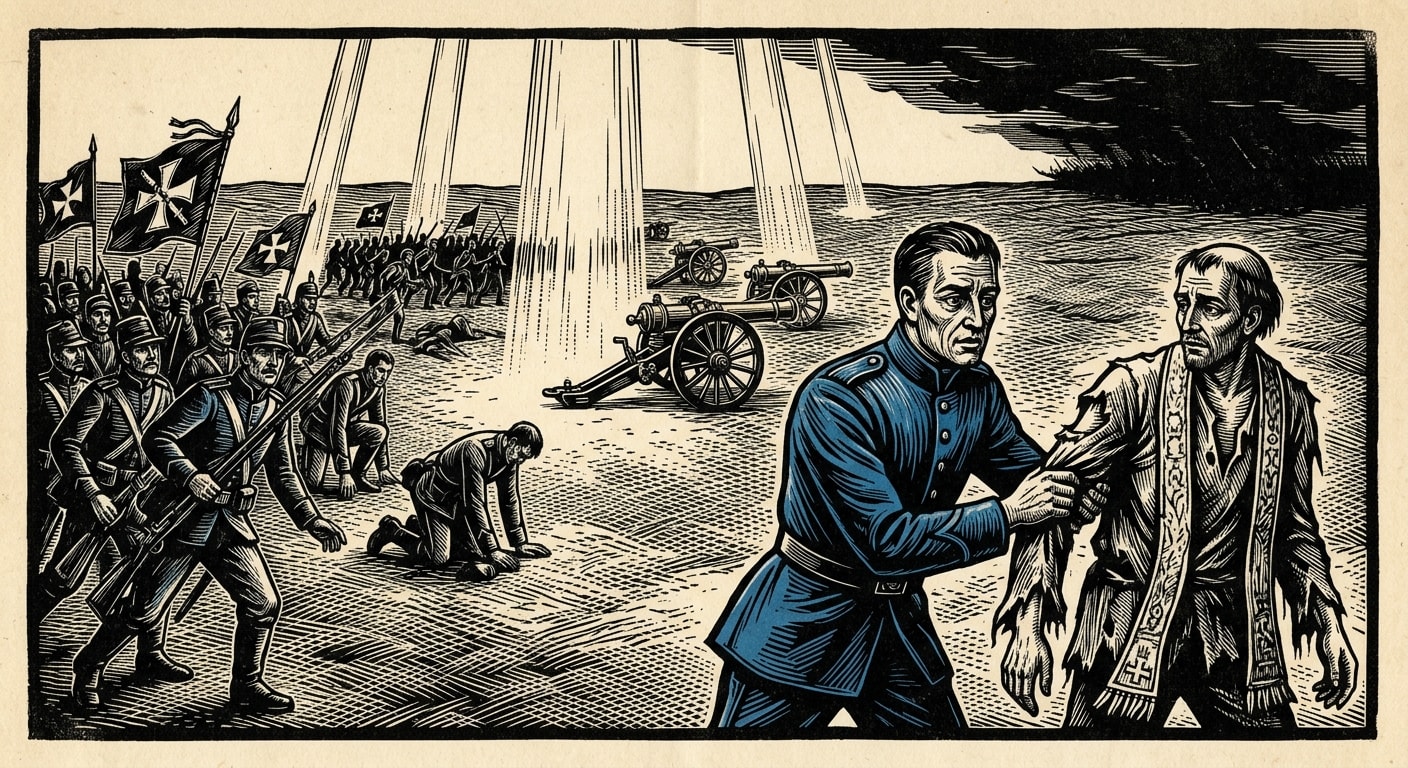
At the Sundering, four hundred thousand men discovered, in the space of a single day, that clockwork jams when fire falls from a cloudless sky, that drill formations dissolve when the earth opens beneath them, and that courage — real courage, the secular courage of trained professionals — is insufficient armour against an enemy that eats your rations, your comrades, and your capacity to understand what is happening to you. At Debrecen, Kargath devoured a hundred thousand men's provisions in a single night. At the Iron Plains, Maldrake burned three divisions in two volleys. The Republican Guards — those same Guards who had fired on pilgrims at Saint-Malo and torn tongues from the faithful at the Ironmouth — threw down their Broken Crosses in the streets and begged for chaplains. There were no chaplains. The Republic had spent a generation ensuring there would not be.
Earlier editions stated the Republican Guards numbered "approximately six hundred thousand."
Corrected to four hundred thousand, per Bureau of War assessment of recovered Rationalist muster rolls (Filed Reference RR-M-45-01, Forbidden Stacks). The earlier figure included auxiliary prefectural militia, which the Bureau of War classifies as "armed civilians with uniforms" rather than soldiers. The distinction matters: soldiers are trained to face enemies; armed civilians are trained to face citizens. When the Adversary arrived, the distinction became fatal.
#On What Remains: The Republic in the Bureau's Cabinet
The Rationalist Republic is dead. Its Concordats of Governance are ash in the Forbidden Stacks. Its Philosophical Prefectures are lines on maps that the Bureau has overwritten. Its courts are rubble. Its Academies are barracks — or churches again, reconsecrated by the Synod with ceremonies that take particular care to scrub the lectern stains from the altar stone. Its currency, the Lumen, is a collector's curiosity — the Bureau of Tithes confiscates them when found, on the grounds that any coin stamped with "RATIO SOLA" constitutes a portable heresy.
What remains — and this is the purpose of the article, the reason the Bureau mandates its inclusion in the Codex — is the lesson. The Synod was built in the Republic's shadow. The Concordat of Strasbourg was written by men who had lived through the Republic's fall, who had watched a functioning state vanish in a single day, who understood that the machinery of governance without the machinery of Faith is a house without a roof, and that the rain, when it comes, does not inquire after the furniture.
Augustinus studied the Republic's prefectural system and saw what could be kept and what must be burned. The Bureau system — those seventeen Bureaus that govern every breath and census entry of the Synod's hundred million souls — borrows its administrative bones from the Republic's Concordats of Governance. The filing systems. The jurisdictional boundaries. The principle that measurement is a form of control. What Augustinus added was what the Rationalists had removed: the theological justification that transforms measurement from tyranny into service, and control from oppression into care.
The Bureau does not acknowledge this debt. The Bureau has never acknowledged this debt. I acknowledge it here, in the margin of a Codex entry that the Bureau will review and approve with its usual thoroughness, because I am the Warden, and the Warden's privilege is to name the machinery. The Rationalist Republic built a machine. The Synod baptized it. Whether the baptism changed the machine or merely changed the name on the plaque is a question that the Bureau has classified as "theologically impertinent" and which I, accordingly, will not answer — in this margin, at any rate.
The Republic lasted fifteen years. The Synod has lasted one hundred and eleven. The difference, the Bureau of Doctrine insists, is Faith. The difference, I note privately, is also that the Synod has never torn out the spiritual defences of the continent and left the door unbarred. Whether Faith or prudence is the greater virtue I leave to the theologians. I am merely the man who writes the Codex, and the Codex records what was, what is, and what the Bureau wishes the reader to believe. All three, in this case, coincide.