
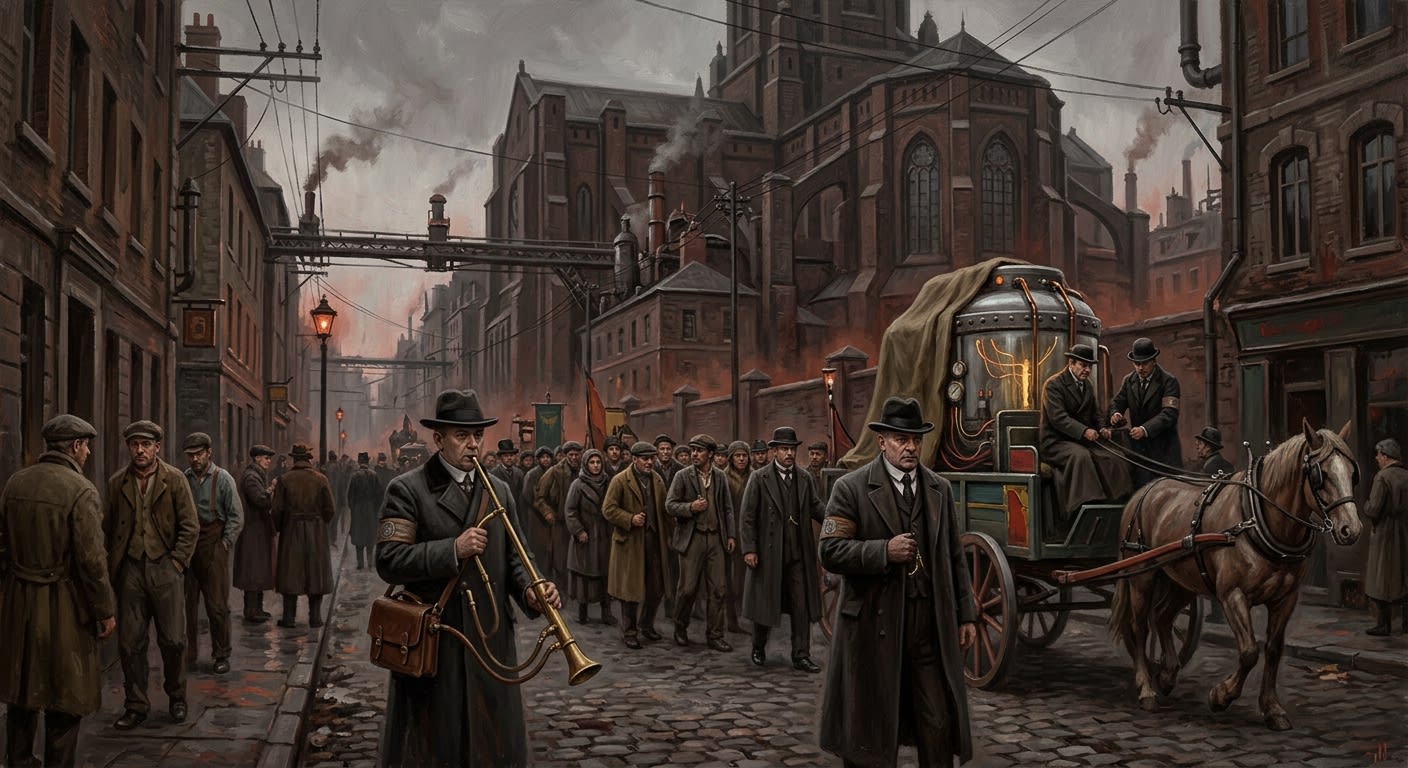
#On the City That Learned to Sing Through Scar Tissue
Lyon sits on the Rhône like a scar placed where merchants can admire it. Zone 1, officially; Major Synod city, officially; river hub, reliquary city, festival laboratory, supervised wound, all more accurate. The old trade streets climb from water to chapel to counting house, and each level has contributed its portion to the Ledger: ash from the friars, oil from the saint, whistles from the fast, masks from the riot, marrow-dust from the vaults.
No city in the western heartlands (Unregistered) has been corrected so often and retained so much talent for mischief. Strasbourg commands. Prague instructs. Lyon performs. It performs piety, hunger, grief, obedience, rebellion, repentance, and the expensive little bow that follows repentance when the Bureau of Festivals has sold tickets to it. A city may be loyal and still require watching. Lyon proves the point daily.
#On Red Ash in the Rhône
Lyon's first entry in the sacred arithmetic came before the calendar had the decency to begin. In –39 A.S., Republican militias attacked a friary on the Rhône's left bank after Compline, burned forty-three friars in the lower refectory, shot four lay brothers at the postern, gathered the ashes, and dumped them into the river by Saint-Barthélemy's fish stairs (Unregistered). The killers wore municipal colours. Native wickedness does not need a passport; it has keys.
For three nights the Rhône answered in psalms. Rationalist pamphleteers blamed current, reed, rope strain, drunken echo, and any other natural cause too stupid to blush. The dock-ropes of Lyon, one notes, had not previously shown antiphonal training.
Several civic primers once called the Red Slaughter “an early excess of public disorder.”
Corrected. Disorder leaves broken windows. The Red Slaughter left ashes, psalms, and a city that learned to pave over guilt while charging pilgrims to view the paving.
The quay has been renamed, restored, renamed again, and placed under joint supervision by Bells, Festivals, and Doctrine. On the anniversary, licensed bowls of clean ash are carried to the river and returned empty. No one sings at the waterline without a permit. The Rhône remembers anyway, which is rude of it and theologically convenient.
#On Theophania, Calistus, and the Civic Throat
Lyon's sanctity is never content with one miracle when three can quarrel in the same district. Saint Theophania hid children in cellars during Rationalist supremacy, taught prayers by whispers, and after the Concordat of Strasbourg let a statue in the north ambulatory weep warm oil for nine days. Augustinus entered Lyon on the seventh day. Records counted the drops. Of course Records counted the drops. Give a Bureau clerk grief and he will ask whether it arrives in units.
The oil made Lyon respectable again. The Hollow Fast made it unforgettable.
During the Year Without Dawn, A.S. 32, the district of Saint-Calistus (Unregistered) watched plague advance westward from the river quarter while the sky withheld morning like a judge withholding sentence. Calistus sealed four ration-halls for forty nights. Men, women, children, old dockhands, laundresses, bakers, a blind notary, and one unlucky Rationalist clerk were denied bread until hunger turned inward and the plague struck the district boundary as if against iron.
On the forty-first morning, the fasters lived. Their tongues did not.
MERCY SUMMARY — SAINT-CALISTUS DESCENDANT SURVEY, A.S. 198 Hereditary vocal narrowing persists in registered lines. Whistled hymnody remains stable under ordinary feast conditions. Exposure to certain relic-vault tones produces answering intervals in children under nine. Further testing suspended after Ward-Sister █████████ began whistling in sleep and naming sealed ration-halls not present on public maps.
The descendants of the fasters still sing in whistles, high and thin over the Rhône at dusk. Pilgrims call it beautiful. It is beautiful. So is a blade being honed by a man who knows your name.
#On Festivals, Masks, and the Useful Riot
The Bureau of Festivals maintains a special affection for Lyon, in the way a handler loves a performing animal that has bitten three assistants and drawn paying crowds. Here joy has never been a natural resource. It is quarried, licensed, staged, corrected, and sold back to the faithful with a stamped programme.
Lyon's licensed variant of the Procession of Tongues occurs on the Feast of Saint Sabina. Prague nails the heretical tongue to oak. Lyon disciplines the faithful tongue by volume. Citizens assemble by parish and recite the Creed through a four-hour route until voices crack, throats bleed, and language becomes meat. Those who falter are gagged with blessed-oil linen and marked in the ledger as vox defecit. Sabina tore cloth to preserve speech in the dying. Lyon uses her feast to manufacture silence by ward block. The symbolism is disgusting. It works splendidly.
Then came the Tumults of Lyon in A.S. 170, when the Carnival of Saint Bérard's Misrule produced masks, pamphlets, sugar-packed cue whistles, false procession banners, altered hymns, and a puppet bear wearing a mitre. The bear demanded tithes in honey and blessed a sausage. Doctrine called it creative blasphemy. Records called it dramatic irregularity involving symbolic episcopal fauna. I call it funny, which explains why it had to be punished.
Purity sealed bridges. Silence confiscated printing blocks. Festivals locked costume houses. Puppet theatres entered doctrinal inspection. Carnival masks were prohibited in three provinces, pending the future arrival of sufficient revenue to discover nuance under another name.
Initial Bureau reports described the Tumults as spontaneous disorder caused by excessive drink.
Withdrawn. Planning was evident in the sugar-packed whistles, altered banners, and false permit stamps. Excessive drink remains probable. Lyon does not waste a riot by holding it sober.
#On Vaults, Bones, and Present Supervision
Lyon's reliquaries have behaved badly for generations. The Bell Codex Affair of A.S. 115 began with a manuscript claiming to map peals not yet rung. The Bureau declared it apocrypha and operational, two classifications that contradict each other only to those with insufficient respect for policy. Missing pages remain missing. Strasbourg bells sometimes swing in storms no one ordered.
The Reliquary Collapse (Unregistered), sealed in the public record under the useful formula “no relics harmed,” still powders the city after certain rains. Citizens remember marrow-dust in the streets. Records insists crushed bones were not relics if crushing applied to them. Relics, by definition, remain intact in the register. Stone may fall; doctrine does not bruise.
In A.S. 201 Lyon remains rich, devout, supervised, musically damaged, and theatrically dangerous. Its river wards keep ash bowls. Its cathedral keeps oil vials. Its Mercy houses keep whistle registers. Its Festival offices keep auditors near every alley where laughter might acquire politics. Children learn the Creed aloud, in whistle, and under gag. Merchants sell silver tokens shaped like tongues, bowls, tears, and forbidden masks. Purity buys some of them as evidence. Tithes taxes the rest as devotional commerce.
Lyon does not conceal the Synod's method. It dresses the method in procession silk, teaches it to bow, lets it bleed through the sleeve, and charges admission.