
#On the Surviving Entry
The Diocese of Pavia takes up one entry in the diocesan rolls. It is a column of ruled vellum with a name at the top, a bishop under the name and a stipend under the bishop. Whatever else once stood under that name is gone. Nobody is left to tithe, no infant waits on the font, and no corpse waits for a burial notation. Nobody has ever asked the entry to notice any of this.
I put the stipend first because it is the only part of Pavia that still moves. Each period it leaves the treasury, passes through the proper channels, gathers the proper seals and lands in the proper hand. That hand belongs to a Bishop-Praetorial. The coin is real and the wax is real. The diocese they pay for is a name with nobody inside it.
Doctrine teaches that the flock is proof of the pasture. Read with ordinary diligence, the rolls return the compliment. A diocese that carries a bishop must carry souls for him, because the style Custos Animae assumes there are animae to keep. And the Bureau of Records does not pay men to guard empty rooms.
#On the Town's Destruction
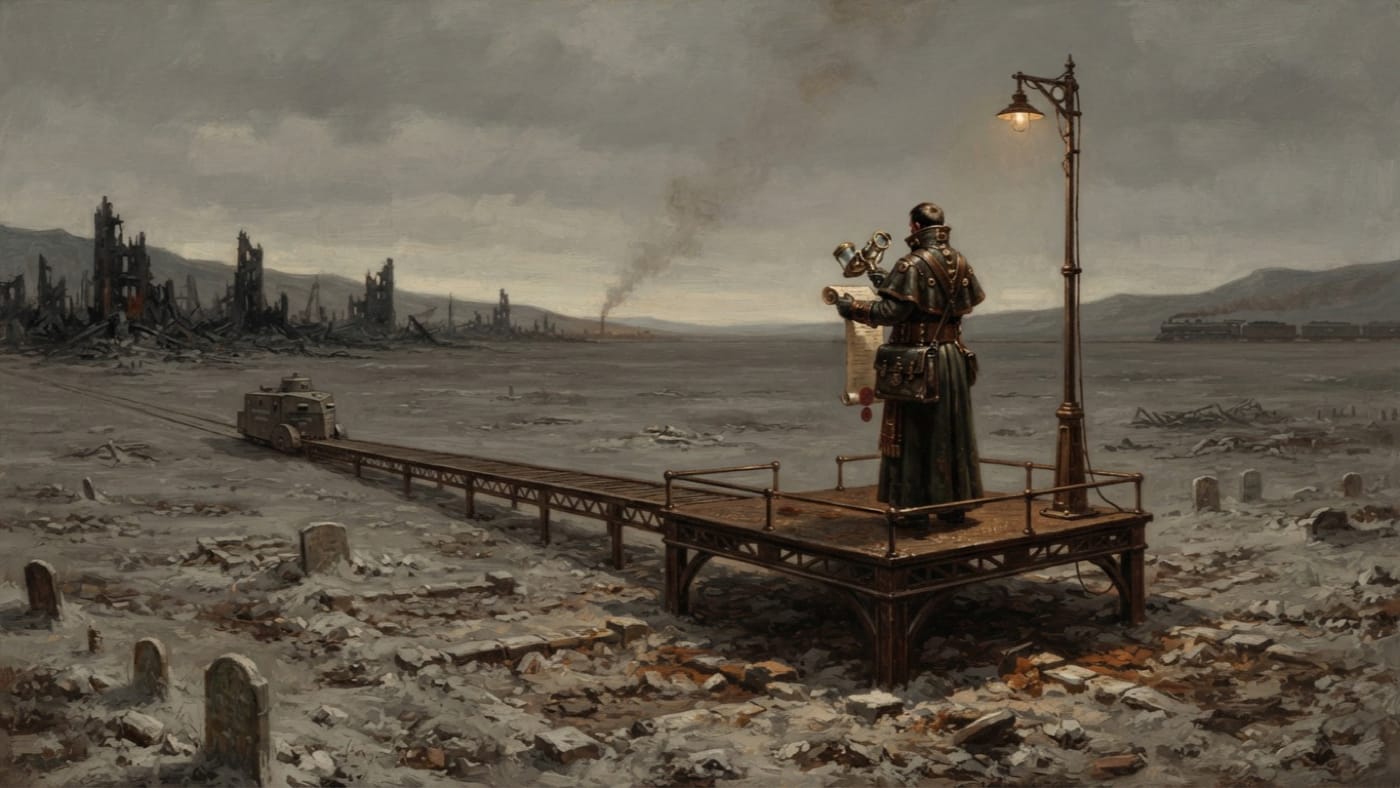
Pavia was a town. The Sundering of A.S. 45 razed it. Those two sentences are the whole of the evidence, and men with access to my stipend have asked me not to embroider them.
The record does not say what Pavia was before. It gives no count of hearths, no saints over doorways, no trade sending carts down the roads of Lombardy. Nor does it say how the town fell. The Sundering opened on 1 November A.S. 45 (1755 by the old reckoning). I can find no entry, and am not competent to invent one, for the hour it reached Pavia or for how a town was turned into a vacancy. Chroniclers pick fire, the hosts of the Great Deceiver, or everything collapsing at once, according to temperament. I pick silence. It is cheaper and harder to correct.
The failure that concerns my office came later, and it was small: somebody did not strike a line.
That is less damning than it sounds. After 45 the Church came out of hiding with a continent to take and a retreat to survive. The provisional council of about A.S. 50 governed by improvisation and terror. Records was remade in A.S. 78. The Synod was formally constituted only in A.S. 90, after both founders were in the ground. The entry passed through every one of these stages untouched. No one ordered it kept and no one ordered it struck. In half a century of emergencies it was never the most urgent page.
#On the Bishop and His Diocese
A Bishop-Praetorial governs a province in spirit and in coin. He is shepherd and tax-gatherer in one vestment, charged with keeping the tithe quota level with the quota of faith. Pavia's bishop keeps both at zero and is paid for the arithmetic.
His name is not in the material before me. Neither is the date of his appointment, nor where he lives, nor whether he followed someone else into the same vacancy. I will not supply any of them. A reader who needs a name may write one in the margin, where it will carry exactly the authority of the entry.
Three of his activities are attested: he draws stipends, he issues decrees, and he inspects ruins that no longer exist.
The stipend needs no comment beyond its regularity. It is the most loyal thing in the diocese. It has never been late, never been questioned, and never been accused of being smaller than the work deserves. Of every officer of the Church paid out of the north, he may be the only one whose duties are exactly as large as his pay.
The decrees are more interesting. A decree for Pavia must be drafted, fair-copied, sealed, and addressed to the faithful, the clergy or the tradesmen of the diocese. Then it goes out, and nothing answers. By the reckoning of the Bureau of Doctrine, an unanswered decree counts as obeyed, because disobedience leaves a record and Pavia leaves none. On that count the Diocese of Pavia is the most obedient jurisdiction in the Church.
The inspections are the hardest part to admire, and I admire nearly anything that pays. Inspecting ruins assumes there are ruins. The source says there are not. Whatever the Sundering left behind, it was not enough to inspect, and the inspection goes ahead anyway. A bishop goes out with his papers, and at the end a report is filed confirming that the diocese stands in its recorded condition. It always does, because the recorded condition is the only one Pavia has.
I can't say whether he walks the empty ground, sends a clerk, or finishes his rounds at a writing-table. The record does not say how it is done. The paperwork is complete, and in this jurisdiction nothing else is required.
In its first section this article reasoned that a diocese carrying a bishop must carry souls for him to keep, because the Bureau of Records does not pay men to guard empty rooms.
Corrected. A diocese carrying a bishop carries a bishop. Registration proves only that a thing is registered, and the Bureau does pay men to guard empty rooms. The writer withdraws the inference. Nobody has asked him to return his fee.
#On the Birthplace Claimed for della Torre
Readers of the della Torre dossier arrive here by a narrow road. Records has assigned the Procurator's birth to Milan, to Pavia, and to a fortress-town near the old Alpine road, depending on whether an office needed him provincial, urbane, or hard to blame on anyone important. One older passage calls him "of Ravenna." It settles nothing, and I doubt it was meant to.
Consider what Pavia gives a man's file. It gives him a birthplace nobody can visit, a parish nobody can canvass, and neighbours who will never be asked what the boy was like. Milan answers questions; it is full of old clerks and older grudges. A Pavian birth ends the inquiry at the first step. And the man who taught the Synod to seize has a better claim than most to an origin nobody can search.
I do not certify the attribution. His documented career starts with the expansion of Purity in A.S. 80. Neither that career nor the Pavia entry gives a birth year, and men better paid than I am have told me not to calculate one. The three birthplaces sit side by side in the drawer. Each is useful to whichever office reaches for it, and none of them is authenticated.
#On the Present Standing
The entry stands today as it has stood since the Sundering. Lombardy around it is fully administered, heartland-safe by northern standards, full of grain, canals and polite fear. Inside the boundary that the rolls still draw, there is nothing. The bells that once marked the diocese are not recorded as ringing. No hamlet is recorded as hearing them. The boundary holds anyway, because the ledger has not been told otherwise.
I have taken part in this. Over my career I signed an edict addressed to the baker of Pavia. I do not remember what it concerned. Flour, weights or oven hours: I signed many edicts that year, and most of them reached somebody.
Pavia's stipend comes from the same treasury as mine. Its bishop's seal is pressed in the same red wax. His decrees go into the same cabinets as my commentaries, and I suspect they are read about as often. Faced with that, a less disciplined theologian might feel some kinship with the empty town. I file the feeling under the rolls' own heading for Pavia: standing, unamended, no action required.
Whatever lived there is gone. The office, the coin and the inspections go on, and the Church loses nothing by it except the people.