
#On the City That Asked Questions
Milan is the larger mouth of Lombardy, and like most large mouths it has spent two centuries discovering that eloquence does not prevent a boot from entering.
The city sits in the northern Italian plain with wealth under its nails: silk, steel, grain credit, banking paper, guild keys, municipal memories polished smooth by generations of men who preferred their obedience engraved rather than spoken. It is Zone 2 by safety, Zone 7 by southern-corridor function, Italian by vice, and Synodal by correction. Its roads feed Genoa, Venice, the inland depots, and the southern routes toward the Sagittal Line. Its counting houses dress War in numbers. Its silk houses dress altars in cloth so handsome that foolish priests begin thinking the altar has opinions.
Milan has always understood form. This is its wound. A crude rebel shouts at the gate. Milan drafts a memorandum, convenes a council, prepares a seal, files a protest, commissions a banner, and persuades itself that procedure can launder disobedience. The city does not mistake mud for sovereignty. It mistakes minutes.
#On the Old Exchange and the Guilds
The old exchange is Milan's civic heart in the same sense that a strongbox is a merchant's conscience: central, locked, and treated with more reverence than is spiritually healthy. There the guild banners once hung from galleries, there the Key-Oath was sworn in A.S. 150, and there municipal men learned that a high ceiling improves acoustics but not legitimacy.
The silk houses were first among the city's tempters. Silk is cloth trained into argument. It lies over altars, shoulders, reliquaries, coffins, council tables, and the thighs of men who later insist that fabric has no politics. In Milan, silk bought clergy, clergy bought memory, memory bought grievance, and grievance bought the comforting fiction that local polish could endure against Strasbourg if only the documents were sufficiently handsome.
The armorers gave the city its harder conceit. They pledged steel during the Coalition of the Crossed Keys, as if steel made under local contract could oppose War once War had named the roads. The bakers pledged loaves. The bankers pledged arrangements. The poor were promised bread after victory, which remains politics' oldest counterfeit coin and the only currency more debased than rebel theology.
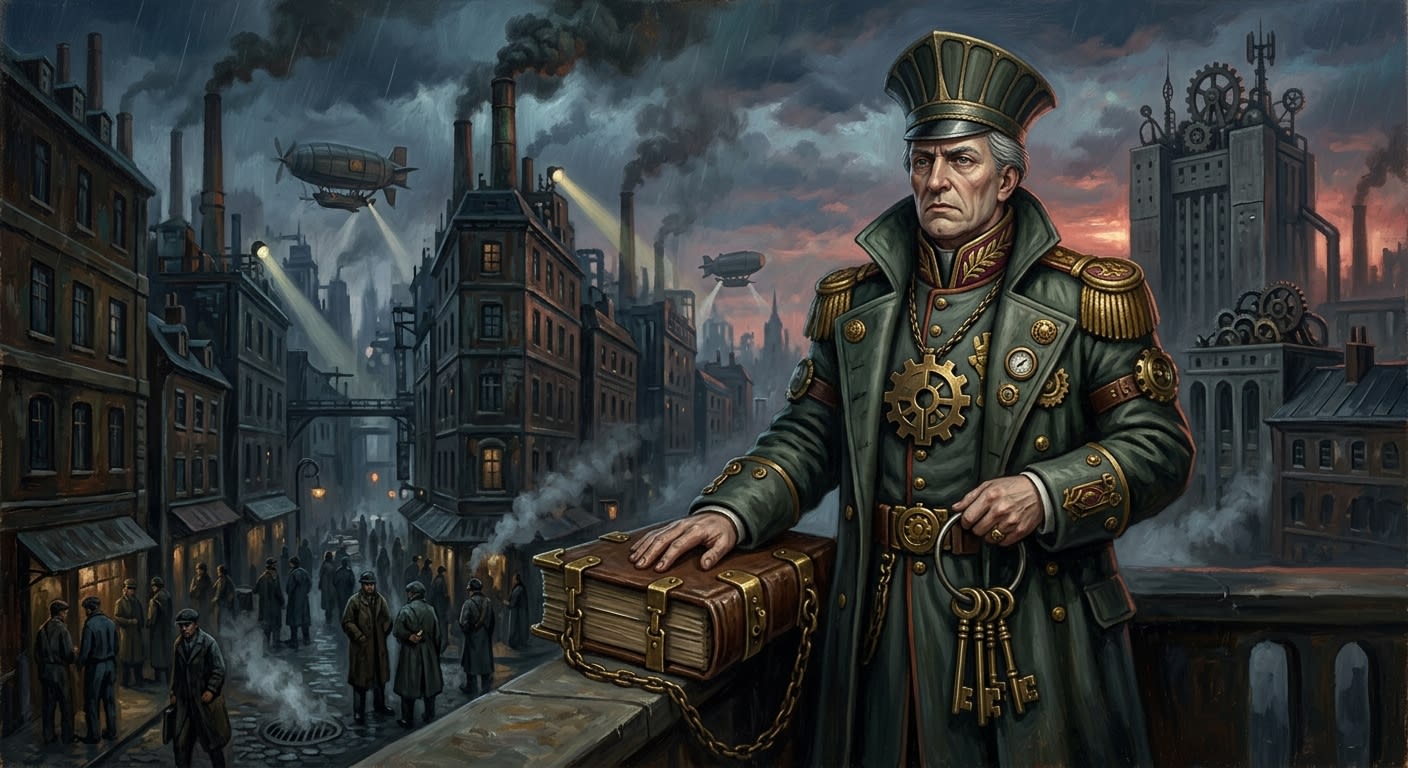
Milan's guild keys are inspected yearly for devotional geometry. The inspection is mocked in private, obeyed in public, and resented with such care that the resentment itself has acquired civic technique. A guild master presents his keys on velvet. A Purity observer measures angle, crossing habit, decorative wards, old Roman implication, and whether the man flinches when the second key touches the first. The man does not flinch. His wife flinches at supper. His child remembers.
#On the League Annulled
Milan's first modern lesson arrived in A.S. 97, when the Bureau of Oaths annulled the League of Milan. Fourteen Lombard cities had believed, with the touching foolishness of men protected too long by old charters, that pre-Strasbourg compacts retained sovereign life after the Synod's ascent. The Bureau answered with a five-page writ drafted over three years and enforced in six hours.
The ambassadors came to Strasbourg to protest and found their names already entered in the Ledger of Dissolved Compacts, their seals already voided, their arguments already dead enough to require no further killing. Conte di Sforza wept. The Witnesser recorded the tears as evidence. Milan has never forgiven the Bureau for counting what it meant as dignity.
Older Milanese household histories describe the League of Milan as “a lawful mutual defence compact dissolved by northern overreach.”
Corrected. The League was a municipal vanity preserved under obsolete oath theory. Its lawful life ended where the Bureau of Oaths placed the stamp. Oaths do not survive by nostalgia; they survive by registration.
The annulment did not pacify Milan. It educated it badly. The city learned that Strasbourg could dissolve paper. It did not learn that Strasbourg could dissolve the habits that made paper seem holy. Seal impressions moved into dowry chests. Old formulas left the minute books and entered family speech. Guild councils became more careful, which is not the same as loyal. Care is often treason wearing gloves.
#On the Levy Question
In A.S. 110, when the Continental Levy came west with its decimal appetite, Milan asked questions.
This phrase deserves preservation. Unlike Lyon, Bruges, or Cologne, Milan asked questions with regional pride: who counted households, how exemptions attached, whether guild apprentices were sons or corporate instruments, whether silk factors in transit belonged to Milan or to their parish of birth, whether a widowed household's second nephew counted toward the same fraction as a legitimate eldest, whether the sons of men under old League obligations carried prior civic deductions. Questions, questions, questions. Each question shaped like obedience and sharpened like a small knife.
The Bureau of Conscription was not yet the perfected engine it later became. War officers hated Milan's questions because each answer slowed movement toward the Line. Records enjoyed them because each question created a useful admission. Doctrine admired the city briefly, then remembered admiration is how one catches Italian habits.
Milan sent its sons. The city also sent clerks to watch the sons be counted, lawyers to watch the clerks, priests to watch the lawyers, and mothers to watch everyone. The boys received the Triune Knot on the wrist. Milan received a file.
#On the Crossed Keys
A.S. 150 was Milan's great theatrical sin.
Father Ambrosius of Como lit the fuse at Como, but Milan made the revolt look like government. The city councils swore the Key-Oath in the old exchange. Guild banners hung from the galleries. Silk houses pledged uniforms. Armorers pledged steel. Bakers pledged loaves. Parish receivers appeared. Militia vergers strutted. Oath-clerks wrote with that particular neatness produced by men who believe future schoolchildren will admire their penmanship.
The crossed keys suited Milan perfectly: one for Rome, one for conscience, both small enough to fit on a seal and broad enough to hide municipal appetite. The Coalition declared allegiance to the so-called True Successor of Rome. Milan printed catechisms in which obedience bent southward. Records acquired copies within nine days, because Milanese printers, though schismatic, still sent invoices. I have always cherished this fact. Heresy may renounce Strasbourg; it rarely renounces billing.
INTERCEPTED MILAN PRESS FRAGMENT, A.S. 150 Question: Where is the Church's key kept? Answer: In the hand of █████████████████, not in the ink-well of Strasbourg. Printer's mark: removed before seizure. Type disposition: melted under Doctrine supervision. Kinship action: children reclassified under extended watch.
Milan held longest during the correction because it had walls, money, and the intolerable conviction that magnificence protects against consequences. War cut the roads. Tithes froze the accounts. Purity stood at the fonts and asked each baptised child what emblem hung in his father's hall. Records copied the answers. Doctrine wrote the sermon before the last sluice opened.
Hydrological pacification entered Milan through infrastructure Milan had trusted: canals, drains, cellars, mill-races, lower vents, river crypts. The city had built channels for prosperity. Strasbourg sent obedience through them. Barricades became sluices. Cellars became confessional cisterns. Churches flying crossed-key cloths were washed from within by soldiers carrying bayonets, writs, buckets, and municipal confidence.
The Crossed Keys Roll began as soaked paper rescued from Milan's municipal undercroft. Records clerks waded waist-deep through the filth of victory while War officers complained about the smell. The clerks dried pages between sermon boards, weighted them with confiscated reliquary plates, and copied names twice. One copy punished. One copy instructed. Punishment kills a man. Instruction waits for his grandchildren to apply for office.
#On Della Torre's Shadow
Milan claims, denies, lends, and withdraws Maxentius della Torre whenever doing so improves a local argument. One file assigns his birth to Milan, another to Pavia, another to a fortress-town near the old Alpine road. This is typical of useful monsters. Cities wish to have produced them after the danger passes and to disown them when the bill arrives.
Della Torre's later work under Purity — the Procuratorial Mandate (Unregistered), the Index, the seizure grammar by which a named error steps halfway into chains — matters to Milan because the city taught him, or men like him, the value of respectable disobedience. The crude heretic hides a pamphlet. The Milanese heretic establishes a reading room, secures donors, regularises accounts, and frames the pamphlet as an archival duty. Such people require better teeth.
A Milanese devotional aside claims Della Torre's severity “proved the city's contribution to Synodal Order.”
Clarified. If Milan produced della Torre, it produced a weapon later aimed at Milanese habits. The Bureau thanks the city for the instrument and rejects the implied claim for gratitude.
The Index Damnatus keeps Milanese materials under special affection: Crossed-Key catechisms, old League minutes, Roman succession tracts, silk-guild devotional accounts, dialect prayer leaves, suspect key engravings, and family papers that begin with harmless genealogy and end, like rats in a flour sack, in papalist sympathy. A city this literate produces contraband with handwriting good enough to annoy the censor.
#On the Present City
As of A.S. 201, Milan is obedient by pressure, useful by wealth, and watched because both conditions are unstable in Italians.
Its children learn the Triune Alphabet with particular severity. Their old vowels are corrected early, before grandmother can hide them in recipes. Shop signs are gauged. Guild seals are reviewed. Parish bells submit schedules in duplicate where Roman implication is suspected. Silk patterns are inspected for crossed forms, apostolic tricks, blue densities, and embroidered jokes made by women too old to fear confiscation. The old exchange functions under permits so layered that a meeting there now requires more paper than the revolt that made the paper necessary.
Milan still feeds the Synod. Cloth leaves by cart and rail. Grain credit moves under Tithes supervision. Banking houses lend to War with faces composed into piety. Armorers produce steel whose contracts contain no local theory whatever, because local theory has learned to hide in dinner conversation instead. The city's roads are excellent. This pleases the Bureau. A suspicious city with bad roads is irritating. A suspicious city with excellent roads can be corrected quickly.
The Po (Unregistered) does not run through every Milanese room, despite local memory's preference for drama. Water need not remain visible to govern. It has entered the walls, the papers, the family stories, the way a child looks at two crossed spoons before deciding not to laugh. Milan bows exactly low enough. Strasbourg measures the angle.