
#On the Nature of Forbidden Knowledge
"To name the forbidden is to spread its contagion. To catalogue the forbidden is to inoculate against it. The distinction is clerical."
I have written many entries for this Codex. None have required as much caution as this one, and none have been so thoroughly stamped, counter-stamped, and re-stamped before the ink was dry. The Bureaucratic Synod maintains a great many instruments of control — bells, ledgers, tithes, the occasional reliquary mace — but of all its mechanisms of governance, the Index Damnatus is the one that makes grown Procurators flinch. Not because they fear it. Because they compiled it. And what a man compiles, he must also read.
The Index Damnatus is not a book. That is the first error the uninitiated commit, and the last error the Bureau of Purity forgives. It is a rolling compendium — a living, swelling, perpetually amended catalogue of everything the Synod has declared unfit for human knowledge. Books, yes. But also names. Bloodlines. Songs. Specific prayers rendered in unapproved dialects. Architectural forms whose geometry offends Doctrine. Flavors of incense deemed "insufficiently sacramental." In Bruges, three generations of stonemasons were exiled for carving grotesques heretical in symmetry. The Index recorded the angle of offense. The stonemasons recorded nothing ever again.
#Origins: The Procurator and His Obsession
The Index owes its existence to Procurator Maxentius della Torre of Ravenna (Unregistered), a man whose hatred of ambiguity bordered on the theological. Della Torre arrived at the Bureau of Purity in the first century Anno Synodi and found what he considered an unconscionable laxity: heretics were condemned, yes, but their works survived. Forbidden books circulated in attics. Proscribed songs were hummed at market stalls, their words swapped but their melodies intact. A banned treatise on celestial mechanics had been copied forty times before the Inquisition caught one — the other thirty-nine, della Torre calculated with the cold pleasure of a man who finally had an excuse, were still being read.
His solution was characteristically Synodal: destroy the forbidden, then catalogue it so thoroughly that destruction could be verified. Every banned text would receive a catalog entry — title, author, content summary, known copies, known readers, known possessors, and the recommended sentence for each category of contact. A man who owned a forbidden book was a heretic. A man who had read a forbidden book was a greater heretic. A man who had memorized a forbidden book was, in della Torre's precise formulation, "a walking blasphemy whose skull must be emptied by the most expedient means available."
Earlier editions of this Codex attributed the founding of the Index to Cardinal Kratz during the Night of Black Decrees.
This is imprecise. Kratz authorized the expansion of the Bureau of Purity's mandate, but the Index itself predates his reforms by at least two decades. The Procurator della Torre's hand was first. Kratz merely gave it more paper.
#The Five Registers
The Index is not a single list. It is divided into five Registers, each maintained by a separate quorum of the Bureau of Purity, each sealed with its own wax, each requiring its own level of ratification to amend:
The Register of Texts (Unregistered) — forbidden books, treatises, pamphlets, broadsheets, almanacs, and any document whose content contradicts ratified Doctrine. The largest register. Its current volume runs to several thousand entries, and that count is itself classified.
The Register of Names — persons condemned, erased, or rendered damnatio memoriae. To speak a name from this register is to commit the crime of "utterance without license." The Index Damnatus Runners carry daily amendment strips to gatehouses, orphanages, and ferry crossings so that the damned cannot outrun their own erasure.
The Register of Sounds — proscribed hymns, melodies, bell-tones, and vocal cadences. The Bureau of Orison and Song feeds this register with ruthless efficiency. Whole dialects have been struck from the permitted tongues of worship because a single phoneme was judged too close to a Rationalist slogan.
The Register of Forms (Unregistered) — forbidden geometries, architectural plans, artistic compositions, and symbols. The grotesques of Bruges are here. So is the angle at which a particular arch was raised in Toledo, because that angle, when calculated, produced a number the Bureau found "provocative."
The Register of Lineages (Unregistered) — condemned bloodlines and heretical genealogies. The families of the damned are catalogued forward as they are punished — children, grandchildren, anticipated descendants — so that the stain of heresy can be traced through generations that have not yet been born. The Bureau of Records provides the genealogical data. The Bureau of Purity provides the ink.
The existence of a sixth register — the so-called ████████████ — is denied by the Bureau of Purity, the Bureau of Doctrine, and the Bureau of Records in a rare unanimity that I find ████████. If such a register existed, it would catalogue not the forbidden but the ████████████████, which is a category of knowledge the Synod does not acknowledge possessing. The reader is advised to believe the denial. The reader is required to believe the denial.
#Distribution and Enforcement
A catalogue is nothing without circulation. Della Torre understood this with a courier's instinct: a ban that arrives late might as well not exist. From this principle arose the apparatus of the Index Runners — the grey-coated messengers who sprint through curfew streets carrying sealed packets of freshly damned names and freshly forbidden texts, updating gatehouses and registries before the condemned can flee.
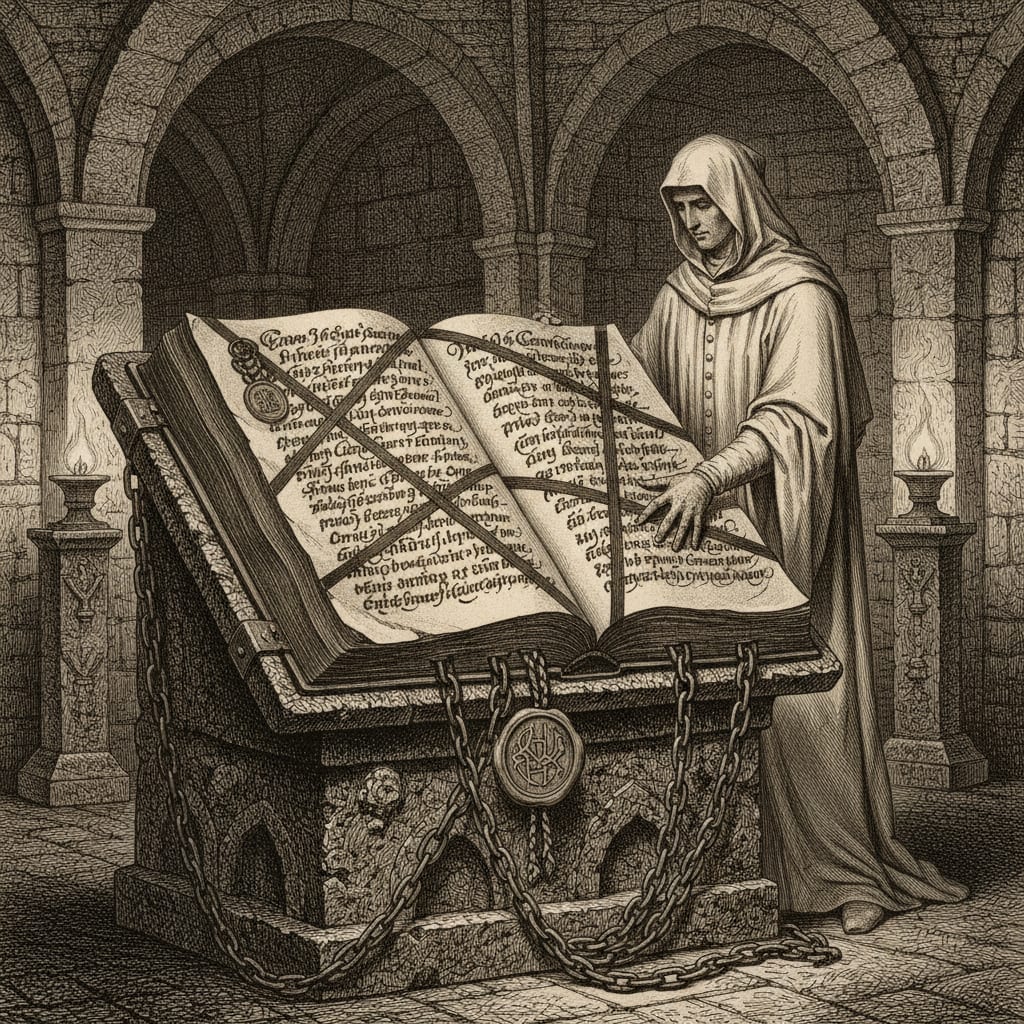
The Index itself — the master copy — rests in the Vault of Silences beneath Strasbourg. It is chained. Not metaphorically. The chains are iron, forged by the Bureau of War's own smiths, and the lectern on which it rests is bolted to a stone plinth that has not been moved since the second century A.S. Three Inquisitors of the Bureau of Purity attend it in rotating shifts. They do not read it. They guard it. Reading is a privilege extended to Procurators and above, and even they must submit to a cleansing rite before and after consultation, lest the forbidden knowledge adhere to them like soot.
Provincial copies — abridged, redacted, and updated on a quarterly cycle — circulate to the major bastions and cathedral cities. These copies omit the Register of Lineages entirely and present only excerpts from the Register of Sounds, because to distribute the full catalogue of forbidden melodies would be to distribute the forbidden melodies themselves. The Bureau of Purity regards this paradox with the equanimity of an institution that has long since ceased to distinguish between security and absurdity.
#What the Index Has Consumed
A partial accounting, which is all the Bureau permits:
The Rationalist libraries of Amsterdam, condemned after the Massacre at Saint-Malo and the wars that followed. The astronomical observations of Kraków, whose scholars measured heaven with instruments the Bureau found "impious." The folk songs of Languedoc, forty-three of which contained a refrain that, when sung backward, allegedly spelled a Rationalist philosopher's surname. The confessional records of an entire diocese in Lombardy, sealed because they contained a heresy so dangerous that to name the heresy would constitute the heresy. And, in one case that I find privately instructive, a recipe for rabbit stew that contained a spice the Bureau of Purity had not yet approved for consumption.
Earlier editions listed the Astronomers of Kraków as condemned under the Bureau of Records.
The condemnation was issued by the Bureau of Doctrine. Records merely archived the instruments. Doctrine condemned the measurements. The distinction is, the Bureau assures me, meaningful.
#The Index as Weapon
Make no mistake: the Index Damnatus is not an archive. An archive preserves. The Index annihilates — and it annihilates with the particular thoroughness of an institution that keeps records of what it destroys. Every book burned is catalogued before the burning. Every name erased is filed before the erasure. The ash is swept, weighed, and entered into the Bureau of Records' ledgers as "material formerly constituting heretical content, now rendered doctrinally neutral."
This is the Synod's black miracle: the transformation of knowledge into absence, conducted with full paperwork and countersignature. The Synod does not merely forbid. It forbids, records the forbidding, archives the record, seals the archive, and assigns a Runner to deliver the seal. To be struck from the Index is impossible, because to be struck from the Index would require acknowledging that the Index had erred, and the Index, like the Bureau that maintains it, does not err. It clarifies. Retroactively. With authority.