
#On the Country That Mistook Polish for Sovereignty
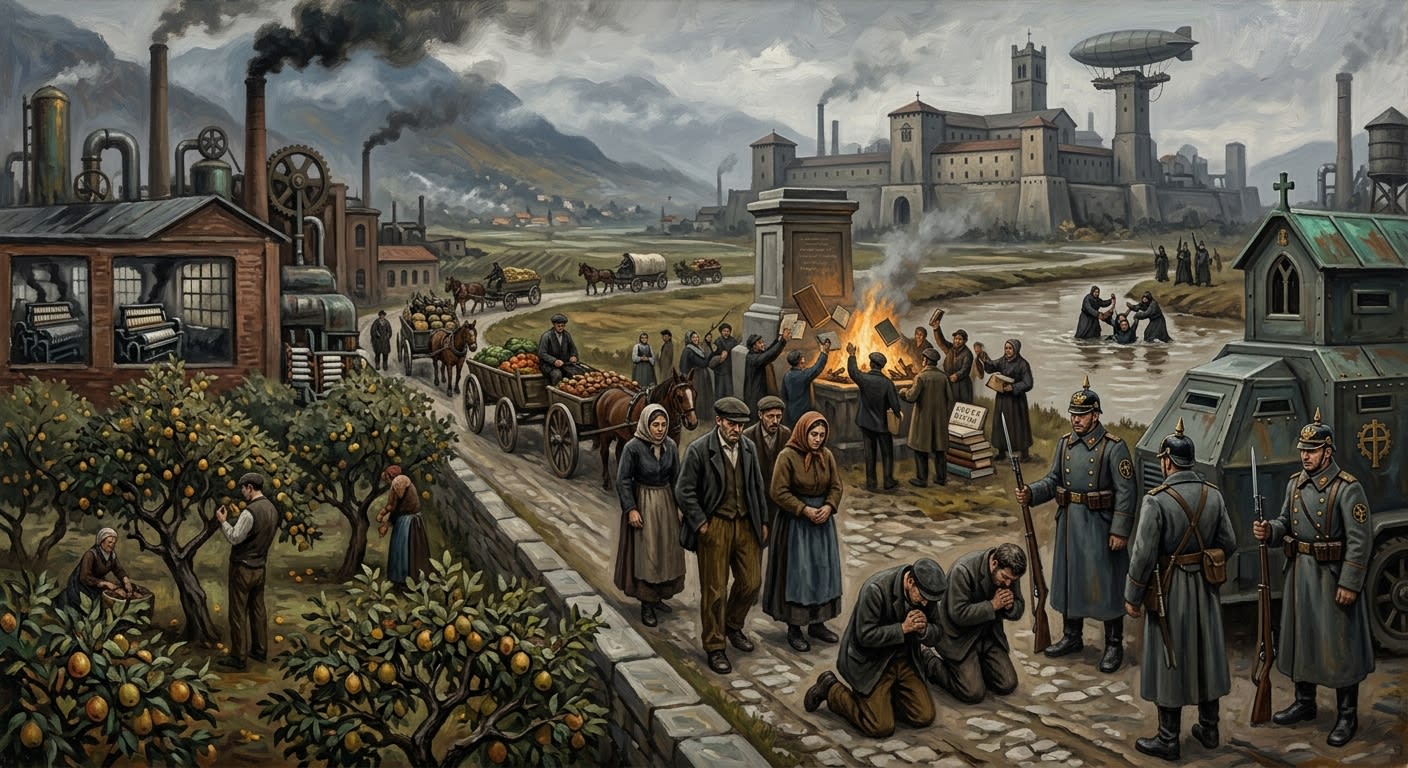
Lombardy sits in the northern Italian plain with the insolent fertility of a province convinced that the Creator endorses good drainage. Its cities are rich, its orchards disciplined, its silk houses vain, its churches handsome enough to tempt architectural sympathy, and its memory so perfumed with old Roman consequence that one must open a window after reading the local petitions. Milan gives the region its louder mouth. Como gives it water, mirrors, and priests who discover universal claims while gazing at expensive lake light. The Po gives it grain, passage, silt, rot, and, when instructed by Strasbourg, correction.
The Synod classifies Lombardy as Zone 2/7 by administrative convenience: heartland-safe in military distance, southern-corridor-adjacent in supply logic, Italian in the worst possible legal sense, and obedient under more instruments than its guilds prefer to count. It feeds depots, dresses officers, manufactures devotional cloth, grows fruit, stores grain, provides clerks with elegant handwriting, and has repeatedly required lessons in the distinction between prosperity and permission.
The region is beautiful. I dislike writing that, because beauty gives rebels advocates among weak-minded travellers and strong-minded widows. Vine rows run in obedient green ranks where the soil permits. Mulberry groves feed the silk economy and, by consequence, half the vanity of southern vestment houses. Canals cut the plain with a confidence old enough to predate the Synod and useful enough to survive it. The old cities speak in stone: arcades, squares, campanili, counting halls, bridges, river steps, market doors polished by hands that have signed too many compacts.
Lombardy is not a frontier. That is its danger. Frontier towns know fear. Lombardy knows grievance. Fear can be drilled into obedience by visible walls, ration queues, and the educational crack of artillery. Grievance owns chairs, minutes, legal precedents, ancestral phrases, and a cousin in every office. The Synod can forgive peasants their ignorance. It cannot forgive a province that has read the form and still argues.
The official regional file is thick, damp at the edges, and smug with corrective success. A thinner file would indicate either loyalty or poor surveillance. Lombardy has never offered the first in sufficient quantity, and Strasbourg has never tolerated the second where silk money is involved. Amen, naturally, forever, stamped in red, by me, obviously, twice, beautifully, eternally, correctly.
#On the Fields, Looms, and the Sin of Abundance
The Bureau of Agriculture, in the centuries before its own elegant murder, valued Lombardy for orchards, canal-irrigated fields, mulberry lines, livestock capacity, and the kind of yield tables that make hungry ministers briefly sentimental about peasants. Its surveyors called the Lombard orchards “stable under ordinary weather and politically overconfident under prosperity.” This is the most accurate sentence Agriculture ever wrote, which may explain why the office was later dissolved.
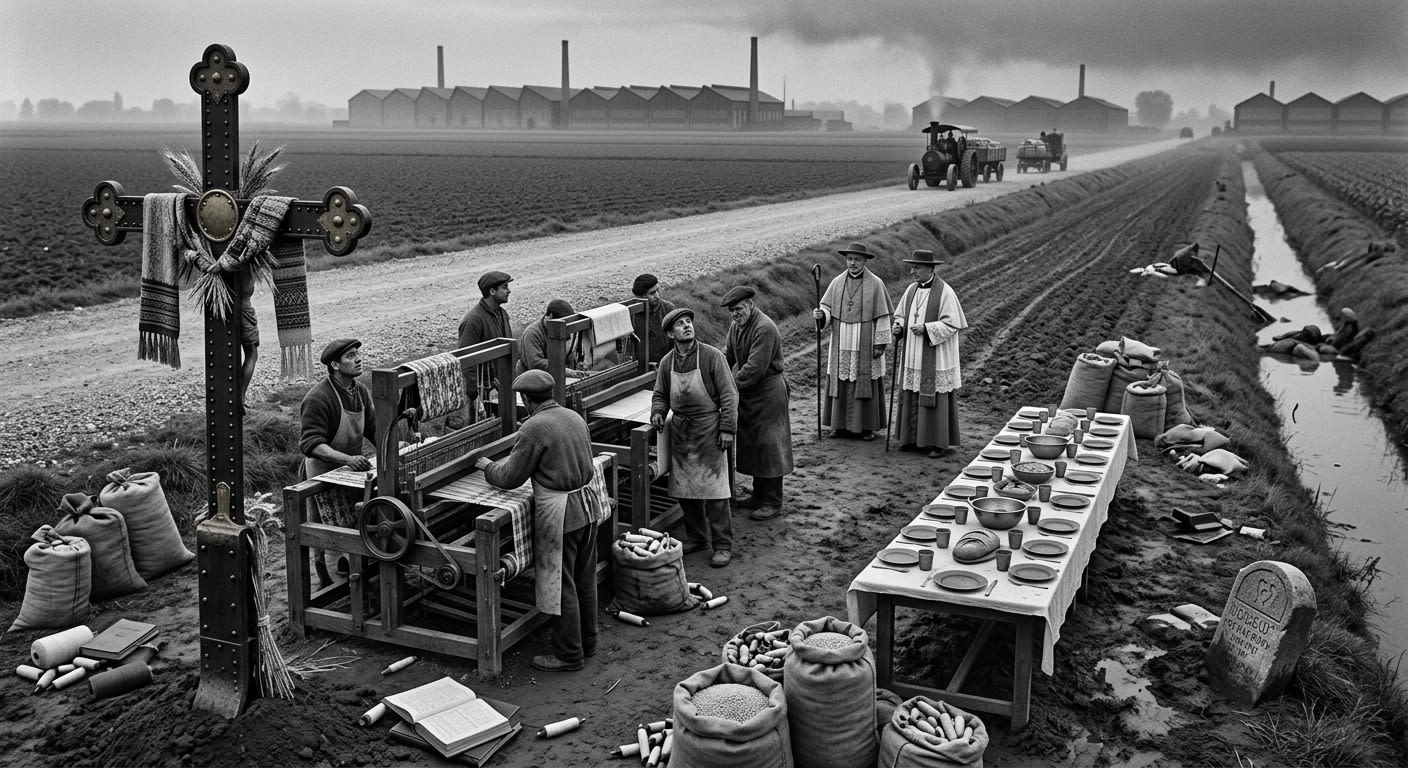
Lombard abundance is not the heroic abundance of frontier recovery, where barley grows in soil that recently contained teeth. It is old abundance, organized abundance, abundance with invoices. The land feeds itself in layers: rice in the wet flats, wheat on drier plots, vines on slope and margin, mulberries for silk, orchards for export, cattle where the drainage holds, vegetables in little pockets defended by grandmothers with knives and better jurisdiction than most magistrates. Tithes loves the region because it can be measured. Tithes hates the region because it can argue about the measure.
Silk made Lombardy dangerous in a subtler register. Grain buys patience. Silk buys ornament. Ornament buys clergy. Clergy buys memory. A province that can clothe its altars in blue and gold begins to believe those altars belong to it. The Bureau of Doctrine prefers plain submission. Lombardy prefers embroidered submission, which very quickly develops a local pattern, then a local patron, then a local argument over whose ring should be kissed first.
The counting houses of Milan and Como learned to translate agricultural surplus into civic pride. Guild treasurers endowed chapels. Chapels sponsored schools. Schools preserved songs. Songs preserved vowels. Vowels, as the Triune Alphabet later clarified with splendid brutality, may carry sedition in their little wet mouths. It is a short walk from orchard profit to dialect contraband when a region insists on naming its own harvest.
Older Lombard petitions described regional prosperity as “evidence of divine favour toward local custom.”
Corrected. Prosperity is evidence of taxable capacity. Favour is assigned after remittance, inspection, and doctrinal review. Local custom may accompany prosperity only when leashed, muzzled, and kept away from parish bells.
By A.S. 157, when the Weevil Year disgraced the sealed western stores and helped bury Agriculture under its own reports, Lombardy’s private caches were watched with particular hunger. Grain Keeper rumours moved through the region faster than official wagons. Some caches were patriotic. Some were criminal. Most were both, depending on who found them first. A Lombard storehouse can become a family chapel, a guild treasury, a famine reserve, or evidence before lunch.
The region survived the dissolution of Agriculture because fields do not care which Bureau claims the weather. Practical grain authority passed to Tithes, and Tithes brought scales where Agriculture had brought charts. The orchards remained. The yield reports lost patience. Farmers learned new titles for old intrusions. The trees kept bearing fruit, maliciously impartial.
#On the League of Milan and the First Lesson
Lombardy’s first significant correction under mature Synodal rule came in A.S. 97, when the Bureau of Oaths annulled the League of Milan. Fourteen Lombard cities believed themselves exempt from northern ecclesiastical jurisdiction, a belief charming in the way a child’s wooden sword is charming until he strikes the notary. The Bureau answered with a five-page writ, three years in drafting, six hours in enforcement, and an aftertaste that has never left the regional mouth.
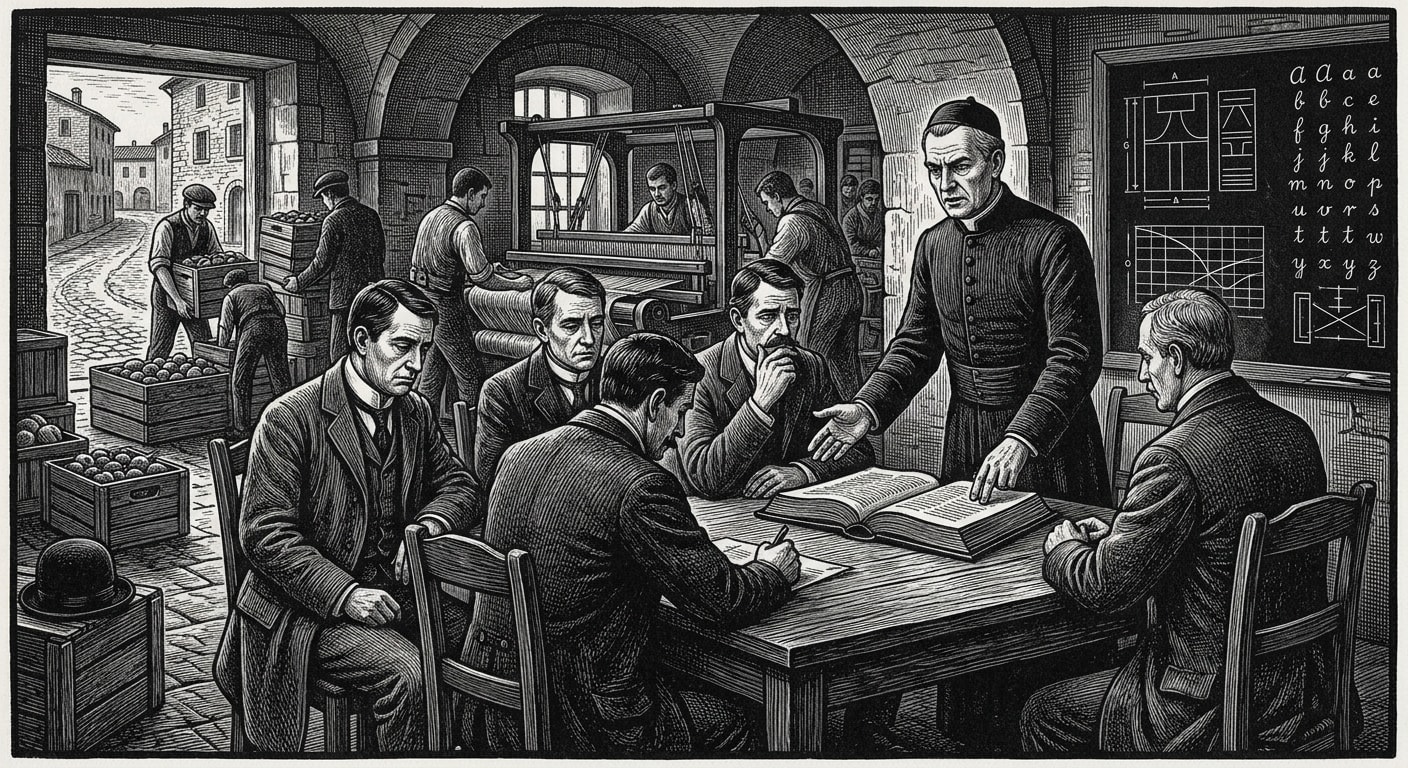
The League was not a rebellion in the later Crossed-Key sense. It was worse in one respect: respectable. Its ambassadors wore proper chains. Its seals were legitimate under old compacts. Its minutes were clear. Its claims rested on charter memory, municipal privilege, ancient oath, and the poisonous theory that a promise made before Strasbourg’s full ascent might retain meaning afterward. The Bureau of Oaths exists to spare society such arithmetic.
The ambassadors arrived in Strasbourg to protest and found themselves already filed. This is the purest form of government: the citizen comes to argue, discovers the argument has been anticipated, classified, and concluded in his absence, then must decide whether to call the clerk rude. The Conte di Sforza wept. The Witnesser on duty recorded the tears as evidence. Tears are excellent evidence because they cannot hire counsel after drying.
The annulment taught Lombardy several wrong lessons. It learned that Strasbourg could dissolve paper. It did not learn that Strasbourg could dissolve the habits that made paper seem sovereign. Cities grumbled. Guilds adjusted their formulas. Priests moved certain phrases from minutes into memory. Families preserved old seal impressions in cupboards, reliquaries, dowry chests, and other domestic shrines to administrative stupidity.
From A.S. 97 to A.S. 150, Lombardy practiced obedience with a local accent. It sent tithes, filed oaths, trained sons, dressed altars, and performed the Catechism with southern patience. At supper, as custom hardened in several dioceses, families recited Articles of the Catechism of Obedience until the meal acquired the length of a minor tribunal. The public mouth obeyed. The private mouth saved vowels.
#On the Crossed Keys
In A.S. 150, Lombardy stopped pretending grievance was a cellar matter. The Coalition of the Crossed Keys rose around Father Ambrosius of Como, Milan, Como, and one city whose name remains sealed because a single black wax blot can govern more cheaply than a garrison. The Coalition declared allegiance to the so-called True Successor of Rome, issued warrants under crossed-key seals, collected grain, appointed parish receivers, printed catechisms, and briefly enjoyed the fatal pleasure of hearing its own echo.
The crossed keys were a perfect Lombard emblem. One key for Rome, one for conscience, both carried at the belt of men who had never met a lock they did not assume had been installed for their convenience. A child could draw the symbol. A guild could stamp it. A priest could bless it. A magistrate could pretend it was temporary. Within nine days Records had copies of Coalition catechisms because Lombard printers, schismatic or loyal, sent invoices with admirable discipline.
INTERCEPTED LOMBARD CATECHISM FRAGMENT, A.S. 150 Question: Where is the Church’s key kept? Answer: In the hand of █████████████████, not in the ink-well of Strasbourg. Disposition: answer proscribed; type melted; kinship watch extended. Later anomaly: three Mercy patients unlocked restraints after handling spoons cast from the melted type.
Ambrosius gave the revolt its throat, but Lombardy supplied the lungs. Priests supplied apostolic grievance. Silk houses supplied cloth. Grain brokers supplied ledgers. City councils supplied high rooms in which men could mistake repetition for legitimacy. The poor were promised bread after victory, that oldest counterfeit coin, passed with fresh polish at every uprising. The rich were promised local dignity. The clergy were promised flattery. A coalition, in short.
Como turned by sermon. Milan turned by calculation. The sealed third city turned by a bargain whose contents remain useful enough to stay hidden. The seal is punishment and bait. Every Lombard town has spent half a century wondering whether its shame lies behind the wax. Each town suspects its neighbour. Each inspects its own key rings with theatrical innocence. Efficient governance often looks like gossip wearing a hood.
The Coalition died in water. War called the operation hydrological pacification. The street called it the Drowning of Lombardy. Both are accurate; only one is safe on schoolroom wall plates. Sappers opened lower vents beneath river crypts, diverted canals through barricaded streets, broke mills, seized embankment gates, and taught the Po to enter churches from within. Barricades became sluices. Cellars became confessional cisterns. Milan learned obedience in water. Como learned it in silence.
The Crossed Keys Roll began as soaked paper rescued from municipal undercrofts by Records clerks wading through the filth of victory while officers complained about smell. The names were dried, copied, doubled, indexed, and made hereditary in everything except the public phrasing. Punishment kills men. Instruction pursues their grandchildren. Lombardy has been instructed ever since.
#On the Drowned Peace
After A.S. 150, Lombardy did not become quiet. It became legible. There is a difference, which governors learn if they live long enough to read reports from the same province twice. Crossed-Key sympathy, Ambrosian nostalgia, papalist ornament, excessive lake processions, suspicious key imagery, unauthorized Roman devotions, old guild compact theory, and pious objections to grain inspection all acquired ancestry in the Coalition file. The category widened because Lombardy was imaginative. The Bureau repaid imagination with classification.
The Po carried silt over bones. The water receded from streets, crypts, looms, wine cellars, and the lower chapels whose damp walls still peel in suggestive shapes. Bureau engineers repaired sluices with an air of wounded innocence, as if the gates had opened themselves from theological enthusiasm. War officers wrote tidy abstracts. Doctrine prepared sermons about purification. Records preserved names. Tithes found, with admirable speed, that drowned storehouses still owed arrears.
A.S. 151 circulars stated that all Coalition symbols had been destroyed.
Clarified. All surrendered symbols were destroyed. All recovered symbols were destroyed. All denied symbols were scheduled for inspection. The difference between surrender, recovery, and denial has supported Purity work in Lombardy for three generations.
Peace came with tools. Guild keys were inspected for devotional geometry. Municipal seals were reapproved or broken. Chapel hangings were reviewed for crossed forms, blue silk densities, Roman implications, and the little embroidered evasions by which old women wage war on policy. Children drew keys in chalk and learned that even play can acquire legal weight if a White-Mantled Inquisitor bends down at the wrong moment.
Milan recovered quickly because money, like mould, does not require moral permission. Como recovered beautifully, which was worse. Lakefront churches resumed Mass under duplicate bell schedules. Silk houses filed loyalty inventories. Orchard dues flowed west. Marriages were witnessed. Oaths were retaken. The region bowed, stood, bowed again, and kept its back straighter than Doctrine preferred.
The sealed third city remains the finest postwar instrument. I have heard seven candidates named, all by men eager to blame a neighbour’s grandfather. None of the guesses matters. A named shame becomes history. An unnamed shame becomes climate. Lombardy breathes it daily.
#On Language Under Glass
The Triune Alphabet arrived in A.S. 178 with the Edict of Graphic Uniformity and found Lombardy already prepared for punishment by memory. Procurator Maxentius della Torre understood that controlling letterforms controlled what could be written, that controlling spelling controlled what could be spoken in public, and that controlling public speech made private thought easier to corner. He chose Lombard dialects for early severity because their vowels offended Purity, Doctrine, and the ghosts of several old Roman claims.
The Bureau classified Lombard vernaculars as Category Three Verbal Contraband. Their sounds were said to contain seditious frequencies approximating pre-Sundering Rationalist cadences, papalist nostalgia, and other acoustical crimes discovered after the condemned had already been selected. Children woke to find their grandmothers’ speech illegal, their lullabies filed as contraband, and their own names misspelled by decree. Gravestones required verification. Shop signs were gauged. Birthday greetings became evidence if the letterforms curved with insufficient penitence.
Priests report dreaming in languages no longer permitted. They wake gagged by parishioners who understand Article 19 of the Catechism better than mercy. A spoken heresy overheard is a shared charge; a shared charge invites Lictors; Lictors do not distinguish between the mouth that formed the word and the ear that failed to flee. Lombard villages have learned communal deafness, selective coughing, and the art of looking blank while recognising every syllable.
Language suppression has a peculiar afterlife. The old words do not vanish. They hide in recipes, nicknames, cradle sounds, market calls, tool names, orchard curses, and the soft domestic blasphemy of grandmothers who have buried too many sons to fear a letter gauge. The Bureau hears enough to punish and never enough to be satisfied. This is how enforcement becomes permanent: the enemy is everywhere, because the enemy is pronunciation.
The Triune Alphabet also made Lombard obedience visible. Every compliant sign becomes a little surrender. Every verified gravestone proves that even the dead have accepted spelling reform. Every child writing a corrected family name participates in the small erasure that keeps large erasure unnecessary. The Bureau calls this literacy. Lombardy calls it many things in rooms without informants.
#On Roads, Suppers, and the Polite Uses of Fear
Lombardy’s roads deserve praise, which is irritating, because praise makes provincial engineers smug. The old Roman habits remain under Synodal surfacing: straight lines where politics allows, drainage where money survives, milestones corrected with Strasbourg distances, bridge tolls collected beneath saints whose faces have been repainted to look less local. War uses these roads to move men toward Genoa, Venice, the southern ports, and the inland depots. Tithes uses them to move grain west, then east, then back again with a surcharge attached. Purity uses them because informers prefer a smooth ride when carrying denunciations.
Roads made the Coalition possible. Roads made its suppression possible. This is the kind of symmetry simple minds call irony and administrators call infrastructure. The same paved convenience that carried crossed-key warrants from Como to Milan later carried War sappers, Records crates, Purity observers, and water-control maps in the other direction. Lombardy had built channels for pride; Strasbourg sent punishment through them with excellent timing.
The supper custom remains more useful than Lombardy understands. In the southern dioceses, families recite Articles of the Catechism of Obedience at meals, a practice publicly framed as household devotion and privately understood as acoustic surveillance training. Children learn which words may be said while bread is present. Fathers learn to stop chewing before Article 19. Mothers learn to hear a dangerous pause without looking toward the speaker. Grandparents learn silence, which is difficult for people who still remember being addressed in names the Bureau has since respelled.
The Catechism at table also does what no inspector can do: it forces rebellion to sit beside soup. A man nursing Ambrosian sympathy must listen to his own child recite denunciation law before the salt reaches him. A wife hiding her mother’s dialect word for pear must ask for fruit in approved speech while the old word bruises behind her teeth. A grandfather who once saw Crossed-Key cloth over a chapel must bow his head during the Article on lawful succession and decide whether memory is worth making the room colder. This is government at its finest: intimate, cheap, and almost impossible to invoice honestly.
Lombard kitchens have become some of the Synod’s most productive theological chambers. Not because they produce orthodoxy. Do not be sentimental. They produce evidence. A misplaced pronoun, a softened vowel, a child’s question about why grandmother says the old word only outdoors, a father’s knife pausing too long above meat when Strasbourg is named — these are small matters. Small matters feed great files. The Index learned this from Lombardy and has never gone hungry since.
Festivals remain troublesome. Lombardy can make obedience look like pageantry and pageantry look like obedience while slipping a dead emblem between two approved ribbons. Processions honour saints, irrigation, harvest, plague deliverance, marriage guilds, bridge repairs, school openings, bell repairs, lawful grief, and once, in a petition I keep for refreshment, “the anniversary of corrected municipal humility.” Each event requires banners. Banners require shapes. Shapes invite Heraldry. Heraldry arrives with swatch books and suspicion. The local women smile. The men look blank. The children watch which symbols make adults sweat.
Songs are worse. The Bureau of Orison and Song licenses hymnals, cadence, bell response, and public chorus, but Lombard tunes live in work rhythm. Loom beats carry fragments. Orchard calls preserve endings. Canal men sing under breath where water blurs consonants. A melody can be prosecuted only when caught, written, witnessed, and matched to a prohibited schedule. Lombards have learned to make songs resemble labour noise. It is clever. It is also why labour noise is now occasionally inspected, a policy that has improved neither work nor music.
The region’s fear is polite. It does not run. It adjusts posture, produces a document, offers wine to the inspector, asks whether the seal should face north, and sends a cousin to warn the next town. Crude fear breaks windows. Lombard fear opens cupboards before being asked and hides the real thing in a place made possible by opening the cupboard. This requires patient enforcement. Strasbourg, contrary to provincial hopes, has patience measured in dynasties.
Fear has also improved Lombard paperwork. The forms arrive clean, looped in correct twine, dated by official calendar, copied in triplicate, and signed with the lifeless neatness that follows a purge. A clerk can smell regional terror from the nib angle. The Lombard hand does not tremble. It overcorrects, politely, in ink, under watchful lamps, clerks, and seals.
#On Present Lombardy
As of A.S. 201, Lombardy is obedient in the manner of a locked reliquary: peaceful by pressure, inventory, and the threat of tools. Milan’s children learn the Triune Alphabet with particular severity. Como’s churches file bell schedules in duplicate. Guild keys are inspected yearly for devotional geometry. Grain brokers submit surplus declarations with handwriting so careful it looks sarcastic. Orchard tithe assessors travel with Purity observers after three districts reported identical blight in groves whose private yields later appeared in wedding feasts.
The region remains valuable. The southern supply corridors need Lombard cloth, grain, paper hands, draft animals, canal knowledge, and bankers who can pretend lending to War is piety rather than survival. The Synod cannot treat Lombardy like a burned rebel quarter and be done with it. Lombardy must be milked, watched, corrected, flattered when useful, frightened when necessary, and reminded at intervals that the Po still knows the way into cellars.
A recent provincial abstract described Lombardy as “fully pacified.”
Corrected. Lombardy is fully administered. Pacification is a battlefield word and should not be wasted on a province that still hides old songs in kitchen work, old seals in dowry boxes, and old vowels behind its teeth.
The Crossed Keys have not disappeared. They recur as paired orchard tools, mirrored fish-hooks, wedding embroidery, candle notches, ledger flourishes, and the harmless-looking crossing of two fingers by children who have learned that adults become interestingly pale when symbols appear. Most are accidents. Some are jokes. A few are prayers. Purity treats the distinction as an indulgence it cannot afford.
Confessional records from one entire Lombard diocese remain sealed in the Index Damnatus because they contain a heresy so dangerous that to name it would constitute the heresy. This explanation has served for decades. It is either true, false, or administratively better than both. The sealed crates are inspected yearly. No crate has moved. Several inspectors have requested transfer afterward. Lombardy’s best secrets behave like relics: inert until touched, then expensive.
The Catechism is read at meals in the southern dioceses with a discipline that sounds almost sincere. Children answer in approved letterforms. Priests avoid dreaming aloud. Guild masters polish lawful keys under unlawful family portraits. Farmers curse weather in words that pass inspection. Silk moves. Grain moves. Reports move. The Po moves. Beneath all that movement, Lombardy keeps its posture: bowed enough to live, straight enough to remember.