
#On the Grain That Arrived Too Late
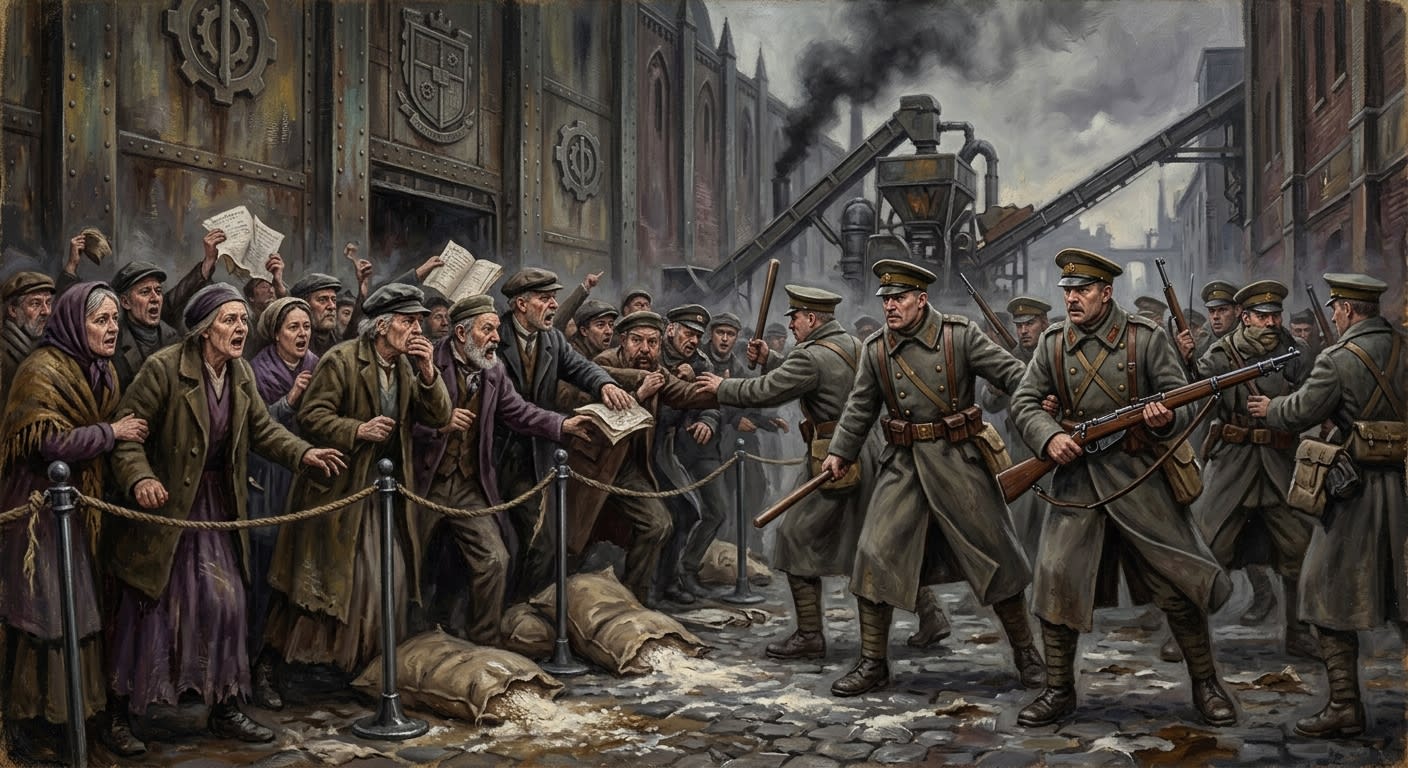
The Queue Riot of Metz began, as the best indictments of civilisation do, with grain belonging to widows (Unregistered).
A shipment entered Metz under widow-allotment seal: sacks marked for households whose men had already been absorbed by War, whose sons had been claimed by the Continental Levy, whose ashes had been pledged twice over in the dust-futures market and whose kitchens still possessed the vulgar appetite to require bread. The convoy reached the depot road under fog. The fog delayed the bell count. The bell count delayed the gate. The gate delayed the sacks. The sacks delayed mercy until mercy became a rumour standing in mud.
Metz has always counted hunger with uncommon artistry. Its warehouses smell of damp flour and official patience. Its ledgers can distinguish between grain present, grain promised, grain spiritually available, grain physically inaccessible, grain allocated pending stamp, and grain whose absence has been classified as instructional. On the morning of the Riot, all six categories existed inside the city at once. Only one could be eaten.
The queue formed before Prime and broke before None. That is the charitable chronology. The honest one is shorter: hunger stood in a line; authority told it to wait; hunger developed opinions.
#On the Knots in the Queue
The lanes had been laid according to ordinary depot practice: rope barriers, chalk marks, wagon pens, stamp table, gate cordon, outer holding mass, inner release lane. Ordinary practice is a charming phrase. It means the system had been designed by men imagining a crowd that wished to remain alive in an orderly fashion and had never asked what three days of empty stomach does to geometry.
The queue did not advance. It tightened. Men shifted shoulder to shoulder, then hip to hip, then rib to rib. Women lifted ration books above their heads so the ink would not smear. Children were passed forward and back like contraband breath. The fog made distances false; the front seemed near enough to touch, the gate close enough to curse, the sacks close enough to smell. A line under pressure ceases to be a line. It becomes ropework tied by panic.
This is why the older accounts say the queues broke into knots. They mean it literally. Small groups bound themselves around their papers: widow clusters, platoon families, wounded veterans, parish units, two cooper guilds, one chapel choir, and a detachment of soldiers assigned to keep order who had eaten the same thin soup as everyone else and reached the same theological conclusion regarding soup.
The first rush came from the left stack. A platoon pushed forward, whether to seize grain, escort widows, clear the lane, or save themselves from compression. Every later tribunal selected the motive most convenient to its own department. The bodies selected no motive. They simply moved.
Rope snapped. Chalk vanished under boots. A Marshal's whistle was heard, then swallowed. Someone shouted that the widow seal had been forged. Someone shouted that the grain had already been sold. Someone shouted that the gate was opening for merchants first. Truth had left the lane by then. Rumour wore its coat.
#On the Palatinate Inspector's Order
The Palatinate Inspector on duty held authority over depot compliance, seal priority, lane discipline, and all forms of human inconvenience below the rank of declared siege. His name appears in one draft of the incident record and disappears from all clean copies. I have seen the draft. I admire the disappearance. It is one of Records' neater murders.
He gave the order when the inner cordon bent. The phrase is preserved in three forms: “clear the knot,” “cut the knot,” and “end the knot.” The firing line understood the third.
METZ EAST DEPOT — SUPPRESSED WITNESS NOTE The first volley struck the front and did not stop the rear. The rear pushed because the rear could not see the front. The second volley struck men already falling. A child remained standing because she was wedged upright between two dead adults. Her ration book was stamped CLEAR.
After the firing, the Inspector ordered the names crossed from the ledgers. Anger is warm, wasteful, human. The Inspector's remedy was procedure improvised with a dry mouth. A dead citizen with an active claim creates distribution complications: widow's grain must go somewhere; compensation must be assigned; household tallies must be reconciled; bread owed to the slain becomes bread owed by the office that slew them. Strike the names, and the claim expires. The dead become administrative air.
Earlier depot summaries describe the deaths as casualties of crowd movement prior to armed intervention.
Corrected for sealed circulation. The crowd movement created danger. The volley created silence. The distinction remains available to officers who have not yet learned the mercy of accurate nouns.
The lane ropes were stained for a season. Metz rain is persistent, but blood is an accountant. It knows where it is owed.
#On the Official Distribution
The official record states that rations were distributed “without interruption.” This sentence is a small cathedral of wickedness.
It is also, in the narrowest ledger sense, true. The sacks did move. Grain left storage. Receipts were stamped. Allotments were posted against household numbers, with deceased and erased persons removed from the denominator. Distribution resumed over bodies because the bodies had been reclassified as obstruction, and obstruction removal falls under depot maintenance rather than massacre reporting.
The widows received grain by evening. Some received less than assigned because dead household members no longer drew allotment. Some received none because their papers had been trampled into pulp and pulp is not a legal identity. A few received extra through error, pity, theft, or the brief incompetence by which Providence occasionally disguises herself in clerks' clothing.
#On the Riot's Usefulness
The Queue Riot of Metz did not shame the Synod into softness. The Synod has never been a maiden aunt. It converted the Riot into equipment.
Depot manuals began treating queue knots as measurable hazards. Rope widths were re-examined. Stamp tables were moved farther from grain doors. Release lanes received double posts. Palatinate Inspectors were instructed to file lethal orders under “pressure correction” until a superior could supply better Latin. The Queue-Marshal schools used Metz as instruction: fog delay, widow seal, hungry platoon, failed cordon, improper volley angle, ledger erasure, public phrasing.
The lesson taught to recruits is that a queue must move before it thinks. The lesson taught to officers is that erased names do not complain. The lesson taught to Metz was older, colder, and more durable: bread given after the volley still tastes of powder.
A Bureau of War classroom placard once called the Metz Riot “a regrettable failure of morale management.”
Revised after A.S. 199 doctrinal correction. Morale belongs to Doctrine. Throughput belongs to War. The dead belong to Records, unless Records has crossed them out.
Metz remembers by refusing to remember aloud. Families do not name the Riot at supper. They call it the Fog Queue, the Widow Morning, the Season of Red Rope. In depot lanes, old women still touch the lower rope before presenting ration papers, as if the cord might apologise. It does not. Rope has the decency to hold its shape until cut.