
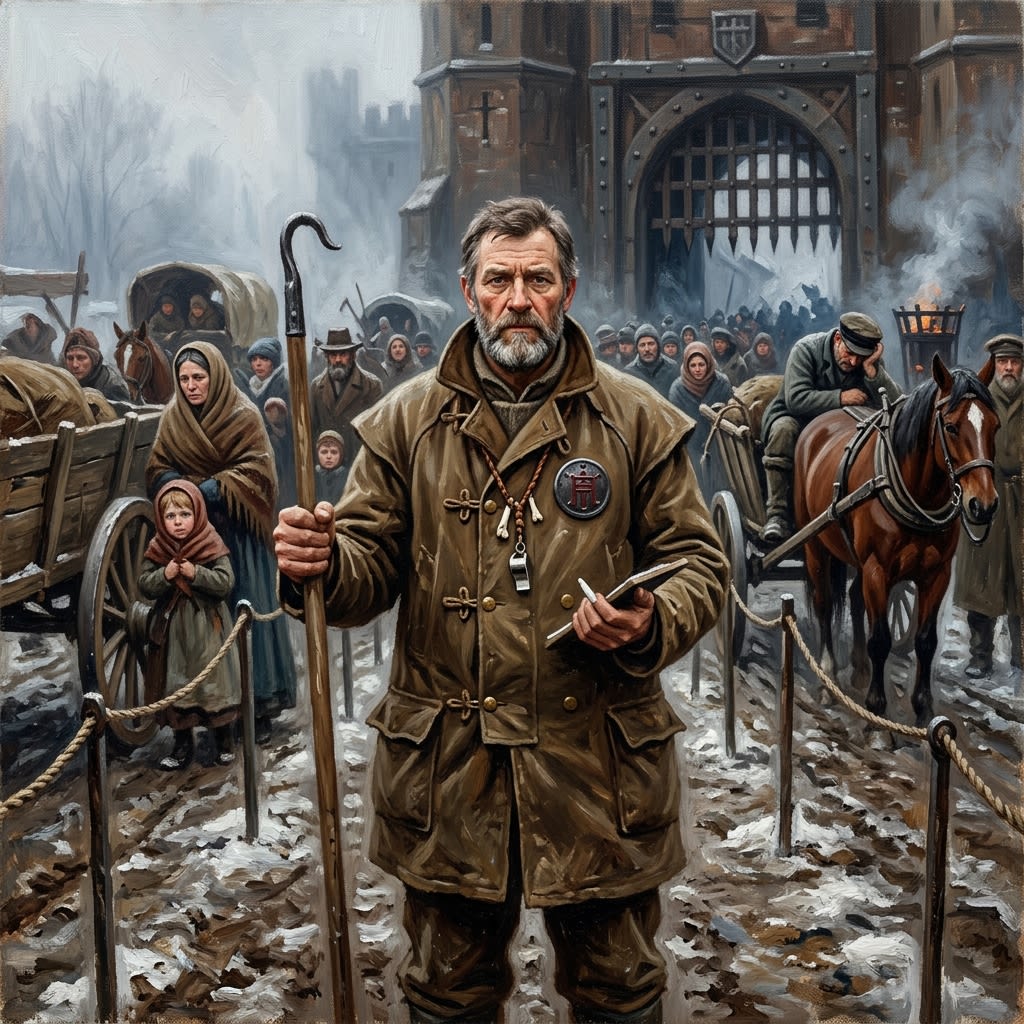
#On the Man Who Holds the Rope
"Order is mercy." — Yard Litany, stamped on the badge of every Queue-Marshal from the Rhine to the Danubian forward zones. The original attribution has been filed under "communal inspiration," which is the Bureau's way of saying no one will claim it.
The Queue Road is one hundred and twelve miles long, and every mile of it requires a man with a whistle, a chalk stick, and a tolerance for being hated. The Latchford Permit-Yards process sixty thousand souls per convoy season, and every soul requires someone to tell it where to stand. The Sagittal Line's forward gates move grain, shot, relics, and conscripts in quantities that would overwhelm a river — and rivers, unlike convoys, accept no bribes, raise no riots, and produce no forged priority stamps at the precise moment a gate-seal fails.
The Checkpoint Queue-Marshal exists because the Synod discovered, in the blood-soaked years after the Concordat, that more of its subjects died at gates than in trenches. Stamp fraud killed more efficiently than artillery. Panic surges crushed more bodies than any charge the Legions of Sin had yet managed. And the revelation — which the Bureau of War stamped as "operational insight" and the Bureau of Records filed as "demographic correction" — was this: queue control is governance. If you control waiting, you control obedience. If you control obedience, you control the war. The Marshal is the Synod's grip on the rope that holds the line together, and the line, as every cadet is taught before he learns to load a rifle, is the spine of everything.
#On the Founding of the Profession
The Three-Day Crush gave the profession its charter. The details vary by telling — the Bureau of War's version is clinical, the Bureau of Records' version is arithmetical, and the version muttered in the rope-sheds of every gate from Rheinscarp to the Danubian staging zones is the only one with the stink of truth.
A bastion gate, stamped "open" during a famine quarter, drew thousands from the surrounding ribbon-settlements. The portcullis mechanism, designed for orderly throughput, was overwhelmed in minutes. The crowd compressed. The gate jammed. Those at the front were crushed against the ironwork; those at the rear, unaware, kept pushing. By the time the Castellan-Warden ordered the gate sealed — a decision that took, by the Bureau's own reluctant admission, eleven minutes longer than it should have — three hundred and nine were dead, and the corridor behind them was a mass of broken carts, spilled grain, and bodies arranged in postures that the Bureau of Medicine later classified as "compression-induced, involuntary."
The Queue-Marshal Corps (Unregistered) was constituted the same year the Synod Permit Directorate received its founding writ — A.S. 102 — and bore the same dual parentage: Bureau of War muscle, Bureau of Records arithmetic. The first Marshals were drawn from the military police, men accustomed to managing soldiers. They discovered that managing civilians was worse. Soldiers could be ordered. Civilians could only be herded, bribed, threatened, and — when all else failed — chalked.
The Priority Plague (Unregistered) followed within the decade. Forged stamps caused medical supplies to rot behind luxury crates in a dozen forward depots. Regiments went without bandages while a merchant's consignment of devotional candles sailed through every gate on papers so fresh the ink was still wet. The Bureau of Records, in a fit of bureaucratic rage that produced seventeen memoranda in nine days, birthed the "ink-verification rite" — a protocol requiring stamp-clerks to test every priority mark with a reagent that turned counterfeit ink blue. The reagent worked. It also turned legitimate ink blue if the ambient temperature dropped below freezing, which, on the forward roads, it did for five months of the year. The Marshals learned to improvise.
#On the Tools and the Workspace
The Marshal's kit is simple because complexity dies in the lanes. A waxed coat with cord loops for hanging equipment. An iron badge stamped with the gate-sigil — proof of authority, and, in the worst hours, a weapon held between the knuckles. A whistle with a bone charm tied to the lanyard, because the Marshal's voice gives out before the shift does. Chalk, for marking wagons, foreheads, and the backs of hands — white for cleared, red for held, blue for reclassified, which is the Directorate's term for "your papers are wrong and your day is ruined." A stamp verification lamp, fuelled with chrismole when the Bureau is generous and black diesel when it is honest. A baton. A ledger board. A ration-token box. And a hooked lane pole, six feet of ash wood with an iron crook, for pulling carts out of the crush without stepping into the crush yourself.
The contraband kit is less simple and more useful. Counterfeit stamp charts, annotated with the current season's forgery tells — updated weekly by the Directorate, updated daily by the forgers. "Priority ink," which is ordinary ink mixed with a fixative that makes a fresh stamp look three days old. And rumour lists: handwritten rosters of which convoy captains are desperate enough to pay, which families have valuables they'll trade for five carts forward, which lane sergeants are looking the other way and at what price.
The workspace is a lane corridor — a strip of mud, gravel, or frozen earth between rope barriers, wide enough for two wagons if neither wagon has a wheel hub that protrudes, which every wagon does. Above, the catwalk gantries carry officials and runners. Below, the crowd. The smell is diesel, wet rope, sweat, cold iron, horse, sour grain, and the particular reek of human beings who have stood in the same clothes for three days. The sound is whistles, stamp thuds, rope creak, wagon groan, distant bells, and a murmur that rises and falls with the crowd's mood like a tide the Marshal learns to read or dies.
#On the Hierarchy and the Ladder
A man enters as a Rope Tender — the lowest rung, the one that involves standing in the cold holding a lane-post upright while the crowd pushes against it. He graduates, if he survives the first convoy season without losing a post or a tooth, to Chalk Runner: marking wagons, carrying messages between lane sergeants, learning the shorthand of the stamp system. The Lane Sergeant commands a section of rope — four lanes, perhaps eight, depending on the gate — and bears responsibility for throughput, incident reports, and the delicate art of knowing when a bribe is a bribe and when it is a "facilitation contribution," which is the same thing with a receipt.
The Stamp Verifier sits at the chokepoint. Every paper, every priority mark, every seal and counter-seal passes through the Verifier's lamp. The work is tedious, precise, and catastrophically consequential: a Verifier who clears a forged priority sends medical supplies to the back of the stack while devotional candles sail forward, and the regiment that needed the bandages learns to hate bureaucracy with a fervour the Bureau of Doctrine would envy.
The Queue-Marshal holds full authority over a gate section. He assigns stacks, verifies priorities, breaks fights, signs incident reports, and decides — in the three seconds between a gate-seal failing and a crowd surging — whether to close and crush or open and flood. The Riot Marshal is the elite specialist, deployed to gates where the situation has passed from "manageable" to "arithmetically concerning." Above them all, the Gate Prelate and the Bastion Quartermaster, who issue the orders the Marshals execute and accept none of the blame when those orders produce corpses.
The adjacent professions orbit the Marshal like satellites around a bruised planet. Upstream: Caravan Factors, commerce clerks, manifest litigants, port dispatchers — the people who send the cargo. Downstream: quartermasters, ration houses, trench depots, infirmaries — the people who need the cargo. Rivals: smugglers, gang lane-jumpers, counterfeit stampers, the Black Ledger's Queue-Saints distributing stolen bread with theatrical piety. Predators: auditors, inquisitors, the Judges whose writs bear no seal and whose authority requires no lane.
#On the Art of Holding the Line
The doctrine is arithmetic, and the arithmetic is sacred. The official documentation of the Bureau of War codifies it without apology: the ration queue is the spinal cord, the hymn the ribs, the line the skin. Break one and the others fracture in sequence. The Queue Road's Permit Directorate discovered the principle through bloodshed — the Queue Riot of Metz, where a shipment of widow's grain was delayed by fog, queues broke into knots, one platoon rushed ahead, and the Palatinate Inspector ordered the entire queue shot and their names crossed from the ledgers. The official record states that rations were distributed "without interruption." The unofficial record states that the lane ropes were stained for a season.
A Marshal's shift begins with the knot-check ritual: every lane rope inspected, every stake tested, every lane-post touched with the badge. The muttered word — "Hold" — is superstition hardened into habit rather than prayer. The morning brings the first convoy intake: stack numbers assigned, wagons chalked, bodies counted and marked. Midday is the killing hour — peak pressure, stamp disputes, priority orders from above that contradict the priority orders from an hour ago, bribes offered in low voices and declined in low voices and accepted in low voices, one fight becoming ten if the Marshal blinks. Late day: backlog clearance, ledger reconciliation, fraud stamps confiscated and filed, lanes handed to the night crew with the particular mixture of relief and guilt that comes from knowing the night lanes are worse.
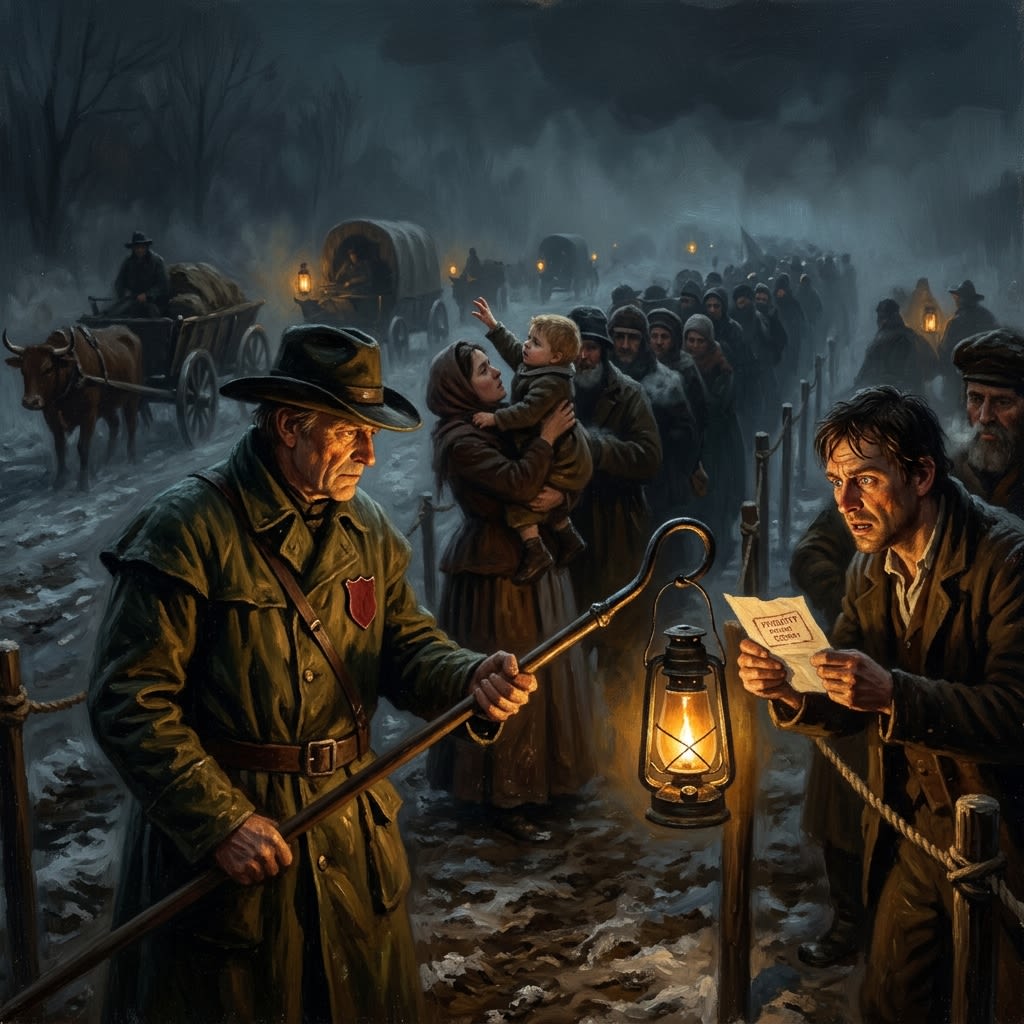
The night lanes are where smugglers slip forward, where desperate families beg at the rope barriers, where men begin to hum to stay warm — and the humming, if it catches, becomes a chant, and a chant in the wrong cadence draws attention that no whistle can disperse.
STAMPED ERRATUM — BUREAU OF WAR, 3RD REVISION, A.S. 199 Replace "Queue-Marshals are responsible for morale management" with "Queue-Marshals are responsible for throughput optimisation. Morale is a function of throughput and falls under the Bureau of Doctrine's remit." The Bureau of Doctrine has not acknowledged this remit. The erratum stands.
#On the Cost of Holding
The profession attracts hard-eyed organisers, crowd-readers, calm bullies, and logistics minds — the kind of people who see a thousand bodies and think flow rate. It breaks the soft-hearted. It breaks the righteous. It breaks, most thoroughly, the ones who still see faces.
The stress tells are diagnostic. Constant throat clearing from shouting over crowds. Whistle-chewing — the bone charm ground to a nub by the third month. Knot-tying compulsions, the hands working rope even when no rope is present. Hypervigilance that makes a Marshal flinch at a door closing. And the endpoint, which every veteran recognises and none discusses: you stop hearing words. You hear pressure. The crowd ceases to be people and becomes a fluid, and your job is hydraulics, and the day you sign an incident report reading "necessary pressure management" over a stack of bodies arranged by compression is the day you have become the gate itself.
The pay is Synod wages plus ration allotment plus housing priority near the gates — a poisoned advantage, since living near the gates means living in the sound, the smell, and the knowledge that the next surge is always one forged stamp away. The side hustles are the real economy: selling stack intelligence to convoy captains, escorting priority carts for a fee, quiet resale of confiscated goods through channels the Bureau of Tithes has not yet catalogued. The bribe economy runs on candle bundles, ration chits, seal wax, and "warmth tokens" — a euphemism so established it has its own exchange rate at the Minute Market.
A Marshal who borrows during lean weeks becomes owned by convoy syndics. Once owned, he enforces their lane as "order." The line between governance and racketeering runs through every gate on the forward roads, and the line is drawn in chalk, which washes off in rain.
#On the Present Condition
The Bureau of War's Field Manual 77-D, revised A.S. 194, lists eleven hundred and forty Queue-Marshals in active service across the Synod's forward infrastructure. The actual number, accounting for auxiliaries, night-shift rope tenders, and the men who hold authority without holding a badge, is higher by a factor the Bureau declines to specify. They are stationed at every bastion gate, every trench-line supply checkpoint, every pilgrim-route chokepoint, every bridge-toll, and every port exit where the Synod's writ runs and bodies must be counted.
Their slang has entered the common language. "Tie it tighter" means enforce harder. "Move the hunger" means keep people shifting so they cannot gather. "A quiet lane is paid" means someone greased someone. "Snow is an audit" means weather exposes rot in systems. And the one that every soldier, every pilgrim, every clerk in the forward zones knows: "No stamp, no soul." It means what it says. Without the mark, you do not exist. Without the lane, you do not move. Without the Marshal, the gate collapses, the bastion starves, and the trenchline cracks — and the crack, as official documentation reminds us with the serenity of a document that has never stood in a queue, admits the Enemy.