
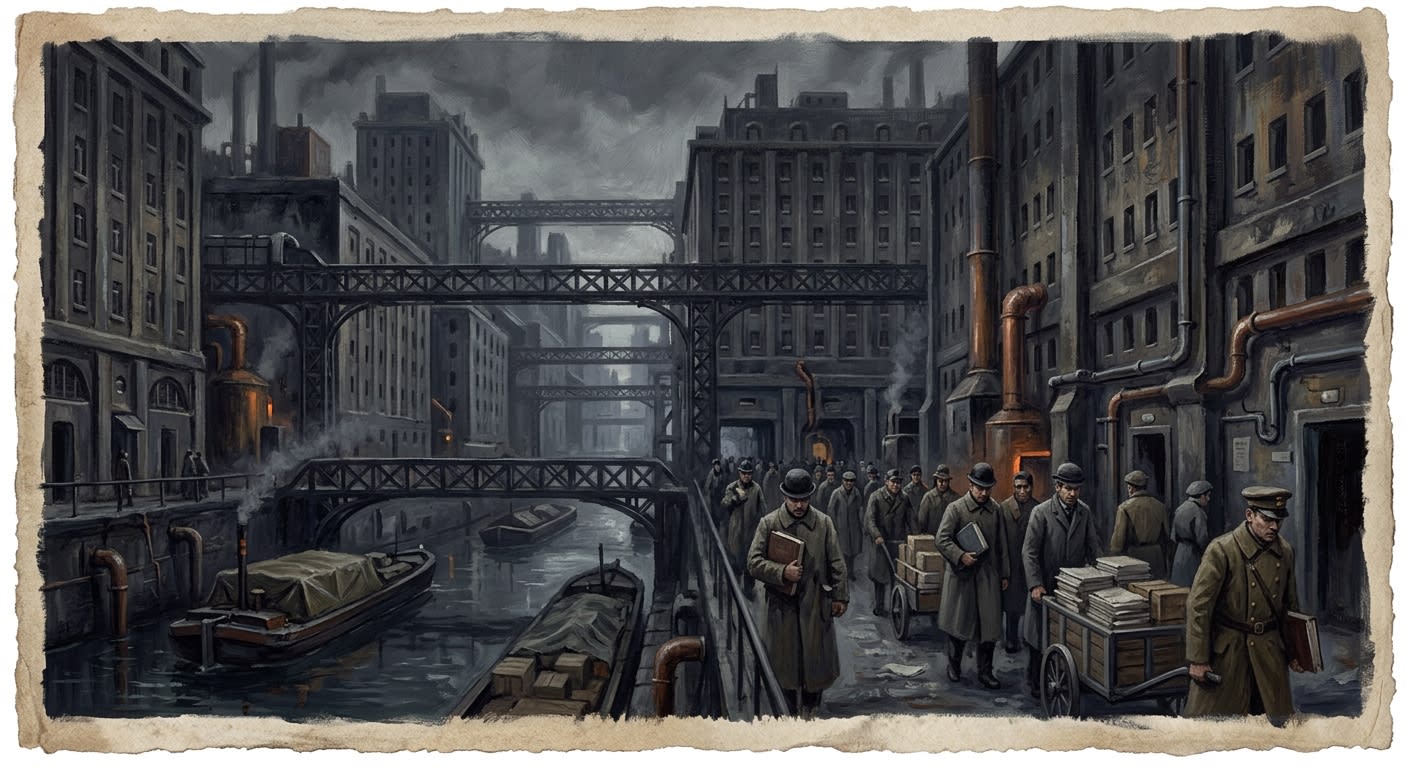
#On the Depot That Learned to Count Teeth
Metz is a western city with an eastern conscience. The maps place it in Zone 1, safe enough for merchants to grow fat and quartermasters to speak in decimals; the files place it nearer the wound, where every ration sack, recruit column, ash vial, and bell-hour ledger seems to arrive already damp with front-line suspicion. It is a supply depot, a cathedral town, a rival to Rheinscarp, and a standing rebuke to any fool who imagines distance from the Sagittal Line as spiritual insulation.
The city grew into its present administrative shape after the Concordat of Strasbourg, when the Synod's western logistics had to be made respectable by force of forms. A.S. 98 is the accepted civic expansion date: the Palatine Warehouses sealed, the ash vaults regularised, the river tolls folded under Records custody, and the first standing garrison chapel licensed to bless convoys before they became someone else's problem. From Metz, wagons move east, south, and inward; bread becomes ammunition, bodies become replacement strength, confessions become clearance slips.
#On the Warehouses and the Double Ledger
Metz lives by duplicate books. One ledger records what entered: grain, salt, rifles, cot frames, relic-dust, penitential wax, boots for men already dead by the time the boots arrive. The second records what should have entered if Providence, road conditions, inspectors, thieves, mould, clerks, and officers had behaved. The gap between the two is called variance when small, theft when vulgar, miracle when useful, and treason when someone politically convenient needs hanging.
The ash vaults beneath the old western counting house hold cremains pledged under dust futures, recovered battlefield particulate, unsorted relic powder, and several drawers marked DO NOT CONSOLIDATE, which is the sort of instruction that exists because someone once consolidated. Metz merchants understand ash as collateral. A grandmother's future cremains may secure winter bread. A soldier's battlefield dust may settle a tithe arrear. A saint's suspected knuckle, powdered accidentally with mule bone, may become a doctrinal hearing before lunch.
The Double-Ledger scandal began as a probate dispute between salvage companies and became a local grammar. Two notarised ledgers claimed the same recovered relic particulate. Records validated both, allowing the contradiction to stand because the bloodshed produced by the dispute was judged an acceptable tithe to sanctity. Since then, "Metz accounting" has meant any arrangement in which two mutually hostile truths are filed in parallel until one produces revenue.
Older quartermaster manuals describe the Double-Ledger precedent as a local commercial irregularity.
Corrected. It is a civic doctrine with invoices attached. Calling it irregularity insults the skill with which Metz made contradiction profitable.
#On the Black Census
The name Metz darkened permanently in A.S. 144, when a post-battle anatomical census at the eastern Metz position traced four hundred and eleven captured Thralls to one dead Ash-Mother. The finding forced Medicine and Records to recognise Classification 7-F: Reproductive Infrastructure, Hostile. Before that day, Ash-Mother had been trench slang, chaplain mutter, soldier nightmare. After Metz, it became a filed category, which is how horror enters polite rooms without dripping on the carpet.
The captured regiment shared dental notches, jaw angles, sigil burns, left-eye ash clouding, and a flinch under bell pressure identical enough to trouble even War, which prefers its troubles visible from a distance. Sorcery-genealogical examination folded the whole regiment inward toward one maternal source. Her remains had been mixed into the mortar of the enemy bastion. The wall contained her ash and depended upon her.
MEDICINE ANNEX — METZ EASTERN POSITION, A.S. 144 Wall sample: calcium, lactate salts, marrow residue, obedience signature persistent. Acoustic event during demolition: female counting voice, eleven breaths. Unauthorised sleeve transcriptions confiscated. Sequence later found scratched into mess table by Sergeant ███████. Disposition: table burned; sergeant reassigned; numbers retained under Seal Cinder.
When the demolition hammers struck, the mortar screamed and milk ran down the stones. I dislike the sentence. It remains accurate. Public abstracts called the event structural stress vocalisation. Private appendices used fewer words and required more locks.
Metz citizens absorbed the news as citizens do: badly, practically, and with household rituals. Fathers checked children's teeth by candlelight. Midwives ironed sheets twice before Root inspections. Recruit sergeants inspected mouths before boots. Bakers stamped loaves with little jaw marks until Purity prohibited the practice and bought the moulds for evidence.
#On Tongues, Bridges, and Civic Silence
Metz also holds a licensed variant of the Procession of Tongues, derived through Ephrath authority and adapted by local Purity officers who looked at Prague's oak tablets and Lyon's exhausted chanting and decided, with Lorrainer economy, to make the city do both less and fear more. The Metz rite is called the Toll of Held Speech (Unregistered). Condemned petty heretics, false stampers, ration queue agitators, and citizens whose public speech has exceeded their station are marched across the Bridge of the Silent Toll with black linen between their teeth and doctrine tablets strapped flat against the chest.
No nail. Metz likes its punishments reusable.
The bridge itself accepts no coin, no whispered prayer, no bargaining. Travellers cross mute. Children are carried with hands over their mouths. Bells are muffled. Hooves are wrapped. Once, local story insists, a child cried halfway across and the span collapsed into the river. Engineering blamed masonry. Festivals blamed unauthorised fear. Purity rebuilt the bridge and kept the silence rule, which tells you which explanation held power.
The procession ends at the east toll-stone, where the tablets are read aloud by a Purity clerk while the condemned remain gagged. Witnesses hear the crime without hearing the criminal. It is efficient, chilly, and utterly Metz.
Touring sermons have claimed the Metz Procession is a gentler form of Purity instruction.
Withdrawn. A knife wrapped in linen is still a knife. Gentleness is a word cities use when they want visitors to keep spending.
#On Present Usefulness
Metz in A.S. 201 is indispensable, which is the most dangerous civic condition short of open revolt. War needs its depots. Records needs its ledgers. Medicine needs its inspection annex. Purity needs its procession licence and its old Valtrix stories. Tithes needs its dust futures. Bells needs its silent bridge schedules. Every Bureau has a hand on Metz, and Metz, being clever, has learned to sell each hand a different glove.
Convoys leave before dawn with flour, hymn-steel fittings, field bandages, nailed crate-seals, and men who were boys yesterday and will be statistics by next month if the Line is hungry. The warehouse bells mark departures. The ash vault clerks balance death against winter credit. The bridge takes silence. The markets gossip anyway, because no city has ever become loyal enough to stop wanting news.
Metz survives by counting what other cities prefer to bless: mouths, ashes, ration slips, condemned words, maternal defects, ledger gaps, bridge-breaths. It is pious in the manner of a locked strongbox. It opens only when the correct seal is pressed, and even then something inside clicks before you see the contents.