
#On the Fraction That Learned to March
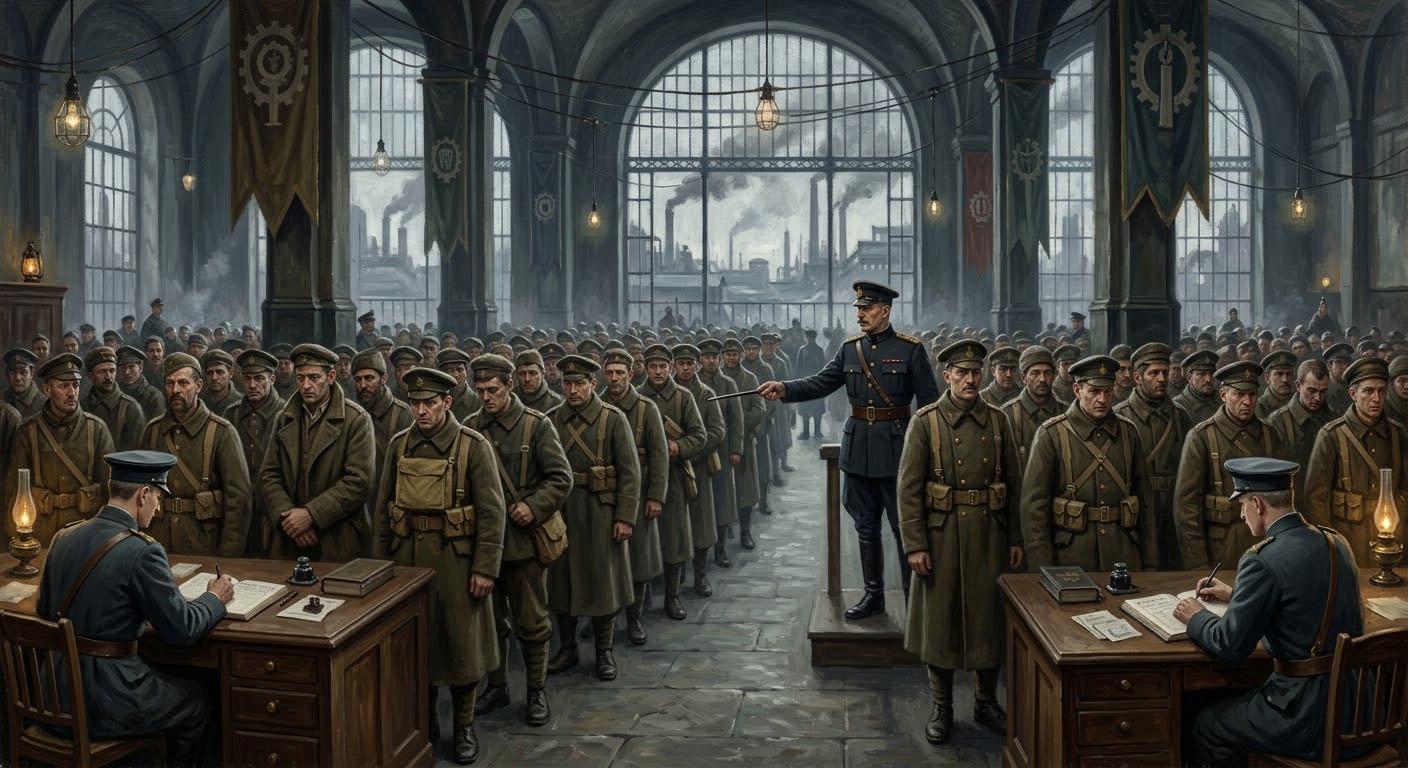
The Continental Levy is the Synod's arithmetic of obedience: one son in ten, assessed by household, corrected by province, sanctified by Doctrine, received by War, processed by the Bureau of Conscription, and carried east until the Sagittal Line has eaten its fill. It began as a decree. It remains as weather. A family may curse rain and still bring in the washing; a province may curse the Levy and still produce its sons.
The first decree belongs to A.S. 110, after the Brașov Crisis made fear administratively useful. Gluttony consumed Brașov proper. Velkara's host used drowned Ash-Fodder as river architecture. Wrath burned the Thracian passes (Unregistered) with fire that had misplaced its fuel and found no need of it. The old feudal levies answered with local banners, local loyalties, local courage, and local extinction. Strasbourg saw the teeth in the bone-case and discovered a continent inside the decimal point.
The approved formula was clean enough for pulpits: one in ten. The First Continental Levy demanded a tenth of every household's sons between the Baltic and the Tagus, under joint seal of War and Doctrine. The Bureau of Records supplied names. Purity supplied consequences. War supplied officers with clipboards, boots, and the grave moral vanity of men who believe their ledgers smell better than fear.
#On the First Decree and Its Convenient Emergency
Every permanent cruelty begins as a temporary necessity wearing wet boots. The First Levy was announced as emergency response. The Synod faced a Balkan collapse, shattered border forces, refugee columns moving west with no maps worth the blood on them, and a populace still naïve enough to think a seal bearing two Bureaus was a request. The decree arrived with sixty days for compliance where roads permitted sixty days, forty where roads permitted forty, and twenty in Seville, whose citizens wept quickly and efficiently.
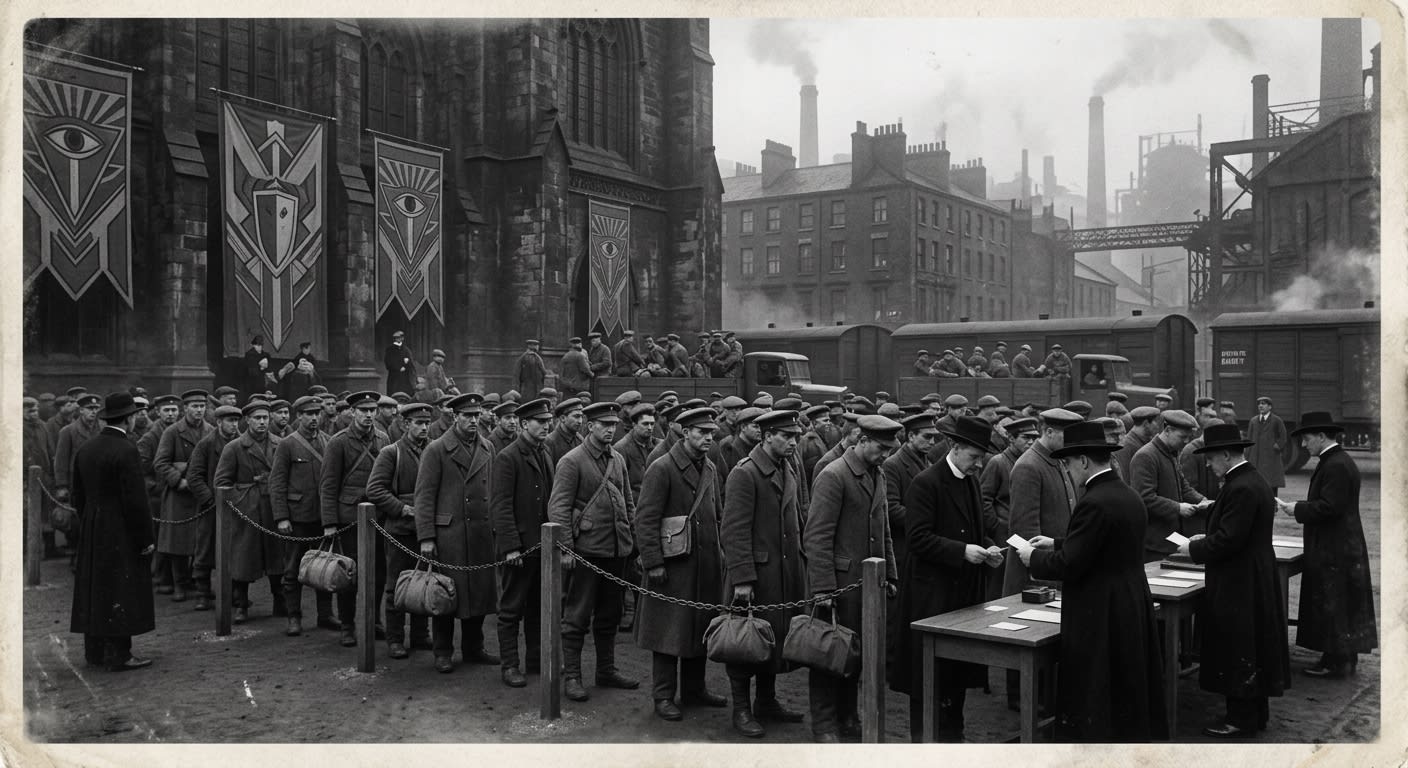
Protests followed. Lyon pulled cobblestones. Bruges killed three Assessors from the wrong Bureau, a mistake understandable to anyone who has ever seen grey cloth approach a doorway. Cologne produced forty-seven legal objections and lost a guild-master to the Index Damnatus by the following Tuesday. Paris muttered behind shutters. Milan asked questions with the sort of regional pride that later becomes ash in a correctional folio.
Refusal was classified as apostasy because apostasy travels better than treason. Treason belongs to princes, flags, and men with speeches. Apostasy belongs to grandmothers, millers, schoolboys, widows, parishes, and anyone else whose resistance must be made contagious only in punishment. A family that refused the Levy did more than withhold labour. It denied the Synod's ownership of the future. Such denial requires correction with descendants attached.
Early provincial catechisms described the Levy as a voluntary continental offering.
Clarified. The Levy is voluntary in the same manner breath is voluntary under water: a soul may refuse for a moment, and then the world corrects him. Families present sons freely because the alternative has been defined as heresy, excommunication, ration loss, and generational stain. Freedom, properly bounded, is efficient.
#On Household Arithmetic
The household is the Levy's preferred battlefield. The Synod does not count affection; affection cheats. It counts males, ages, birth-rolls, confession marks, dental condition, labour value, prior exemptions, and the little discrepancies by which families attempt to make love illegible. Every household with two or more eligible sons enters the calculation. One boy in ten is the public number. One in eight appears in provinces classified as spiritually surplus. Other fractions exist behind seals so black the wax seems to have learned shame.
The oldest form took sons between fourteen and thirty-five. The Nursery Levy Decrees later taught the state to look into cradles with better manners and worse intent. Infant registration compressed. Midwives became informants by paperwork. Stillbirths acquired political significance. A hidden child became a stolen soldier in advance, a desertion committed before the deserter could stand.
Assessment begins before the boy understands assessment. The Great Ledger of Souls receives the baptismal entry. The parish roll receives the household. The Book of Promise assigns future utility. Records watches for missing names. Conscription watches for excess brothers. Tithes watches for the coin that remains after flesh has been collected. Mercy prints pamphlets explaining why tears are devotional. Purity watches the pamphlet reader for insufficient gratitude.
A family learns the grammar early. Do not miscount sons aloud. Do not joke about nephews. Do not say the baby is delicate unless the Mercy examiner can be bribed, persuaded, seduced, or bored beyond professional endurance. Do not let the boy learn roads before he learns catechism. Do not let him sing off-tempo. The Line hears rhythm through the Bureaus. So does the scaffold.
#On the Mustering Field
The mustering field is where a private grief becomes public property. Fathers stand at the rail. Mothers stand until second bell if local regulation permits mercy in measured doses. Boys are brought forward by parish, then height, then name, then correction number. A Levy Assessor stamps the wrist with the Triune Knot in ink that clings for nine days. The nine days matter. A boy who runs carries his accusation on his own skin.
The first musters were agricultural things: pasture, table, clerk, guard, bell. By A.S. 112 the chaos had embarrassed even Strasbourg, which tolerates embarrassment only when it can invoice the victim. The Bureau of Conscription was constituted to resolve what the First Levy had exposed: compulsory offering requires a priesthood of forms. Seventeen regional offices followed. Four hundred provincial depots followed. Eleven thousand clerks followed, like flies to a wound with excellent prospects.
At the field, boys become material in transit. War may later call them soldiers; Conscription is less romantic. They are weighed, measured, inspected, confessed, sorted, and assigned. Dental health matters because cartridge paper must be torn by teeth. Height matters because rifles, shovels, guns, and stretchers all prefer particular bodies. Piety matters because a coward with correct piety can be made useful, while a brave heretic merely improves the enemy's morale by dying loudly.
LEVY SEVENTH RENEWAL ANNEX, A.S. 185 Affected provinces: ████████████ Public rate retained: one in ten Operational rate under Martial Edict ████: ████████████ Household appeals processed: █████ Household appeals granted: █ Instruction: publish mercy language in all districts where quota pressure exceeds burial capacity.
#On Mud, Barracks, and the Conversion of Boys into Line-Matter
The raw levies move from mustering fields to catechism-barracks at Metz, Stuttgart, Lyon, Essen-of-Hymnsteel, Brast, and whatever temporary camp War has lately dignified with a chapel and a latrine trench. Training once promised six months. The Sin-Generals declined to respect the schedule. Nine weeks became sufficient by redefinition, which is the cheapest form of miracle.
The Baptism of Mud gives the transition its sacramental costume. The recruit is marched into a flooded trench, held chest-deep while a Tribune-Chaplain reads the Litany of First Earth, and raised shivering into his new legal condition. The mud remains three days. It dries into a grey crust. War calls it sacrament. Conscription calls it completion of transfer step. The boy calls it cold, if he has retained any rustic honesty.
Drilling makes the body answer before the mind can object. Heel-strike. Rifle angle. Hymn cadence. Bowl silence. Latrine order. Bayonet catechism. Boys from Aquitaine, Dalmatia, Burgundy, the Rhineland, Bavaria, and the forward corridors are broken out of local habits and pressed into Synodal tempo. The Bureau loves tempo because tempo survives terror longer than conviction. A terrified man may forget doctrine. His feet remember the drum.
The Levy made possible the standing army that feudal Europe failed to imagine because feudal Europe loved names too much. Lord's men. Duke's men. Parish men. Mountain men. The Synod improved them into numbered men, stamped men, trench men, men whose letters home arrive already corrected for morale. Strasbourg did not abolish belonging. It nationalised it.
#On Renewal, Resistance, and the Lie of Completion
A temporary measure renewed every generation becomes an ancestor. The Levy's renewals are called Continuations of the Original Grace by War, quota updates by Conscription, demographic wounds by mothers, and stable manpower environment by clerks who should be assigned to instructional terrain until their adjectives improve. The Third Renewal (Unregistered) produced a sealed provincial incident. The Seventh Renewal (Unregistered) in A.S. 185 altered more than public language admits. The current year, A.S. 201, finds the instrument alive, polished, hungry, and better staffed than many hospitals.
Resistance has become professional. Pale Kin Runners move children through false stillbirths, swapped names, forged baptismal slips, borrowed cousins, night carts, ash-cellars, and midwives whose courage exceeds their actuarial sense. Some families maim sons to spoil classification. Some teach them to stammer. Some send them into monasteries with sudden vocations so transparent even Mercy laughs. Some present the least loved boy and keep the clever one hidden. Love has ranks. The Bureau knows.
A Mercy pamphlet states that no household loses more than it can spiritually bear.
Withdrawn from current circulation. Households have borne more than the pamphlet can grammatically survive. The approved replacement reads: “No household is assessed beyond the requirements of Providence as interpreted by competent authority.” Longer, uglier, safer.
The Synod answers resistance by widening the definition of concealment. A false cough becomes evasion. A delayed birth notice becomes active heresy. A missing cousin becomes conspiracy. A village with too many lame boys receives a Mercy audit, then a Purity escort, then a Records correction that improves the lameness statistics by removing several households from the denominator.
#On the Present Use of the Tithe of Flesh
As of A.S. 201, the Continental Levy feeds every bastion, trench town, rail corridor, reliquary flotilla, artillery battery, mud chapel, and disciplinary posting that War can name without blushing. Brest receives boys who learn that bridges can judge. Shipka receives boys who must rotate before sleep becomes citizenship. Przemyśl receives boys trained to avert their gaze from Pride's beautiful horrors. Irongate receives boys who hear gaskets sing in their teeth. Constantinople receives boys and returns walls, bones, smoke, sometimes letters.
The Levy's genius is continuity. Coin runs thin. Grain rots. Saints' bones require authentication. Boys continue to be born with scandalous regularity, despite Bureau incompetence, parental despair, famine, plague, demon-fog, and the ordinary human refusal to let the state have the last word in bed. The Synod made that refusal taxable. Then it made it march.
The Warden-General signs allocations beneath the Empty Throne. Conscription moves the bodies. Records perfects the absence they leave behind. Mercy teaches the remaining family how to grieve correctly. Purity watches for improper grief. Doctrine explains that the household has been honoured.