
#On the Roll That Should Not Exist
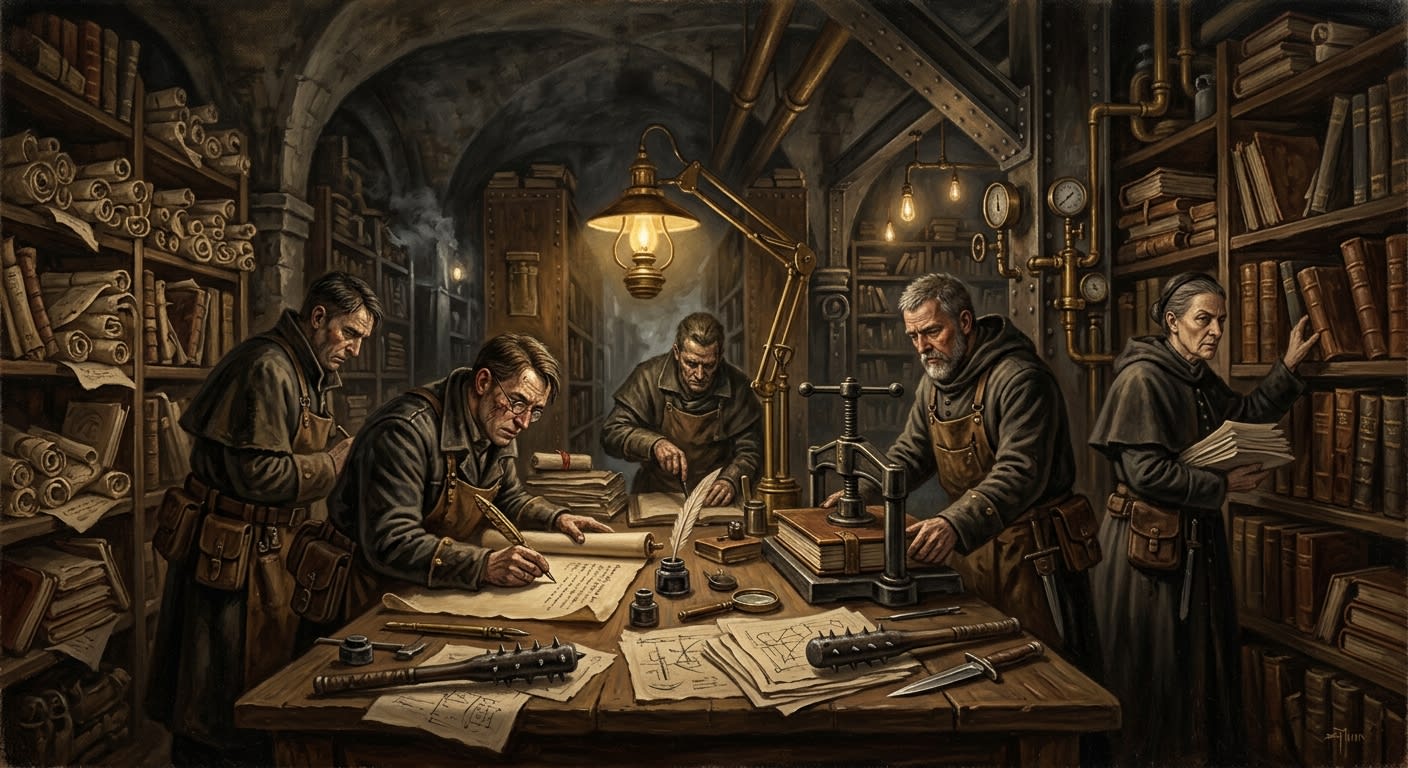
The Shadow Archivists are the alleged third faction of the Records Scribe profession: Scribes who keep unsanctioned copies of the master rolls in locations the Bureau of Records has not found, cannot name, and insists, with the clammy vigour of a guilty deacon, do not exist. Their supposed work is duplication. Their supposed crime is memory. Their supposed motive depends upon whom one asks and how recently that person has been searched.
Some call them preservers. Some call them blackmailers. Records calls them “an unsubstantiated anxiety among junior staff.” Purity has investigated them four times and concluded four times that no such group exists. Each investigation file has since been reclassified, which is the Bureau’s preferred method of hanging a bell around silence and calling it prudence.
#On Their Alleged Origin
The official Roll began as necessity in A.S. 78, when Veyrault gave the Synod a memory with teeth. Birth, marriage, confession, tithe, levy, death: six columns to hold a soul in place. Later came the seventh column, unlabelled and emptied quarterly by Purity. Later came famine rolls, siege revisions, duplicate purges, night corrections, and those splendid administrative miracles by which a citizen may stop existing between supper and Matins while every office involved remains innocent.
The Shadow Archivists, if the rumours have bones, began when some Scribe looked upon a corrected roll and understood that truth had become a visitor. A line vanished. A household shrank. A death date moved. A child’s name became a blank so neat that even grief had nowhere to kneel. The Scribe copied the old page before surrendering the new one. Then another Scribe did the same. Then the copies required hiding places.
A prior cautionary lecture attributed the first shadow copy to “foreign rationalist subversion.”
Corrected for internal use: the first shadow copy, if it existed, was almost certainly made by a Records hand, with Records ink, in a Records room, under a Records lamp. Treason prefers familiar furniture.
Saint Verran is invoked here with improper tenderness. Purists love his clean line. Pragmatists love that his line worked. Shadow Archivists, in their private theology, love the ten thousand removed names. A miracle that erases ten thousand people teaches devout men to keep a second book.
#On the Hiding Places
Records imagines a hidden archive as a rival vault: black door, stolen seal, shelves arranged with theatrical malice. This is how officials imagine crime because officials think architecture is destiny. A useful shadow roll lives meaner lives. It may be pasted inside the backing of an icon. It may be written in split-ink beneath parish hymnals. It may sit in a cooper’s tally book, disguised as barrel weights. It may be sewn into funeral shrouds stored above an ossuary chapel where no Audit Liaison wishes to breathe.
The surviving rumours favour three methods. The first is the palimpsest copy: old devotional texts scraped and overwritten with registry data in faint hand, readable only under warmed blue wax. The second is the distributed roll: each keeper holds one parish, one quarter, one family chain, never enough to condemn the whole obedience if seized. The third is the death-cache: names placed among burial clearances, because even Purity tires when the dead begin to outnumber the forms.
No one has established the number of hiding places. A popular tavern count says seventeen. Records denies the count with such force that seventeen has become a liturgical joke among Scribes who still possess a death wish.
#On Preservation and Power
The generous account says the Shadow Archivists preserve what Records erases. In this account, they are monks of forbidden accuracy, keeping old rolls against famine revisions, noble purchases, Purity disappearances, and the Erasure Notary’s beautiful annihilations. A mother whose child became a ghost might one day find proof. A dead soldier might be restored to his pension roll. A lineage cut for convenience might be made dangerous again.
The ungenerous account says a hidden roll is a knife with alphabetical tabs. The man who knows the old version of a record can sell truth to the injured, sell silence to the guilty, and sell both to Citation Advocates when court season opens. A Shadow Archivist with three old death rolls and a calm face can make a noble household sweat through velvet. Preservation is a clean word. Power has better boots.
Both accounts are true often enough to ruin the tidy mind. The Shadow Archivist preserves the erased child and also prices the restored proof. He saves the record and also owns the saved thing. In the Synod, even virtue acquires filing fees.
EXTRACT — FOURTH PURITY INQUIRY INTO UNSANCTIONED REGISTRY DUPLICATION Question: Did you copy the removed household line? Answer: I copied what was present before absence was authorised. Question: Where is the copy? Answer: ███████████████████ Question: Who else holds pages? Answer: the dead, if they are still honest. Disposition: █████████████████████████
#On Their Enemies
The Purists fear Shadow Archivists as rival priests. A Purist can tolerate corruption more easily than unauthorised scripture. The Pragmatists hate them as creditors hate mirrors. Every profitable correction becomes a hostage if an earlier page survives elsewhere. Purity hates them because Purity’s clean removals depend upon the world accepting that a blank was always blank. Records hates them because they are Records without permission.
Their friends are harder to name. A Confessor-Booth Clerk whose parish list has been amended too often may pass word toward them. A widow may bring coin wrapped in candle paper. A disgraced Scribe may trade access for shelter. A Doubt Auditor may buy an old roll and then denounce the hand that sold it. Friendship is an unsafe category. Use “temporary alignment” and keep your gloves on.
Several prosecutions have described Shadow Archivists as “anti-Synodal preservationists.”
This phrase is withdrawn. The Bureau cannot prosecute an organisation it has declared nonexistent. Individual offenders may be punished for duplication, theft, seal misuse, corrupted devotion, or excessive curiosity.
#On Their Present Nonexistence
As of A.S. 201, the Shadow Archivists remain officially absent. No membership roll has been produced. No central vault has been found. No confession has survived long enough to inconvenience the published conclusion. Records continues to deny them. Purity continues to investigate what it denies. Scribes continue to avoid certain jokes near certain shelves.
This is the proper condition for a shadow archive. Discovery would make it a target. Recognition would make it a faction. Myth makes it portable. Every corrected page points toward an earlier page. Every erased name suggests a second mouth. Every blank space in the Roll grows, under the right lamp, faintly ruled.