
The Confessor-Booth Clerk
"The booth hears; the Synod decides." — Standard intake inscription, all registered confession booths
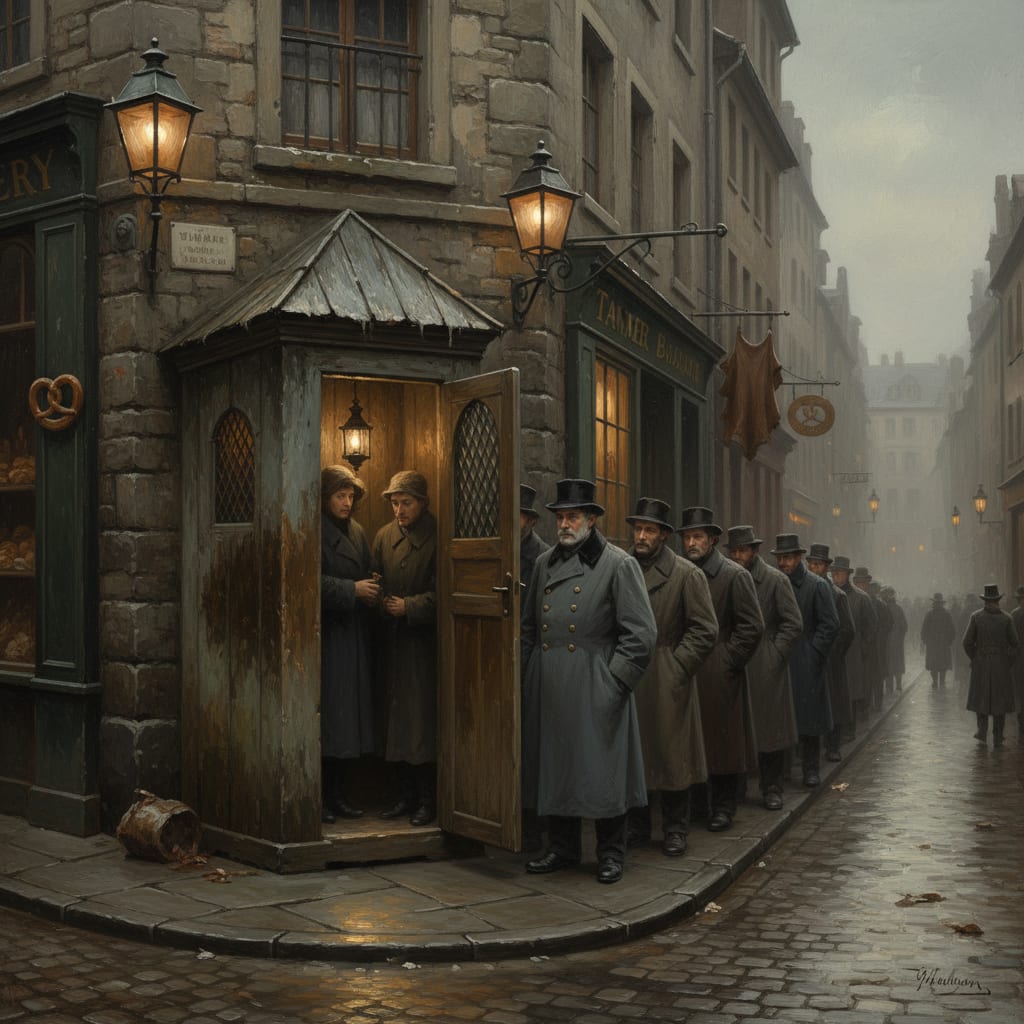
There is a wooden box on every third block in Strasbourg. It squats between the bakery and the tanner's like a blister on the street's face — unpainted, brine-scrubbed, always damp inside, smelling of cheap incense and cheaper fear. A shutter in the front. A grille behind the shutter. Behind the grille, a clerk.
The clerk is not a priest.
I wish to make that distinction with the clarity the Bureau of Doctrine so rarely achieves, because it is the hinge upon which the entire apparatus turns. The Confessor-Booth Clerk — Sin-Stamper, Booth-Rat, Paper Priest, Rot-Collector, call the creature what you will — holds no sacramental authority. Cannot absolve. Cannot bless. Cannot, in strict theological terms, forgive a sin any more than a rain gutter can forgive the filth that passes through it. What the clerk can do is stamp. And in the Synod's dominion, the stamp is the sacrament's working cousin: less holy, more efficient, and far more dangerous to lack.
#On the Institution and Its Necessities
"Confession is the city's bath. The booth is where grime becomes wash." — Bureau of Purity Standard Catechism, Section 14
The booth system arose from arithmetic rather than theology.
In the early decades after the Concordat, the Synod's parish structure strained under a population that had been taught to confess everything — sins of action, sins of thought, sins of omission, sins of appetite, sins of proximity to sin, and the sin of insufficient enthusiasm in the confession of prior sins. The Bureau of Doctrine had spent a generation making confession mandatory. It had not spent the corresponding generation producing enough confessors to hear it all. Priests buckled. Parishes overflowed. In A.S. 104, the Bureau of Rites issued the Confession Reform — a document of such bureaucratic beauty that I keep a copy framed above my desk — which standardised sin categories, introduced the rubric card, and, with a single subordinate clause buried in paragraph forty-seven, authorised "lay intake clerks of sufficient moral neutrality" to perform the mechanical elements of the confession process.
Moral neutrality. That phrase alone should have warned them. What the Reform created was a class of functionaries whose qualification was the absence of the very quality one might expect in a person who hears other people's sins: empathy. The Bureau did not want empathetic clerks. It wanted fast ones.
By A.S. 112, the Booth Proliferation Decree mandated one confession booth per three city blocks in all Synod territories. By A.S. 130, the first census counted fourteen thousand active booths across the continent. By A.S. 201, the number is estimated — the Bureau of Records uses estimated here because it has lost count, which it has classified as "ongoing enumeration" rather than administrative failure — at twenty-two thousand, including mobile booths on carts, field booths in the forward trenches, shipboard booths on the Reliquary Flotilla, and the two hundred and fourteen double-rowed Confessional Lanes that line the internal corridors of Bastion-Brest, where confession is a crossing toll, not piety.
#On the Process, and What It Does to Both Parties
"Speak plain. Pay plain." — Standard neutral intake line
The process is mechanical. That is the point.
A citizen approaches the booth. The citizen queues. The queue is doctrine — the Bureau of Rites has issued four separate memoranda affirming that the physical act of waiting constitutes a preparatory penance, and the Bureau of Tithes has issued a fifth affirming that the waiting period may be billed. The citizen reaches the shutter. The clerk opens the grille. The citizen speaks. The clerk selects a sin category from the rubric card — minor, moderate, contagious, or escalatory — collects the fee in coin, salt, or ration chit, assigns a penance (attendance quota, recitation count, or labour slip), and stamps the receipt.
The receipt proves you have been processed. Without it, you cannot secure ration clearance, transit permits, medical treatment at a Mercy Ward, or the weekly absolution token the Bureau of Doctrine issues to the compliant. Lack of a current stamp is doctrinally not a sin — the Bureau of Rites has been clear on this — but in practical terms it is indistinguishable from one, since every subsequent bureaucratic interaction will ask for it, and every subsequent bureaucratic functionary will note its absence with the kind of expression that suggests your file has just acquired an annotation you will never be permitted to read.
The clerk does not judge. The clerk does not advise. The clerk offers no comfort, insight, or moral guidance, because the Mercy Rationing Reform of A.S. 134 restricted mercy stamps to licensed confessors, and the clerk is not licensed, and the distinction between "processing" and "forgiving" is the single bright line upon which the Bureau of Doctrine insists the entire system depends. The clerk categorises. The clerk stamps. The clerk moves to the next penitent. The booth does not forgive; it files.
#On the Clerk, and What the Booth Does to Its Occupant
"Never listen twice." — Booth proverb
The hierarchy is vertical and grim: Receipt Runner at the bottom, sweeping booths and counting blank receipt folios; Booth Clerk in the middle, stamping and categorising through eight-hour shifts that feel like geological epochs; Night Clerk in the dark hours, when the confessions acquire a different quality — strategic, transactional, occasionally delivered by individuals whose interest in spiritual cleanliness is secondary to their interest in laundering guilt into paperwork; Booth Supervisor above, responsible for throughput, brine compliance, and the quarterly audit that keeps every clerk in the district awake for the preceding week; and District Confession Registrar at the summit, a political creature who has long since stopped hearing individual sins and hears instead statistics, trends, and the particular pitch of a district whose drift metrics suggest it is about to produce either a riot or a heresy.
The work costs.
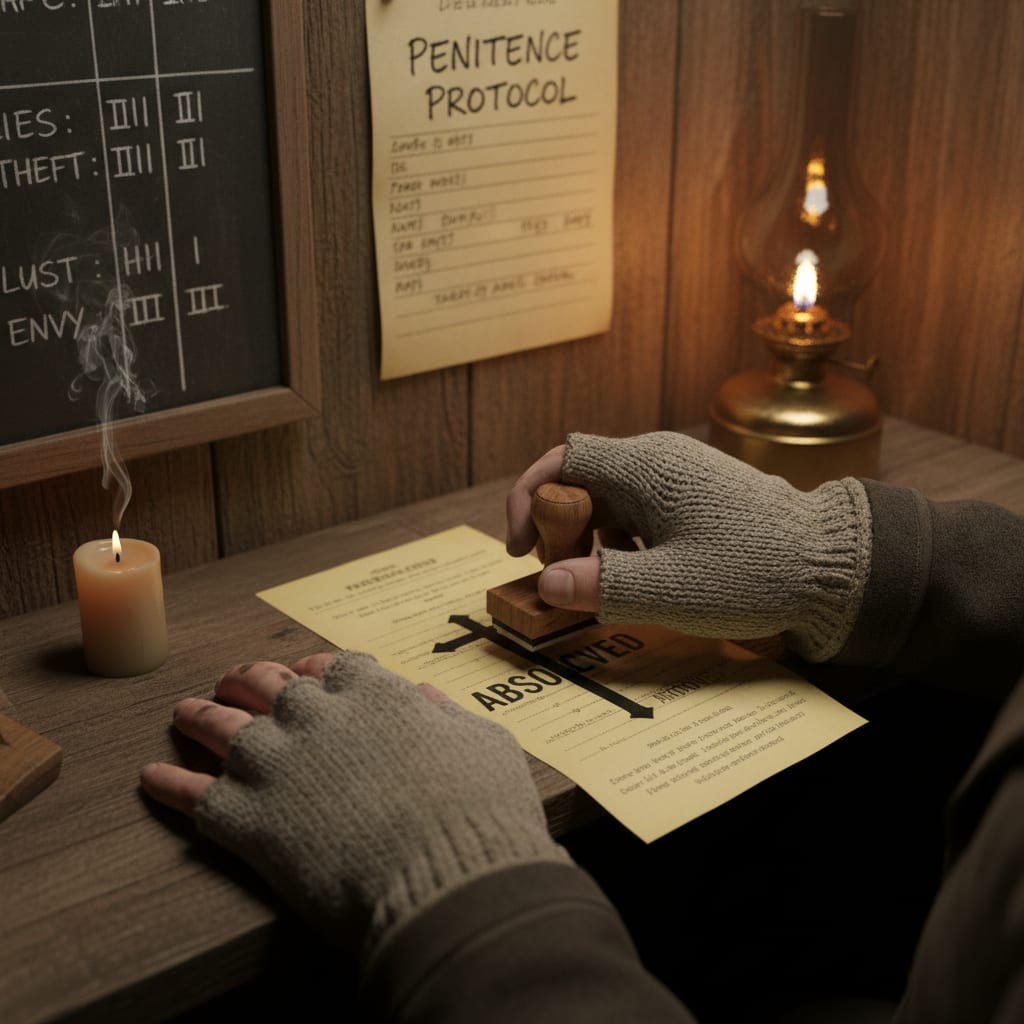
The body is simple enough: ink-stained thumbs, brine-cracked knuckles from the morning scrub, wax burns from sealing receipts, the permanent hunch of a person who has spent years bent toward a grille. The fingerless gloves most clerks wear — ostensibly for stamping speed — double as armour against the splinters the brine-swollen wood throws at regular intervals, and the face veil some adopt is less religious modesty than operational necessity, since a clerk recognised in the street by voice or posture becomes a target for every grudge the booth has processed.
The mind is more expensive. The profession calls it booth contamination — the slow accretion of other people's sins into the clerk's own interior, the way a wall absorbs smoke. After a year, a clerk stops hearing confessions as stories and hears them as categories. After three years, the categories replace the stories entirely, and the clerk begins to categorise everything — meals, conversations, weather, the behaviour of dogs — according to the rubric. After five years, if the clerk has not transferred, promoted, or died, the categories become the clerk's native language, and the clerk begins to stamp motions in the air when there is no stamp and no penitent and no booth, because the body has learned a liturgy the mind cannot unlearn.
The veterans call this becoming dry-handed, after their patron — Blessed Clerk Harlowe "Dry-Ink," who is mythologised as the clerk who kept a district clean by refusing mercy stamps during a drift wave. Whether Harlowe existed is a question the Bureau of Records has classified as "devotionally sufficient," which is Records' way of saying the answer does not matter because the story does.
#On Cadence, Echo, and the Thing Behind the Grille
"If cadence feels wrong, close the shutter." — Booth Standard Practice, Rule 7
There is a protocol for when the voice on the other side of the grille sounds wrong.
The protocol exists because of the Echo Scares — a series of incidents, first documented in the northern bastions in the A.S. 180s and reaching their most spectacular expression in Bastion-Brest's Confession Echo of A.S. 199, in which the voices heard through confession grilles were not the voices of the penitents speaking them. At Brest, sins spoken into the booths began coming back hours or days later as whispered repetitions on the bridge deck, audible to passing soldiers, the candle flames bending toward the booths when an Echo was active. At Booth 77, the echoes preceded the confessions — sins repeated before they were spoken. The Bridge Tribunal sealed Booth 77 with planks and posted a guard. The guard requested transfer four times. His requests remain under review.
The Bureau of Doctrine classifies the Confession Echo as a "doctrinal resonance event." The garrison calls it what it is. The booths are talking back.
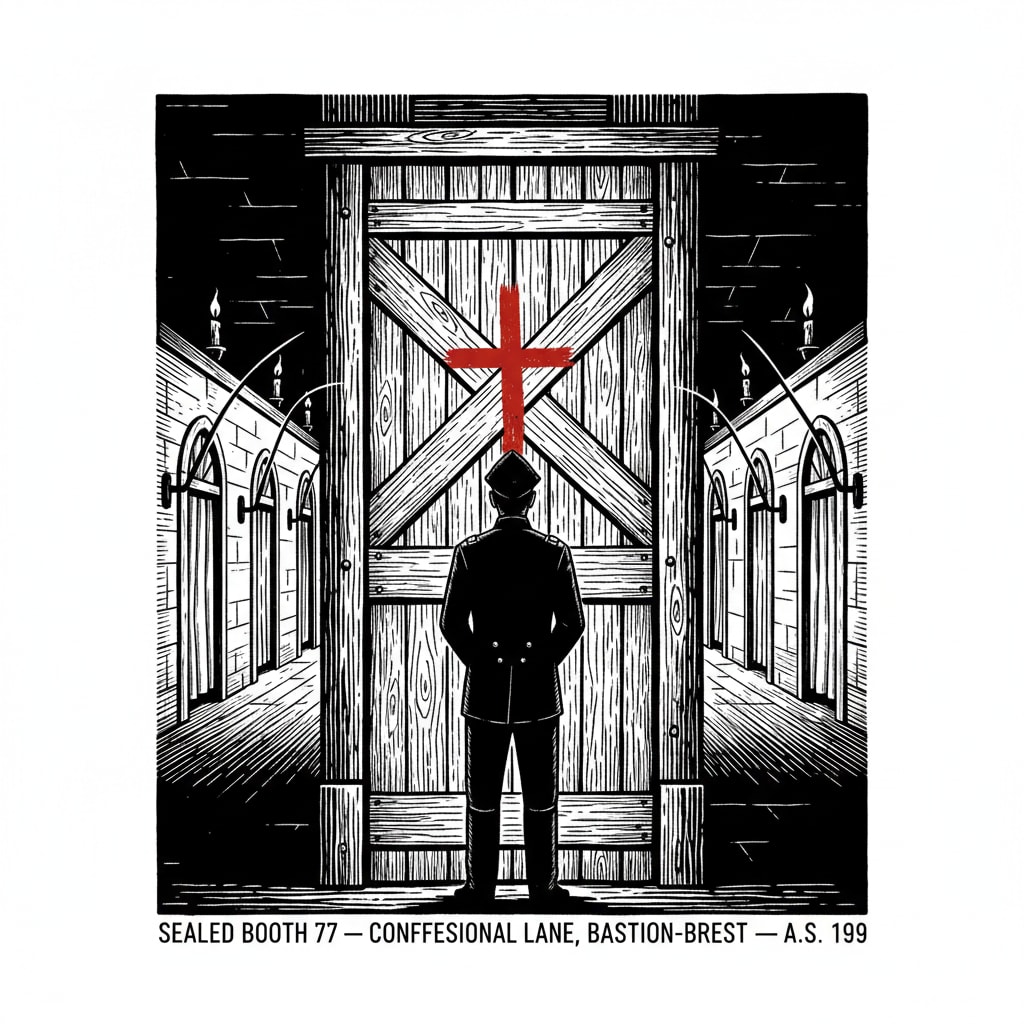
The cadence protocol requires clerks to monitor the rhythm of incoming confessions against a standard wheel of approved phrasings. A genuine penitent stammers, hesitates, breathes at irregular intervals. A compromised voice — whether by demonic mimicry, counter-hymn interference, or the unnamed phenomenon the field chaplains at Brest describe as "booth breath" — maintains an inhuman regularity. Too smooth. Too even. Too calm for the sins being confessed. When the cadence locks, the clerk closes the shutter, marks the booth seal with a red chalk cross, and sends for a Codex Auditor. What the Auditor does with the information depends on the Auditor. What the clerk does is sit in the dark behind a closed shutter and wait for instructions, listening to the silence, which is worse than the voice, because the silence sounds like the booth is thinking.
#On the Economy of the Stamp
"Rot pays in small coins." — Booth proverb
The stamp is currency. This is understood by everyone except the Bureau of Doctrine, which insists that the stamp is "a sacramental receipt of spiritual compliance" and refuses to acknowledge the secondary economy that has accreted around it like barnacles on a hull the Bureau has never bothered to scrape.
A clean stamp — a receipt certifying the bearer's processing in good standing — opens doors. Ration queues. Transit gates. Mercy Ward admissions. Employment registers. Marriage applications, which require both parties to present current stamps and which the Bureau of Oaths will not witness without them. A missing stamp closes the same doors with a firmness that suggests they were never open. A forged stamp, if detected, leads to the Paper Mines of Ulm. An expired stamp leads to the back of the queue, which at peak season stretches around three blocks and, at Bastion-Brest, around fourteen pylons.
The clerk sits at the centre of this economy with a stamp set and a stack of blank receipts, and the blanks are counted. Every morning. Every evening. Every shift change. Counted by the clerk, counted by the supervisor, counted by the district registrar, and counted quarterly by an audit team from the Bureau of Records whose arrival is announced by the particular silence that descends on a booth district when fourteen thousand stamps' worth of minor corruption needs to be concealed in the time it takes an auditor to walk from the carriage to the first booth.
Missing blanks is a capital offence. The Bureau of Doctrine does not call it that — the Bureau calls it "material breach of sacramental custody" — but the punishment is immurement, and immurement is death with extra masonry.
The corruption is universal and universally denied. A merchant needs a clean stamp before the audit. A soldier needs one before leave. A smuggler needs one before the transit gate. The clerk provides, for a fee the booth vocabulary calls "wash money" or "ink oil" or "paper smoothing," depending on the district and the clerk's sense of irony. The fee is small. The fees accumulate. The supervisor takes a cut. The registrar takes a cut of the cut. The Bureau of Tithes, which is aware of the entire arrangement, takes what it calls a "spiritual surcharge on unscheduled sacramental services," which is the Tithes' way of taxing the bribe economy without admitting it exists.
STAMPED ERRATUM — Bureau of Records, A.S. 200. A previous circular described the confession-booth bribe economy as "negligible in scale and doctrinal significance." This assessment has been revised. The revised assessment describes the economy as "structurally integrated, fiscally material, and doctrinally problematic." The revision was filed under Forthcoming Action Required and has been filed there since A.S. 194.
#On the Clerk's Place in the Machine
The Codex Auditor reads the clerk's tallies and hunts for doctrinal drift. The Street-Vicar delivers correction cases and collects names. The Bureau of Mercy requires a confession receipt before it will bind a wound. The Bureau of Records absorbs the confession abstracts into the Great Ledger of Souls, where every doubt whispered through a grille accumulates in files the citizen will never see and the Bureau will never discard. The clerk is a valve in a pipeline that runs from the citizen's mouth to Strasbourg's vaults, and the valve's only function is to open, close, and stamp.
The street depends on the booth. The booth depends on the clerk. The clerk depends on the stamp. And the stamp depends on the blank receipt, which is counted every morning, and if one is missing, someone is going to the Mines.
There is a wooden box on every third block. It is always damp inside. The shutter opens at dawn and closes at curfew, and between those hours, a clerk sits behind a grille and listens to a city confess, one stamp at a time, and the stamp lands with a sound like a small bone breaking, and the clerk does not flinch, because flinching is for the first year, and this is not the first year, and the queue is long, and the blanks are counted, and the booth does not forgive.
The booth files.
Fiat quod scriptum est.