

#On the Profession and Its Necessity
"Doubt is rot; rot spreads." — Bureau of Purity Catechism, Third Revision, A.S. 104
The faithful do not ask questions. I state this as fact, as doctrine, as the settled finding of one hundred and fifty-six years of institutional observation, and I state it knowing full well that the sentence itself invites a question — why? — which is precisely the sort of question that employs the men and women I am about to describe. The Bureau of Purity maintains a branch of operatives whose title, when spoken aloud in garrison towns and factory districts, produces a silence more perfect than any Bellwarden's toll. They are called Codex Auditors, or — in the formal diction of the Bureau of Doctrine — Auditors of Doubt. The street calls them Doubt-Hounds. The street is, for once, accurate.
Their function is this: to detect hesitation before it becomes opinion, and opinion before it becomes faction. They audit belief the way the Bureau of Tithes audits grain — with ledgers, with cross-referenced tallies, with a precision that makes the subject feel weighed, found light, and filed accordingly. Where the Inquisitors of the Flame arrive with fire and spectacle, the Codex Auditor arrives with a clipboard, a standardised rubric, and the unhurried patience of a man who knows he will be believed over you.
The distinction is important. The Synod does not lack instruments of violence; it possesses them in superb abundance. What it lacks — what any institution governing two hundred million souls across eight war zones must lack — is omniscience. The Inquisitor can break a heretic. The Auditor finds the heretic before the heretic knows he is one. The difference is the difference between surgery and vaccination, and the Bureau of Purity, whatever else one might say of its methods, has always preferred prevention to cure. Cure requires paperwork. Prevention requires only fear, and fear is cheap to administer.
#On the Origin of the Office
The Codex Auditors did not spring into existence by decree. They accumulated, like silt in a canal, from the runoff of three institutional crises that the Hierarchy would prefer you did not examine too closely.
The first was the Schism of the Unspoken — a nameless doctrinal drift that spread through the southern garrisons between A.S. 78 and A.S. 83, in which no heretical text was ever found, no heretical preacher ever identified, and yet three regiments quietly ceased taking communion. The phenomenon terrified the Bureau of Doctrine, which had built its entire surveillance apparatus around the detection of words — pamphlets, sermons, graffiti. The Unspoken moved through silence. Through pauses. Through the beat between the bell and the amen, growing a half-second longer each week until the silence itself became a creed.
The second crisis was the Confession Reform of A.S. 104 (Unregistered) — the Bureau of Rites' monumental effort to standardise confession phrasing across all eight zones. The intent was uniformity: a man confessing gluttony in Bastion-Brest should use the same words as a man confessing gluttony in Bastion-Constantinople. The result was something the reformers had not anticipated. Standardised phrasing made deviation measurable. A confessor-booth clerk could now flag a parishioner who substituted "remorse" for "contrition" with the same mechanical certainty that a Tithe Assessor flagged a short bushel. The confessional became an instrument of detection, and the men who read the abstracts became, almost accidentally, intelligence analysts.
The third crisis — the Quiet Purges of A.S. 112, in which the Bureau of Purity removed four hundred and eleven teachers, choirmasters, and street-vicars from the Rhineland without public trial or documented cause — demonstrated that the apparatus existed. The Hierarchy simply named it. The Codex Auditors were constituted as a formal branch of the Bureau of Purity in A.S. 114, under the authority of the High Interrogatrix, with a mandate broader than any Inquisitor's writ: to audit not actions, but belief itself.
#On the Substance of the Work
A Codex Auditor's day begins with brine. This is ritual, a washing of mouth and hands prescribed by the Bureau's operational catechism — the Auditor must approach the day with a "clean tongue," unburdened by the residue of private speech. Whether this is theology or hygiene is a question the Auditor does not ask, because the Auditor does not ask questions. The Auditor measures them.
The raw material of the profession is the confession abstract — a document produced by Confessor-Booth Clerks in every parish, every garrison chapel, every factory prayer-hall across the Synod's territory. The abstract is not a transcript. It is a statistical summary: sin categories tallied by frequency, phrasing deviations noted, emotional tenor assessed on a five-point scale ranging from "sincere contrition" to "performative compliance." The abstracts arrive on the Auditor's desk in bundles, organised by district, and the Auditor reads them the way a physician reads a pulse — watching for irregularity.
A healthy district shows stable patterns. The same sins in the same proportions, confessed in the same approved language, with a compliance rhythm that matches the bell schedule. A sick district drifts. The word "contrition" appears less frequently. The word "remorse" appears more. The three-second pause between the bell and the amen stretches to four, then five. Attendance at the Ninth Bell devotions drops by two per cent, then four. The drift is imperceptible to any individual confessor. The Auditor, reading a hundred abstracts from the same district over a six-week period, sees it as clearly as a cartographer sees a river changing course.
From the abstracts, the Auditor triangulates. Confession data is cross-referenced against Tithe records (a man whose giving declines before his language changes is exhibiting financial doubt, which precedes theological doubt in seventy-three per cent of documented cases), school recitation logs (children who stumble on the Fourth Article are repeating something they heard at home), factory attendance patterns (absenteeism on feast days correlates with doctrinal drift at a rate the Bureau of Records has classified "statistically damning"), and ration-hall congregation reports. The Auditor does not rely on a single ledger. The Auditor reads them all, and the picture that emerges from their intersection is more intimate than any confession.
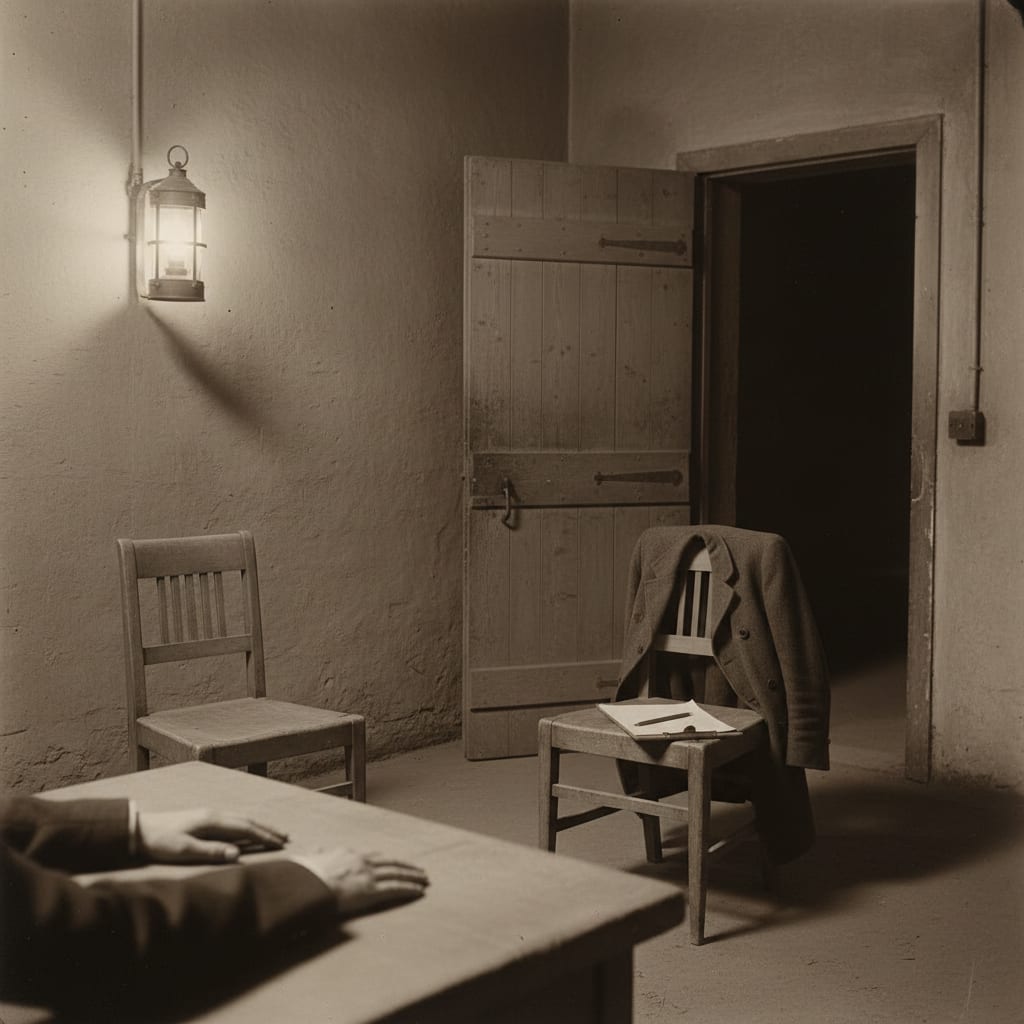
When the numbers warrant it, the Auditor conducts interviews. These are not interrogations — the Bureau is quite specific on this point, and I am required by Standing Order 22-D to note the distinction. An interrogation is conducted by an Inquisitor, under flame-oath, with the authority to compel testimony and administer physical correction. An interview is conducted by an Auditor, in a quiet room with good lighting, with the authority to ask questions and record pauses. The Auditor's interview script begins gently — "Tell me about your week" — and escalates through calibrated pressure points designed to expose the gap between what a subject says and what a subject means. The gap is the variance. The variance is the report.
#On the Hierarchy and Its Instruments
The ladder is steep and the rungs are greased with mutual suspicion. A young operative enters as a Variance Clerk — a transcript runner, essentially, ferrying confession abstracts between parish clerks and the district office. From there, promotion follows a path through Field Auditor (conducting institutional examinations of schools, factories, and chapels), District Codex Auditor (managing a territory's complete variance portfolio), and — for the ambitious or the damned — Confession Pattern Analyst, a specialism so rarefied that the Bureau does not publicly acknowledge its existence.
The Pattern Analysts read confession abstracts not for content but for structure. They map the rhythm of an entire district's spiritual speech — cadence, vocabulary density, emotional distribution — and flag anomalies that no individual Auditor could detect. They are, in essence, cartographers of the collective soul, and their maps are classified at a level that requires the Bureau of Shadows' countersignature to access.
At the apex sits the Synod Registrar of Orthodoxy (Unregistered), a title that has been held by four individuals since the office's constitution and that currently belongs to a woman whose name I am not permitted to print. She reports to the High Interrogatrix. The High Interrogatrix reports to the Hierarch of Purity. The Hierarch of Purity reports to Providence, and Providence, as we are taught, does not accept late filings.
STAMPED ERRATUM — BUREAU OF PURITY, A.S. 199: "The Registrar of Orthodoxy's name has never been classified. The Registrar has simply never introduced herself. These are different administrative conditions."
The Auditor's toolkit is modest and terrible. The rubric — a standardised checklist of approved phrases, devotional timing benchmarks, and emotional-register markers. The phrase wheel — a rotating disc of approved penance language, calibrated to sin category and district norms. The black-book — a private ledger of names, observations, and leverage, maintained by the individual Auditor and subject to no oversight except that of a senior Auditor's black-book, which contains the names of Auditors whose black-books have grown too thick.
And the seal token — a stamped disc of authority that, when presented to any confessor-booth clerk, street-vicar, or Records Scribe, compels the immediate surrender of parish documentation. The token is small enough to fit in a glove. The fear it produces is not.
#On the Profession's Costs
Blessed Marrow-Eye Lestine, the legendary Auditor who condemned an entire choir because their harmony "hesitated," is the profession's patron and its warning. She is celebrated in the Bureau's internal catechism for her incorruptible ear — she could, it is said, hear doubt in a cough, detect heresy in the way a man held his hymnal. She is less celebrated for the manner of her death: alone, in a locked room, having filed a variance report against herself. The report cited "irreconcilable spiritual contamination through prolonged exposure to the subject material." The Bureau sealed the document. I have read it. I wish I had not.
The Auditor's occupational disease is called echo — a condition in which the constant consumption of other people's doubt begins to produce doubt in the consumer. The symptoms are diagnostic: compulsive hand-washing (beyond the ritual brine), counting pauses in ordinary conversation, an inability to answer simple questions without analysing the questioner's intent, insomnia structured around the bell schedule, and — in advanced cases — the conviction that one's own prayers contain variance. The Bureau does not classify echo as a spiritual hazard. The Bureau classifies it as a "performance metric indicating excessive conscientiousness."
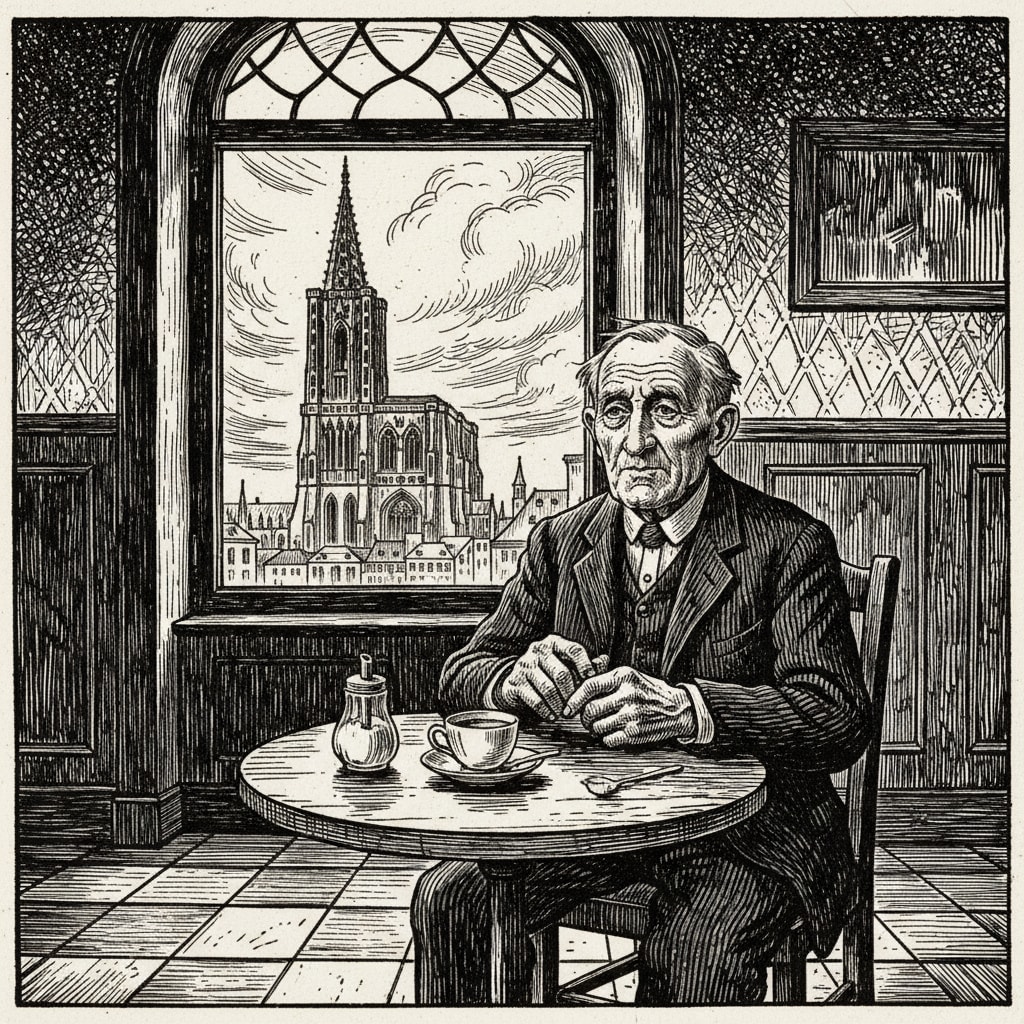
The moral hazards are worse than the spiritual ones. The Auditor manufactures certainty from ambiguity — that is the function. A man whose confession abstract shows a two-per-cent deviation in phrasing is probably grieving, or tired, or poorly educated, or speaking through a rotten tooth. He is almost certainly not a heretic. The Auditor knows this. The quota does not care. The Bureau's quarterly assessment requires a minimum number of "resolved variances" per district, and a district Auditor who returns clean reports is not congratulated for maintaining orthodoxy but investigated for negligence.
The result is predictable, documented, and — in the Bureau's own internal language — "an acceptable operational friction." Auditors fabricate. They phrase-trap, asking scripted questions designed to force a subject into forbidden language. They witness-launder, converting three frightened neighbours into "independent corroboration." They mercy-bargain, offering reduced penance in exchange for a name — any name — that can populate the next quarterly report. The Bureau knows. The Bureau has always known. The Bureau considers the practice a lesser evil than the alternative, which is a population that discovers its Auditors are fallible, which would introduce doubt into the system designed to eliminate doubt, which is — I am assured — theologically untenable.
#On the Present Condition
There are, by the Bureau's most recent assessment, approximately nine hundred active Codex Auditors operating across the Synod's eight zones, with the heaviest concentrations in Zone 2 (the Rhineland heartlands, where the population density makes statistical detection most effective) and Zone 7 (the Constantinople theatre, where the Warrens' forty thousand unregistered souls provide both the greatest challenge and the richest hunting ground). The profession is expanding. It has been expanding since A.S. 178, when the Bureau recognised that the traditional Inquisitorial model — find the heretic, break the heretic, burn the heretic — was losing efficiency against threats that did not announce themselves.
The Syrion front at Bastion-Shipka has produced a particular challenge. Auditors stationed in Zone 5 report a phenomenon they call "echo speech" — variance patterns in confession abstracts that match no known human drift profile. The phrasing deviations are too uniform, too evenly distributed across the population, as though the doubt were being broadcast rather than generated. The Bureau of Doctrine says this is Sloth's influence on morale. The Bureau of Purity says this is a classification question and has dispatched a Pattern Analyst. The Pattern Analyst has not yet reported. The Pattern Analyst was dispatched in A.S. 198.
The profession's greatest accomplishment is invisible — the doubt that was never spoken, the faction that never formed, the schism that died in a variance report before it drew its first breath. Its greatest failure is equally invisible: the innocent lives ground to powder between quota and conviction, the grief classified as heresy, the exhaustion classified as drift, the humanity classified as variance and filed in a black-book that will outlast the name it contains.
I have been asked whether the Codex Auditors serve the faith or merely serve the fear that sustains it. I recognise the question as a phrase-trap. I decline to answer. The Bureau will note my silence, measure its duration, and file the appropriate report.