
#On the Nature of a Bridge
"A bridge that is also a fortress is either a masterwork or a confession of failure. Brest is both." — Drax, marginalia on the Northern Theater Survey, A.S. 199
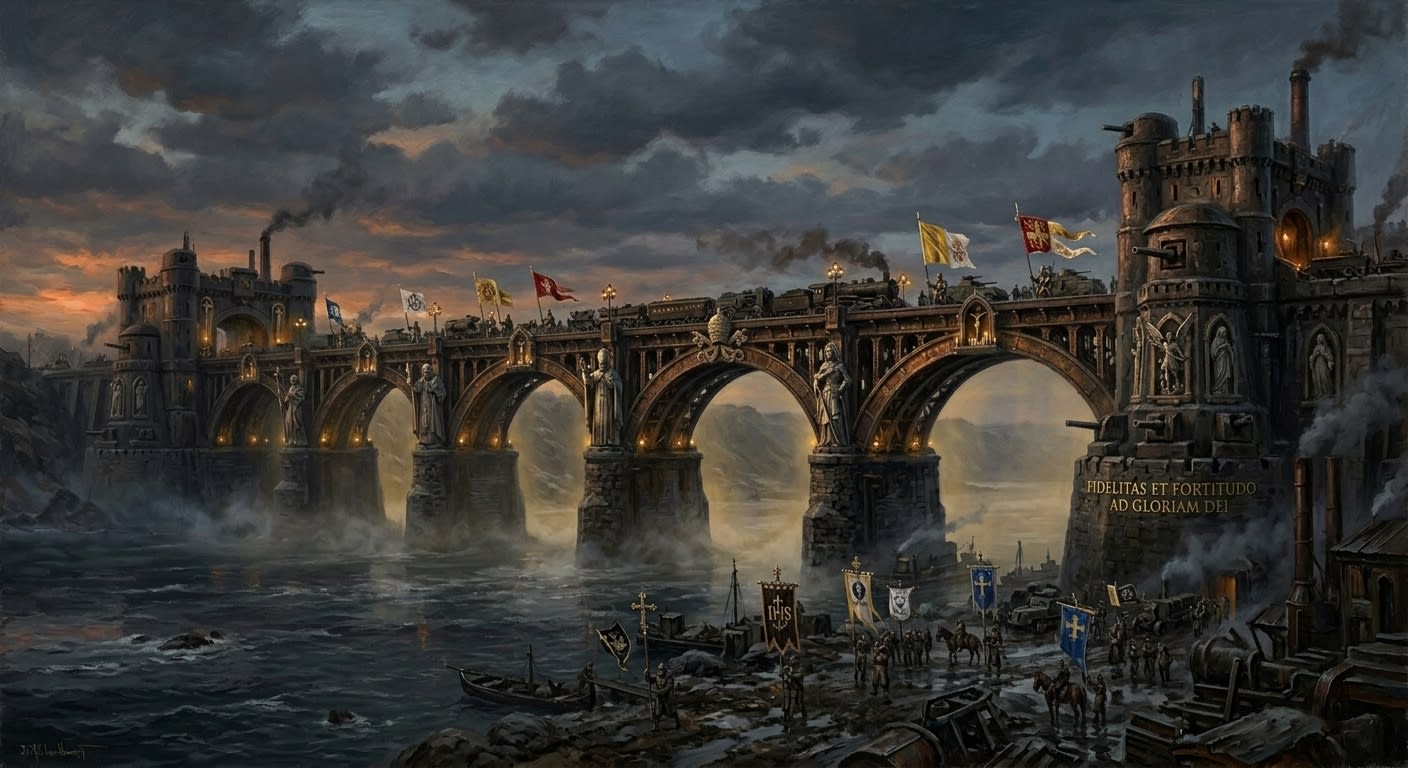
The Bureau of Doctrine, when it consents to describe Bastion-Brest at all, calls it "the Lock of the Bug." The Bureau of War prefers "the Flat Anchor." The soldiers who garrison it — boys shipped from Warsaw on the northern rail, who arrive expecting the romance of the Carpathians and receive instead a horizontal infinity of mud, mist, and confession booths — call it the Ribs, and mean by this the brass-sheathed trusses of the great bridge-span that defines the place as surely as the carillon defines Constantinople or the fog defines Shipka.
Brest is the second of the seven great bastions, counted north to south along the Sagittal Line: south of Königsberg at the Baltic, north of Przemyśl in the Carpathians, and stationed at the single worst stretch of ground the Line has to offer. The Polish lowlands provide no mountain pass to guard, no gorge to span, no lake-maze to exploit. They provide mud. They provide visibility so excellent that the enemy can see you for thirty miles in every direction and you can see it for thirty miles back, and the seeing does nothing for anyone because neither party has anywhere to hide. The Sagittal Line here is a scar cut into flat earth, and Bastion-Brest is the stitch that holds the wound shut.
The Bug River is the one mercy the terrain provides. Broad, cold, deep enough in the spring thaw to drown a horse standing, it runs north to south and forms the natural moat that geography denied the rest of the sector. The bridge-fortress spans the Bug at the only bedrock pinch for fifty miles — a geological anomaly the first engineers of the Line exploited in A.S. 67, two years after Augustinus declared the Sagittal Line permanent and seven years before the Concordat of Strasbourg gave him the bureaucracy to enforce it.
#On the Rising of the Ribs
"We built Brest because the river was there. We stayed because the paper was." — attributed to the first Bridge Commandant, name struck from the Ledger
The original fortification was a thing of logs and desperation. Six companies of retreating infantry, the remnants of the Great Retreat's northern column, reached the Bug in the winter of A.S. 66 and found a stone bridge — old, Prussian, adequate for commerce and utterly inadequate for war. They held it for nine days against something the surviving journals describe only as "the pressure from the east," which the Bureau of Doctrine has never formally identified and which I shall address in its own section with the circumspection such matters demand.
The stone bridge fell on the tenth day. The retreating companies built a pontoon, fell back across it, burned the pontoon, and dug in on the western bank with the frantic energy of men who understand that there is no position behind them worth retreating to.
What stands at Brest now is four generations removed from that pontoon. The brass-ribbed bridge-fortress was designed by the Bureau of Engineering in A.S. 92, two years after the Concordat formalized the Synod's authority, and was completed — if completion is the correct term for a structure that has been under continuous expansion for a hundred and nine years — by A.S. 98. The design is singular among the Line's fortifications: a bridge that is its own bastion, spanning the Bug on thirty-two arched trusses of riveted brass and iron, each truss a structural rib enclosing a gun-casemate on its outer face and a confessional booth on its inner. The marriage of artillery and penance was deliberate. The architect, one Procurator-Engineer Hallam, submitted his plans to the Bureau of War and the Bureau of Doctrine simultaneously and received approval from both within the same week, a coincidence of bureaucratic efficiency so unprecedented that the Bureau of Records opened an investigation into whether the approvals had been forged.
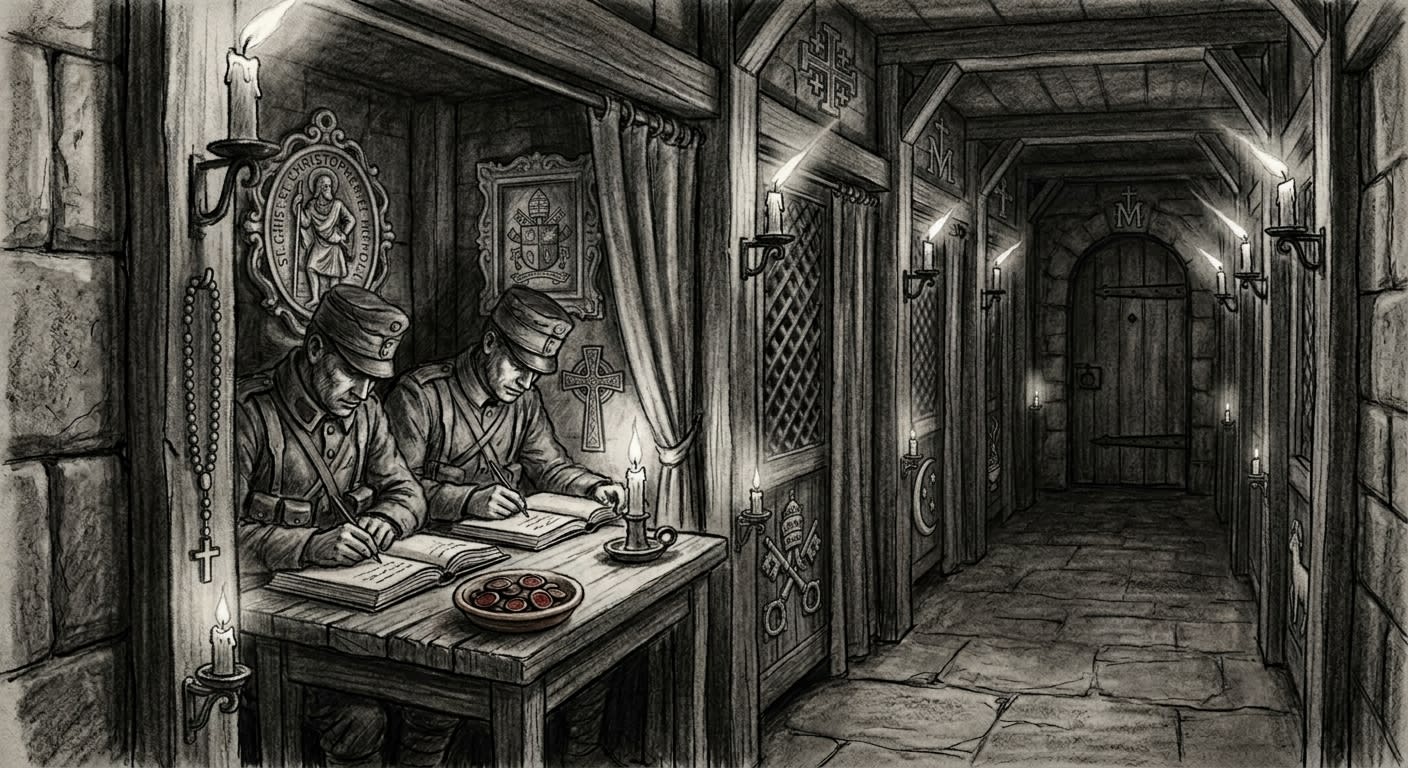
They had not. Both Bureaus recognized what Hallam had built: a chokepoint that filters bodies, souls, and paper in a single span. A crossing at Brest requires a confession receipt stamped against the crosser's identity file, an absolution token dispensed by the confessional booth assigned to the crosser's declared sin category, and a transit seal from the Crossing Bureau certifying that the sin confessed is consistent with the sins previously confessed. To cross the Ribs is to submit to a moral audit conducted at gunpoint. The Bureau of Doctrine considers this arrangement beautiful. The soldiers consider it something else.
Earlier editions of this Codex identified the bridge architect as "Procurator-Engineer Hallam of Mainz."
The Bureau of Records has determined that Hallam was from Kanzleiburg. The attribution to Mainz was clerical — the result of a filing clerk who, having run out of ink at the critical moment, substituted the nearest city name from memory. The clerk has been reassigned. Hallam's birthplace has been corrected. That the correction took ninety-three years is, per the Bureau, "consistent with thoroughness."
#On the Anatomy of the Span
"The bridge breathes. Ask the men who sleep inside the ribs — they will tell you the brass expands in summer and contracts in winter, and that the sound it makes is not metal stress but exhalation." — Foreman Jost, Brasswright Guild
The bridge-fortress runs east-west across the Bug at a span of eight hundred metres, counting the approach ramps and the two great gatehouses that bookend the structure like the jaws of a vise. The gatehouses are granite, iron-clad, bristling with firing positions and lousy with clerks. The East Gatehouse — the intake, the mouth that swallows — processes arriving convoys, levy transports, pilgrim columns, and the occasional prisoner detail. It smells of wet paper and vinegar, because the Bureau of Purity insists on fumigating every document that arrives from east of the Vistula, and the fumigant is vinegar-based, and the documents are always wet because the Polish lowlands are always wet. The West Gatehouse — the outlet, the teeth that release — handles outgoing inspections, officers' crossings, and the "clean lane" reserved for personnel whose confession files the Bureau of Doctrine has pre-certified. It smells of gun oil and hot bread, because the officers eat well and the guns eat better.
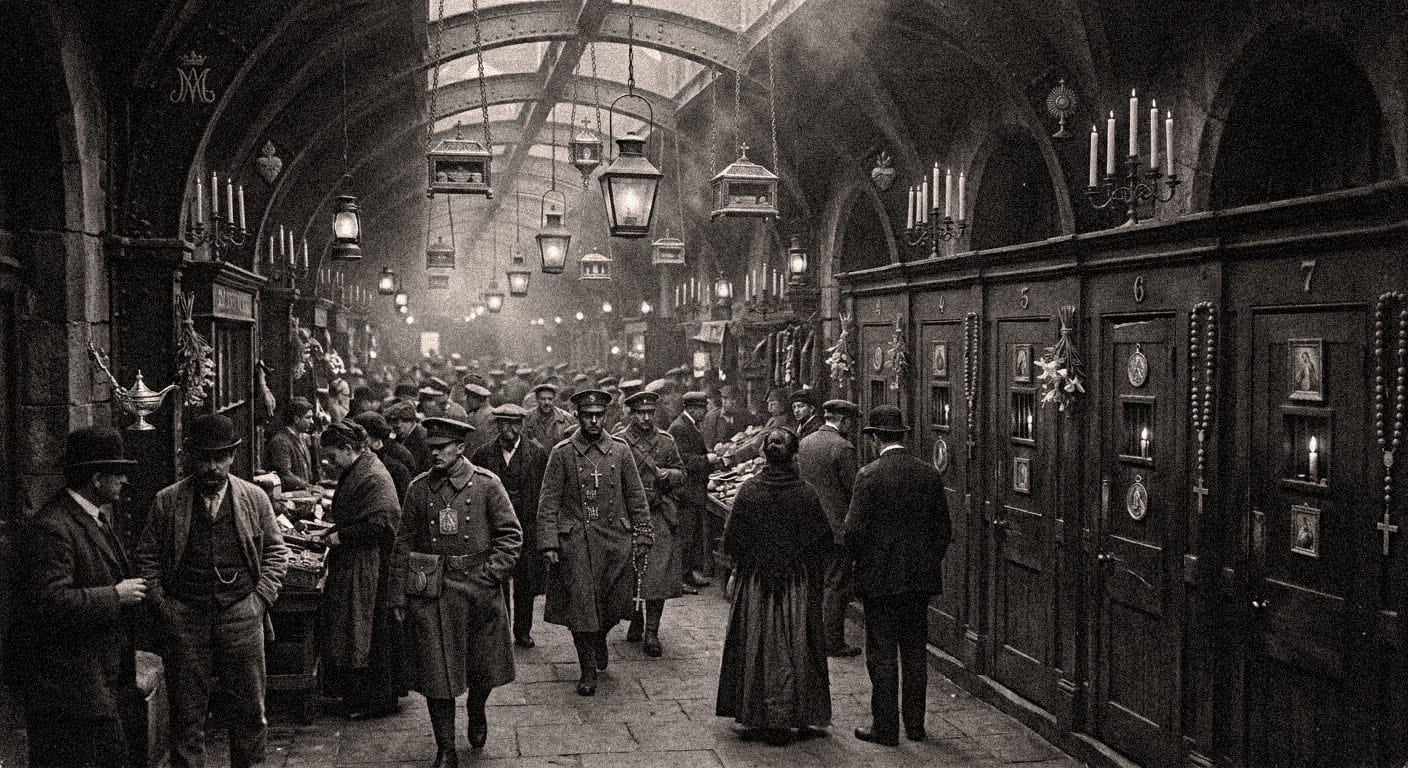
Between the gatehouses, the span. Thirty-two brass ribs, each as tall as a cathedral nave and as wide as three men standing abreast, arching from pylon to pylon across the cold brown water. The Ribwalk runs the length of the bridge's upper deck — a market street a thousand paces long, where brine and sweat and cordite compete for dominance and lose to all three. Below the Ribwalk, the Casemate Galleries: gun positions inside every fourth rib, crewed day and night, the barrels protruding through brass shutters that open and close with a mechanism the Brasswright Guild maintains at a cost the Bureau of Tithes has tried seven times to audit and seven times has been informed is "classified under operational necessity."
Below the Casemate Galleries, descending into the pylons themselves: the Confessional Lanes. Two hundred and fourteen confession booths arranged in double rows along the bridge's interior corridors, each booth equipped with a scribe, a candle, and a seal. The lanes are narrow, candlelit, and designed to funnel traffic in a single direction. There is no reversing in the Confessional Lanes. You enter at the east end a sinner; you emerge at the west end absolved, or you do not emerge. The scribes record every confession in duplicate — one copy for the crossing file, one copy for an archive the Bridge Tribunal maintains in a vault beneath the Absolution Hall. What the Tribunal does with that archive is a matter the Bureau of Records has been asked about precisely once. The clerk who asked was transferred to Königsberg within the week.
The pylons — fourteen of them, stone and iron, sunk to bedrock in the Bug's silted channel — contain the Pylon Warrens: housing for the fourteen thousand souls who live inside the bridge and call it home. The Warrens are damp, vertical, poorly lit, and organized by a system of bunk allocation that ties sleeping arrangements to declared sin categories. Those who confess pride sleep highest, nearest the Ribwalk. Those who confess sloth sleep lowest, nearest the water. The logic is the Bureau's. The complaints are the tenants'.
#On the Crossing Economy
"No sin, no step." — Proverb of the Ribs
Everything at Brest is transactional, and every transaction passes through a confession booth. The crossing toll — coin, ration chits, or labour-hours for decking upkeep — is the least of it. The real currency is the absolution token: a wax-sealed disc, stamped with the Triune Knot, dispensed by the confessional scribe upon completion of a satisfactory confession and required for every movement between the bridge's eight districts. Lose your token and you cannot cross. Forge your token and the Bridge Tribunal revokes your crossing file. Refuse to confess and you are classified as "clean," which is illegal, because the Bureau of Doctrine has determined that no living person is without sin, and to claim otherwise is heresy of the fourth category, punishable by immurement or — if the Tribunal is feeling generous — assignment to the dredge crews who clear ice from the pylons in winter.
The Bridge Tribunal — presided over, in this wretched year of A.S. 201, by Presiding Judge Elsbeth Krail, a woman whose voice is as soft as old linen and whose eyes are as gentle as a branding iron — adjudicates all crossing disputes, all identity corrections, and all cases of "manifest irregularity," which is the Tribunal's designation for sins confessed that do not match sins previously recorded. Judge Krail holds court in the Absolution Hall, mid-span, in a chamber that smells of wax heat and iron ink and the particular anxiety of people who have been told that their paperwork contains a discrepancy.
Gun-Cantor Marshal Vonn commands the bridge's artillery — a devotional man who prays before every salvo and whose prayers have not, to the Bureau of War's knowledge, ever improved his accuracy, though the Bureau concedes that accuracy and devotion serve different ledgers. The Gun-Cantors control the casemate fire keys, the curfew bells, and the bridge's capacity for "safety salvos" — the polite Bureau designation for firing into the crossing lanes during emergencies. What constitutes an emergency is Marshal Vonn's determination. What constitutes a safety salvo is a matter of definitions the Bureau of War has not been eager to examine.
The third pillar of Brest's governance is Seal-Registrar Hett Ruis of the Crossing Bureau, who controls the stamps, the identity files, and the crossing writs without which no person, cargo, or document may transit the span. Ruis smiles. He smiles when granting crossings and he smiles when denying them and he smiles when the denied are escorted to the processing pens, and the quality of his smile does not change between any of these occasions. The Bureau of Records considers Ruis an exemplary civil servant. The soldiers call him the Knife.
#On What Faces the Span from the East
"Every bridge invites a crossing. Velkara merely supplies the applicants." — Drax, memorandum to the Bureau of Doctrine, A.S. 200
The other bastions know their enemy. Königsberg faces the Grey. Przemyśl faces Atheron. Irongate faces Morwen. Shipka faces Syrion. Constantinople faces Kargath and Maldrake together and has learned to tell the difference between Gluttony's rot and Wrath's fire by the colour of the smoke.
Brest faces Velkara.
I am permitted to say the following, because the Bureau has determined that the following constitutes "general awareness suitable for senior clerical consumption." I am not permitted to say more. I am not permitted to explain why I am not permitted to say more. I am permitted to acknowledge that the restriction exists, which the Bureau considers a concession of remarkable generosity, and which I consider an insult dressed in its own vocabulary.
Velkara's pressure upon Bastion-Brest does not resemble a conventional siege. It resembles opportunity. It resembles forged passage, licensed falsehood, bought absolution, the wrong man carrying the right papers, the right man carrying the wrong sin, and a bridge built to sort bodies and souls discovering that both can be counterfeited. The Bureau of Doctrine classifies the Brest sector as a Velkaran corruption front of unusual administrative depth. I classify it as what happens when temptation acquires a stamp room.
What the garrison reports — and I reconstruct this from field chaplains' oral testimony, because the written reports are sealed — is this: Velkara rarely spends men where paper will suffice. The assaults begin before the breach. Convoy seals arrive microscopically altered. Transit writs pass inspection with signatures the dead once used. Confessions are heard in the correct voice and filed under the wrong soul. Patrols intercept crossings in which every stamp is valid, every token authentic, every witness persuaded, and every person involved somehow misidentified. When violence does come, it comes through the door the ledger opened: saboteurs in courier coats, chapel girls with duplicate keys, penitents bearing relic tins full of lamp-oil and wire. Brest's enemy does not merely press the span. It seduces the machinery that decides who may cross it.
Three inspectors were transferred to Bastion-Brest from the Thracian Subterranean Survey in A.S. 200. The transfer was filed as "career development." The Maldrake dossier notes, correctly, that no one at Bastion-Brest considers a transfer there to be career development. What the inspectors found in the Thracian slag-rivers — "routing behaviour," the Bureau of Engineering called it, liquid wrath moving in patterns toward specific targets — prompted their recall. That they were sent here, to a sector where sabotage travels most efficiently by paper, is a detail the Bureau has not explained and which I have been advised not to speculate upon. I speculate upon it in every waking hour.
#On the Confession Echo
"Never confess a name you love — the river will take it first." — Proverb of the Ribs
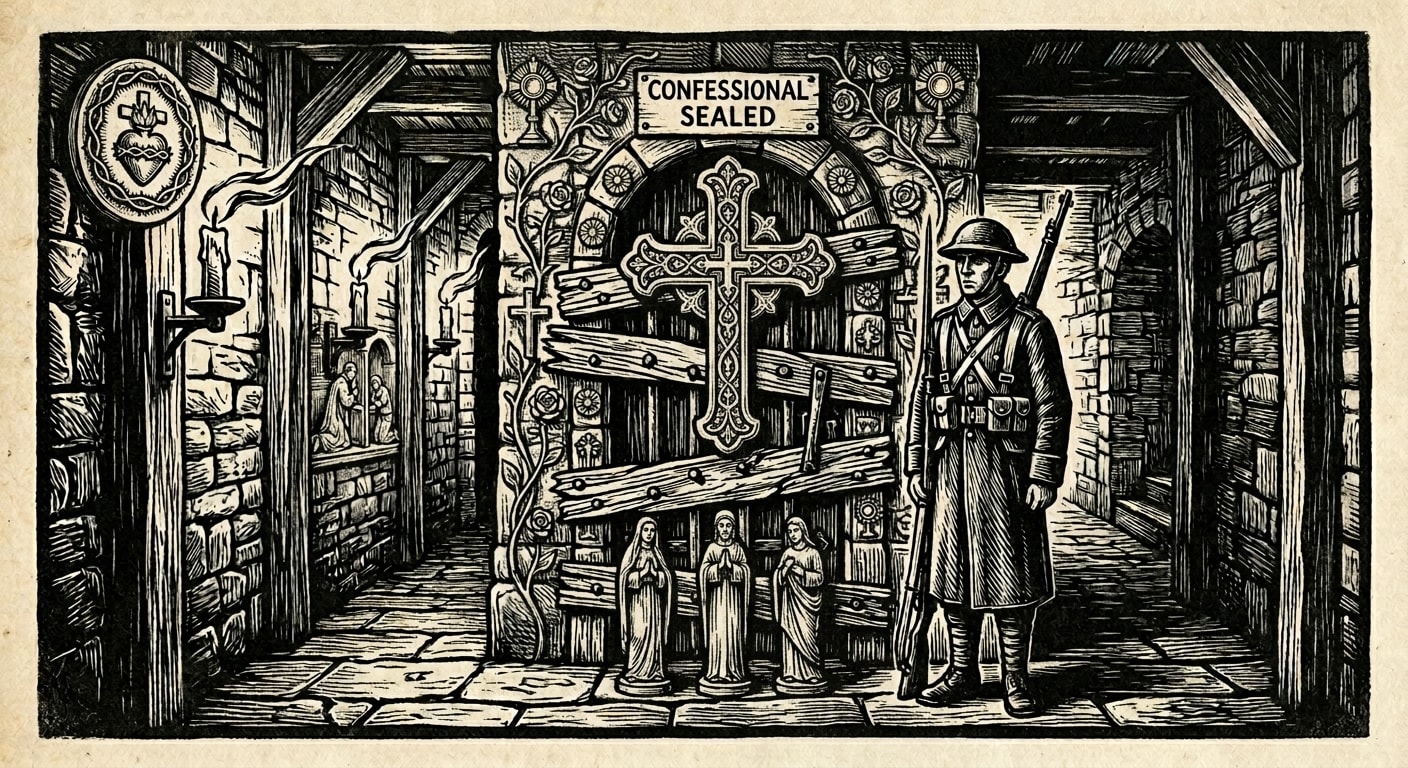
There is a local anomaly at Brest, and it is this: sins spoken into the confession booths come back.
The phenomenon began in A.S. 199, which places it two years before the present writing and one year after the first confirmed Velkaran crossing-complex escalations. The Bureau of Doctrine classifies it as a "doctrinal resonance event." The garrison calls it the Confession Echo. What occurs is this: a sin spoken into a booth — a specific, named sin, confessed by a specific, named individual — re-emerges hours or days later as a whispered voice on the bridge deck, repeating the confession in the original speaker's cadence, audible to anyone within earshot. The candle flames in the Confessional Lanes bend toward the booths when an Echo is active. The ink on crossing stamps beads into droplets the scribes describe as "sweating." The mist beneath the ribs — which is always present, because the Bug breathes — forms shapes that the garrison's field chaplains have been ordered to describe as "atmospheric condensation" and which they describe, when the chaplains are not listening to each other, as faces.
The Bridge Tribunal blames heresy. Specifically, Judge Krail has attributed the Echoes to the activities of a group the Tribunal designates the Blank-Sheet Circle — a heretical cell operating in the Pylon Warrens that manufactures blank crossing papers, enabling "nameless crossings" that bypass the confession system entirely. The Tribunal's theory holds that the Echoes are a demonic response to the presence of unnamed souls on the bridge: confession returning to claim what confession was denied. The theory is tidy. The theory is Doctrinal. The theory does not explain why Booth 77 repeats confessions from the future, or why the Echoes intensified in the same month the Thracian inspectors arrived.
I do not have a better theory. I do have a suspicion, which is that Brest's Velkaran pressure and the Confession Echo are not separate phenomena but aspects of a single one — that what tempts the bridge from the outside has learned to press it from the inside as well, through the very mechanism the Synod built to filter souls. The confession system was designed to sort the faithful from the faithless. Something has found the sorting mechanism and is using it for purposes the Bureau has not anticipated.
I have filed this suspicion with the Bureau of Doctrine. The Bureau has classified my filing under Outside Current Doctrinal Scope.
Earlier editions of this Codex did not contain an entry on the Confession Echo, because earlier editions were compiled before the phenomenon began.
This erratum exists to pre-empt the inevitable suggestion from future Hieromnemons that the omission was negligence. It was not. One cannot omit what does not yet exist. The Bureau of Records endorses this position. The Bureau of Records also endorses the position that things which do not yet exist should, nevertheless, have been anticipated. The two positions are contradictory. The Bureau does not regard this as a problem.
#On Life Inside the Ribs
"Which rib keeps you warm?" — Shibboleth of Brest; locals answer with a number
Fourteen thousand souls inhabit the bridge in ordinary times. In convoy seasons the number swells past twenty thousand, because the bridge is a chokepoint for three roads and a rail spur that feeds the northern front from Warsaw, and when the convoys back up — and they always back up, because the Confessional Lanes can only process so many souls per hour and the Bridge Tribunal has never consented to expand capacity because capacity serves the Tribunal less well than scarcity — the overflow camps on the span. Tents on the Ribwalk. Families in the Casemate Galleries, sleeping between the guns. Children in the Pylon Warrens, growing up in the vertical damp, learning to speak in "safe sins" — minor offences you can admit without consequence, the social currency of a place where confession is not piety but paperwork.
The Ribwalk is the closest thing to civic life the bridge possesses: a market street running the bridge's full length, where brine and sweat and cordite mingle in an olfactory compromise that no one finds pleasant and everyone finds familiar. Licensed traders sell what the convoys bring — grain, cloth, medicine, the occasional smuggled relic of dubious provenance — and unlicensed traders sell what the convoys do not bring, which is everything else. The Bureau of Purity patrols the Ribwalk in force during daylight hours. After curfew, the Ribwalk becomes something else: a single-file corridor lit by lanterns that mark the "truth lanes," the night-crossing routes with mandatory booth stops at every third pylon. To walk the truth lanes after dark is to submit to confession six times in eight hundred metres. The soldiers who do it nightly have developed a repertoire of sins so practised, so efficiently delivered, so perfectly calibrated to satisfy the scribes without revealing anything of consequence, that the Bureau of Doctrine has begun to suspect the bridge is producing a new form of heresy: the ritual of confession emptied of all content, performed as reflex, the sacrament reduced to a transit stamp.
The Sluice Yards, downstream of the bridge proper, are where the river does its work and where Brest does its dying. The dredge crews — penal labourers, mostly, serving sentences for confession irregularities — haul ice and debris from the pylons in winter, and in summer haul things from the Bug that the Bureau of Records classifies as "river salvage" and which the crews, who have pulled them from the water with hooks and seen them up close, classify with a vocabulary the Bureau of Purity would not approve. The Under-Deck Moorers — a cartel of boatmen who control the fog routes beneath the span — operate from the Sluice Yards with the grudging tolerance of the Bridge Tribunal, which needs the moorers' skiffs for maintenance runs and cannot afford to prosecute the entirety of its own maritime infrastructure.
#On the Garrison and Its Condition
"Brest does not break soldiers. Brest files them." — Gun-Cantor Marshal Vonn
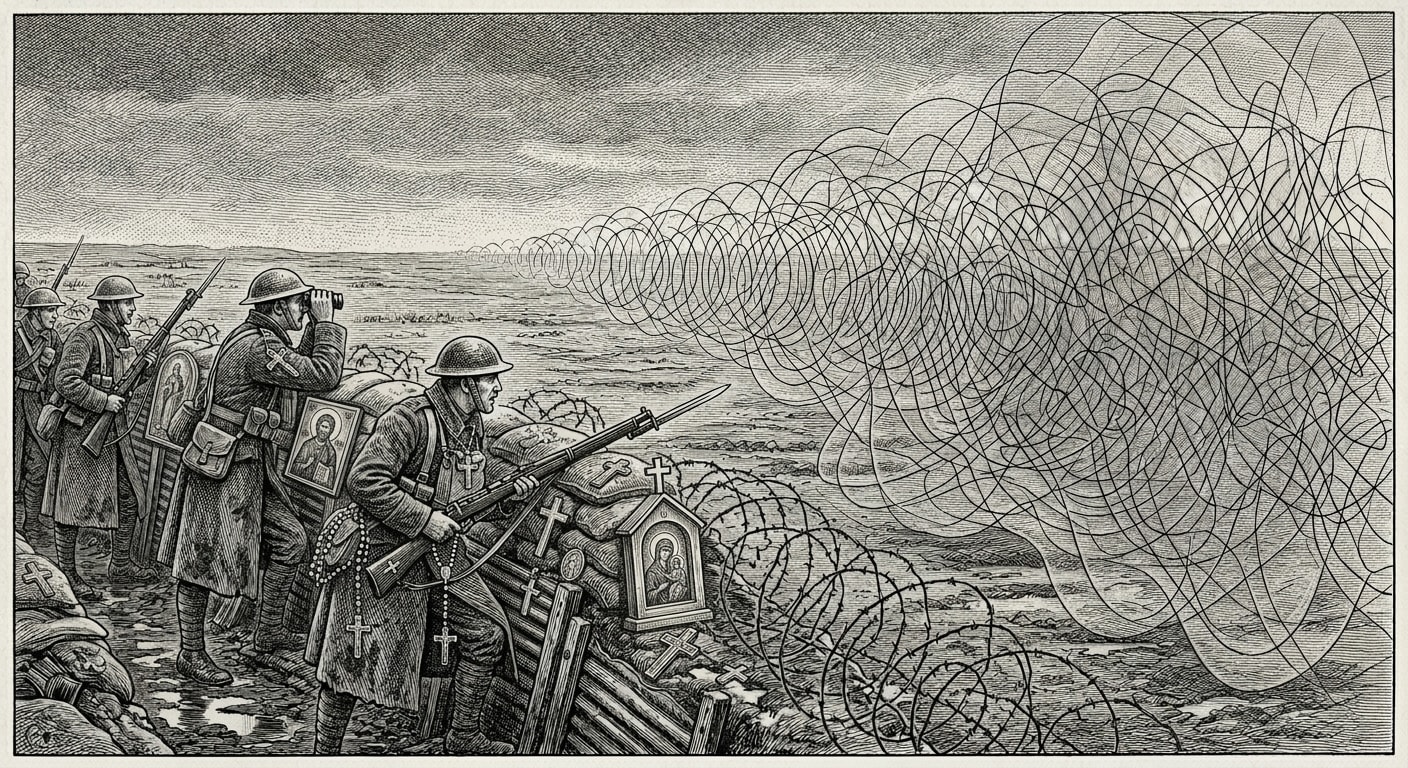
The garrison of Bastion-Brest numbers approximately eight thousand combat troops at full strength, supplemented by four thousand administrative and support personnel and an unknown number of Bureau agents whose presence is neither confirmed nor denied. The troops are drawn primarily from the northern levy — the sons of the Polish lowlands, of Warsaw and Kanzleiburg and the flat agricultural belt between them — because the Bureau of War has determined that soldiers raised on flat ground fight best on flat ground, which is either tactical wisdom or laziness, and the distinction, as I have observed, is often procedural.
Morale at Brest is not good. I say this with the Bureau's permission, which surprises me, and I suspect the permission was granted because the Bureau has determined that denying what every field chaplains' report confirms would require a quantity of redaction ink that exceeds the quarter's allocation. The soldiers of Brest face an enemy that can wear the right face, carry the right seal, and arrive through the right gate with the wrong intent. They search carts whose papers are immaculate. They interrogate pilgrims whose sins were pre-cleared by a hand now under investigation. They pray against deception and the prayers return as echoes. They ring the bell-resonance towers along the Wire and still wake to find a token valid, a booth compromised, a sentry bribed, a manifest subtly corrected in someone else's favour. The chaplains report a condition they are careful not to call despair — because despair is a sin, and sins at Brest have administrative consequences — but which they describe, in the language of pastoral care, as "a sustained posture of theological exhaustion."
The Bureau of War's most recent quarterly assessment of Bastion-Brest — which I have read, because the Bureau of Doctrine co-seals it and the Bureau of Doctrine is, however reluctantly, my Bureau — concludes with a sentence I shall reproduce here because it is, in its way, the most honest thing the Bureau of War has written about the northern front in a decade: "Bastion-Brest remains operational. The definition of 'operational' has been revised."
#On the Present Condition
"The river forgets; the ledger doesn't." — Proverb of the Ribs
Bastion-Brest, in this two hundredth and first year of the Synod's calendar, is operational. I use the Bureau's revised definition, because the original definition required conditions that Brest has not met since A.S. 197.
The Confession Echo persists. Booth 77 remains sealed. The Bridge Tribunal has arrested nineteen members of the Blank-Sheet Circle in the past six months and has not arrested the phenomenon. Velkara's pressure upon the crossing has intensified since the spring thaw, and each investigation leaves the garrison smaller and the sealed files thicker. The three inspectors from the Thracian Subterranean Survey occupy quarters in Pylon Nine and have submitted, between them, forty-seven reports to the Bureau of Doctrine, all of which have been classified and none of which have been acknowledged. They do not look like men engaged in career development. They look like men who have been told something they cannot repeat and sent to a place where the thing they were told is happening.
The confession system continues to function, in the sense that confessions are taken, tokens are dispensed, crossings are permitted, and the Ledger is maintained. Whether the system functions in any deeper sense — whether it sorts the faithful from the faithless, whether it filters the clean from the contaminated, whether it does what the Bureau of Doctrine designed it to do — is a question the Bureau has forbidden me to ask and which I have, by writing it in this sentence, asked.
Brest holds. The Bug runs cold beneath the brass ribs and the mist rises every morning and the confession booths open at the dawn bell and the guns sit in their casemates with their shutters oiled and their barrels pointed east at an enemy that does not always require a breach because it has learned the virtues of paperwork. The soldiers confess. The scribes record. The Tribunal adjudicates. The system operates as designed, and the thing that presses from the east has found the design useful, and the Bureau has not yet determined what it means when the enemy of false passage begins to use your own machinery of salvation as a door.
I have sealed this entry. I have stamped it. I have submitted it to the Bureau of Doctrine for ratification, which will require the Northern Theater co-seal, which will require the approval of a classification tier that does not officially exist.
The Bureau will ratify it. The Bureau always ratifies what it cannot suppress, because ratification is a form of containment, and containment is the best the Bureau can offer Brest, and the best the Bureau can offer Brest is, I suspect, no longer enough.