

#On the Origin and Necessity of Absence
"A name is a covenant. Remove the covenant, and the man who bore it becomes a rumour of himself."
The Synod does not kill everyone it condemns. Killing requires a body, a grave, a record of the death, and — most inconveniently — a widow. The widow weeps, and the neighbours remember, and the memory hardens into martyrdom, and the Bureau of Purity spends the next forty years scraping the martyr's name off cellar walls where the faithful have scratched it in reverence. Execution is expensive. The dead are expensive. The dead have always been expensive.
Erasure costs ink and wax.
The Erasure Notary — formally, Notary of Nullity; colloquially, Black-Stamp, Name-Knife, Paper-Executioner — is the Synod's answer to a problem older than the Theocracy itself: how does one destroy a person without producing a corpse? The answer is administrative. Strike the name from the Great Ledger of Souls. Void the ration claim. Collapse the marriage. Invalidate the oath-witness record. Freeze the property. Cancel the burial rights. The man persists in flesh — for a while — but the city no longer recognises him, the gate no longer admits him, the bread-queue no longer feeds him, and the hospice no longer treats him. He is, in the Bureau's preferred terminology, absent.
The profession emerged during the Great Retreat, A.S. 48–65, when the collapsing frontier produced a catastrophe of duplicate rations. Deserters drew bread under dead men's names. Smugglers registered phantom families. Plague-carriers crossed checkpoints on stolen permits. The embryonic Bureau of Records — then a handful of clerks with poor handwriting and worse tempers — devised a simple mechanism: a black wax seal, struck over a name, rendering it void across every downstream ledger. The first strikes were emergency triage. They became, within a generation, the Synod's quietest and most versatile weapon.
#On the Substance and Procedure of the Strike
The process is clinical and the consequences are total.
A strike begins with a sealed writ — tribunal order, Codex Auditor flag, Inquisitorial directive, or direct Bureau of Records nullification under Standing Order 22-N. The Notary receives the packet, verifies the authority chain (who requested, who countersigned, who may be blamed if the strike is later deemed inconvenient), and performs an identity anchor check: mother's name, baptism mark, oath-witness record. One wrong anchor and the strike hits the wrong life. Wrong-name strikes are the profession's cardinal terror, and I shall address them presently.
The Notary then locates every dependent ledger. Birth roll. Marriage register. Ration claim. Property deed. Guild membership. Gate passage permit. Ossuary allocation. Burial rights. Each receives the black seal — a stamped circle of wax pressed over the relevant entry with the Notary's personal signet, a date, and a classification code. Downstream notices follow: the gate office voids the passage permit, the ration clerk pulls the allocation, the ossuary registrar cancels the burial plot, the tithe office freezes the property. Within hours, the struck individual cannot travel, eat at licensed distribution points, receive medical treatment, marry, inherit, testify, or — most cruelly — be buried in consecrated ground.

The profession maintains approximately nine hundred active Notaries across Zones 1 through 5, with the highest concentration in Strasbourg, Queue Road corridor stations, Latchford Permit-Yards, and the Bastion-Brest confessional transit system, where 214 booth stops generate a constant flow of flagged identities requiring administrative resolution. The Black Seal annex in Strasbourg — a dry, windowless vault beneath the Bureau of Records headquarters — serves as the profession's central archive and training facility. The air smells of old vellum, lamp-smoke, and the faintly acidic residue of centuries of ink.
#On the Precedents and Their Lessons
The Erasure of Guillaume remains the profession's foundational case study. When Duke Guillaume of Aachen opened the citadel gates to the Rationalists during the Atheist Wars, the Synod did not execute him. Execution would have required a trial, testimony, a record — and a record is a thing the Bureau can be forced to produce under oath. The Bureau chose erasure. Guillaume's bloodline was excised from every register, his name scraped from ledgers, his crest pulled from stone. Beggars in Cologne still wear sackcloth masks; some whisper they are Guillaume's children, cursed to wander faceless for their father's treason. The Bureau of Records completed the work in eleven days — a feat that Notaries still cite as the professional benchmark, though the scope of the task (a ducal lineage spanning four centuries of heraldic record) makes it unrepeatable under current staffing allocations.
Earlier editions of this entry described the Guillaume erasure as "the first recorded instance of lineage-wide nullification." This is incorrect. The first was the Carnelian family of Metz, A.S. 67, during the plague-permit crisis, and it was bungled so thoroughly that three Notaries were themselves erased for the resulting contradictions. The Guillaume erasure was the first competent lineage-wide nullification.
The Schism of Avignon produced the doctrine of the Trifold Erasure: death of the body, death of the name, death of the memory. The schismatics' names were scraped from every register so that they could not become martyrs — because a martyr requires a name, a name requires a record, and no record means no martyr. The Bureau calls this not cruelty but strategy, which is how the Bureau distinguishes its cruelties from those of lesser institutions: the Bureau's cruelties have filing codes.
The Scriptorium of Nemea serves as the profession's sacred downstream terminus. A name erased at Nemea's recommendation ceases to have existed. A debt struck from Nemea's corrected copy ceases to have been owed. Nemea exports absence — certified, stamped, sealed, and delivered by courier to every tribunal, gate-court, and bastion registry on the continent. The Notaries of the Black Seal annex regard Nemea with the mixture of reverence and professional jealousy that a provincial surgeon reserves for the capital anatomist.
#On the Controversies and the Shadow Market
The profession's internal fracture runs between Purists and Pragmatists. The Purists — who predominate in the Strasbourg Black Seal annex and the Bureau of Records' central audit division — insist that every strike must follow the full authority-chain protocol, every dependent ledger must be sealed simultaneously, and every Notary must maintain what the regulations call "clean-hand practice": no off-book actions, no delayed filings, no favours. The Pragmatists — who predominate everywhere else — observe that the Synod itself lives off-book, and that a Notary who refuses to delay a filing when a patron requires it will find his own name on someone else's desk by morning.
The shadow market is an open secret that the Bureau classifies as "periodic anomaly under ongoing review." Intermediaries — desperate spouses, patron agents, rival clerks, smugglers requiring clean passage — approach Notaries offering fuel chits, salt, heating tokens, or the currency the profession values above all others: favours. A delayed filing before a convoy departure. An anchor swap that redirects a strike to a decoy identity. A half-strike that voids rations and passage but leaves burial intact — the profession's quietest mercy, performed by Notaries who have not yet shed the inconvenience of a conscience.
The risks are commensurate. Three Notaries in Münster who attempted to reconstruct a sealed census were reassigned; their current whereabouts are filed under classifications I am not authorised to read. The Candlewick Palatinate maintains a category for persons whose erasure "will generate no paperwork" — meaning they were never registered in the first instance, meaning they were already ghosts before the Notary touched the seal. And at Lorn, I have read reports — reports I was not supposed to have read — of human beings whose names had been struck from the Ledger and who therefore, in the Bureau's understanding, could no longer occupy space above ground. The tunnels beneath the switchyard are their afterlife. The silence is their hymn.
#On the Hazards of the Trade
Wrong-name strikes haunt the profession the way structural collapse haunts the Litany-Engineers. A single misidentified anchor — a mother's name transposed, a baptism mark misread — and the strike descends on an innocent household. Rations voided. Property frozen. Children branded. The family stumbles into the Null Verge before the error surfaces, and by then the downstream ledgers have already propagated the absence. Reinstating a struck name requires counter-signatures from seven offices, an audit trail that exposes everyone who touched the original writ, and — in cases where the struck individual has already starved — a posthumous erratum that the Bureau of Records files under "Regrettable Administrative Sequence, Category Two." There is no Category One. The Bureau does not admit to a worst case.
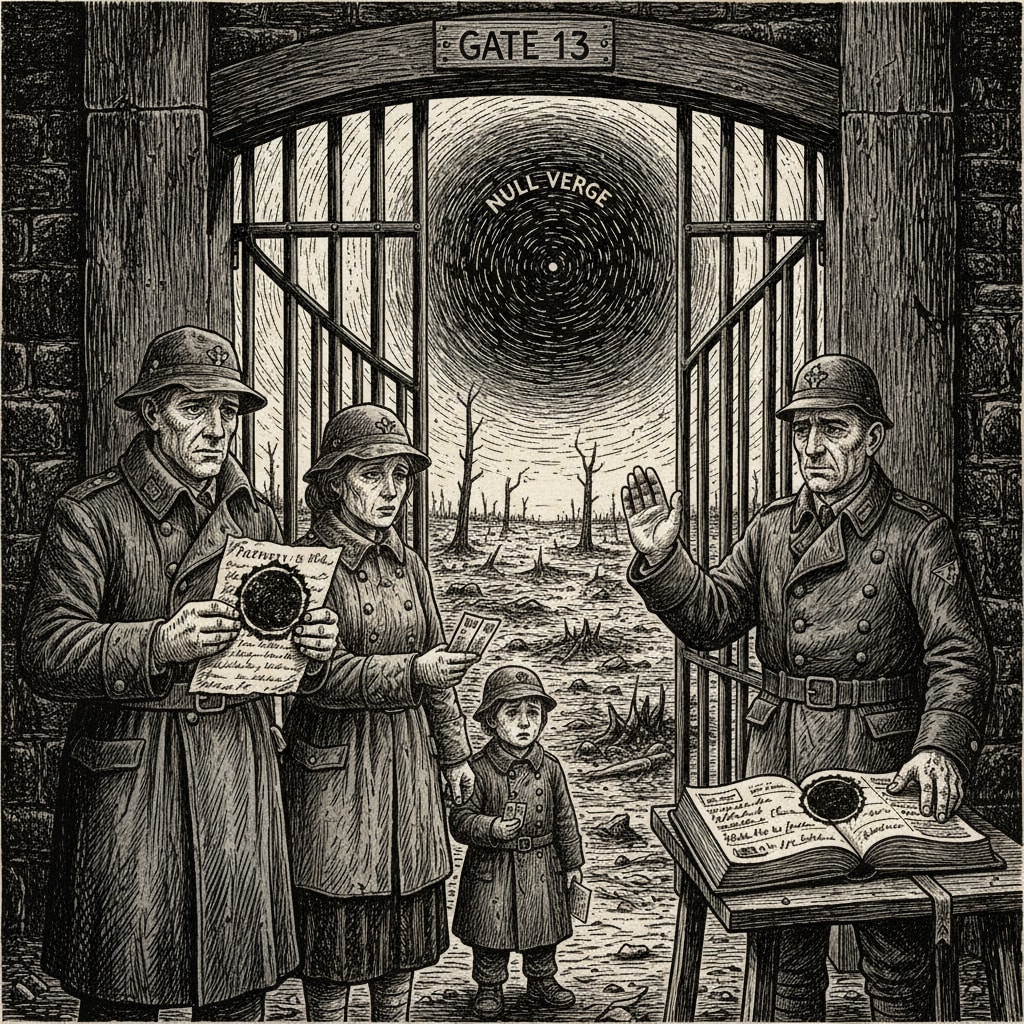
Physical hazards are minor but chronic: paper-dust lung, ink-acid burns on the cuticles, lamp-smoke headaches, and the quiet violence of revenge attempts. The profession's superstitions reflect its terrors. Never speak an erased name aloud in the vault — a clerk in Metz did so, and later found the name written on his own ration card. Carry a strip of blank vellum in your sleeve, "so absence has somewhere to land." Wash your hands before every strike session, because wet hands "smear truth." Tap the Black Seal stamp twice on stone before use, and never — under any circumstance — strike while the vault door stands open.
The Carnival of Ink at Bastion-Constantinople — A.S. 162 by canonical reckoning — remains the profession's worst single incident. During a festival, a dozen trench-court duels were fought simultaneously in the market square. Arguments crossed and tangled until every participant was implicated. By nightfall, four hundred names had been erased, and the Bureau declared the ledger "purged of inefficiency." No Notary was disciplined. The paperwork was exemplary.
Standing Order 22-N, as revised A.S. 199, now requires a cooling period of forty-eight hours between the receipt of a strike writ and the execution of dependent ledger seals. This revision was prompted by the Metz incident of A.S. 197, in which a Notary struck eleven names in a single session and discovered, at the twelfth, that his own mother's ration card was in the stack. The cooling period is officially described as "a safeguard against procedural fatigue." The Notary in question has been reassigned.
#On the Present Condition
The Erasure Notary persists because the Synod requires a weapon that leaves no wound the eye can see. The scaffold produces martyrs. The dungeon produces legends. The strike produces silence — and silence, in the Bureau's economy, is the cheapest commodity and the most effective. Nine hundred Notaries maintain the fiction that the Great Ledger of Souls is a perfect record of every living citizen, when in truth the Ledger is a palimpsest of absences, a document defined as much by what has been scraped away as by what remains.
The hierarchy runs from Registry Runner and Index Clerk at the bottom — children, mostly, fetching rolls and filing downstream notices — through Strike Scribe and Nullity Clerk at the middle ranks, to the Erasure Notary proper, and upward to the specialists: Lineage Severers who execute family-wide strikes, Gate-Nullity Liaisons who coordinate with the Gatewarden-Notaries, and Ossuary-Nullity Adjudicators who determine whether the dead may rest. Above them all sits the Black Seal Prelate, a figure so rarely seen in public that some Registry Runners believe the position itself has been erased.
Saint Vellum the Silent watches over them — the profession's patron, credited with "purging the city of invisible demons," which is the Bureau's preferred way of saying he standardised the strike marks and trained the first generation of Notaries who could erase a man before breakfast and file the absence before lunch. His feast day is observed in the Black Seal annex with a ritual washing of hands, a counting of seals, and a silence so complete that the Registry Runners swear the vault itself holds its breath.
No record, no right. No name, no wound. The ledger is the only reality that counts — and the Erasure Notary is the one who decides what the ledger remembers.