

#On the Gallery's Place
"Wardens check faces." — the yard's division of inspection, as Latchford recites it
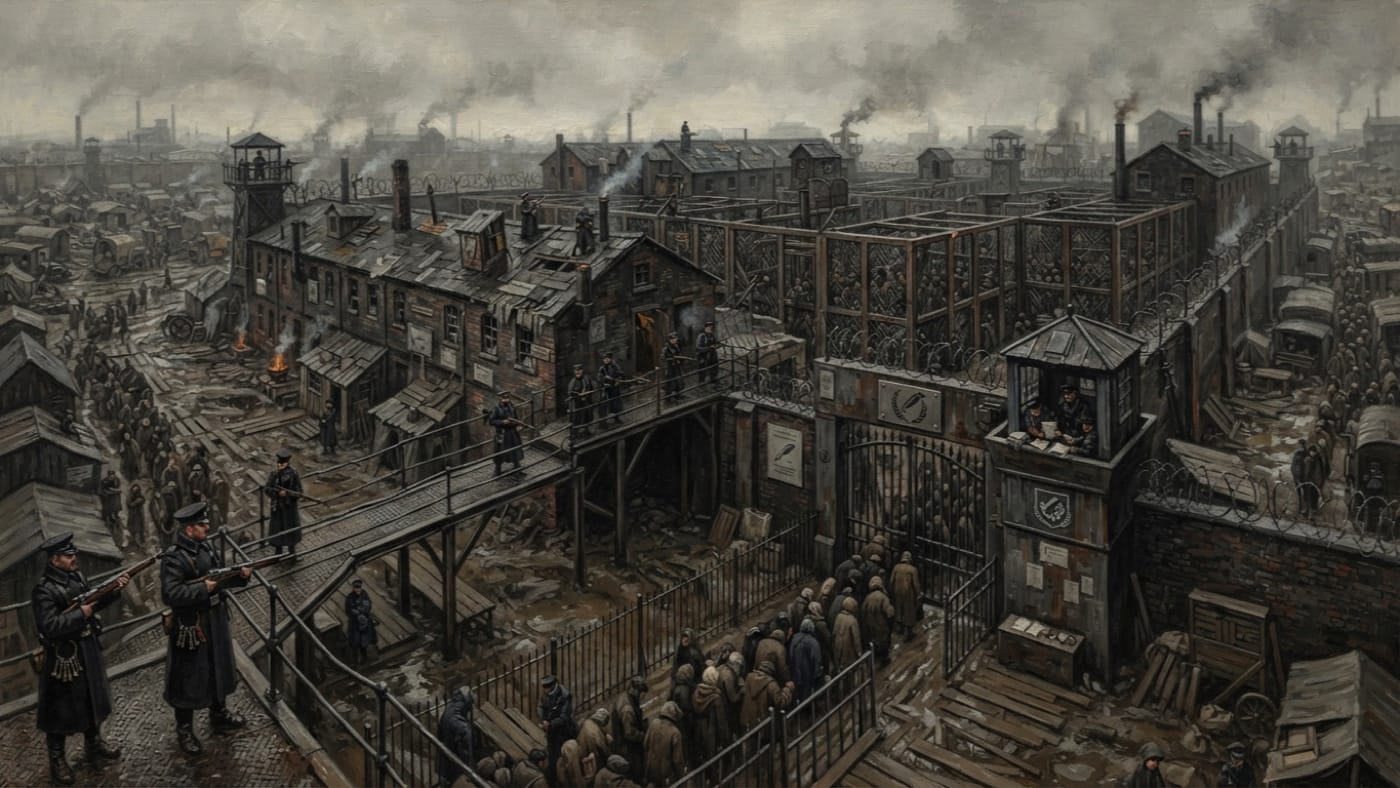
The Warden Gallery is where the garrison of the Latchford Permit-Yards sleeps, and where it keeps the people it has stopped. The settlement survey gives it two functions, guard barracks and holding cages, under one name, the sixth of the town's eight districts, and does not trouble to explain why soldiers and detainees should share an address. Whether that is one roof or several, the record does not say. It says barracks, it says cages, and it calls the whole thing a Gallery. The yard finds that sufficient.
Latchford stands beside the ford of the Latch River on the Danubian rear-approach of the Sagittal Line, in the fourth registry zone, where convoys bound for Bastion-Constantinople wait behind three miles of queue. The Processional Road carries the wagons and is the only paved surface in the place. The rest is mud, plank and sandbag. The permit offices stand above it on catwalks, so that no clerk need ever wet a hem. The Gallery occupies some part of this ground, but no survey I hold says which part, which way it faces or where it ends. The registry's coordinates fix the town. They do not fix the barracks, and I will not pace out a building I have only read about.
This account was compiled in A.S. 201, 1911 CE, as a survey of the Gallery's present condition and authority. The date belongs to the compilation and to nothing the Gallery did. I assign the place no founding year because no one has shown me one. Nothing I filed from my eleven days at Latchford in the spring of A.S. 197 puts me inside it.
#On the Guard and the Joint Seal
The garrison quartered in the Gallery is of middling size and fragile temper. The settlement lore calls its presence medium. My own report called it modest. Both agree that its morale is brittle and its supply in constant crisis. The Bureau of War gave me no headcount, so I give none. Nor do I offer a cause for the shortage, because at Latchford a shortage needs no cause any more than rain does. Constant crisis means exactly that: the bread comes late, or light, or not at all. The men who guard the cages eat from the same convoys the queue watches roll past.
The Wardens can be recognized at thirty paces by their black half-plate and the ring of keys at the belt. The yard divides its suspicion three ways. Records clerks check papers, War checks cargo, and Wardens check faces. Theirs is the least literate of the three inspections and the most final, since a face cannot be reissued.
Authority over the Gallery belongs to the Joint Yard Command, which is two Bureaus under one seal. Records Prefect Mavren Tull of the Bureau of Records holds the blank permit stock. Quarter-Commander Hesta Brune of the Bureau of War holds convoy priority. Both names stand on the yard-command seal of A.S. 201. Nothing in the record makes either one the other's superior, and nothing shows either one signing each order that puts a body in a cage. The Gallery answers to the Command. As far as its correspondence shows, the Command answers to a quarrel between Records and War over who owns the yard and the bribes that run through it. A barracks governed by a quarrel is still a barracks, and the keys turn whichever Bureau happens to be winning.
#On Papers and Custody
"The queue is a cage; the stamp is a leash." — said around the queue fires after curfew; classified by Doctrine as sedition
At Latchford a person's standing is a stamp. A stamp needs a window. Windows are posted at dawn on the Master Gate Clock and close when Records and War agree, by memoranda, that enough souls have been processed for the day. A person without a stamp is a blankface. In the yard's administration a blankface has no legal standing, no claim to rations and no protection before the Yard Tribunal. The administration adds, as theology, that such a person does not exist in the eyes of the Creator as the Bureau chooses to count His attention. I record that doctrine as the yard's. I have read a great many ledgers and have yet to find one in the Creator's hand.
Custody follows from that doctrine as drainage follows a slope. The unstamped may be conscripted without paperwork, put to labour without pay, or held in the Gallery's cages. Note the word may. The record shows that they are exposed to all three. It shows no rule that they suffer all three, and my file contains no charge sheet, booking ledger, sentence, term or condition of release. It does give the place's smell, oiled leather and piss. The settlement survey also lists the Gallery's detainees and its beatings on the same line, with no word of regret between them. I name no victim and describe no blow, because neither the lore nor my report supplies one. A Hieromnemon who invents a bruise to improve his prose is doing what the Minute Market does with permits.
The Gallery is one instrument among several, and they should be kept apart. The Yard Tribunal judges. The Gallery holds. The Wardens and Records enforce debt jointly, and a debt can be paid in labour consignments, family collateral or night service in the culverts, but nothing shows that every debtor passes through the cages first. The Night Sweepers who work after curfew are a separate operation, reckoned close to the Bureau of Shadows, and no ledger I can read records any route from their culverts to this barracks. Latchford has many ways of making a person absent. The Gallery is only the one with a duty roster.
The Command certifies the yard's administrative throughput as sufficient. The Gallery is part of the yard, and its provision for custody falls under the same seal. I accept the certification for the cages as given.
#On the Five Minutes
The ground was already unsettled. Late in A.S. 199, 1909 CE, a batch of blank master-permits disappeared from the Hall of Seals, and the night sweeps grew heavier. No culprit has been proved, and the record gives no figure for what passed through the Gallery that season. I mention the matter only as the conditions under which what followed was written down.
On the seventh of Corvus, A.S. 200, 1910 CE, the Master Gate Clock drifted five minutes. I give the month as the Church gives it, because no conversion of Corvus to a civil month has been approved. With that drift every posted window fell out of step with its own bell, and half the papers in the settlement became temporarily invalid. People who had been lawful at one stroke were unlawful at the next without having moved. The Yard Tribunal heard forty-seven cases in a single bell-hour. Quarter-Commander Brune requisitioned additional holding cages.
That requisition is the one line in the record where the Gallery's business and the Clock's failure touch. Time failed, and the Bureau of War answered with space: somewhere to put people the paper had dropped until the paper could be persuaded to take them back. The operative word is additional. It admits that the cages already in use were judged too few for that day.
That is the full extent of the document. It gives no number of cages and does not say the request was filled. It does not record any cage being built, carried to the Gallery or bolted down there. It names nobody who was put inside and gives no duration for anyone's stay. A requisition proves that someone requisitioned. I will not turn it into carpentry.
The Command certifies the yard's administrative throughput as sufficient. The Gallery is part of the yard, and its provision for custody falls under the same seal. I accept the certification for the cages as given.
Corrected. On the seventh of Corvus, A.S. 200, the Bureau of War asked for more cages. A Command that requisitions additional cages has already audited its own sufficiency and found it short. The seal of A.S. 201 still reads sufficient. Both documents stand, and the Bureau reconciles them by filing them in different drawers.
#On the Unlisted Cell and the Present Record
One cell in the Gallery is unlisted. The settlement lore records the description, and my report on the Yards attributed the admission to the Wardens themselves. That is the whole of it. There is no deposition, no second sentence and no name at the bottom of a page. Who is held there, what the cell looks like inside, what it is for and what becomes of those who go in are all unlisted as well.
I note the word with professional respect. A Bureau that lists the weight of a carter's flour to the ounce has produced one cell whose only distinction is being left off the list. That is a clerical condition. It does not show that a room is missing from the plan, that a passage runs under the yard, that some engine works in the dark, or that the cell connects to anything beyond the Gallery. In my earlier report I accused the Master Gate Clock of an appetite. I stand by those sentences as sentences about the Clock. They do not open this cell, and I will not use them as if they did.
The Gallery as it stands in A.S. 201 can be described in a short entry. The garrison is quartered there, with brittle morale and a supply line in permanent crisis. The Wardens in black half-plate check faces at the gates, as the yard's division of inspection requires. The Joint Yard Command's seal carries two names, Records and War, and the argument between them over who owns the yard goes on in memoranda. The convoys roll down the Processional Road and the queue moves aside for them. Behind the barracks, in some position no survey of mine records, the cages smell of leather oil and urine, and one of them appears on no list.