

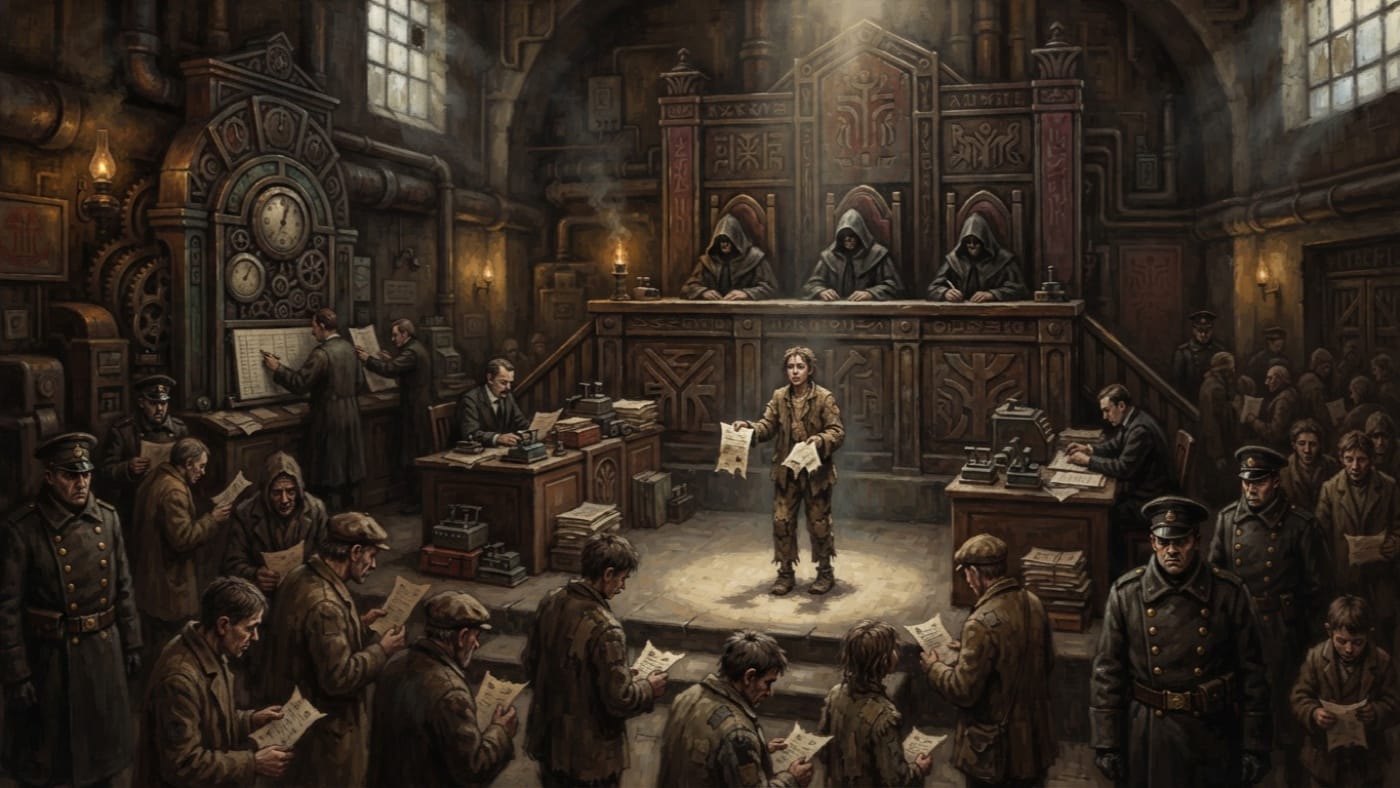
#On Standing Before the Yard Tribunal
"What's your next window?" — Latchford greeting; outsiders say "tomorrow"
Every court has to decide whether the person in front of it may be heard. Most courts settle this quietly in a clerk's anteroom, and the answer is nearly always yes. The Yard Tribunal of Latchford asks before anything else is said, and the answer is already on the petitioner's papers in wax. If the stamp holds, the petitioner may come before the bench. If the stamp has lapsed, smudged, drifted out of its window or never been applied, the petitioner may not. The queue has learned that this first ruling is usually the only one that matters.
The court rules on whether permits are valid, on who has documentary standing, and on what follows when the Master Gate Clock fails to keep the time it posts. It should not be confused with the Yard Tribunal of Lorn, which hears crimes against motion in a soot-brick hall that shakes when freight goes by. Lorn judges whatever interrupted the schedule. Latchford judges whether you are on the schedule at all. The two benches share a name and, now and then, an interest in the same forged paper. I am not prepared to certify that they share anything else.
No file I hold gives the court's address in the Yards, and its founding year is unrecorded. I find both gaps restful.
#On the Stamp and the Right to Be Heard
"The queue is penance; the stamp is mercy." — official yard propaganda, displayed on tin plaques at every gate
The sequence is short. At dawn the day's windows are posted on the clock, and the notices are damp before anyone can read them. During a posted window the Hall of Seals stamps applicants who hold their papers out in both hands and say their destination aloud. The stamp gives the holder standing: the right to cross the ford, board a convoy, draw rations and appeal to the Yard Tribunal. In Latchford a stamp is the only kind of personhood the administration recognises.
Without the stamp a person is what the yard calls a blankface. A blankface has no legal standing, no claim to rations and no protection before this court. The Bureau of Doctrine adds, as a point of theology, that a blankface does not exist in the eyes of the Creator, insofar as the Bureau chooses to count His attention. I record that formula as the Bureau's. The Creator has not countersigned it.
Exposure follows. An unstamped person may be conscripted without paperwork, put to labour without pay, or held in a cage. The court that could hear an objection to any of this is closed to the person objecting, because that person has no standing to object. The petition fails before anyone speaks.
The Unwindowed are a different case, and the yard keeps the line between them sharp. A carter whose cargo permit is valid, sealed and countersigned can reach the bay just as the bell closes his category. His papers are still good. He has simply lost his slot. Until the next posting he is Unwindowed: he has standing but nowhere lawful to use it. The published account of the clock says the Yard Tribunal knows this difference exactly and charges for it. I have no copy of the charges. Missing a window erases no one. It makes the holder late, and lateness is something this court can see. A blankface it cannot see at all.
#On Appointment, Command and Custody
"Warmth is proof." — Latchford proverb
The settlement survey describes the court as Archon-appointed and says nothing more. It does not record which Archon made the appointment, by what instrument, or for how long. The detail matters because everything else in Latchford belongs to the Joint Yard Command. Prefect Mavren Tull speaks for the Bureau of Records and holds the blank permit stock. Quarter-Commander Hesta Brune speaks for the Bureau of War and controls convoy priority. Records decides who is recognised, War decides what moves, and the Bell Orders set the day's throughput through memoranda between two offices that would rather not share a room. Neither commander appointed the court, and neither sits on it. That gives the bench the standing of an outside authority, along with the misfortune of ruling on papers both commanders write.
The bench's membership is not on file, and neither are its rules of hearing, the length of its sessions or its scale of sentences. Severe procedures are recorded for trench-courts elsewhere on the Line, but they tell us nothing about this one, and I will not bring them in.
The papers it handles can at least be named. The Transit Window Pass is ruled into minutes like a penitent's chart. The Cargo Sanctification Slip carries the dual seal of War and Records. The Confession Attachment Receipt carries Doctrine's seal, so that a soul which has confessed in writing can be audited against its own confession. The Hall's discrepancy clerks write Discrepancy Citations "for the Tribunal," and Latchford has more than one tribunal. On Ration Audit Row the Tribunal of Discrepancy once fined a carter four ration days for six ounces of surplus flour. The settlement lore lists the citation and does not say which bench receives it. I will not decide that for them.
The duties are divided. The Tribunal judges. The Warden Gallery holds prisoners. The Wardens and Records enforce debt together, and a debt may be paid in labour consignments, in family collateral or in night service in the culverts. No record shows that every debtor, detainee or missing person has first passed through a judgment of this court. The Night Sweepers work separately and are reckoned close to the Bureau of Shadows.
#On the Seventh of Corvus
"Never trust a bell you didn't see struck." — Latchford proverb
The ground was already unsteady. Late in A.S. 199 (1909 CE), a batch of blank master-permits disappeared from the Hall of Seals, and the night sweeps grew heavier. No culprit has been proved, and no recovery has been announced.
On the seventh of Corvus, A.S. 200 (1910 CE), the Master Gate Clock drifted by five minutes. I give the month in the Church's reckoning, because no civil equivalent has been approved. Every minute-grid ruled against the clock now described a window that either had not opened or had already closed, and half the papers in the settlement became temporarily invalid. That means half the papers, which is a different figure from half the population. A household may carry six documents and a quartermaster two dozen. People who had been lawful at one stroke of the bell were unlawful at the next without having moved.
The Yard Tribunal processed forty-seven cases in a single bell-hour.
Those are cases. The record gives no charges, no outcomes and no count of separate defendants, and the same unlucky carter could appear twice if his cargo slip and his transit pass failed separately. I was not present. My inspection was three years earlier, and the bench owed me no seat. I hold the figure as Records entered it, measured in the unit Records used.
The other responses are recorded with the same economy. Prefect Tull smiled throughout. Quarter-Commander Brune requisitioned additional holding cages. Old Sable raised his prices. The smile is on file and its meaning is not, so I give it no motive. The requisition tells more, because of the word additional: it shows that War, faced with a failure of time, had already judged the existing cages too few. The court processed people while the Gallery made ready to hold them, and the record does not say how many people passed from one to the other.
The invalidity was temporary, and the record says so. It does not say what remedy restored the papers, whether new stock was issued, or whether everyone who held a voided paper got standing back once the drift ended. The paper recovered. I have no ledger that accounts for the people holding it.
#On Minutes and Admissible Evidence
"If you argue with time, time wins." — Latchford proverb
A court of permits stands or falls on one skill, which is telling lawful paper from unlawful possession. Latchford tests that skill every night.
In the Minute Market under the Clerklofts, Old Sable sells forged minute-slips, windows and routes. A market minute has nothing to do with sixty seconds. It is a purchased favour: an extended window, a faster stamp or a deferred sweep. Records admits three confirmed occasions on which his slips were processed as genuine. The missing blank master-permits are a worse problem. They are genuine stock taken from genuine custody, and no counterfeit spotter's lamp can show them to be false. Some later slips carry windows the clock has not yet announced. Either someone in the room where Bell Orders are drafted is talking, or someone knows the schedule better than the people who make it. I state the two possibilities and choose between neither.
Each of the three powers has its own wish for Sable. Tull wants him contained. Brune wants him useful. The Yard Tribunal, by published account, wants him hanged after a trial long enough to confiscate his ledgers. These are wishes. I find no indictment, no trial opened and no rope bought. Lorn's court also pursues his paper where it circulates, and that common interest does not make the two benches one.
A preliminary Yard Tribunal notice stated that no evidence connects Old Sable to the blank-permit disappearance.
Corrected, as it already is in the Sable dossier, for accuracy of wording: no evidence admissible before the Yard Tribunal connects Old Sable to the disappearance. There is now so much inadmissible evidence that the filing clerk asked for a second shelf and was refused on budgetary grounds. The court rules on the first shelf only.
#On the Present Protection
"The queue remembers." — Latchford proverb
As of A.S. 201 the joint seal stands. The windows go up at dawn, the bell closes them, and throughput is certified as sufficient. The Yard Tribunal sits wherever it sits and hears whoever holds a stamp. A blankface still has no protection before it, and the Doctrine formula behind that exclusion has not been revised. The Unwindowed still wait until the next posting with valid papers and nowhere lawful to use them. The blank master-permits are still missing. The clock still drifts, and its nine inspection reports are still filed.