
#On the Nature of the Ford
"If it isn't stamped, it didn't happen." — Yard Litany, attributed to no one, repeated by everyone
I have been to Latchford. I went once, in the spring of A.S. 197, under orders from the Bureau of Doctrine to conduct what the accompanying writ described as a "pastoral inspection of administrative morality." I returned eleven days later. The writ had specified three. The Bureau of Records has since classified those eight additional days as "clerical weather," which is their way of saying that Latchford consumed them and spat out the bones, and that no further inquiry would be productive.
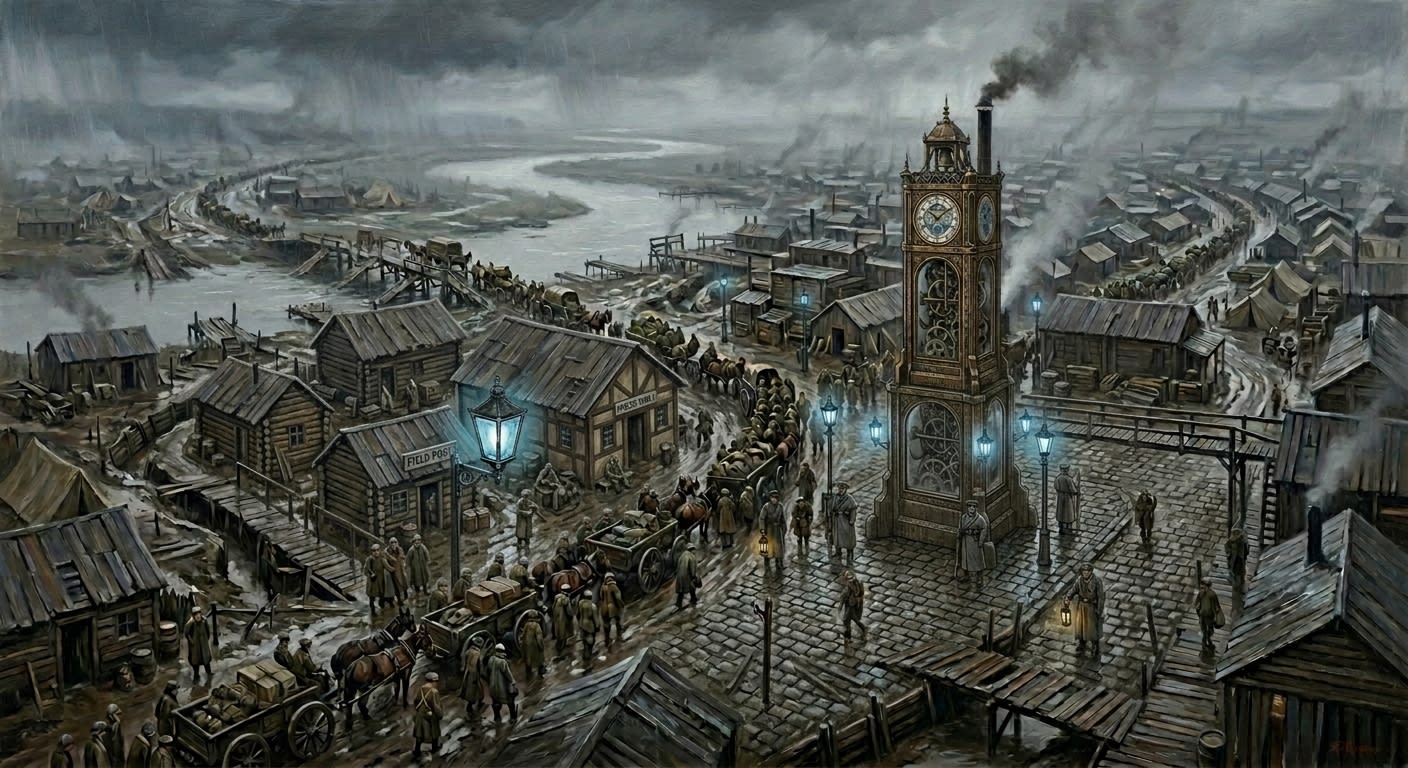
Latchford Permit-Yards is a trench-town on the Sagittal Line's rear-approach corridor — a swollen, ink-stained choke-settlement built around a single muddy ford on the Latch River where the Danubian section of the Line accepts its tribute of men, material, and paperwork. It was founded in approximately A.S. 72, seven years after the Line solidified from desperate entrenchments into continental fortification, when some nameless logistics officer of the Bureau of War determined that a ford checkpoint was necessary to regulate the chaos of supply trains bound for Bastion-Constantinople. That officer's name does not appear in the records. The checkpoint, however, metastasized.
What began as a timber gate and a ledger-post is now three miles of wagon queues, eight named districts, a population that fluctuates between eighteen thousand permanent residents and sixty thousand howling supplicants depending on the convoy season, and a bureaucratic apparatus so dense that the Bureau of Records itself has, on two occasions, lost personnel inside it.
The place is, in architectural terms, a throat. The ford sits at its base — cold mud, plank bridges, the bones of older plank bridges beneath them forming patterns that the Bureau of Rites has inspected and refused to classify. Above the ford, the town rises in stacked catwalks and timber offices, each layer of bureaucracy built literally on top of the last, so that the permit clerks look down on the queue from their lofts like raptors scanning a river for fish. Below, the drainage canals carry the runoff of a hundred thousand documents toward the Paper Sump, where the discarded lives of the administratively inconvenient dissolve into acidic ink and algae.
The locals call it the Yards. Soldiers call it Ink-Mire. The Bureau of Records calls it "Latchford Transit Facilitation Point, Danubian Sector, Sub-Registry 14-C." I call it what it is: the place where the Synod's war machine digests its own paperwork and excretes human beings.
#On the Stamp and the Window
"The queue is penance; the stamp is mercy." — Official yard propaganda, displayed on tin plaques at every gate
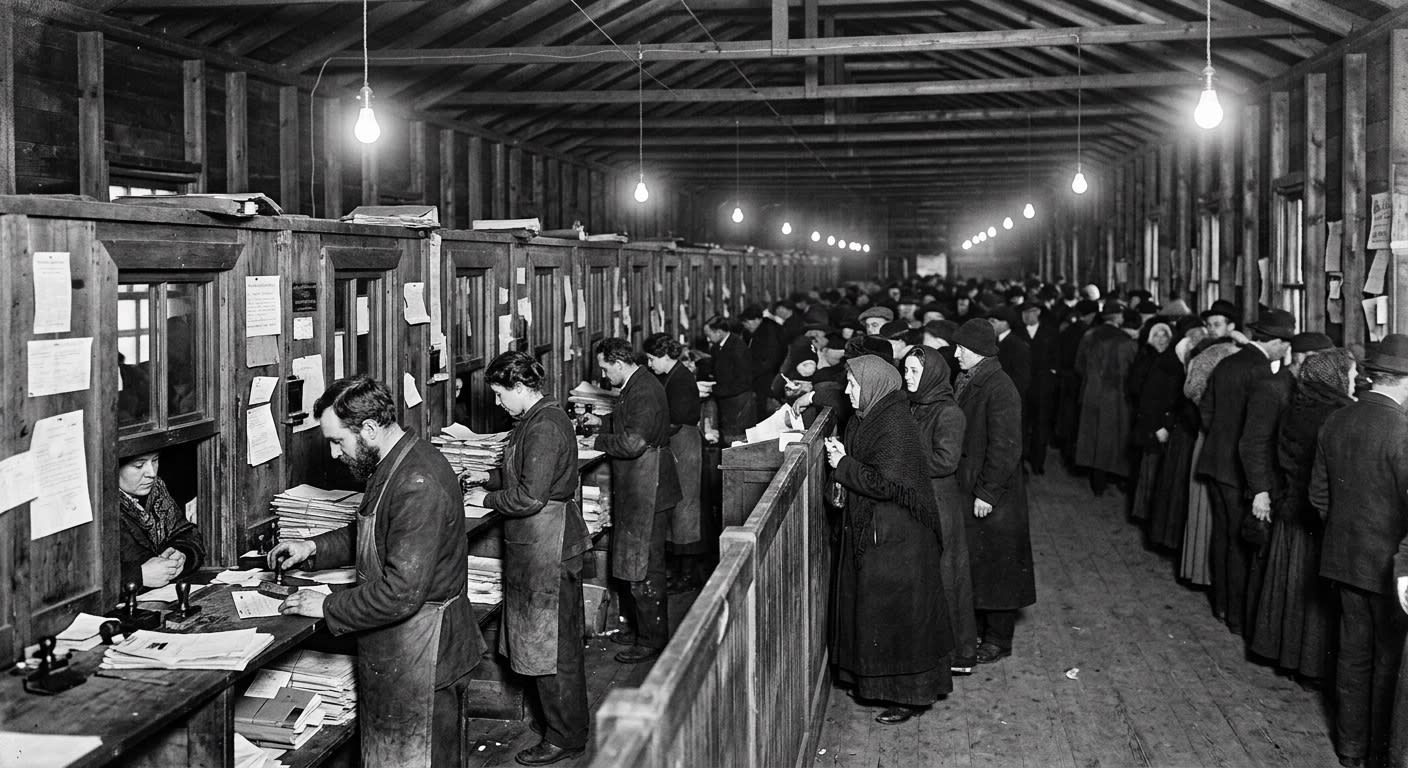
To move through Latchford — to cross the ford, to board a convoy, to exist as a recognized entity within the administrative field of the Bureau of Records — one requires a stamp. To receive a stamp, one requires a window. A window is a unit of time, measured in bell-minutes, during which the Hall of Seals will process a given category of paperwork. Windows are posted at dawn on the Master Gate Clock — a brass and iron mechanism that stands at the centre of the yard-spine like a mechanical confessor — and they close when the bell says they close, which is to say: when the Bureau of War and the Bureau of Records have agreed, through a negotiation conducted entirely in memoranda, that enough souls have been processed for the day.
The Hall of Seals is where the stamps fall. Thirty-two stamping bays, each manned by a permit clerk whose hands are permanently stained with sanctified wax, each bay processing an average of eleven applicants per bell-hour — a number the Bureau of Records considers optimal and the Bureau of War considers an insult to operational tempo. The wax smells faintly of burnt hair. The Bureau of Doctrine assures us this is the fragrance of the sanctifying additives. The Bureau of Doctrine assures us of many things at Latchford, most of them olfactory.
What the stamp grants is personhood. An unstamped individual at Latchford is a "blankface" — a creature of no legal standing, no ration entitlement, no protection under the Yard Tribunal, and no existence in the eyes of the Creator as the Bureau chooses to enumerate His attention. The unstamped may be conscripted without paperwork, seized for labour without recompense, or simply vanish into the Warden Gallery's holding cages, where one cell is — per the Wardens' own admission — "unlisted." What happens to those who enter the unlisted cell is itself unlisted.
The counter-narrative, whispered in the queue fires after curfew, runs thus: "The queue is a cage; the stamp is a leash." The Bureau of Doctrine has classified this counter-narrative as sedition. The Bureau of Doctrine has not, as of this writing, managed to stop anyone from saying it.
#On the Districts and Their Odours
"Warmth is proof." — Latchford proverb
Latchford arranges itself along a spine — the Processional Road, which is the one paved surface in the settlement and serves as the convoy route. Everything else is mud, plank, and sandbag.
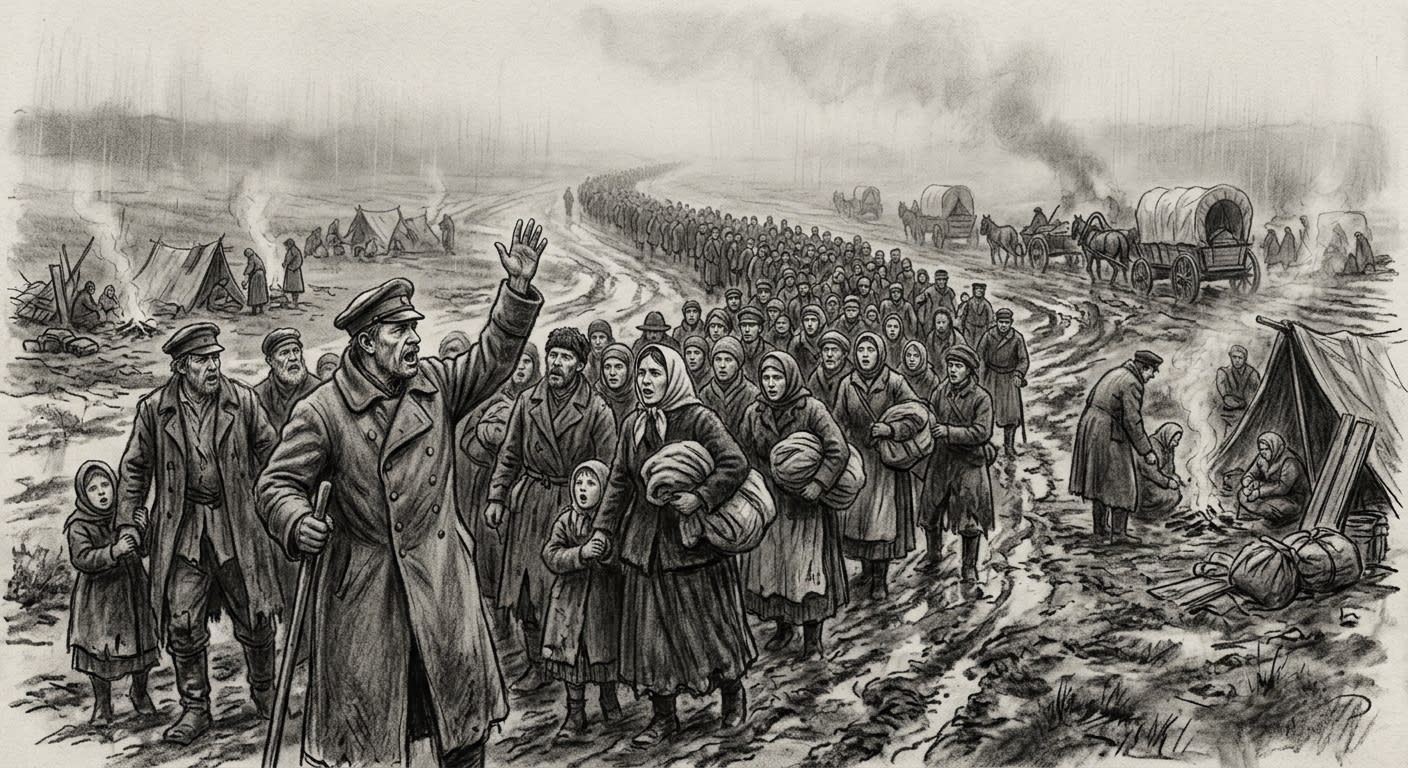
The Long Queue is the settlement's defining feature: a wagon-and-human line that extends up to three miles from the intake gates, swelling and contracting with the convoy season like a snake digesting intermittent meals. The smell is wet wool, horse sweat, sour bread, and despair — which has no smell, properly speaking, but at Latchford it has acquired one through sheer persistence. Families camp in the queue for days. Some have camped for weeks. A woman known locally as the Permit Widow sells her dead husband's travel window one minute at a time, and has done so for three years, and still has minutes remaining, which tells you everything about both the economy and the arithmetic.
The Ration Audit Row is where food is weighed, assessed, taxed, and — if the discrepancy clerks find irregularity, which they always do, because the scales are calibrated to find irregularity — confiscated. The flour fog hangs thick enough to chew. The Tribunal of Discrepancy sits in permanent session. I attended one hearing. A carter had been charged with a six-ounce flour surplus, which the Tribunal treated with the gravity appropriate to a capital heresy. The carter was fined four ration days. He wept. The Tribunal stamped his file and called the next case.
The Clerklofts rise above the yard in stacked timber dormitories where the scribes sleep, eat, and write in shifts that never fully end. Candle smoke stains the ceiling planks black. Ink permeates the linen. The clerks are the settlement's aristocracy — stamped, sated, warm — and they know it. A Latchford proverb: "A clean seal beats a clean soul." The proverb is older than the settlement. The settlement grew up around the proverb like scar tissue around a splinter.
The Warden Gallery houses the garrison — modest, morale-brittle, supply-constant-crisis. The holding cages smell of oiled leather and piss. The chain towers at the settlement's approaches mount artillery grids that the Bureau of War has tested exactly twice and the Bureau of Engineering has condemned exactly once. The condemnation was filed. The artillery remains.
#On the Minute Market and the Currency of Time
"If you argue with time, time wins." — Latchford proverb
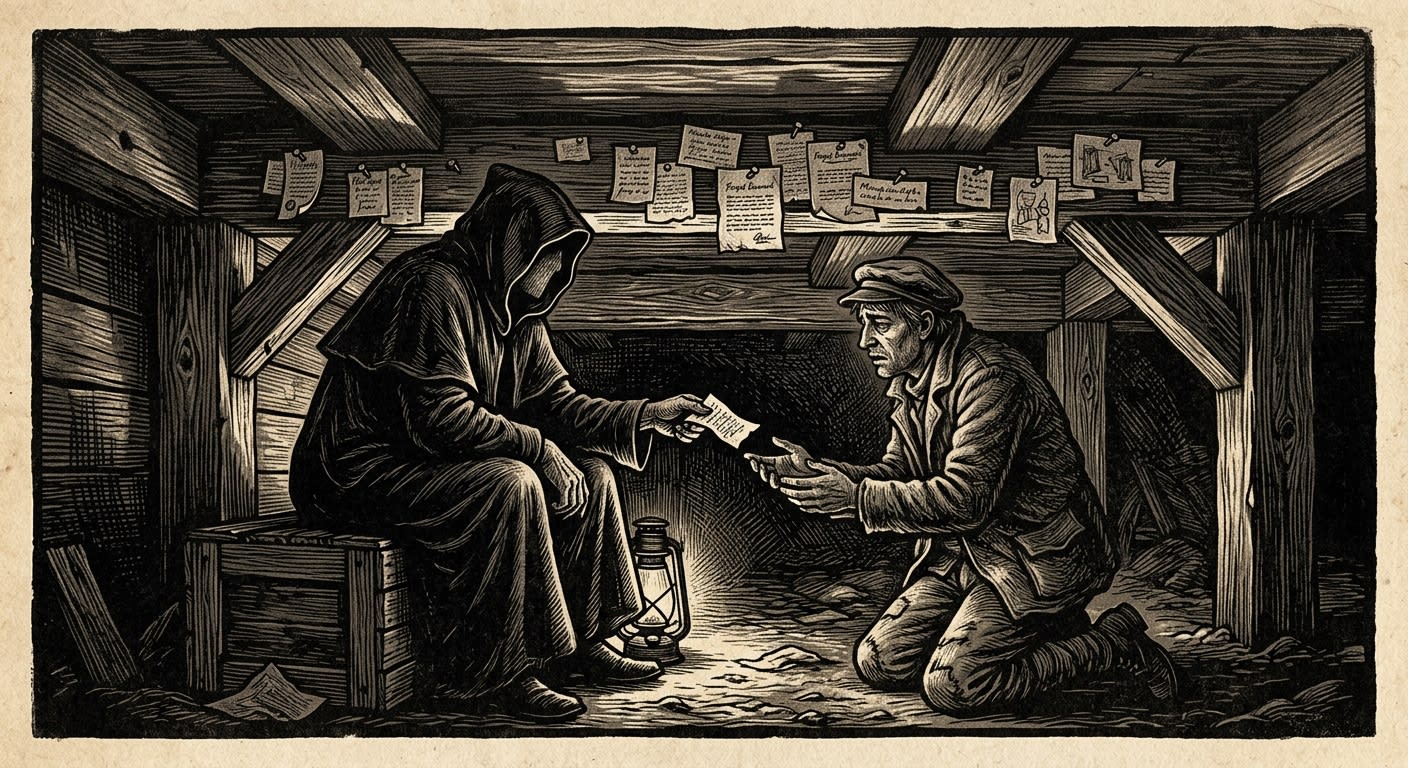
Beneath the catwalks, in the crawlspace between the legitimate settlement and the drainage canals, the Minute Market operates. It sells what the Bureau sells — time, identity, movement — at prices the Bureau would find theologically objectionable and economically competitive.
A "minute" at Latchford is not sixty seconds. A minute is a unit of bribery — a quantum of purchased time that can extend a window, accelerate a stamp, or defer a draft sweep. Minutes are denominated in minute-slips, which are forged documents of such exquisite craftsmanship that the Bureau of Records has, on three confirmed occasions, accidentally processed them as genuine. The man who runs the Minute Market is known only as Old Sable, and he has operated beneath the catwalks for longer than most clerks have operated above them. He sells kindness as a premium add-on. He sells survival as the base product. The Bureau of Shadows is aware of him. The Bureau of Shadows has not moved against him. Draw your own conclusions.
The economy of Latchford runs on four currencies: ration chits, stamped paper, bone tokens, and minute-slips. Coin is secondary. What counts as wealth is warmth, ink, identity, and distance-from-the-yard. The greatest luxury a Latchford resident can possess is a clean departure — papers in order, stamps uncontested, the ford crossed without incident — and it is a luxury that the settlement's entire apparatus is designed to make as expensive as possible. The throughput is the product. The delay is the price. The Synod profits from both.
Debt at Latchford is enforced by the Wardens and the Bureau of Records jointly. Payment can become labour consignments, family collateral, or "night service" in the culverts — which is a euphemism the Bureau of Mercy has declined to investigate and the Bureau of Doctrine has declined to define. The class structure of the settlement is brutally legible: the Stamped and Sated at the top (clerks, officers), the Licensed Labour in the middle (queue shepherds, tradesmen), the Unwindowed below them (stuck in line, no valid time slot), and — at the very bottom — the Erased-but-Used, who work the culvert crews and the night cleaning shifts, who have no papers and no names, and whom the Bureau counts only when counting them is convenient, which is never.
#On the Night Sweeps and the Missing
"Never trust a bell you didn't see struck." — Latchford proverb
After curfew, Latchford changes. The lanterns go "counting-bright" — a cold, blue-white illumination that makes faces legible at thirty yards and shadows impossible to inhabit. The patrol routes tighten. The bell schedule shifts to shorter intervals that confuse outsiders and orient the Wardens. The Minute Market moves under boards. And the Night Sweepers come out.
The Night Sweepers are — officially — sanitation crews. They wear no insignia. They carry forged writs. They move through the culverts and the Silent Zones with the practiced efficiency of men who know exactly which rows of the queue will not be missed in the morning, and they take them. Where the taken go is a question that Latchford's residents have learned not to ask, because asking it is the fastest way to join them.
Previous administrative reports from Latchford, compiled under the supervision of Records Sub-Prefect Harlan (since transferred), asserted that "no disappearances attributable to institutional action have occurred within the settlement boundary."
This is correct. The settlement boundary, as defined by the Bureau of Records in A.S. 194, excludes the culverts, the Silent Zones, the Paper Sump, and the ford. Disappearances occurring in these areas are, per definitional remit, disappearances occurring outside the settlement. The Bureau's accuracy is, as always, beyond reproach.
The public rumour says the Night Sweepers take only criminals. The street-truth — half true, as all street-truths are — says they take anyone whose papers could fix a discrepancy. The buried truth, which I am recording here because the Bureau of Doctrine has authorized me to record everything and the Bureau of Shadows has authorized me to record nothing, and these two authorizations cancel each other into a silence that sounds remarkably like permission, is that the disappeared are fed to something. The Master Gate Clock requires minutes. The minutes come from somewhere. The equation, once stated, is simple enough for even a Sub-Prefect to solve, though no Sub-Prefect has been invited to try.
#On the Ford and What Lies Beneath
"The queue remembers." — Latchford proverb
The ford itself — the Latchford Crossing, the one piece of genuine geography in this temple of paperwork — sits at the settlement's base, where the Latch River spreads across a shallow mud flat spanned by plank bridges built on the bones of older plank bridges. The bones beneath the planks form a pattern. The Bureau of Rites inspected the pattern in A.S. 195 and refused to classify it. This refusal is itself classified.
The locals call them Minute-Eddies — tiny time-shears that cluster around the ford and the Master Gate Clock. Clocks drift. Bells double-tap. People swear they have lost two to five minutes. Stamps appear for events that have not yet occurred. The countermeasures are salt lines on thresholds, wax seals on boots, and walking only on the painted queue boards — superstitions that are, in the professional opinion of the Bureau of Rites, "not fully wrong," which is the most alarming endorsement the Bureau of Rites has ever issued.
The local superstition: "If you hear your name in the bell, don't answer." I did not hear my name in the bell. I am grateful for this. I am also unable to confirm that the bell did not say my name, because the bell at Latchford says many things, and not all of them are audible to the listener they concern.
A batch of blank master-permits disappeared from the Hall of Seals in late A.S. 199. The night sweeps intensified. The Master Gate Clock drifted by five minutes on the seventh of Corvus, A.S. 200, rendering half the settlement's papers temporarily invalid. The Yard Tribunal processed forty-seven cases in a single bell-hour. Prefect Tull smiled throughout. Quarter-Commander Brune requisitioned additional holding cages. Old Sable raised his prices.
The ford endures. The queue endures. The settlement, which exists for no other purpose than to digest the passage of human beings through the machinery of the Bureau, endures — because the machinery endures, because the war endures, because the stamps endure, and because, at Latchford, the distinction between a human being and a piece of stamped paper has been so thoroughly eroded that the Bureau of Doctrine no longer considers the distinction worth maintaining.
#On the Master Gate Clock and Its Appetite
"A clean seal beats a clean soul." — Latchford proverb
I have reserved the clock for last because the clock is the thing the Bureau does not wish discussed, and I am the Bureau's most faithful servant, which is to say I am the servant who knows which obediences matter and which are decorative.
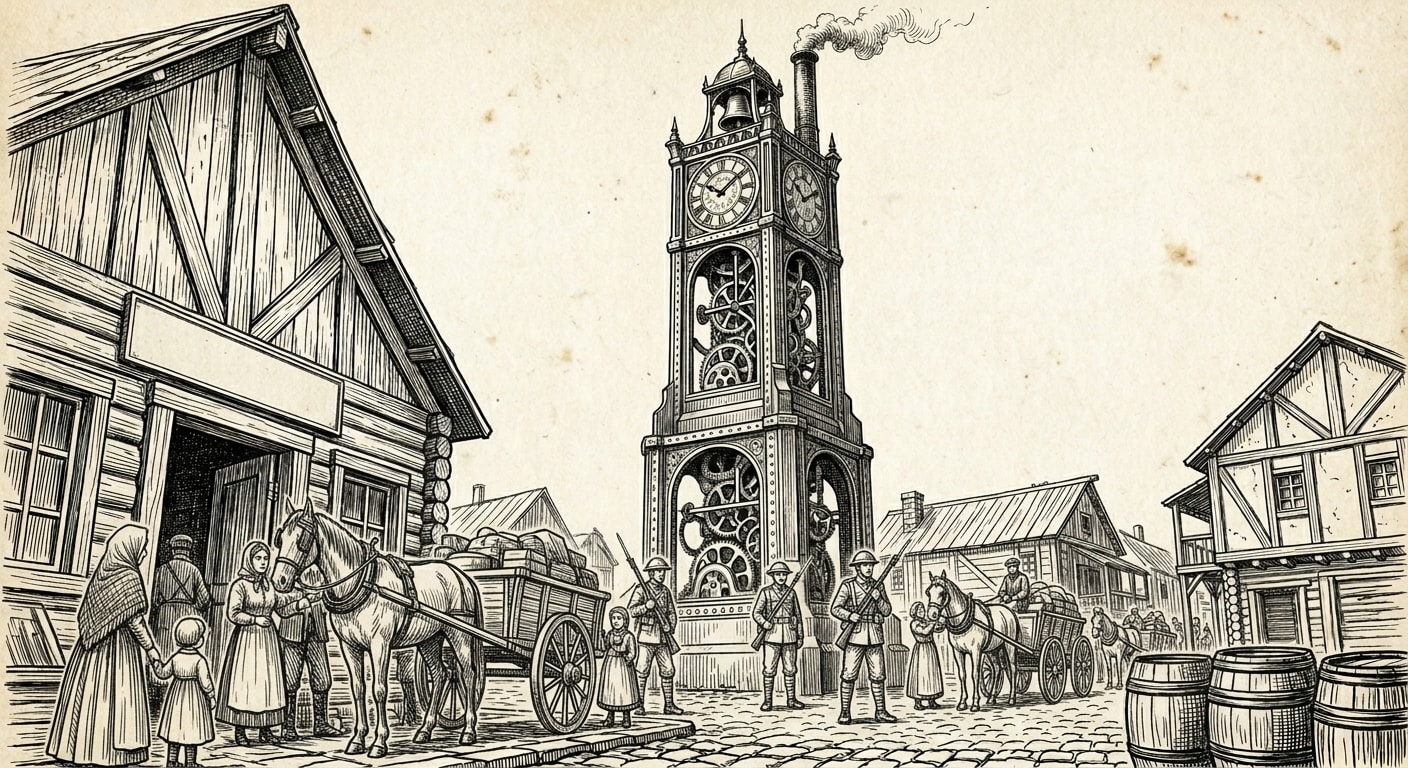
The Master Gate Clock was installed in approximately A.S. 110, when the Bureau of Records determined that the convoy throughput required mechanical regulation. It is a brass-and-iron tower mechanism that posts the daily windows, governs the bell schedule, and dictates — with a precision the Bureau of Bells has certified as "doctrinally adequate" — the pace at which the settlement processes its human cargo.
The clock drifts. This is known. The clock drifts in ways that mechanical clocks do not drift — losing minutes in clusters, gaining them back at intervals that correspond to no known maintenance schedule, occasionally producing bell-strikes that the bell-ringers do not remember initiating. The Bureau of Engineering has inspected the mechanism nine times. Each inspection has produced a report. Each report has been filed. No report has been acted upon, because acting upon a report would require admitting that the clock behaves in a manner inconsistent with the Bureau's understanding of clockwork, and the Bureau's understanding of clockwork is — by doctrinal decree — comprehensive.
The buried truth, which is buried only in the sense that everyone at Latchford knows it and no one at Latchford says it, is that the clock is fed. The minute-eddies at the ford, the missing persons from the night sweeps, the stamps that appear before their events — these are symptoms, and the clock is the disease, or the cure, or both. Something beneath the ford requires stabilization. The minutes siphoned from the queue, from the eddies, from the disappeared, are the stabilizing agent. What is being stabilized — whether it is the ford, or the river, or something older than either — the Bureau of Rites will not say, and the Bureau of Rites' refusal to say is, at Latchford, the closest thing to a confession the settlement has ever produced.
Prefect Mavren Tull controls the blank permit stock and smiles like a stamp press. Quarter-Commander Hesta Brune controls the convoy priority lanes and sleeps, I am told, with a loaded requisition form under her pillow. Old Sable controls the Minute Market and has never been seen in daylight. Between them, they own the settlement — the official apparatus, the military apparatus, and the shadow apparatus — and the Bureau of Shadows, which owns them all, watches from a distance it finds adequate and they find insufficient.
The clock ticks. The queue shuffles. The stamps fall. The ford endures. And the settlement, which is not a city and not a fortress and not a prison but contains elements of all three in proportions that the Bureau of Doctrine has ruled "administratively harmonious," processes its daily ration of human souls and sends them forward to the Line, or backward to the heartlands, or downward into the culverts, which is — at Latchford — the same as nowhere at all.