

#On the Market's Station
"Warmth is evidence." — Candle-Sump proverb, quoted in the Wickmarket mostly by people who have none
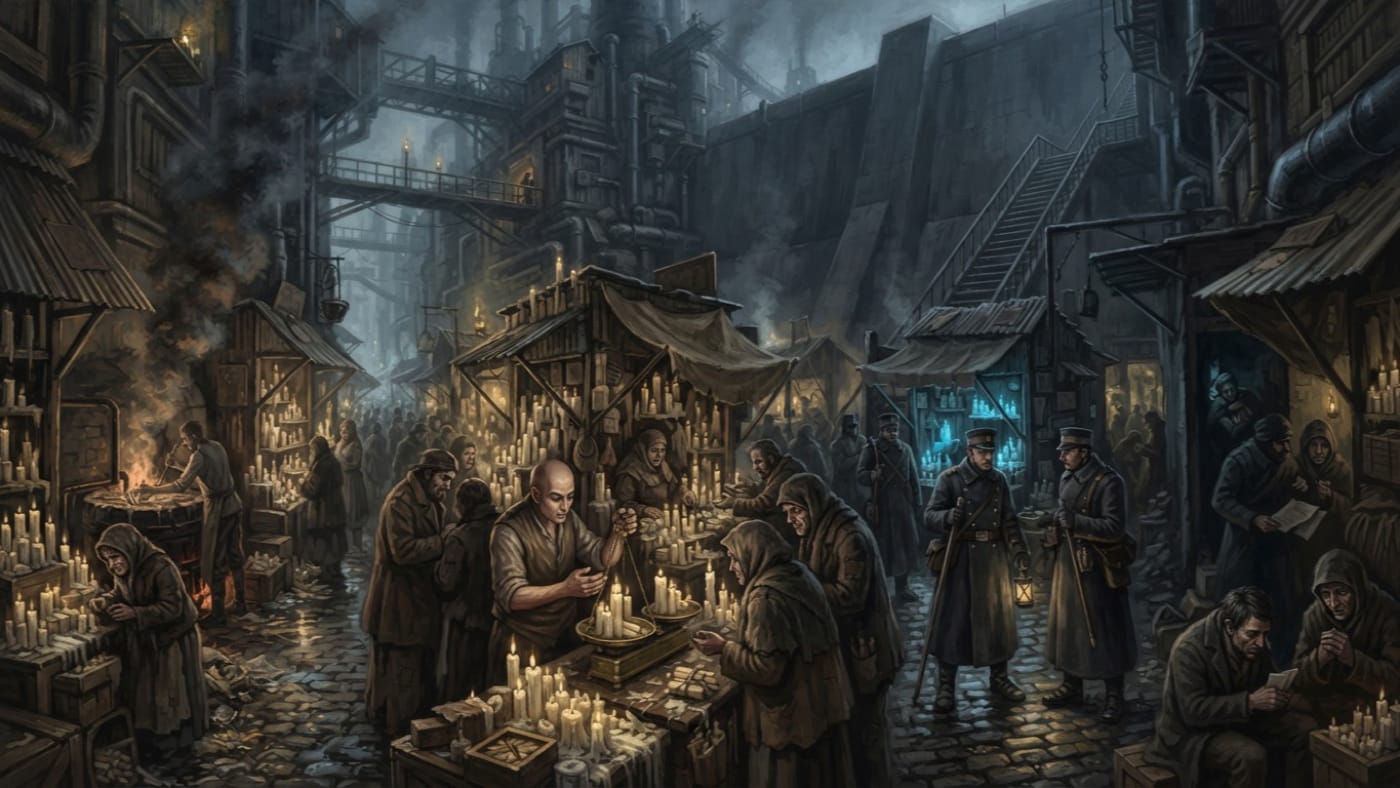
In the Wickmarket the tallow is auctioned before any candle is made, and the bidding begins with a smell. Warm wax, singed hair, and a pinch of spice stirred into the cheaper lots to help them sell: that is the Wickmarket of the Candle-Sump District. It is one of the eight named wards along the canal spine of Lower Vire, below the floodwalls and above nobody who matters. Its stalls sell candles. Its auctions sell what candles are made of. Its pickpockets sell nothing, and they are the most honest merchants in the ward, because they make no claims about the goods.
The labour comes in two kinds. Renderers stand over the vats, where tallow and bone-fat are boiled down into something that will hold a wick. Wick-braiders twist the fibre. Their fingers are burned smooth, so a braider of twenty years has fingertips as blank as an unissued tag. The Registry has no objection. It prefers its identities on paper.
The market's best customers never come down to it. Upper Vire Heights buys Sump candles in bulk and credits them to its own chandlers, so the candles lit in the drawing rooms above are certified clean and made here. The Heights have never visited the Wickmarket and have never needed to. The skiffs and the stairs carry the candles up, and the refuse comes back down the same way, free of charge.
#On Wick, Tallow and Permission
The Wickmarket is the territory of the Candlewright Compact. The Compact owns the rendering vats, keeps inspectors and holds a monopoly on wick fibre and tallow. Anyone who sells a candle in this ward is selling the Compact's fat on the Compact's fibre, and pays for the privilege. The record lists the guild's methods as price squeezes, sabotage and inspection bribes. I have the list. I do not have a name, date or incident for any act of sabotage, and I will not supply one from my own imagination, which the Bureau of Doctrine has more than once asked me to keep sheathed.
The Wickmarket is administered under the Compact, by the same arrangement that binds the Prefecture, the Registry and the Kitchens.
There are two Compacts. The joint authority compact renewed in A.S. 187 binds Prefect Mott, Chief Clerk Voss and Matron Ilka, and the market falls under it like the rest of the district. The Candlewright Compact is a guild. It signed nothing with those three, and it needs no signature to set the price of a candle. The struck sentence was drafted by a clerk who trusted the noun.
The law of flame is short. Every open flame in the district must be registered. An unregistered flame may be charged as arson or as heresy, and the officer who finds it chooses which, according to mood. The candle levy is assessed per wick. Each day at the Wick Blessing, inspectors mark approved candles with an ash-cross, and at midday, between the tag queues and the skiff rush, the wicks are inspected again. A candle without its cross carries a question. The documents before me do not say whose inspectors hold the ash on a given morning, the guild's or the district's, or which office collects the levy. I note only that the Compact keeps inspectors and that inspection bribes are among its methods. The reader may draw the diagram. I will not initial it.
District currency comes in several forms: ration chits, stamped paper, bone tokens, care credits and the occasional coin. The Wickmarket takes all of them and one more besides. A bribe paid in candles is called wick-pay. The Compact therefore supplies the district's light, its heat and a good part of its corruption, and it profits on all three.
As of A.S. 201 the Compact has declared a wick blight and tripled its prices. The declaration is established. The blight is not. I have seen no blighted fibre, no survey of the crop and no finding from the Bureau of Alchemical Standards, which has its hands full with the Sump's air. What I can record is the consequence. Fires are going out across Lower Vire in households that cannot pay three times what they paid before. Where the proverb holds warmth to be evidence, a cold room reads as a confession. Families who burned candles for their dead in three stages (name, debt, silence) are now choosing which stage to leave out.
#On the Back Lanes
At curfew the lanterns are rationed, the patrols withdraw along the Coughwalks, and the Wickmarket becomes a whisper-market. The stalls stay open. Their keepers lower their voices.
After curfew the back lanes trade in what the district fears. There are cough tonics for failing lungs and tag-ink for papers that need amending. There are quarantine ribbons for people who would rather choose the colour they are confined under. And there are clean identity slips. The lanes share this trade with the Washhouse, whose cartel brokers smile too cleanly for Candle-Sump and never cough. The Wickmarket is where the goods change hands. Where they come from is a different file.
The slips are the costly item. A clean slip turns a deserter into a pilgrim or a debtor into a dead man's heir, and it does so with paper, ink and seals the Bureau of Records would recognise as its own. The parent assessment describes a shadow registry beneath the district: names drawn from the crypt drafts and laundered upward into the Great Ledger. I will not repeat its workings here. The Wickmarket is the counter, not the press.
The back lanes have limits, and they observe them more strictly than the front stalls do. No broker in Candle-Sump sells a true Inquisitorial waiver, at any price the Sump can name. The district record lists quarantine clears and blank master-tags as the only things here not for sale. The same record says ribbons are sold. I note both statements and decline to reconcile them. A ribbon bought in a back lane remains a ribbon until a Provost reads it, and falsifying one crosses a red line in this district. The buyer pays for a colour and a risk, and only the colour is guaranteed.
#On the Blue Candles
Around the Wickmarket, three different things burn blue, and the Bureau's clerks file all three in one drawer.
The first is the report. Candles near the crypt mouths are said to burn with a cold blue flame. The crypt drafts carry rot-spores and what residents call name-whispers, and candles near the vents gutter in patterns that look like letters. The blue-burn is feared enough to have its own superstition: if your candle burns blue, do not say your name that night. I offer no explanation, and the Bureau has not asked me for one.
The second is the merchandise. The Wickmarket sells counterfeit blue-burn candles. District contraband lists put blue-burn candles beside blank tag stock and master-seal wax, which tells me the authorities treat them as seriously as forged seals. I have seen no recipe, no maker and no test that could tell a purchased blue flame from one that came unbidden. The candles are on sale, and that is all the record supports.
The third is the denunciation. The Quarantine Provosts treat blue-burn reports as actionable. On a report, the residents named in it are taken from their beds for doctrinal health assessment. The residents have learned to report blue-burn mostly when they want a neighbour gone. A report costs nothing. A candle to back it up can be bought two lanes from the stall where the neighbour sells his tallow.
The guild is not accused here. The record does not connect the Candlewright Compact to the counterfeit candles or to the crypt anomaly. A Hieromnemon who made that connection on the record's behalf would only be practising the Provosts' method in a finer hand.
#On the Present Condition
In A.S. 201 the Wickmarket sells candles at three times their former price to a district whose fires are going out. The auctions continue. Inspectors still make the ash-cross at the Wick Blessing, and the levy still falls per wick, on fewer wicks.
Around the market, the district's quarrels go on. The Registry and the Sluice Prefecture dispute who owns the seized clean slips, and some of those slips passed through these lanes before they were seized. The Care crews threaten to strike if rations are cut again. Rot-lung has worsened in the Paper Loft Quarter. The Washhouse is reported to be planning a mass identity swap, and Matron Ilka is reported to be using the ration crisis to press for the Kitchens' autonomy. None of this has happened yet, and all of it will be planned by candlelight bought here.
A transfer order for Inquisitor Halvyr is moving through the Bureau of Purity's approval chain. Halvyr carries a portable audit press and burn authority. The order has not been approved, and Halvyr has not arrived. I make no forecast. The stallholders have made their own, and none of them has registered it.