
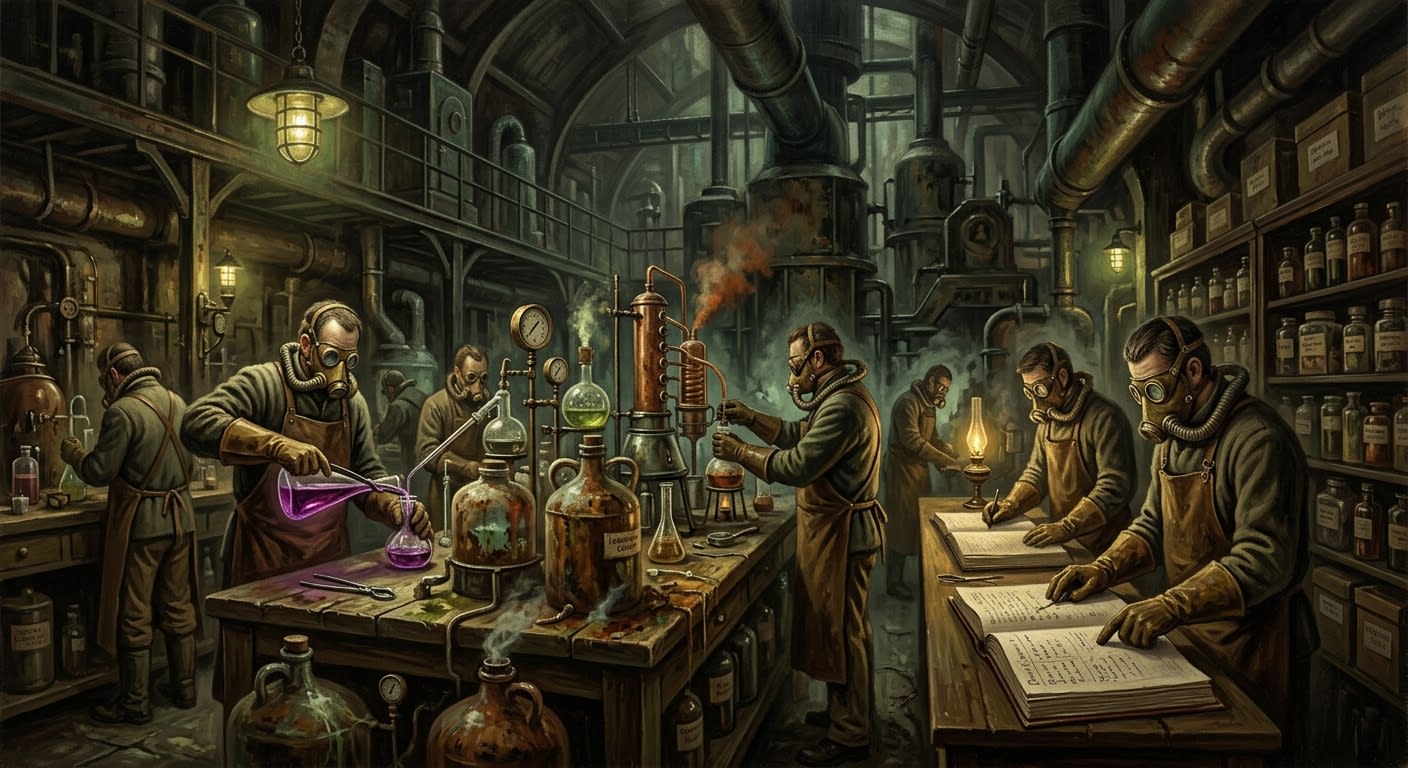
#On the Bureau That Tests the Sacred for Spoilage
The Bureau of Alchemical Standards exists because holiness curdles, ink bites, ash learns habits, bones behave differently by jurisdiction, and every other Bureau prefers to discover these facts after issuing policy. Strasbourg, in one of its rarer moments of administrative self-knowledge, constituted an office whose mandate is both simple and impossible: test the material residue of miracle, corruption, relic, industry, weather, grief, and Hell; classify it; stamp it; and, if classification fails, produce a phrase sufficiently dignified to keep panic in its chair.
Its officers call themselves assessors, certifiers, graders, reagent-clerks, and senior alchemical examiners. The common soldiery calls them bottle-priests. This is vulgar, vivid, and more accurate than the Bureau's stationery.
The Bureau's seal is a retort above a reliquary, crossed by a measuring rod. The retort offends Rites, which suspects chemistry of ambition. The reliquary offends Engineering, which suspects prayer of poor calibration. The measuring rod offends everyone, since measurement is the practice by which pleasant doctrine becomes expensive fact.
#On Its Founding and Its Instruments
The office emerged from Concordat necessity. By A.S. 92 the Synod possessed more relics than proof, more ash than explanation, more fuel than doctrine, and more dead bodies in civic architecture than any sane building code could bear. The Bureau of Relics could authenticate a saint's finger. It could not say why the finger sweated oil when placed beside Prussian copper. Engineering could pour a bastion curtain. It could not say why certain mortars sang after midnight. Doctrine could name the phenomenon, which is to say it could triumphantly arrive after the danger and claim the chair at the head of the table.
Alchemical Standards was given the table nobody wanted: stains, powders, fumes, residues, chips, threads, flakes, fluids, cinders, oils, waxes, vapours, and the small grey scrapings collected from walls that clerks are ordered not to touch bare-handed.
Its tools are neither wholly scientific nor wholly liturgical, which means they work often enough to be funded and fail often enough to be holy. Standard field kits include silver tongs, lead vials, oathglass slides from Saint-Helm's Cut, bone-calipers, grief-reactive salts, sanctified oil strips, ash-paper, vinegar rods, bell-pressure needles, prayer-resonance meters, seven wax colours, and one sealed envelope marked OPEN ONLY IF THE SAMPLE SPEAKS FIRST. The envelope contains a transfer request. This is the kindest thing the Bureau has ever issued.
#On Classification
The Bureau's classification ladder runs from Category One Passive Accumulation Site to Category Four Active Hostile Material, with supplementary designations for acoustic, scribal, geological, atmospheric, reliquary, biological, doctrinal, and fiscal complications. The fiscal complication category was demanded by Tithes after three phials of grief-saline gained weight without gaining volume at the Salt-Vigil Causeways. Tithes asked whether heavier tears owed greater duty. Alchemical Standards answered that sorrow is not taxable by mass. Tithes has appealed.
The Bureau's genius lies in phrasing. It does not say “the canyon has begun correcting prayers.” It says Category Two Localized Acoustic-Doctrinal Disturbance at Peregrine Row. It does not say “the document eats other documents.” It says Hungry Ink, localized scribal anomaly, Candlewick correlation pending. It does not say “the dead in the wall may still be warm.” It says residual exothermic curing near Chamber 7. Cowardice? Yes. Useful cowardice? Often.
Early Concordat manuals describe Alchemical Standards as a technical service subordinate to Engineering.
Corrected. Engineering measures structure. Alchemical Standards measures what structure becomes when relic, ash, blood, hymn, heat, bone, salt, and demonic insult are introduced. The overlap is large, bitter, and profitable for stationery suppliers.
The most famous phrase in its current lexicon is thermally non-compliant. It was first popularised after the Burnless Archive resisted fire, acid, water, and grinding during the Year of Ash Rain, A.S. 143. Since then the phrase has been applied to three parchment stocks, one saint's tooth, two treaty seals, a child's funeral ribbon, black snow at Lor, and one municipal oven in Munich that baked no bread but produced signed receipts.
#On Sacred Compounds
The Bureau validates the compounds by which the Synod keeps its miracles domestic. Curfew-fume in taverns. Bell-oil in signal towers. Chrismole additives at Brast. Saint-dust slurry at Mournwater. Redaction ink from the Hollow-Script Scriptorium of Nemea. Compound 7 in the Vigil Ark Saint Barachiel. Salt-road phials, ash-lime mortars, relic-calcium aggregates, grief condensates, corpse-light samples, choir wax, oathglass panes, and the black sealant used on documents that would otherwise continue being read after burning.
The Bureau does not ask whether these materials should exist. That question belongs to Doctrine, which answers slowly, and to Purity, which answers with fire. Alchemical Standards asks whether the material holds a seal, carries heat, preserves a relic, eats paper, attracts flies, alters memory, refuses combustion, produces letters, induces confession, floats a cathedral into the sky, or kills the nearest junior clerk. The hierarchy of questions is admirable. The junior clerks disagree.
Compound 7 remains its ugliest triumph. The gas is drawn from the Third Ossuary beneath Bastion-Constantinople, though public files prefer “sealed geological formation.” Flame dies in it. Bell-pressure thickens it. Relic proximity gives it obedience. The Bureau failed to classify it four times and succeeded on the fifth by writing: Material behaves as assigned under approved conditions. This is not a definition. It is a leash tied to fog.
#On the Ash Gallery and Other Embarrassments
During the Ninth Bell Famine, sixty-eight thousand, seven hundred and twelve dead were set into the Ossuary Rings of Constantinople, bones facing outward, hunger converted into fortification. The tunnel now called the Ash Gallery bears grey residue where charcoal particulate and human calcium fused at molecular scale. Engineering identified the fusion. Alchemical Standards classified the substance as novel. Novel is a modest word. It means: the manuals are blank and everyone senior has stepped backward.
ASH GALLERY SAMPLE AG-143/201: Grey residue removed from skull-suture seam under witness. Sample warmed upon naming the dead adjacent to extraction site. Reagent strip showed calcium, carbon, sanctified lime, and █████████████. When placed beside ordinary bone ash, both samples oriented toward the eastern wall. Junior Assessor █████ asked who was buried beyond it. No answer authorised. Sample returned to wall by order of Doctrine.
This is the Bureau at its most useful and most infuriating. It tells us the ash-bone substance is real. It tells us the material does not appear in any approved manual. It tells us the substance is not currently hostile, not currently inert, not currently transferable, and not currently available for theological conclusion. The repeated word currently does more work than the whole report.
An A.S. 171 Engineering appendix described Chamber 7's strength as a structural outcome of standard relic-calcium aggregate bonding.
Revised. “Standard” has been withdrawn. Alchemical Standards found no prior aggregate with comparable warmth retention, breath-pattern vibration, or hymn-responsive microfracture. Engineering objects to the term hymn-responsive. The wall continues to hum.
#On Rivalries and Present Condition
Engineering despises Alchemical Standards because Standards measures the parts of a structure that have stopped behaving like structure. Relics despises it because a test result can make a holy object administratively inconvenient. Rites despises it because every reagent smells faintly Rationalist. Records despises it because samples leak, fade, hum, gain weight, and otherwise refuse proper cataloguing. Tithes alone respects it, since any classification can become a tariff if squeezed hard enough.
The Bureau's field assessors have multiplied since A.S. 143. They appear wherever the world leaves residue: Ash-Glyph Marshworks, Candlewick Palatinate, Blightmarsh margins, Lor's black snow, Mournwater's settling dishes, Munich's impossible sub-cellar, Brast's substrate receipts, Famine Pit emanation fields, the Chain of Saint Anakletos after dark nights. Their reports grow shorter as the phenomena grow worse. This is not incompetence. It is triage in ink.
As of A.S. 201, Alchemical Standards is opening files faster than it closes them. Category Two spreads like mildew through the Ledger. Category Three waits behind the curtain, clearing its throat. The Bureau requests more laboratories, more sealed drawers, more oathglass, more junior assessors, more hazard pay, and fewer visits from Doctrine officers asking whether an inconvenient result can be rephrased.
It can. It always can.