
#On the Citation
"Whether this helps the soldiers or merely annoys them into wakefulness is, per Bureau Internal Memorandum 312-K, 'a matter of vigorous internal debate.'"
This entry is a survey, made in A.S. 201, of a document the Codex knows by a single sentence. The sentence appears in my own entry on Syrion, among the notes on his armies, directly after the passage on the Grey Heralds. It reports that the Bureau of Bells rings more often in the provinces near the Languid Dreamer's front. It reports that the value of that extra ringing is, per Memorandum 312-K, "a matter of vigorous internal debate." It dates the debate from A.S. 160 and records no conclusion.
That is the whole of the evidence, and I will not counterfeit the rest. The Codex holds no issue date for 312-K. It names no author or signatory and records no seal or ratification. A.S. 160 marks when the arguing began, by the account available. It does not tell us when the paper was drafted, and any reader who confuses the two will find the error corrected in the margin.
#On the Office That Rings
The Bureau of Bells decides when bronze may speak. Its peals set the sanctioned hours of labour, prayer, rations, movement and curfew across the Synod's territories, and the provinces live by them. A town does not ask the time. It is told.
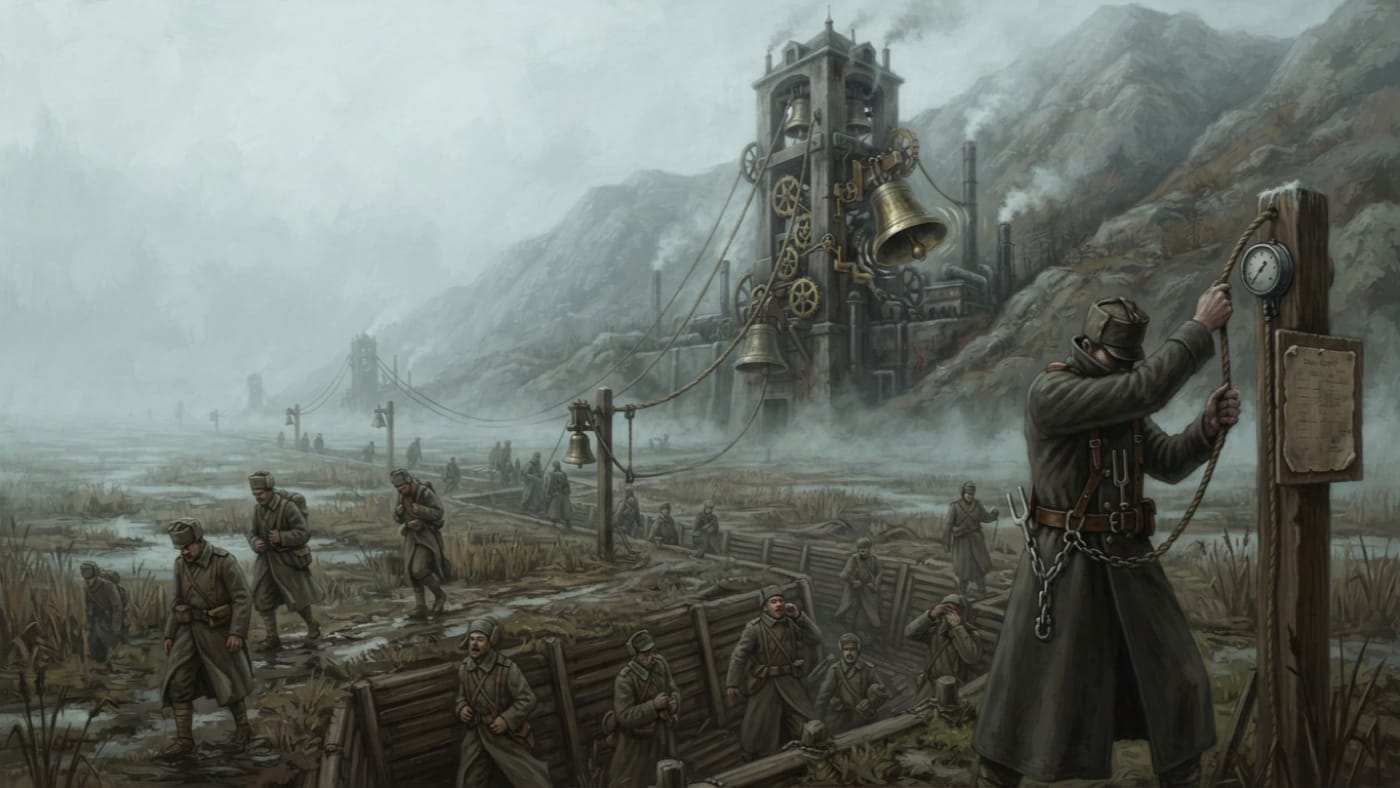
The Bellwardens keep the instruments. They calibrate pitch and strike interval against the peal chart, test each bell with tuning forks, and carry the toll-key on a chain fixed to their own bodies so that it can be neither stolen nor mislaid. They log every deviation. They pay for the work in rope burns along the forearm, brass dust in the teeth, and hearing that goes a little at a time until the warden is the last person in the tower to notice a wrong note.
The chronology is short. The Office of Bells was constituted in A.S. 52 / 1762 CE, under the provisional government, before any formal Synod existed to own it. That Synod was settled at Strasbourg in A.S. 90 / 1800 CE. The Bell Codex, the current standard of sanctioned peals, was ratified in A.S. 115 / 1825 CE. None of these dates tells us anything about 312-K. I list them so that nobody borrows one.
The Bureau of Bells was founded with the ratification of the Bell Codex in A.S. 115.
The Office of Bells was constituted in A.S. 52, under the provisional government. The Bell Codex ratified in A.S. 115 is the current standard of peals and did not create the Office. Bell practices and local bell records may be older than either date. The two events are separate and are not to be merged into a single convenient founding again.
The Bureau regards Syrion's influence as the single greatest threat to institutional productivity. That is the Bureau's own appraisal, and from inside a bell tower it is perfectly coherent. Everything the Bureau produces is a kept hour, and Sloth is an hour lost. In the Bureau's ledger, a province that sleeps through the labour peal has defaulted on a debt.
#On the Front That Must Stay Awake
Bastion-Shipka guards the Shipka Pass through the Balkan Mountains, on the southern reach of the Sagittal Line. It is the last bottleneck before Thrace and the road to Constantinople. Syrion is its assigned adversary, and its garrison is the most heavily staffed with Bellwardens of any on the Line. Below the ridges the approaches cross reed-choked marsh, where the fog settles first. Along those approaches, timing relays carry the peal outward so that trench, depot and reed road march to the same count.
Syrion does not prey on the idle. He prays on the exhausted: the sentry on his ninth night, the clerk whose figures have begun to swim. His fog disturbs the hours, then the memory of them, then the will to go on keeping them. His Grey Heralds come out of it speaking kindly. Rest now. You have done enough. The citation of 312-K sits directly after them in my entry. The placement explains itself: an enemy who recruits by inviting men to sleep can expect a Bureau to answer with noise.
Rest is still lawful. The Synod does not forbid sleep, and a soldier who never sleeps is a corpse that has not yet been told. The Bureau's quarrel is with the sleep that does not end. No published peal chart claims it can tell the two apart by ear.
Irregular wake-bell patterns are among the measures issued against Syrion at fog-adjacent posts. The others are anchor litanies recited while touching boot and belt, enforced movement, stimulants, and the rule that no soldier stands watch alone. These belong to the general doctrine against the Languid Dreamer. None is an authenticated clause of 312-K, and the reader who goes looking for one in this entry will be disappointed.
#On the Controversy
The account allows two readings. In the first, the additional ringing helps the soldiers. In the second, it merely annoys them into wakefulness. The citation does not award the point to either side, and neither will I.
Three things are being confused here, and the Bureau has an institutional interest in keeping them confused. The first is a lawful peal: struck on schedule, in tune, entered in the log. The Bureau can certify this with chart, fork and ledger, and does so daily. The second is a waking soldier, whom any sergeant can confirm by looking. The third is a soldier protected from Syrion. Nobody has certified that, and the passage citing 312-K does not claim anyone has.
The first does not guarantee the second, and the second does not guarantee the third. A tower can ring flawlessly over a trench of sleepers. A man jolted upright by bronze is awake, and whether being awake is enough to refuse a Herald is a separate question. Even the annoyance reading is not a verdict of failure. An irritated sentry is still upright, and the account does not say whether an upright sentry is a safe one. That gap between the readings is the whole of the debate, and the debate has fed on it for four decades.
The Bureau's habits are no secret. It can count the peals it rang. It can count the hours on the chart and the deviations in the log. It cannot count the invitations that were refused, because a refusal leaves no mark on brass. An office that measures its own activity will naturally prefer more of it. I will not say that this preference keeps the bells ringing near the front, because the citation does not say so either. I will say that the ledger shows exactly what the Bureau can measure.
The citation also does not tell us who argues, how they argue, or what they have tried. It says the debate is vigorous. I accept the word. Nobody has ever called it fast.
#On the Present Application
As of this survey, the account stands where it stood. The Bureau of Bells rings more frequently in the provinces near Syrion's front. Memorandum 312-K is cited as the place where the value of that ringing is disputed. The dispute began in A.S. 160 and has produced no conclusion.
The bells go on and so does the debate, and the record does not oblige either to wait for the other. The extra ringing has not been reported stopped for lack of proof, and the debate has not been reported closed for lack of silence. Anyone who wants a stronger finding must find a stronger document. This one says what it says.
At Shipka the relays carry the count down to the reed road. The ringers keep their ropes. The sentries hear the bells, are helped by them or irritated by them, and the Codex leaves that question open, as the memorandum does.