
#On the Naming of Shipka, and Why the Bureau Chose a Grave for a Cradle
"That which once slept shall guard against sleep." — Siting ledger, Bastion-Shipka, c. A.S. 68
A kingdom died in its own banquet hall, and the Synod nailed its name to a fortress in the mud.
The kingdom was Phocis — a valley realm of tidy vineyards and meticulous tax-rolls, whose scribes boasted they could predict a harvest to the bushel. They could not predict Syrion. On the Night of a Thousand Lamps the king raised his cup to toast the Dawn of Reasoned Peace. The musicians struck their first chord. Somewhere between the first sip and the second the court folded softly into sleep — not a fall, but a settling, like dust onto a ledger no one has opened in forty years. For three days the servants shook them. For three weeks the valley bells rang themselves hoarse. In the end the scribes, ever industrious, dutifully noted the absence of royal decrees and continued filing empty ledgers for another year before they, too, forgot to ring for dawn.
From Phocis, Syrion's haze crept valley by valley, softening will, loosening habit, thinning the walls between waking and dream. The royal heartland lies now in what the Bureau styles the Vales of Stagnance — a fog-choked expanse where the sun slides but never rises and rivers wander like sleepwalkers, changing their beds whenever they tire.
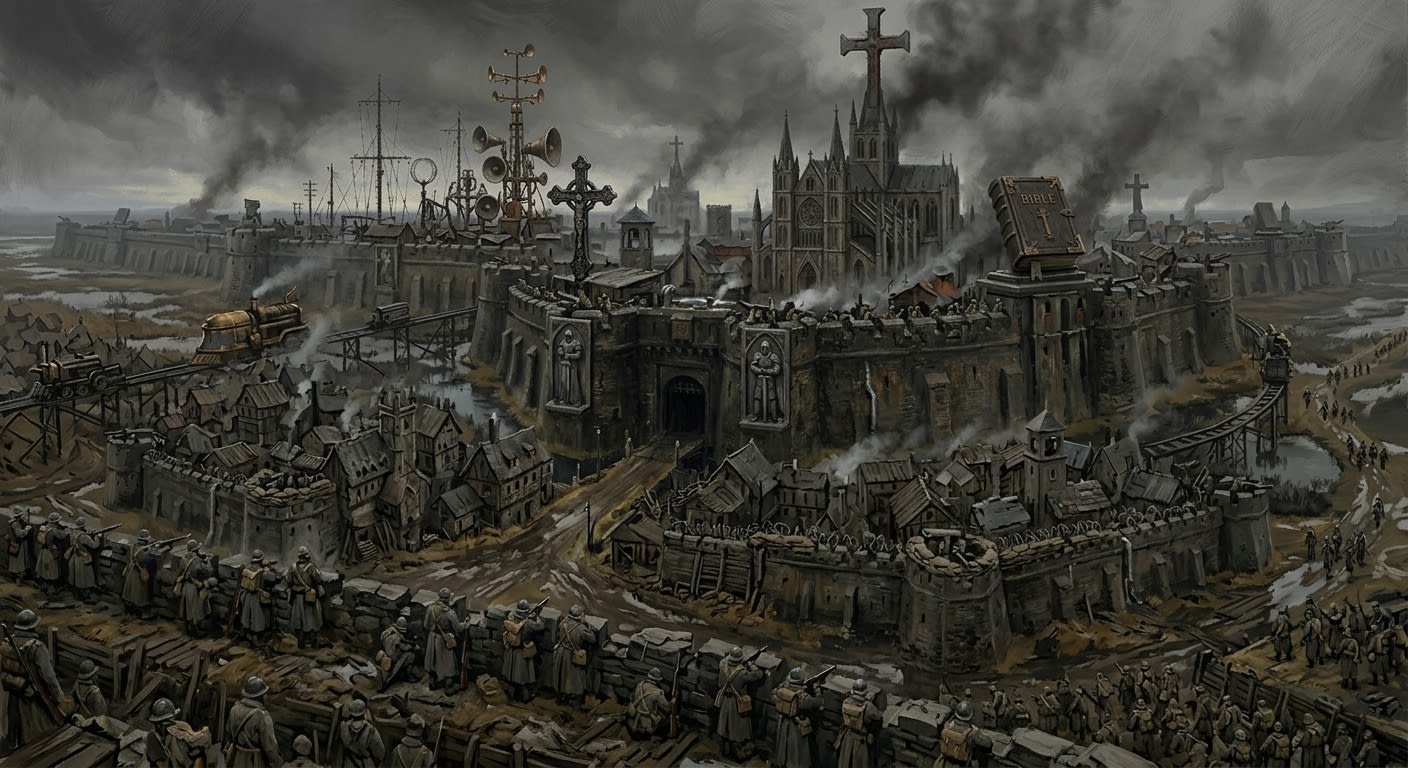
Modern Bastion-Shipka takes its name from that fallen realm as vow and indictment both. When the Synod pushed a line of bastions to the western lip of the fog, the engineers and theologians who stood upon the last firm ground wrote in the siting-ledger: That which once slept shall guard against sleep. The bastion sits where old Phocis's marches once began — a waking scar at the edge of a dream that tried to swallow Europe whole.
#On the Geography, and Why the Mud Is the Enemy Before the Fog
The Sagittal Line runs through mountains and rivers and ruined cities, and at Shipka it runs through a country that refuses to decide whether it is land or water. The Balkan Mountains rise to the south; Syrion's Vales press from the east. Between them the land slumps into a broad, shallow trough — the Phocis Marsh Corridor — where every foolish river and nameless creek that ever tried to find the sea has given up, pooling into black water and reed-choked channels. The soil, where it exists, is a mat of roots and half-rotted turf. A man may stamp upon it and find reassuring firmness or a hidden sink that drinks him to the waist. The marsh does not care which.
Across this instability the Synod has driven a single raised embankment: the reed road, carrying the marsh spur of the Sagittal rail. It is narrow, slightly crowned, faced in fascined brush and rough cribbing — the only thing in all that hissing expanse that pretends to geometric straightness. Bastion-Shipka is built around the inner end of this embankment as a hand clenches about the handle of a knife.
The corridor bears a double stain in the doctrinal maps. To the north and east, the lowlands remember the campaigns of Kargath the Maw, whose hunger turns harvests to slime. To the east, Syrion's veils have pooled into the Vales of Stagnance. At Shipka the two influences do not fully manifest, but they cast long shadows. Convoys arrive with stores spoiled beyond what humidity warrants — grain swollen and sour, oil become rancid gristle. Quartermasters curse "Kargath's breath" and accept the losses as cheaper than rerouting. More troubling is the stillness. Even on days without visible fog, sound falls short of its proper distance on the reed road, conversation thins and dies, and the tramp of boots is muffled by air that should be open and clear.
The Bureau of the Hourglass classifies the corridor as a persistent low-grade stillness field — a Syrionic seepage too weak to earn the dignity of a capital Wound, strong enough that all timing work in the sector must be double-checked against bastion clocks.
#On the Founding, and the Men Who Built a Fortress on Soup
Bastion-Shipka rose during the early consolidation of the Sagittal Line — those decades after A.S. 65 when the Spine was still a patchwork of desperate redoubts and the Bureaus were learning an unwelcome truth: Syrion's stillness did not respect the geometry of generals. It flowed along rivers, pooled in basins, seeped through marshes where watchtowers were rare and discipline grew lax.
The Phocian lowlands proved ideal conduit. Patrols reported fog that deadened sound, mists in which spoken orders fell to the ground like broken glass. Farmers spoke of days that went missing. The Synod decreed a marsh-gate: a bastion sunk into mud at the western edge of Syrion's reach, to serve as stopper in a rotting bottle.
The first architects were drawn from the Order of Litany-Engineers and the Marsh Cartography Division — men and women more familiar with sump pumps than relic cabinets. They salvaged what remained of pre-Syrion Phocian fortlets, ivy-choked towers and half-drowned curtain walls, and knit them into something new: low, thick bastion walls faced with old kingdom stone but mortared with ossuary dust, in keeping with the Spine's practice that the dead should hold the line still. Beneath those walls they sank a lattice of piles and flood-gates — a second fortress inverted into the mud. The earliest pump-rooms were consecrated as chapels of pressure: valves engraved with psalms, gauges ringed in catechism. When the pumps failed, men drowned. When they held, the bastion stood. The founding ledger records that at Shipka, salvation depends upon maintenance schedules as much as upon prayer. Doctrine underlined the second clause. The engineers quietly underlined the first.
By A.S. 190, Syrion's fog had pushed westward enough to demand expansion. The Bureau of War doubled the garrison, extended the reed road's fortified stations, and added a permanent Hourglass field office — three analysts lodged above a narrow suite of rooms, officially on "quiet assignment" after service at hotter fronts, positioned precisely where the Synod most feared to be surprised.
#On What Shipka Guards, and Why the Timetable Is Holier Than the Relic
The catechisms teach that faith feeds the soldier's soul. A pious man still dies if his bread train is late.
Through Shipka's marsh spur pass the mundane miracles of survival: grain from the western provinces, powder and shell-fuses, coal for the furnaces of Constantinople, lamp-oil and timber, bandage-bolts and tinctures. In the other direction, hospital carriages bear the broken — men whose blood leaked out on the trench-lips of more celebrated cities, ferried back to quieter wards where the Bureau of Mercy counts them, patches some, buries others. Shipka does not choose what these trains carry. Its duty is sterner: they must move.
The reed road embankment is the only stable path for leagues. Twice in the annals — once during the Grain Riots of the Drava corridor, once when Kargath's breath poisoned harvests in the Alpine Marches — Shipka's spur bore burdens far beyond its nominal capacity, trains nose-to-tail for days while clerks in Strasbourg congratulated themselves on "resilient logistics." The clerks had never walked the reed road at three in the morning.
But Shipka guards more than sacks and shells. It guards time.
The marsh corridor lies on the western fringe of Syrion's reach. Here, his languor does not yet drown kingdoms, but it seeps — in mists that muffle sound beyond what physics permits, in fogbanks that stretch minutes thin, in the habits of stilt-villages where whole hamlets have been found asleep at their nets. The Bureau of the Hourglass has marked Shipka as TIMING RELAY 7A — a baseline node from which sector-wide bell and telegraph drift are measured. Its bell-towers and signal masts stand watch over seconds themselves. Comparison of its clocks with those of adjacent bastions reveals whether Syrion's stillness field has crept westward by another invisible pace. When a supply train arrives by its own chronometers "on time" but three days late by Shipka's reckoning, the Hourglass scribes add small Sloth-sigils in the margins and send copies to Strasbourg.
The citizen should understand, then, that Bastion-Shipka is a watchtower whose battlements are made of minutes. It holds the line in the very measure by which the Synod orders its prayers and barrages.
#On the Seepage of Sloth, and the Three Manners by Which the Dreamer Nibbles
Official doctrine, written far from the marsh, treats Syrion as a distant, majestic horror: vast valleys of perpetual dusk, cities gone to sleep forever. The truth along the Shipka corridor is smaller and more insidious. Here the Dreamer does not announce himself with spectacle. He nibbles.
Lullaby Offensives. Thin threads of sound braided through fog. Watchmen on the reed road hear distant chimes — half a hymn and half a child's toy, ringing no known bell-code, leaving their eyelids heavy. Telegraph sounders have, on rare nights, tapped out fragments of Synodal hymns no operator was keying, in slow narcotic rhythm. Ladder crews speak of mist-banks that hum at the edge of hearing; those who tarry grow listless, content to watch reeds breathe instead of doing their duty. The Bureau classifies such reports as Syrion-mimetic auditory phenomena. The soldiers call them "the sleepy bells." Both designations are accurate. The Bureau's is merely less honest about the danger.
Time-Bleeds. Patrols return swearing they walked for half a watch to find their shift-horn unmoved. Others stumble back insisting on an hour while the bastion clocks show ten minutes. Horn-codes along the corridor arrive in the wrong order — end-of-shift before mid-watch, Scour pre-signals chimed with no hand on the rope. Water-clocks pause and surge, as if time itself were a reluctant servant. The Hourglass catalogues these as localized stillness fields, sub-threshold; exploitable for calibration — a pious way of saying that Shipka is used as an early-warning gauge for Syrion's westward reach.
Sleep Contagion. The stilt-hamlets under Shipka's tithe supply instructive cases. Entire villages found at dawn with every inhabitant — child, granddam, dog — standing where they were the night before, eyes half-lidded, breath shallow, impossible to rouse. Bastion scribes observed dozing upright at their desks, quills poised above the same half-written word; upon waking, they insist they merely blinked. Doctrine prefers the term mass exhaustion incidents unless Hourglass timing anomalies confirm otherwise. In the margins of those reports, the Hourglass analysts stamp the sigil of Syrion anyway.
Previous Bureau assessments classified the Shipka corridor as "negligible Sloth influence, manageable through standard caffeine and bell-density protocols."
The Bureau of Doctrine has revised this assessment after the loss of Outpost Eleven-West (A.S. 194), in which an entire platoon sat down around a construct resembling a country hearth, closed their eyes, and has not opened them since. The corridor classification has been elevated to "persistent low-grade; active monitoring required." The Bureau does not concede error. The Bureau clarifies.
#On the Scour That Has Not Fallen, and the Fires Held in Reserve
Scour is the holy fire that cleanses corrupted quarters — doctrine's last resort and bureaucracy's favourite threat. Bastion-Shipka has sealed caches in every quarter and along the reed road: drums of accelerant, pre-laid fuses in culverts and sewer runs, resin-soaked wadding in choke-points, all mapped in red on War's charts and euphemised in Doctrine's copies as sanctified purgation channels.
The Scour ledgers record two near-authorisations.
The first came when marsh-fire and sleep contagion flared simultaneously in the outlying stilts. Watchers on the ladders reported households standing amid flames, swaying, clothes alight, making no move to flee. The Order of Ash demanded immediate Scour of the quadrant. Instead, the engineer-captains opened pumps and sluice-gates, flooded a section of the reed road, cut telegraph access to the burning hamlets, and drove back the blaze with brute water and demolition. Dozens died. The stilt-villages were reduced to charred ribs. The fire never reached the main quarter, and no permanent stillness lingered in the survivors. War's after-action summary praised commendable initiative. Purity's unpublished marginalia called it insufficient zeal, borderline softness toward contaminated laity.
The second came when a distant fog-bank resolved under glass into a moving mass: chains dragging through water, a shape the size of a collapsed tower, flashes of iron and pale flesh. A Slumber-Hulk — one of Syrion's chained giants, moving with the speed of centuries. Alarm bells sounded the Wrath-Sloth Convergence code. Choirs mounted the wall. Scour crews unsealed their pitch. For six hours the bastion stood on the knife-edge of ignition. Saturation fire and hymned counter-rhythms pushed the Hulk sideways in its drift, turning its steps parallel to the reed road. It trudged back into deeper mists without entering Scour radius. Ladder-crew graffiti, preserved in a disciplinary annex: Better to sweat six hours than burn six streets.
#On the Defences, and the Jealous Gun Named Aegidius
The crest of the wall carries mixed batteries: squat field-pieces in rust-coloured mantlets, a brace of long guns for counter-battery across the reed road, and the venerable bell-cannon formally catalogued as Exalted Howitzer Saint Aegidius, Third Revision. Its barrel is banded with the names of a minor forest of saints and auditors, each inscription hammered in after a verified intercession. The local gunners swear the piece sulks if left unfired too long, throwing high unless wooed with chant and ash.
The drill follows the standard: one peal and crews snap to posts; two, and powder is sanctified by spit and cinder; three, and the relic-shell is offered into the barrel's throat like a tithe into a collection plate. When Aegidius speaks, the garrison describes it as a low organ pipe felt in the teeth — a pressure that seems to shove the marsh itself a pace further east.
The Choir platforms cling to the marsh-facing walls like barnacles — raised wooden stages bolted into stone, shielded by sloped tin roofing and reliquary screens. Shipka serves as a proving ground for anti-Sloth wake-hymns: brisk, upward-striving compositions designed to jar sleepers back into rhythm when the mists crawl too close. Motifs of ascent and heartbeat — drums mimicking pulse, sopranos scaling ever higher before resolving in sharp percussive refrains. One documented trial successfully roused an entire stilt-village from a three-day communal doze. Another drove several ladder-crew soldiers into forty hours of trembling, bloodshot-eyed wakefulness, insisting that if they closed their eyes the marsh would rush in. The Bureau classified this as over-correction of Sloth toward Wrathful alertness. Subsequent revisions shortened the refrain.
Captain Varik's Scour company rounds out the bastion's prepared eschatology: masked fire-crews in oil-slicked canvas and hooded mica-lensed masks, drilled to stride where no one else will walk, carrying ignition-lances and sprayers and sealed orders that name the streets they are authorised to burn. Every citizen of Shipka knows, in the abstract, that their homes sit atop a web of potential fire. Few wish to see their own doorstep pencilled as Ignition Point 7c.
#On the Engineers, and Why Grease Is Holier Than Incense
The rail workers' quarter presses against the inner bastion wall like a callus between stone and mist — a tangle of workshops, crew-houses, freight platforms, and narrow lanes slick with coal-dust and oil. Here live the multi-generation rail clans: pipe-fitters whose fathers bled in the trenches of Constantinople, pump-wrights whose grandmothers laid the first sleepers across the drowned lowlands, telegraph technicians who can read a stuttering click as readily as a priest reads scripture. Children grow up counting bolts instead of beads, learning the names of valves before the names of minor saints.
Their place in the hierarchy is ambiguous. Formally, they rank beneath the line soldier — no banners, no place in the processions. Practically, every officer knows that if the rail quarter lays down its tools, the bastion's guns will starve for powder within a week. This knowledge breeds a particular pride among the engineers: quiet, bitter, the assurance of those who know the fortress cannot openly honour them yet cannot function without them.
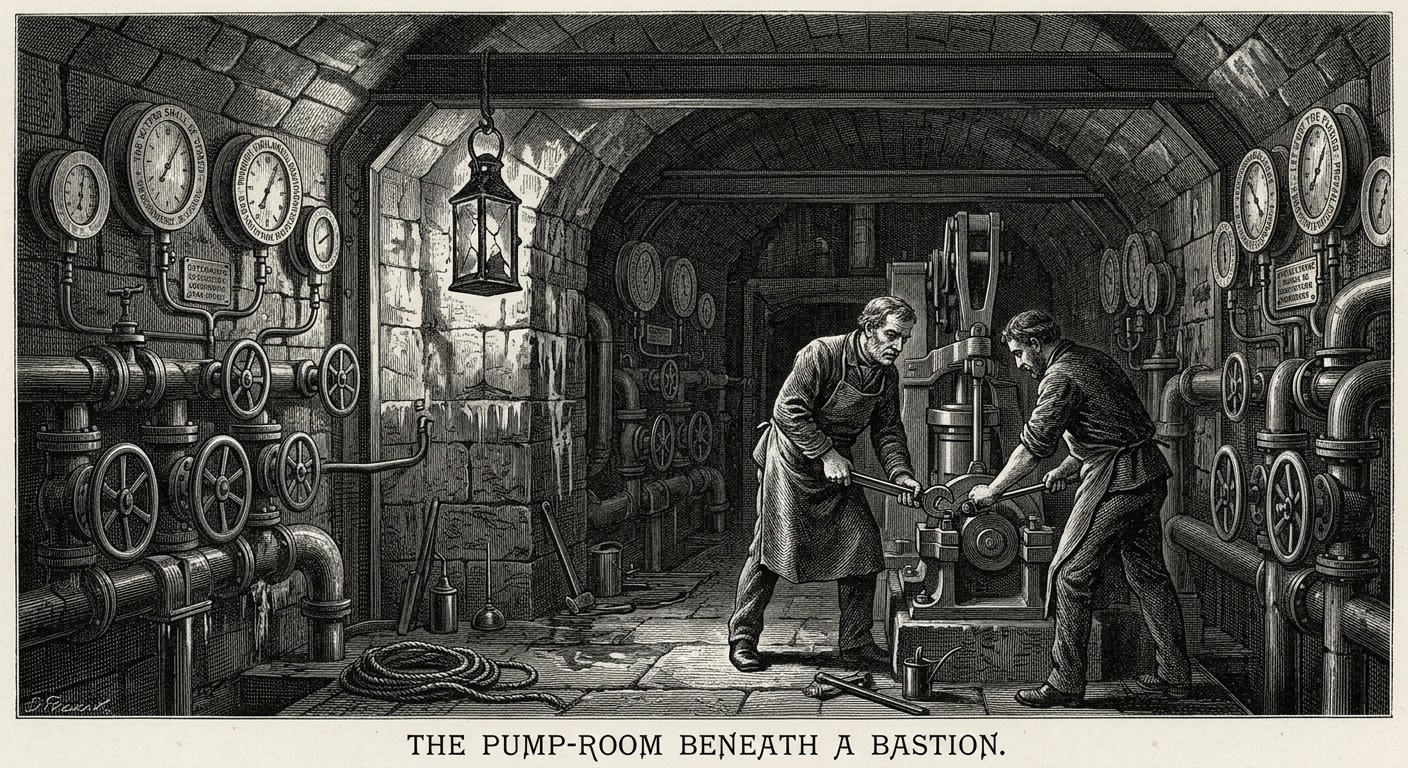
The pump-room under the west bastion is the bastion's second heart — larger, louder, more reliable than the chapel above it. Here the pumps thud and valves chatter, sucking the marsh back from the foundations one breath at a time. Engineers enter it with a kind of lay-liturgy: voices drop, boots tread carefully, and every crewman mutters some variant of the old line blessing — keep it quiet, keep it steady, keep it true. Doctrinally harmless. Overzealous confessors have attempted to correct these into approved hymns, with the success one might expect when correcting men who are elbow-deep in water and have been awake since before the dawn bell.
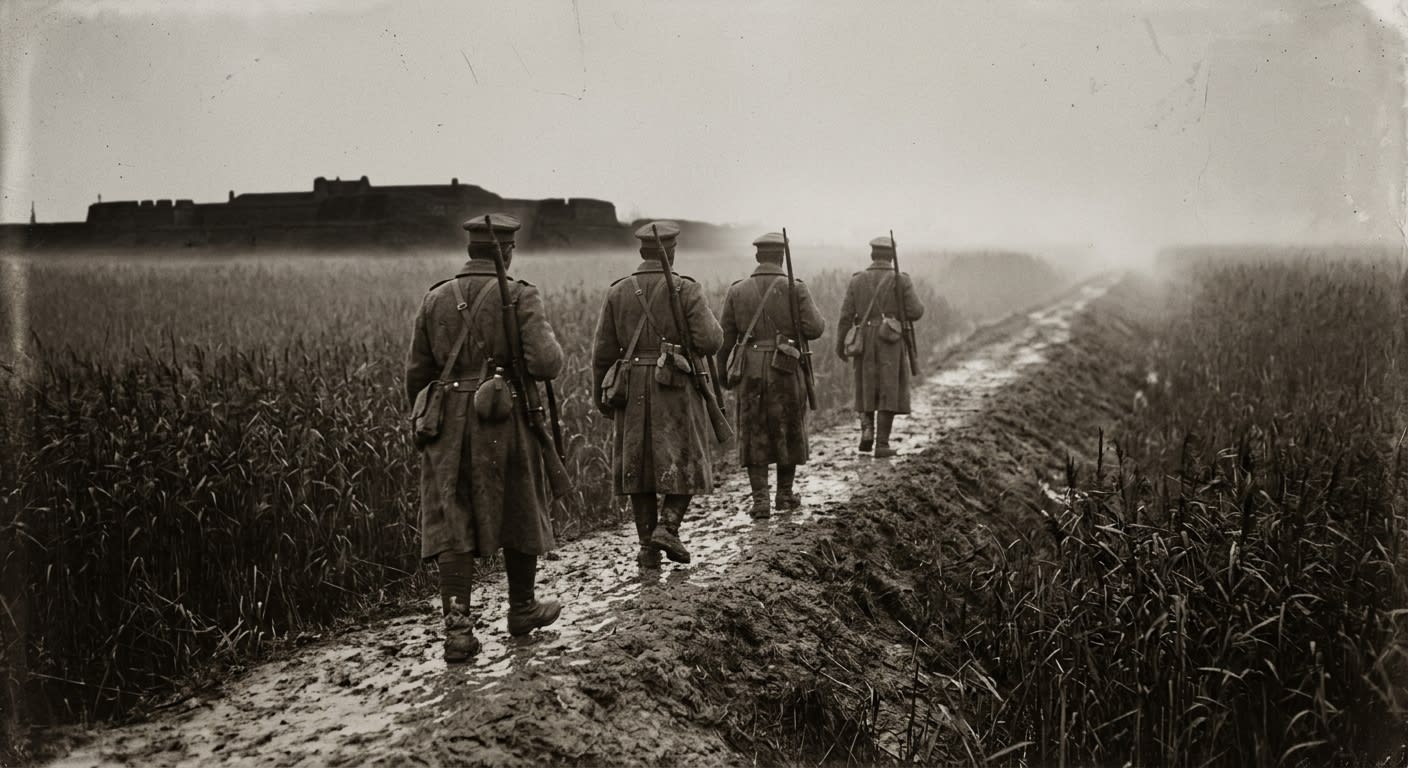
From the pump-room radiate the duties of the line gangs — mixed teams of rail-men and telegraph hands who walk the reed road in all weather. They replace warped sleepers, clear culverts of reeds and the occasional bloated carcass, splice snapped wires, and lay charges when ordered to drop a section of track into the bog against enemy use. A typical gang contains a concentration of practical knowledge that the Bureau of War finds valuable and the Bureau of Purity finds troubling: men who calculate stress tolerances in their heads, read cloudbanks as easily as horn-codes, and improvise trestles from scrap and prayer. Their unwritten catechism can be summarised in a rail-quarter proverb: Do it correctly, not bravely.
From this flows a ferocious taboo against falsifying measurements or lying in inspection logs. The engineer who softens a stress reading to please an officer, or omits mention of a hairline crack to avoid extra work, is judged by his peers as worse than a coward — a traitor to the line itself. A man who lies in a maintenance ledger conspires with the Great Deceiver against the lives depending on that track.
#On the Districts, and the Four Faces of Shipka
The bastion has accreted districts the way a swamp accumulates sediment: crisis by crisis, each quarter an answer to some prior inadequacy.
The Upper Works. The formal military and administrative nucleus, raised on the highest and most stable ground the marsh permits. The Commandant's Tower, the Bell Gallery, the Warden's Scriptorium, and the Chapel of Saint Phocianus the Vigilant — patron of this unglamorous hinge. The Bell Gallery doubles as a timing nerve-centre, banks of telegraph relays and Hourglass instruments crowding the chancel where another bastion might display relic-caskets. The chapel has acquired the nickname the Engine-Shrine for its prominent lectern carvings of pistons and gears entwined with grape-vines and crowns of thorns. Commandant Gaius Tarvor presides — a rail officer risen through merit and meticulous ledger-work, whose subordinates describe him as fair as a weighing-scale and just as charming. He speaks in declaratives, mistrusts improvisation, and has denied supply requests on grammatical grounds.
The Rail Quarter — "The Vertebrae." The beating heart, a warren of workshops and bunkhouses hugging the tracks. The Throat — the main rail-yard, a maze of sidings and turntables through which all traffic must pass. Ashka's Kettle — the quarter's largest tavern, built into the shell of a decommissioned boiler, ruled by Old Ashka Greave, a former Scour trooper with burn scars up her left arm and a voice that can silence a room mid-brawl. The Sump-Chapel — a shrine wedged beneath a rail-bridge, dedicated to those who went down into the works and did not return, cluttered with small tokens: bolts, washers, nameplates from uniforms. Forge-Master Oskar Rhone — massive, soot-scarred, fifty years in the quarter, the man through whom nothing of consequence occurs without a nod — suspects recent supply shortfalls are deliberate diversion, someone skimming materials and selling them along the line.
The Stilts — "Tithes-End." Beyond the formal walls, where the reed road peters into causeways and plank-tracks, sprawl the stilt-hamlets: timber platforms and pile-houses perched above wetlands, connected by rope-bridges and narrow boardwalks. Tithe-hamlets, technically subject to the bastion's writ, practically semi-autonomous. They send quotas of fish, peat-bricks, and reed-thatch in exchange for not being burned as unregistered squatter-heresy. Time here is marked by tides and the migrations of eels, not bells. Mother Tess Halver — ancient, sharp-eyed, midwife and herbalist — has begun treating an unusual number of patients with creeping lethargy, dreams that linger into waking, and a tendency to speak in murmurs and forget their own names. She suspects Sloth-taint. She cannot report it without the bastion burning the Stilts preemptively.
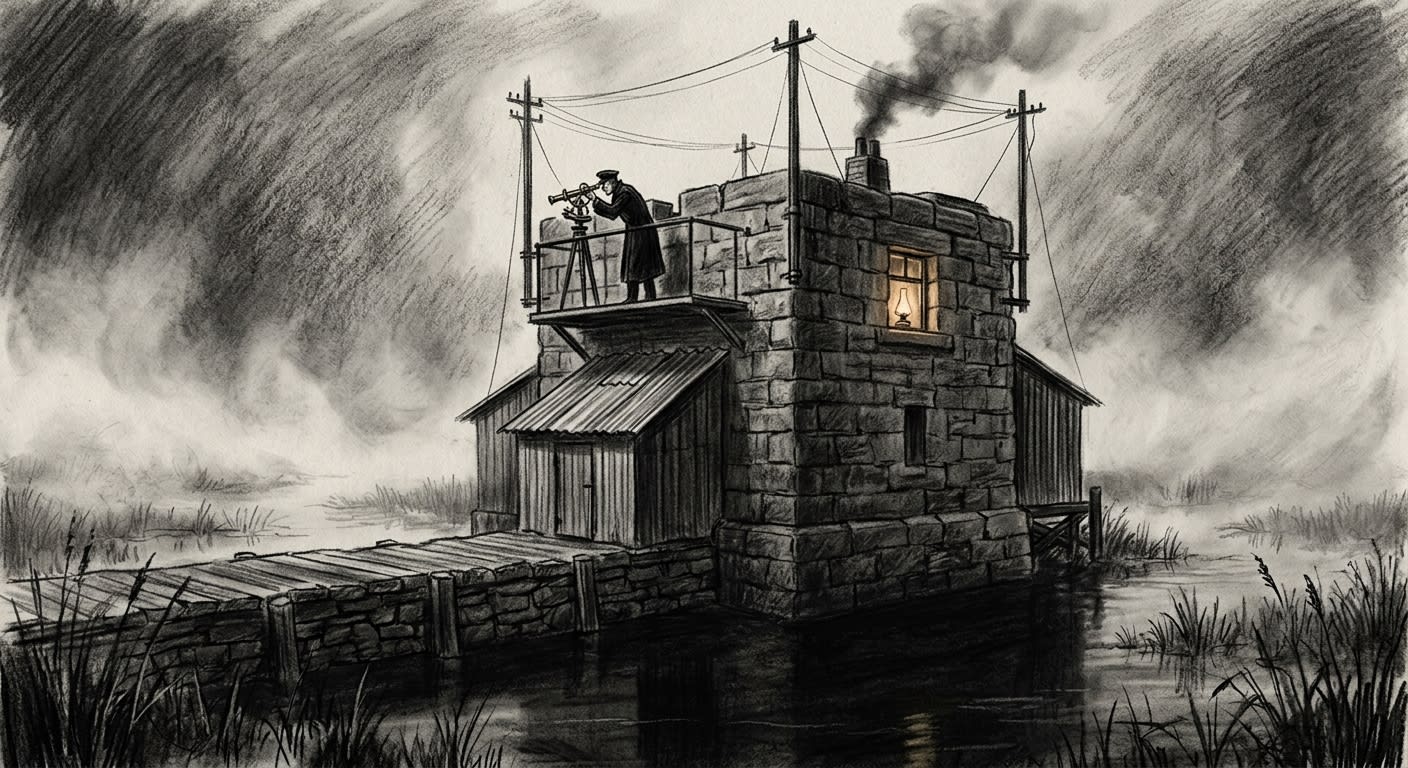
Station Two — "The Listening Post." Two kilometres east of the main bastion, perched on a reinforced causeway jutting into the deepest accessible reach of the marsh. A squat stone blockhouse surrounded by instrument-sheds and telegraph masts. Adept Meryth Vesk of Lyon — thin, pale, ink-stained, brilliant — maintains drag-gauges that measure the thickness of passing time, resonance-bells tuned to detect distortions in local causality, seismographs recording tremors no earthquake explains. Soldiers rotate every three months; longer tours produce station-sickness — insomnia, auditory hallucinations, a tendency to count one's own heartbeats obsessively. Vesk has detected an anomaly she cannot explain: a recurring skip in time-flow, always at the same hour, lasting exactly ninety seconds. It does not match Sloth's known signatures. Something old may be waking. The Bureau, characteristically, has not responded to her report.
#On the Cults of Quiet, and the Heresy of Lying Down
Where Sin presses from without, heresy blooms from within — watered by fatigue, fear, and the kind of hope that is indistinguishable from surrender.
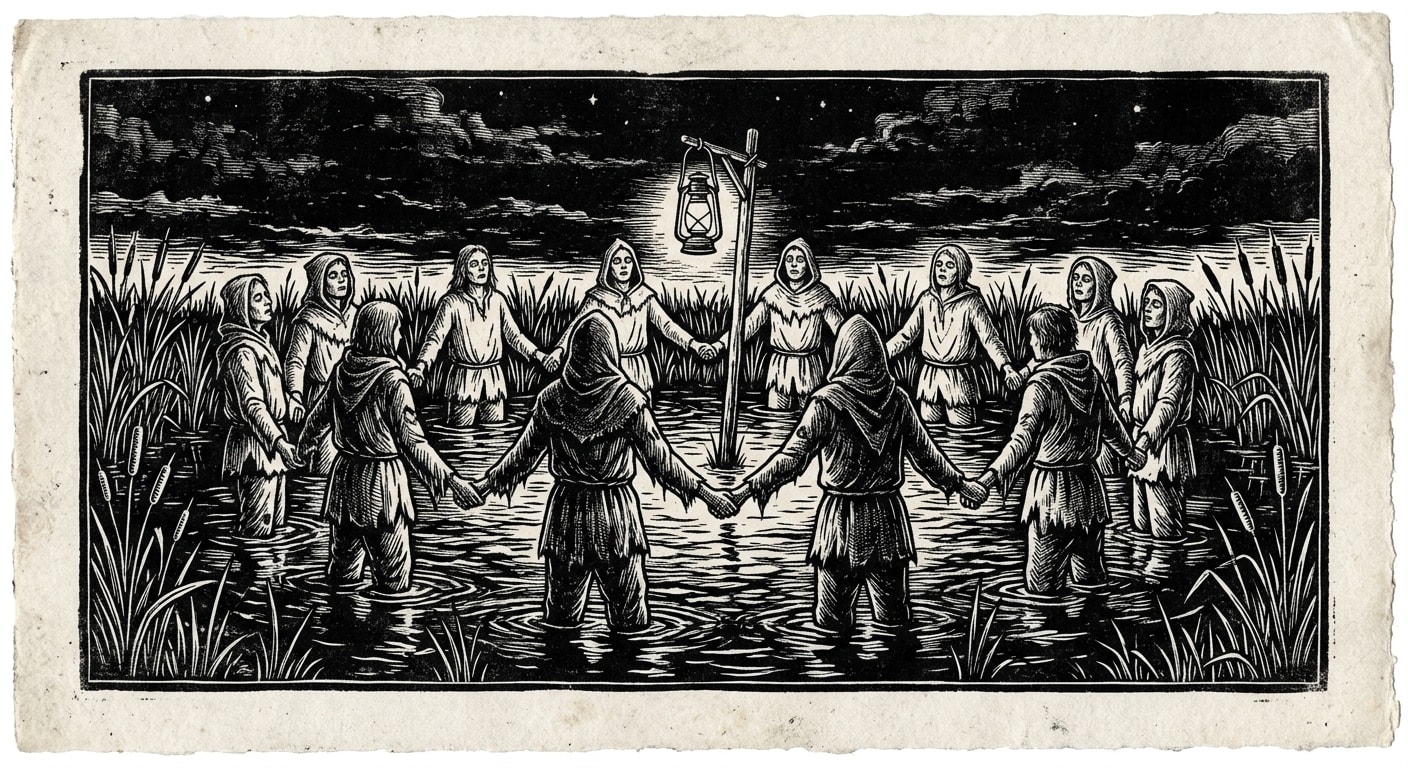
In the stilt-hamlets, Purity and Hourglass have broken up gatherings called Shared Rest Vigils or Circles of the Gentle Lantern. Their pattern is consistent: villagers sit in rings at the marsh's edge, hands linked, staring into a dulled lantern while a leader murmurs phrases about laying down burdens and forgetting the ache of days. After an hour the participants sway in unison, breathing shallowly. Some do not respond when shaken, yet their bodies shuffle to maintain the ring. Several incidents ended with the entire circle found at dawn waist-deep in marsh water, still holding hands, eyes open and unblinking. Condemned under the designation Somnolent Communion Cells.
More insidious are the Rest Societies that form among bastion clerks, nurses, and rail hands — mutual-aid circles that begin as reasonable attempts to share shifts and end by preaching that the true sin lies in never stopping. Their slogans, confiscated from hand-copied notices in the rail quarter, include such half-truths as: "The Synod demands endless waking; the Lord surely permits one honest sleep." And: "If the Wall cannot stand without our exhaustion, perhaps the Wall is the heresy." When discovered, their organisers are charged with Sloth-heresy with seditious overtones and either publicly penanced or quietly disappeared.
The frontier engineer community has proven resistant. Their shared doctrine — rest is earned, not offered — functions as inoculation. Any promise of rest without cost reeks to them of a weapon, not a mercy. It is an irony the Synod should treasure more than it does: the bastion's strongest bulwark against Sloth may be men who grumble at catechism but refuse, as a matter of craft-ethic, to be lulled.
Bureau of Purity records for the Shipka Tithe-District have historically classified heretical activity as "minimal, rural in character, and confined to stilt-hamlet superstition."
The Bureau now acknowledges three confirmed Somnolent Communion cells (A.S. 196–201), two Rest Societies within the bastion proper (A.S. 199–201), and an unresolved investigation into pre-Synodal folk practices among the marsh-dwellers that may constitute a fourth category of Syrion-adjacent heterodoxy. The revised classification is "active, diffuse, and inadequately resourced for counter-operation." The Bureau regrets the previous assessment was optimistic.
#On the Life of the Bastion, and the Sound of Staying Awake
The life of Shipka is ruled by sound. At dawn the first bell of the Pumps tolls from under the west bastion — blunt, utilitarian, measured by the Bureau of Bells to the second. Pump-crews descend into their humid iron chapels. Shortly after, the horns of the Reed Road sound staggered calls, and the first line patrols tramp onto the embankment counting sleepers, checking fishplates, watching for the telltale stillness in the reeds that means gas, or worse.
By mid-morning the guns drill. Saint Aegidius rehearses alongside Choir platforms, so that when smoke and song must marry in earnest they do so without discord. The Scour companies keep their own hours: mask-seal inspections, siphon-pump drills, timed charges up and down the Scour stairs. By late afternoon the bastion settles into clerical and maintenance hours — Hourglass adepts ticking through timing ledgers, catechists quizzing children on simpler litanies, the second pump-bell calling a fresh crew into the depths.
Night brings its own counter-rhythm. Telegraph sounders chatter. The pumps breathe steadily, exhaling a damp reassuring tremor through the stone. From the marsh come frogs and strange birds, their calls woven into what normal sounds like. The sentries on the wall know which choruses mean all is well and which sudden absences demand a report.
True silence — no pumps, no frogs, no distant creak of timbers along the reed road — is rare. When it falls, every veteran in Shipka feels their skin crawl. In a bastion built to restrain Syrion's creeping stillness, the absence of noise is warning.
On feast days, when the garrison marches beneath reliquaries, the rail quarter holds its own commemorations: a broken length of rail carried shoulder-high in memory of a derailment survived, a dented pump housing stood with candles. The engineers drink in the Bent Fishplate, the Saint of Leaks, and the Still Bell — this last so named for a cracked bell suspended over its door, retired from service when the Bureau declared its tone unfit. Within such places, the rail gangs trade tales of near-failures and ugly saves: the culvert that would have burst if a junior hadn't heard a wrong note in the pump's rhythm, the coupling that cracked in time to be spotted, the day a shift came back with all their toes. These stories have become a secular catechism of Shipka — parables of vigilance and the wages of carelessness.
The bastion has its own calendar within the Synodical one. The Day the Couplings Held — a notorious near-derailment when a heavy supply train screamed for half a kilometre yet stayed on the rails. The Night the Marsh Stayed Down — a flood that should have topped the reed road, beaten back by frantic pump-work and improvised sluicing. Official homilies credit prayer and saintly intercession. Over mugs and cracked knuckles, the crews toast the pump-room instead.
#On the Present Condition, and What the Ninety Seconds Mean
The garrison at Shipka rotates every four months — the heaviest Bellwarden rotation on the Line, mandated because longer tours produce men who can no longer count days. The Bureau of War considers this an acceptable cost. The Bureau of the Hourglass considers it data.
The other bastions know their enemy. Königsberg faces the Grey. Przemyśł faces Atheron. Irongate faces Morwen. Constantinople faces Kargath and Maldrake together. Shipka faces Syrion, and Syrion's warfare is the kind that does not provide the courtesy of a visible front. The fog drifts. A ridge held last week is grey this week. A village that answered correspondence in March is silent by May, and by July the village is there but the villagers are standing in the market square with their eyes open and their minds somewhere the Bureau cannot follow.
The ninety-second skip that Adept Vesk has measured at Station Two remains unresolved. It recurs at the same hour. It does not match Syrion's known signatures. It does not match anything in the Hourglass taxonomy. Vesk's report sits in a Bureau queue in Strasbourg, four places behind a request to reclassify a bell-tone and seven places behind a tithe dispute in the Rhineland. The clerk responsible for the queue has not read it. He has been busy.
The Bureau does not ask.
Shipka endures — muddy, stubborn, sardonic — by rising every day to do it all again. Its glory is measured in shifts survived and failures averted. The Synod does not heap laurel upon such places. It heaps expectation. And then it waits for the timetable to arrive on time, which at Shipka it does, which at Shipka it always has, which at Shipka it had better continue to do, because the only thing separating the road to Constantinople from the fog of the Languid Dreamer is a raised embankment, a few thousand souls who trust their spanners more than their psalters, and a bell-cannon named Aegidius that sulks when left idle.