
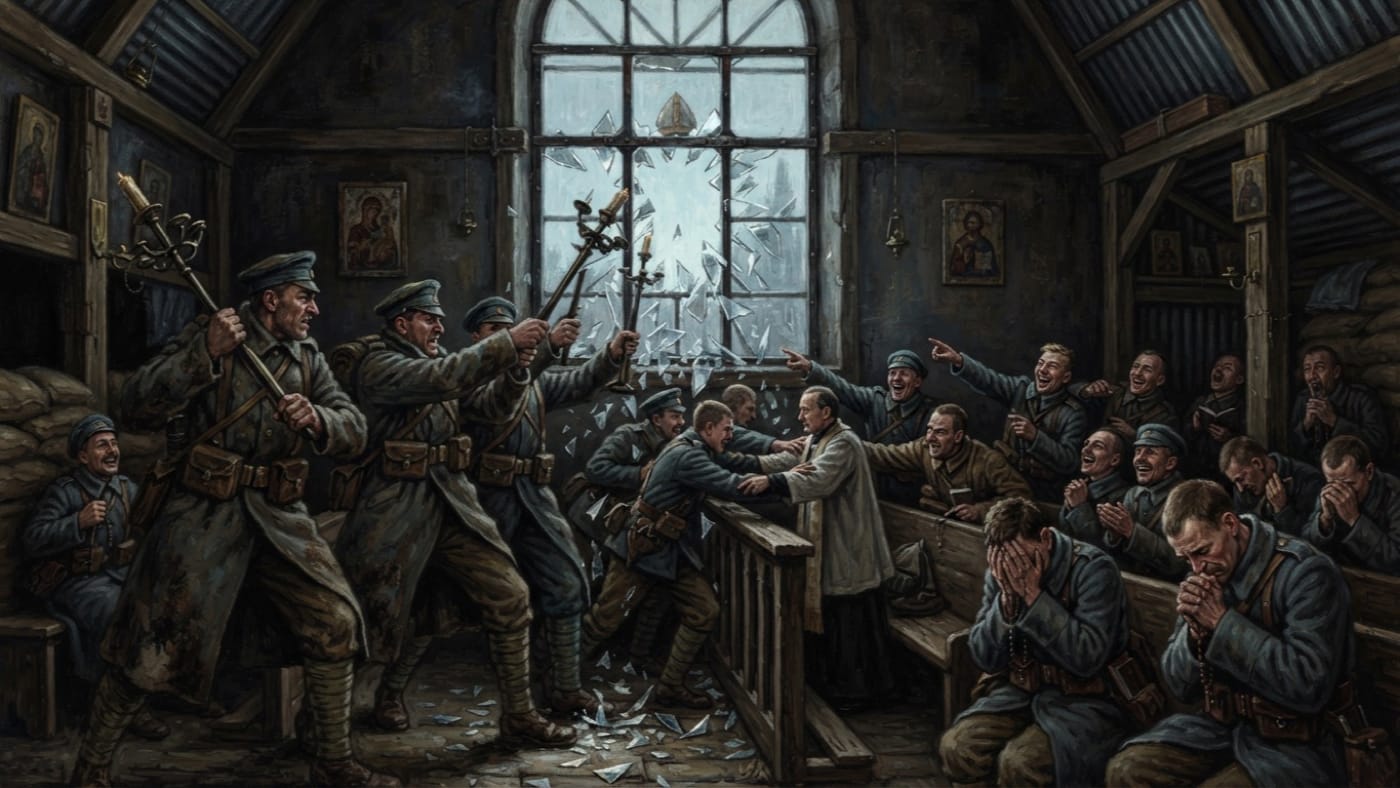
In A.S. 188, which the Church reckons as 1898, the east transept window of Saint Phocian's Forward Chapel at Bastion-Przemyśl was replaced with mirror-glass salvaged from a ruined manor. The quartermaster responsible believed the reflective backing would strengthen the pane. At a later dawn mass, twenty-two soldiers raised their eyes from devotion and found themselves wearing mitres. The service did not survive the discovery. The chapel survived by the margin of three candle-stands.
The Bureau of Records files the matter under the Mirror-Lord case tradition, which is correct. It also files it under Glazing, which is equally correct and frightens me more.
#On the East Transept
The forward chapels of the Wire Orchard are made from whatever the Line leaves lying about. Timber comes from anything that stood too near the guns. Iron arrives rusted and leaves rustier. Tallow smoke blackens the vaults until the painted saints look like colliers. Ration clerks weigh candles as they weigh bread. In that sector, a quartermaster who finds a whole sheet of glass in the rubble of a manor house has found treasure.
He found a mirror. He reasoned that the silvering would stiffen the sheet against concussion, as a board stiffens a ledger. As carpentry, the thought has merit. As theology, it hung a looking-glass in a house of prayer, at the hour when a congregation comes in the half-dark to kneel before something larger than itself. At a dawn mass the eye goes east, toward the first light. That morning the first light came back carrying portraits.
The account gives no name for the manor and no route for the glass. It does not give the day the pane was set or say what broke the window it replaced. I decline to supply them. A Bureau that invents its own provenance has no standing to condemn anyone else's.
#On the Twenty-Two
Twenty-two soldiers saw themselves in the window wearing the mitres of bishops.
The account describes no other vestment, and it needs none. A mitre is a hat. Office is a different article entirely. It is conferred by examination, consecration and the laying on of hands, and entered in a register that someone must later answer for. The glass dealt only in hats. The trouble began when men in a chapel forgot which of the two they were looking at.
Four laughed. I have no complaint against the four. Laughing at oneself in a bishop's hat is the soundest response the record preserves, and the Przemyśl formula later approved against this enemy, We all look like hell, is the same laughter with its boots on.
Nine wept. Their reasons are not recorded. The Mirror-Lord literature offers two possibilities. A man may weep at the glory of the image, or because he has seen a vestment he will never deserve and knows it. Atheron profits from either. Exaltation and abasement are one lever pulled in opposite directions.
Six declared the celebrant unworthy and attempted to correct the liturgy by force.
This is the sin the window was made for. The six reasoned as the Mirror Courts teach. From the mitre they inferred an office, and from the office a right to judge the man at the altar, who wore only what his ordination allowed. No one compelled them. The glass offered a lie that flattered them, and they chose to believe it. Then they rose from their knees and acted on it with their own hands. Doctrine is plain on this point and I am plainer. No demon in Synod territory takes the body or seizes the will. The Great Deceiver supplies the portrait. The sinner signs it.
The account names no one, counts no injuries and reconstructs no struggle. I shall not stage one. It is enough that six soldiers, at dawn, in a chapel built to keep them alive, tried to depose a priest in the middle of his office on the authority of a hat.
#On the Breaking of the Glass
The remaining three took up candle-stands and smashed the window.
That is the whole of the record, and it suffices. A chapel candle-stand is heavy, ugly iron, made to stand in a corner and hold tallow. That morning three of them did more for doctrine than anything else in the Wire Orchard. The glass broke, the mitres went with it, and the chapel was saved.
Younger clerks ask me whether the three were immune. They were not. The account counts them among the twenty-two. They saw the mitres as clearly as the six did, and they chose the candle-stand over the crozier. Some will want a miracle in this. I find a decision, which I prefer, because a decision can be required of the next man.
The breaking proves no killing either. A Mirror-Lord's court needs a surface. Remove the surface and the court adjourns. The account does not say whether its president suffered by the adjournment, and neither will I.
#On the Later Regulations
Nothing in A.S. 188 forbade the quartermaster's window. I stress this because once the Bureau has a rule, it likes to discover that the rule always existed and that someone broke it. No such rule existed. Circular 192-M came four years later, after the Switchbox Nine affair. Seven signal clerks spent two hours under shelling in Switchbox Nine. By the end they had enthroned one man on a crate and bound another with telegraph wire. Purity then proposed to dull every glass, brass fitting and horse's eye on the front. Logistics refused, and the compromise was the circular. It requires that unnecessary reflective surfaces in forward command, chapel, medical and signal positions be dulled, covered, smoked, scratched or veiled before dawn watch.
Chapel is in the list. Dawn is in the list.
The field doctrine of A.S. 199 came eleven years after the chapel. It came from the eastern salient, where Sergeant-Matron Olya Krev ordered Battery Seven to shut its eyes and recite its laundry while she fired the gun by touch. The Przemyśl countermeasures now stand as follows. Meet polish with grime. Let a witness judge a man's reflection in his place, and the witness should dislike him mildly. Speak in inventory rather than titles. Under suspected Mirror contact a soldier names the boot, the mud and the cartridge, and leaves his own worth to somebody less interested.
Read against that doctrine, the chapel is its errata sheet, issued eleven years early. The quartermaster polished where the circular would have him dull. The twenty-two judged their own reflections with no witness. The six spoke in titles. Only the three did anything like what the later rule requires, and they did it with iron, before anyone had written the rule down.
#On the Petition
One of the three later petitioned for ordination. His grounds, as preserved, were that the reflection had shown him appropriately dressed.
He saw the mitre. He broke the glass that showed it. Afterwards, at his writing-table, he asked the Church to turn the glass's lie into fact. His was among the steadiest hands in that chapel at dawn. The vanity came later, by post.
Dress is evidence of tailoring. A vocation is weighed by men who have read the candidate's file, heard his confession and set him against the Ledger with a cold pen. A reflection sits on no examining board. It holds no seal, takes no oath and answers to no Doctrine reviewer. Of all the reasons a soldier might give for seeking holy orders, this one alone names the enemy as his referee.
All three soldiers who broke the glass came away with their judgement restored.
Corrected in this article. The account records that one of the three afterwards petitioned for ordination, citing the window as his evidence. Breaking a mirror does not certify the man who broke it.
The petition's fate is not recorded, and I will not invent one. Were the matter mine to rule, I would refuse it on its own stated grounds. On the same page I would commend the man for the candle-stand. A man may save a chapel and still be unfit to run one. Much of the clergy manages only the second half.