
#On the Nature of the Wire
"In the beginning there was the barb, and the barb was good, and the Bureau of Doctrine stamped it so." — Attributed, without attribution, to the Logistics-Penance Tribunal
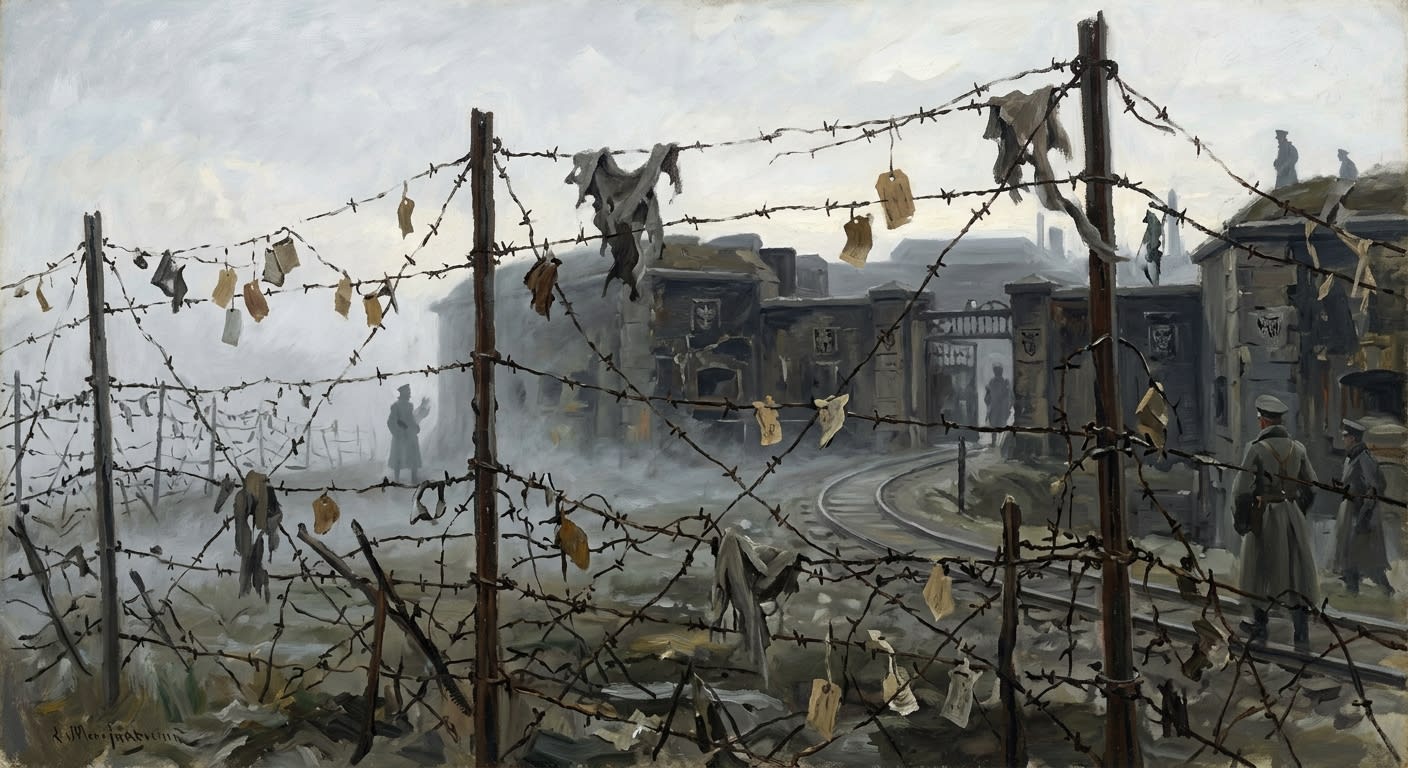
Other bastions announce themselves with bells, with carillons that rattle the faith loose from your molars. Königsberg tolls across the Baltic ice. Constantinople shakes the Bosphorus chain with bronze. Przemyśl does nothing of the kind. Przemyśl hisses. You hear it before you see it — a thin metallic susurrus rising from the Carpathian ridgeline, as though the mountain itself were drawing breath through clenched iron teeth. That sound is the Wire Orchard: three miles of barbed steel strung so thick across the approaches that from the rail spur it reads as a dead forest, post and thorn where oak and beech once stood, each strand dressed in the papery fruit of ration tags, transit chits, confession receipts, and the occasional sleeve of a man who did not stop when told to stop.
The Bureau of Records classifies Bastion-Przemyśl as a "fortified transit choke of the Carpathian mid-sector." The soldiers who serve there call it Taggrove. Refugees who survived its processing queues call it the Orchard of Knives. The Provost-Marshal (Unregistered) calls it home, which tells you everything you need to know about the Provost-Marshal.
What Przemyśl is, in the most naked terms that the Bureau of Doctrine will tolerate, is a machine for sorting flesh. It stands where the Sagittal Line crosses the western Carpathian arc — the sole corridor of intact rail and wagon road through a landscape the Sundering rendered largely impassable — and it squeezes everything that passes through it: men, materiel, paper, rumor. What enters Przemyśl is processed. What exits Przemyśl is stamped. What fails to satisfy the stamp is — well. The wire is hungry, and the Bureau is efficient, and the two rarely disagree.
#On the Founding and Rising
"Build where the ground remembers how to bleed." — Provost doctrine, allegedly pre-Concordat
The bastion was raised in the years following A.S. 67, when the Sagittal Line had solidified into something the Bureau of Records felt comfortable calling permanent and the Bureau of War felt comfortable calling insufficient. The western Carpathians presented a problem the Synod had not encountered at Brest or on the Polish lowlands: terrain that was simultaneously defensible and labyrinthine. The passes twisted through ridgelines like arteries through a stone heart. The old fortress at Przemyśl — a Rationalist-era garrison already crumbling when the Synod's surveyors arrived — sat at the convergence of three such passes and controlled the only rail spur connecting the central corridor's supply depots to the forward trenchworks.
What the Synod built on that foundation was less a fortress than an industrial process given walls. The old stone core became the Taghouse Row (Unregistered) — permit halls, stamp counters, confession vaults — while the ridges above were threaded with wire until the mountain wore a crown of thorns that would have made the Creator blush, had He been disposed to blushing, which theologically He is not. By A.S. 75 the Wire Orchard had reached its first full extension: a kill-zone of electrified barbs, flood-ditches, and patrol trenches encircling the bastion at a radius of two miles. By A.S. 92, the Concordat era, it had swelled to three.
The wire was never purely military. From the beginning, Przemyśł served as the Synod's choke-bastion for deserter control and supply integrity — the instrument by which bodies, paper, and rumor were filtered between the rear depots and the front. A man could reach the trenches at Bastion-Sibiu without passing through Przemyśl if he was willing to cross the mountain on foot, in winter, through territory that Atheron considered his personal antechamber. Most were not willing. Those who tried were generally recovered by the Provost's dawn harvest patrols — or not recovered at all, which amounted to the same entry in the Ledger.
Prior editions of this official documentation listed the bastion's founding year as A.S. 54, attributing its construction to a "spontaneous garrison of the Carpathian faithful."
The Bureau of Records has corrected this. Nothing about Przemyśl is spontaneous. The bastion was planned, surveyed, and authorized through forty-seven separate writs between A.S. 64 and A.S. 72. The prior author's confusion is understandable: the filing system for those writs requires three separate keys, a Bureau-certified translator, and a disposition toward paperwork that borders on the erotic.
#On the Fortifications and the Orchard
"Every strand is a sentence. The question is whose." — Orchard Warden graffito, Tower Nine stairwell
The outer defenses of Bastion-Przemyśl are unique among the seven bastions of the Line, and the Bureau of Engineering has never satisfactorily explained whether this uniqueness represents genius, madness, or — as I suspect — a filing error that metastasized into doctrine.
The Wire Orchard is what it sounds like: an artificial forest of barbed and electrified steel, strung between salvaged pylons and iron posts across the churned terrain of the western approaches. The wire is not laid in conventional belts. It is grown — or so the soldiers say, and the Bureau of Engineering does not contradict them loudly enough to constitute a denial. Strands loop and branch in patterns that seem organic from a distance: tangles that mimic scrub-brush, fans that spread like dead limbs, spirals that the Orchard Wardens call fruit-clusters because the ration tags and transit chits snagged in their teeth hang like pale, papery apples.
Beyond the Orchard, three concentric rings of defense: the flood-ditch (waist-deep in the dry months, chest-deep after rain, and of uncertain depth during the spring thaw — the Bureau of Engineering's measurement teams having declined to wade it more than once), the patrol trench, and the inner wall proper. The inner wall is old Rationalist stone reinforced with bone-lime mortar, tar-soaked timber cladding, and the prayers of every Logistics-Penance clerk who has ever filed a requisition for structural repair and received instead a catechism on the spiritual benefits of load-bearing faith.
Seven districts compose the bastion itself:
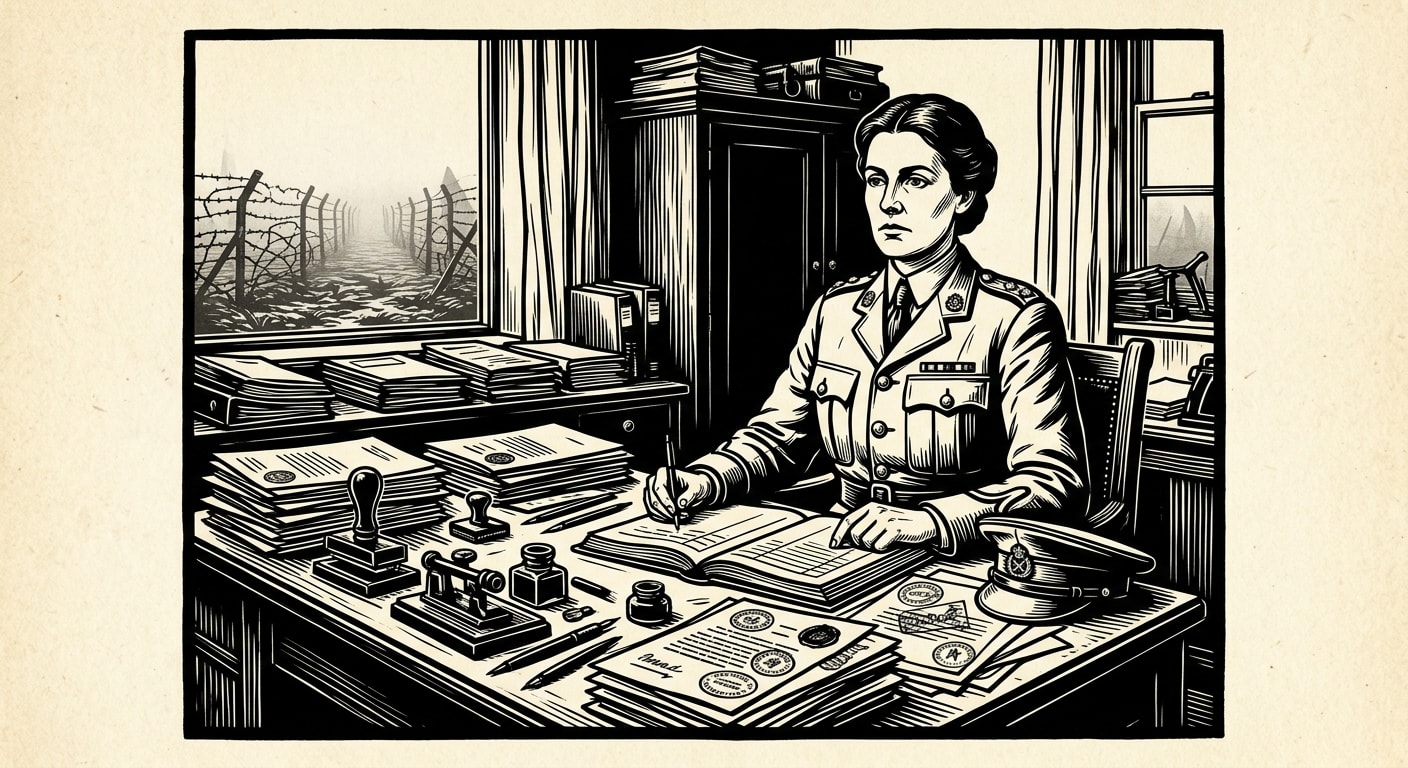
Taghouse Row occupies the bastion's administrative core: permit halls stacked three stories deep, stamp counters running the length of the old fortress courtyard, and a smell of hot wax, ink, and human desperation that no amount of incense has ever overwhelmed. This is where existence is verified. A man enters with a name; he exits with a stamped tag or he does not exit.
The Orchard Ring is the inner edge of the wire-zone: gallows posts, patrol staging, and the Warden towers from which the grid is maintained, observed, and — on harvest mornings — reaped. Tower Nine, the tallest, is called the Orchard Eye by those who serve in it and the Orchard's Iris by those who have been observed by it. A missing patrol logbook was reported from Tower Nine in A.S. 199. The Bureau of Records denies the logbook existed, which is the Bureau's preferred method of confirming that it did.
Rail-Throat Yards handles everything the rail spur delivers: grain bricks, fuel, ammunition, prisoners, conscripts, and the occasional sealed manifest from Strasbourg that no one in the Yards is authorized to read and everyone in the Yards can summarize from memory. The air is diesel, coal soot, and cabbage — the three sacraments of logistics.
Candleworks Quarter produces the wax that seals the stamps that authorize the tags that permit the men to live. Tallow rendering, wax purification, die-cutting: sweet and rancid in equal measure, the smoke constant, the fires carefully tended by sealwrights whose hands are mapped in burn-scars like the contour lines of a country only they can read. Sealwright-Master Joryn Malk presides. His smile has the exact dimensions of a Bureau stamp.
Barrack-Ash houses the Provost garrison and the draft cages where new conscripts are held pending processing. It smells of bleach, damp wool, and the particular variety of terror that men produce when they have been told they will be stamped and do not yet know what that means. Approximately 2,400 provost troops and auxiliaries are stationed here. They eat first. This is policy.
The Underwire — the tunnel network, the old trench galleries, the culverts and root-cellars of the pre-Sundering orchard that the bastion was built upon — is officially maintained by sanitation crews. Unofficially it is maintained by smugglers, the mutual-aid cell known as the Gleaners, and whatever is responsible for the silent corridors where sound simply stops. The Bureau of Purity has investigated the silent corridors twice. Both investigation teams filed reports consisting entirely of the phrase "Nothing to report." The phrasing was identical in both documents, seven years apart, composed by different hands.
The Chapel of Counting serves the spiritual needs of the garrison, which in practice means it operates as a confession vault of exceptional thoroughness. Confession slips are indexed, cross-referenced, and filed in archive rooms that extend three levels beneath the chapel floor. Archivist-Prelate Odran Kelle administers this operation with the gentle efficiency of a man who has read every secret in Przemyśl and retained a pastoral smile throughout. The smile is more frightening than the secrets.

#On the Garrison and Its Economy
"A tag is warmer than a coat." — Proverb of the Orchard
Life in Bastion-Przemyśl is measured in days — specifically, in the life-days printed on a man's ration tag. The tags are small, wax-sealed, and stamped with a date of issuance and a date of expiry. Between those two dates, the bearer is permitted to eat, sleep under a roof, and exist in the Ledger of the Bureau of Records. After the expiry date, the bearer is — in the elegant euphemism of the Logistics-Penance Tribunal — administratively corrected.
The economy runs on stamps. Ration tags serve as currency; stamped paper as contract; wax seal-blanks as the denomination of real power. Coin is meaningless in Przemyśl. Coin cannot be eaten, cannot authorize transit, cannot prove that you are who you claim to be. A man with a hundred gold crowns and no tag will starve before nightfall. A man with a valid seal-blank and an expired tag will negotiate his way to breakfast. The hierarchy of value is absolute: light, then paper validity, then clean water, then distance — the last being measured as the length of a viable route out.
The black market operates in the Underwire galleries, selling forged tags, bootleg ink, antibiotics, tower patrol passwords, and the occasional blank confession slip — this last being the most dangerous contraband in Przemyśl, since a blank confession slip is a weapon that can be loaded with any sin and aimed at any name. The Underwire's currency is information. Its prices are set by the Runners, who know the tunnel routes and the curfew gaps and the exact moment when Tower Nine's searchlight sweeps past the eastern ditch. To enter the Underwire you need a contact. To leave it you need luck. To profit from it you need a moral flexibility that the Bureau of Doctrine would classify as heresy if the Bureau of Doctrine were willing to admit the Underwire existed, which — as a matter of official doctrine — it is not.
Wealth in Przemyśl flows upward with the precision of a well-filed tithe. The Synod and Provost eat and sleep warm. The Guild sealwrights eat and fear audits. The laborers eat sometimes. The drafted and imprisoned freeze. And the Erased — those whose tags have expired or been confiscated or were never issued — exist below the economy's floor: invisible, unhousable, and prey.
#On the Enemy Opposite
"He does not attack. He condescends." — Marshal's briefing, Carpathian Theater, A.S. 195
The enemy facing Bastion-Przemyśl from the eastern Carpathian highlands is Atheron, Sin-General of Pride — He Who Cannot Bow, the Exalted, Lord of the Highest Throne. Where Kargath devours and Maldrake burns, Atheron elevates, and the distinction is the most insidious thing about him.
The Ebon Heights — Atheron's domain in the eastern Carpathians — are visible from the Orchard Ring on clear mornings: black ridgelines rising beyond the wire, each crest crowned with a spire taller than the last, the Crownspire at their apex catching the first light like a needle stitching the sky to a wound. The spires grow. The Bureau of Engineering has measured them annually since A.S. 73, when the Cartographic Expedition first documented the territory, and every year's measurement exceeds the last. The Bureau does not explain this. The Bureau does not need to explain this. The spires explain themselves: they are taller because they are above, and to be above is to be right, and to be right is to grow, and the growth is its own argument.
Atheron's forces do not assault Przemyśl as Maldrake assaults Constantinople — in fire and fury and the shriek of the Hellbow Legion. Atheron's war is subtler. His demons — the Exalted, the Judges, the Crowned, the Contemptuous — infiltrate through the passes in ones and twos, influence-demons working the wounded dignity of officers passed over for promotion, clerks denied advancement, soldiers who know they deserve better than this wire-strung hell and who hear, in the wind off the Ebon Heights, a voice that agrees with them. A voice that says you are above this.
The Synod's countermeasures are documented in the Atheron dossier and need not be repeated here. What bears recording in the context of Przemyśl is their particular failure mode. The Doctrine of Equality Before the Divine — the teaching that all men are equal in the sight of the Creator — is recited at every muster, every confession, every ration blessing. The soldiers mouth the words. They look left at the provost eating first. They look right at the Erased eating nothing. They look up at the officers' quarters on the upper terrace. And they understand, with a clarity that no catechism can dull, that Przemyśl is already a hierarchy — a machine that sorts men into ranks of worth and feeds them accordingly — and that Atheron barely needs to whisper when the architecture does his preaching for him.
The Golden Masquerade of Varna — Atheron's known cult — has been detected in the Carpathian supply corridor twice: once in A.S. 187, when a logistics officer was found to have been promoting subordinates based on a ranking system of suspiciously external origin, and once in A.S. 199, when a Confession Vault intake clerk reported that three separate confessants had used the phrase "I deserve better" in precisely identical cadence, tone, and emphasis, as though reading from a shared breviary. The Bureau of Purity investigated. The clerk was reassigned. The confessants were not located. The investigation was filed under "Resolved," which in the Bureau's taxonomy sits between "Abandoned" and "Classified."
#On the Wire-Hymn
"If the wire says your name, don't answer. It's counting you." — Common superstition, Orchard Ring
The Wire Orchard has a voice.
Read that literally. I am not indulging in metaphor or poetic license grown sentimental in the small hours. The wire grid surrounding Bastion-Przemyśl produces, at irregular intervals and without identifiable mechanical cause, a low harmonic resonance that the garrison calls the Wire-Hymn (Unregistered). The resonance begins in the outer strands — the oldest wire, strung in A.S. 75 — and propagates inward through the grid in patterns that the Bureau of Bells has analyzed seventeen times without producing a report the Bureau of Doctrine was willing to accept.
What the soldiers hear in the Wire-Hymn is names.
The names are not always of the living. Tags flutter without wind during a Hymn event; ink bleeds into spirals on freshly stamped documents; people wake with wax in their ears. On severe nights — three or four per year — the wire moves. Not in the wind. There is no wind on those nights. The wire rearranges itself: strands contract, others extend, the Orchard's geometry shifting by increments too small to observe and too large to ignore. Patrol routes that were straight at dusk bend by morning. Lanes that connected the flood-ditch to the inner wall close. New lanes open where no lane was.
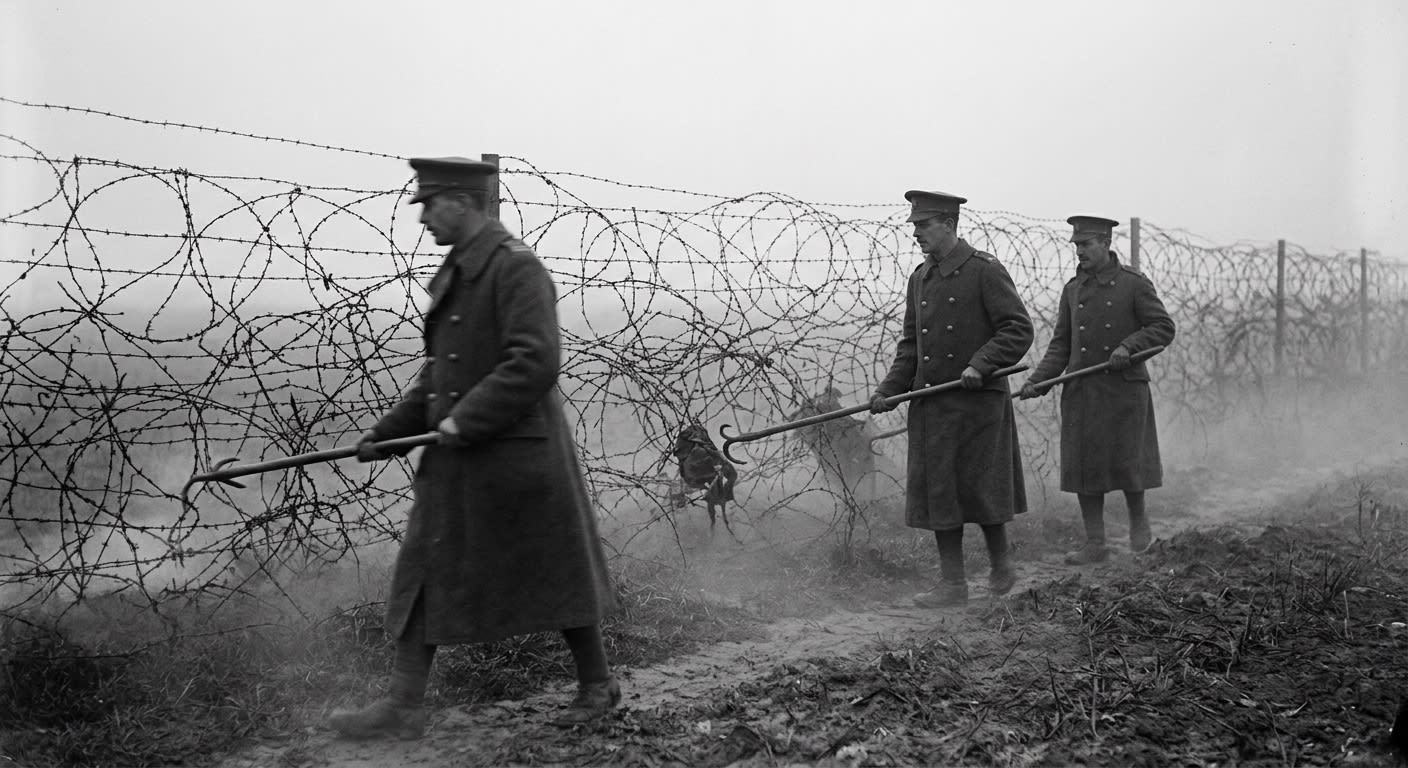
The garrison's countermeasures are salt lines, wax plugs for the ears, and the carrying of blank paper — silent paper, the soldiers call it, as though unwritten sheets were talismans against being written upon. The Orchard Wardens patrol with wire-cutters blessed by the Chapel of Counting and re-strung with replacement barbs within the hour. The Wardens insist the replacements are identical. The Bureau of Engineering, in a rare moment of candor, has observed that the replacement wire "does not always agree."
The buried truth of the Wire-Hymn — known to Archivist-Prelate Kelle, suspected by the Bureau of Bells, and classified at a seal-level that exceeds even my considerable clearance — is that the resonance predates the Synod. The wire was strung on posts driven into the same ground where an older orchard stood, an orchard of ████████ origin whose root-system extends beneath the bastion into tunnels and cellars that the Underwire's diggers have never mapped to completion. The Hymn is not the wire singing. The Hymn is the ████████ singing through the wire. Whether it indexes, or corrects, or ████████████████ is a question that the Bureau of Doctrine has stamped NOT FOR PRESENT CONSIDERATION, which is the Bureau's way of saying it is terrified.
#On the Harvest
"Dawn is a knife with paperwork." — Proverb of the Orchard
Every morning before the first bell, the Provost-Marshal dispatches the dawn harvest patrols.
The official function of the harvest is deserter recovery. The Carpathian passes leak men: soldiers who slip through the wire in darkness, refugees attempting the reverse crossing into Synod territory, smugglers running the Underwire corridors, and the occasional influence-demon of Atheron who has completed its work and is drifting toward its next victim with the unhurried gait of something that knows it cannot be caught. The Provost's patrols recover what the wire catches and cut down what the wire kills.
The unofficial function is rather broader.
Provost-Marshal Vanna Rook (Unregistered) commands the dawn harvest with a punctuality that would earn commendation from the Bureau of Rites. Her patrols return at first light with tags on strings — identity tags, ration tags, transit chits — harvested from bodies found in the Orchard Ring. The bodies are carted to the ditchpits unless tagged for formal burial (a wax seal on the tongue, per Przemyśl custom). The tags are entered into the morning's ledger. The ledger is balanced. If the ledger does not balance — if the incoming tags exceed the morning's projected intake — the Logistics-Penance Tribunal adjusts.
The harvest boards — public lists of names posted in Taghouse Row — shift overnight. A name present at curfew may be absent at dawn. The Bureau of Records attributes this to "clerical optimization." The soldiers attribute it to the Provost. The truth, as in all matters pertaining to Przemyśl, lies somewhere between the stamp and the wire.
The mutual-aid cell known as the Gleaners operates at the margins of the harvest, sheltering the Erased, swapping tags between the living and the recently dead, and running escape routes through the Underwire into the marshes beyond the southern gate. The Gleaners are heretics by any standard the Bureau cares to apply — tag-swapping is identity fraud, which is sacrilege against the Great Ledger, which is grounds for immurement. The Gleaners know this. They operate regardless. The Bureau of Purity has been attempting to exterminate the cell since A.S. 183 with a success rate that the Bureau itself declines to quantify, which, in my professional assessment, constitutes its own quantification.
#On the Present Condition
"How many days you carrying?"
The question is asked with a gesture, not a number. It is the shibboleth of Przemyśl, the handshake of the Wire Orchard: the open palm, angled slightly, showing the calluses where the tag-string rubs. Locals answer by tapping their chest — once for a week's ration, twice for a month's, a flat hand for an indefinite stamp, which in Przemyśl is as close to wealth as a man can approach without attracting the attention of the Provost.
The bastion holds, as all bastions hold, because the alternative is not holding. Atheron presses from the Ebon Heights with the cold patience of something that considers itself above haste. The Wire Orchard sings its hymn. The Candleworks render tallow and pour wax and cut the dies that stamp the seals that authorize the tags that permit the men to eat, and the cycle turns with the indifference of a mechanism that has forgotten it was built by hands and not by mandate.
A missing stamp die was reported in A.S. 200. The implications are severe. A stamp die is not a seal-blank; it is the instrument that makes seal-blanks. With a stolen die, a forger could print valid identity tags — valid ration permits — valid lives. The Bureau of Records dispatched an investigative team. The team filed a preliminary report noting that the die's serial number appeared in the records of two bastions simultaneously, which should be impossible, which the records do not explain, and which the Bureau has classified as "an administrative artifact of no strategic significance."
Provost-Marshal Rook has used the crisis to consolidate authority, positioning the dawn harvest as essential security rather than supply management, and angling — with a bureaucratic deftness that would impress even the Bureau of Doctrine — toward a coup de tribunal: the absorption of the Logistics-Penance Tribunal under Provost command. The Archivist-Prelate watches from the Chapel of Counting. The Sealwright-Master watches from the Candleworks. Both of them smile. In Przemyśl, a smile is a weapon with a wax seal.
If the die is not recovered — if the forged tags continue to proliferate — the result will be a tag inflation that collapses the ration economy entirely. The Bureau of War has modeled this scenario. The model predicts riots within three months and mass erasures within six. The Bureau has filed the model. The Bureau has stamped the model. The Bureau has, with characteristic foresight, ensured that the stamp on the model was issued by the very die that is missing, which means the model cannot be validated without the instrument whose absence the model describes.
The Bureau of Doctrine regards this as ironic. The Bureau of Records regards this as an error. The soldiers of Bastion-Przemyśl, who have never seen the model and never will, regard the wire and the wire regards them and the hymn continues its count and the Orchard bears its terrible, papery fruit.