
#On the Instrument
"Brass keeps no sabbath." — gun-yard saying, attributed to Republican artillerists
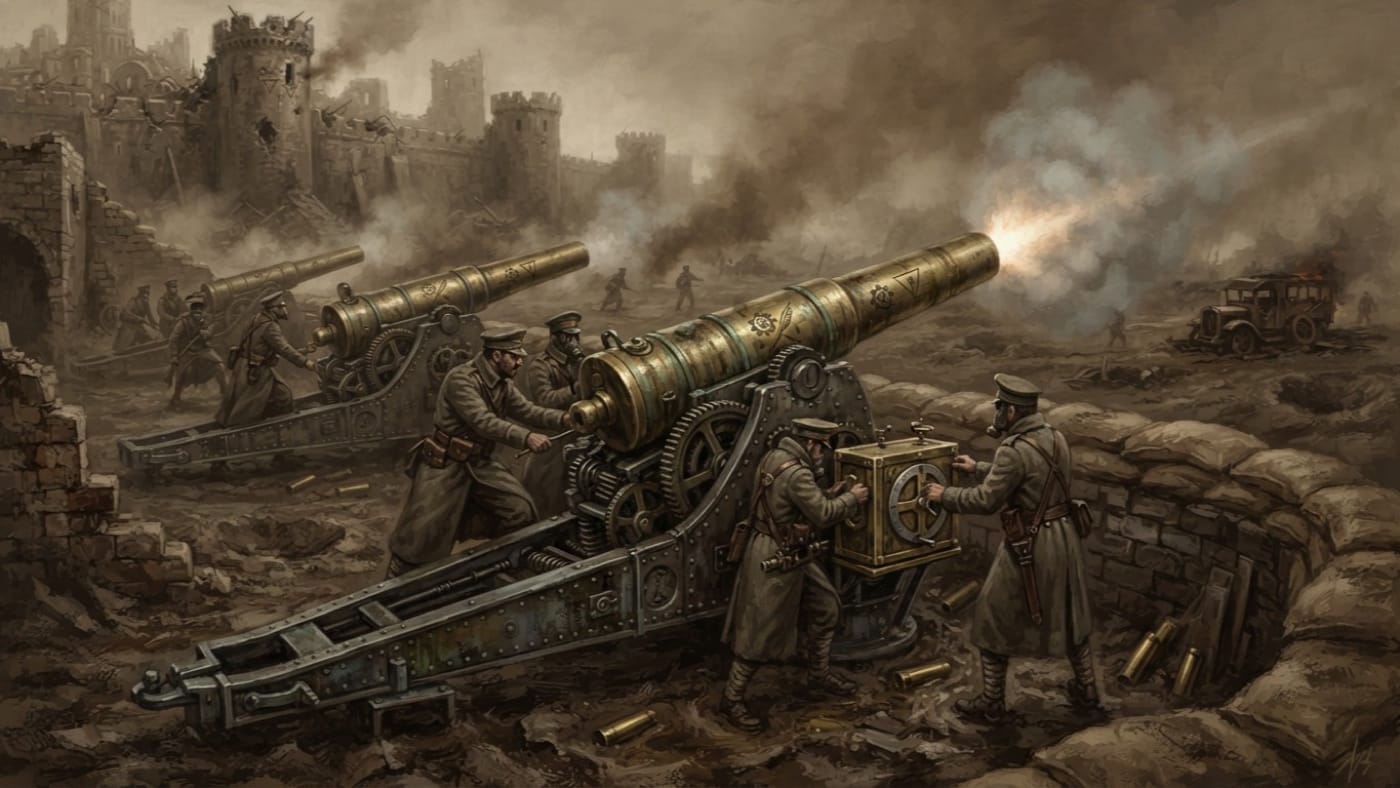
Clockwork artillery is a brass-barrelled cannon mounted on a spring-loaded carriage. The Rationalists built it to breach the walls behind which the faithful kept their altars, and it breached them. That is the difficulty.
The Church keeps a well-stocked cupboard of enemy instruments it may condemn without reservation. The census-clerk's ledger of erasure was vile. The Amsterdam pamphlet press was quick, cheap and ugly. Clockwork artillery belongs on a different shelf. It was honest work, soundly cast and cleverly sprung, and it killed the defenders of the Creator's altars faster than their own guns could answer.
As Warden I am required to condemn its makers. I do so below, at length and with pleasure. As a subject of the Synod I am also required to acknowledge that the Bureau of War still fields the design under another name. Both requirements bind me, and neither has been waived. A theologian who cannot hold two binding instructions in one hand should apply to the Bureau of Tithes, where the instructions are fewer.
#On the Mechanism and Its Measure
The barrel was brass. The carriage was sprung. Between the two sat the clockwork that gave the weapon its name, an apparatus whose particulars the Bureau of War keeps in its own folios and does not lend to theologians. I have asked. I was given tea and a receipt.
What the record does preserve is a number: four rounds per minute. The Rationalists adored that number. It could be written on a chalkboard, recited in a lecture hall and printed beneath an engraving, and it carried no ghosts. A faithful gunner of the same decade served his piece with powder, rammer and a muttered psalm. The Rationalist gunner served his piece with powder, rammer and a ratio.
Every engraving of a Rationalist battery leaves out the men. The guns are clean in those pictures and the crews are tidy, and the smoke goes politely upward. Brass wants polish. Springs want grease. A carriage built to absorb recoil still has to be dragged through Spanish dust and Alpine mud by men and horses, and both kinds of animal died along the way. The clockwork worked only as fast as the men around it, and the ratio on the chalkboard does not count them.
I admire it. The admission costs me something, so I make it once and plainly. The craftsmen who cut those gears understood tolerance, load and fatigue better than half the armourers in the Church's employ at the time. They put that understanding at the service of a creed that wanted the Church's altars turned into rubble and its rubble used for road-metal. The gears were sound and their purpose was damnable, and the Bureau has never found it necessary to choose between those two facts.
#On the Batteries of the Atheist Wars
The faithful attached one name to these guns more than any other: Lucien Artois, the Iron Rationalist, who in the chroniclers' phrase "fielded armies of clockwork artillery and scorched holy ground with relentless barrages." The chroniclers credit him with the batteries. They do not credit him with the invention, and I decline to award him a patent the record withholds. Heretics get no royalties from me.
At Montreval, in the southern passes along the Avignon–Lyon road, the faithful learned what the guns could do. From A.S. 15 to A.S. 18 (1725–1728 by the old reckoning) Cardinal-Marshal Severin held the pass-town against Artois, preaching to garrisons too hungry to stand for the whole sermon. The town remembers three winters of siege. It remembers the barrages more precisely. A wall built for an older kind of war could expect a pause between shots, time enough to shore a breach with timber and rubble and say a decade of prayers. Clockwork artillery shortened the pause. The masons on the walls and the priests beside them had less time for their work.
The Siege of Toledo, in A.S. 15 / 1725 CE, is often credited to Artois as well. The attribution is careless. Toledo's besieging commander was Colonel-Prefect Étienne Grimal, whose clockwork guns faced Father Clemente de los Rios and the brothers of the Order of Saint Iago. Artois's name belongs to the weapon. It does not belong to every field the weapon fought on. At Toledo the monks carried relics onto the battlements and called fire down upon the artillery lines. The Church's histories record that the fire came. They are less forthcoming about what the guns did to the battlements in the meantime.
The Siege of Toledo, in which Rationalist clockwork batteries were brought against the Order of Saint Iago, took place in A.S. 71.
Corrected: A.S. 15 / 1725 CE. By A.S. 71 the Rationalist Republic had been finished for twenty-six years and could not have besieged anything, and the Order of Saint Iago had other concerns. The earlier date stands in all future copies. The clerk responsible has been reminded that the Atheist Wars come before the Sundering.
Along the Rhine frontier the batteries appear in reports that give no dates and show no interest in giving them. I list the frontier for completeness. I will not invent a year for it to please a reader who likes tidy columns.
#On the Iron Plains
There was a second war, and the guns were not built for it.
In the early campaigns of the Sundering, in A.S. 45 / 1755 CE, Rationalist divisions met the Great Deceiver's legions on the Hungarian plain at the place the registers call the Iron Plains. The surviving accounts agree on very little, except for the fire. It fell from a cloudless sky, and whole divisions were lost in it. The Doctrinal account names Maldrake, the Sin-General of Wrath, as the author of that fire. In this account the clockwork jammed, the crews burned at their own brass carriages, and the carriages melted into slag that cooled where it lay.
I do not know in what order these things happened. Neither does anyone else who writes about it. Did the springs seize before the brass ran, or did the brass run first and seize them? The witnesses were busy, and most of them died. I record the outcome, which is the only part anyone was in a position to observe.
Recovery parties sent onto the plain afterwards reported carriages fused to the ground and to something else. The rest of the report is sealed.
The Bureau of Doctrine's verdict, recorded wherever the Rationalists are taught: excellent engineering, inadequate metaphysics. The theology was absent, says Doctrine, and so the machine failed when the supernatural took the field. I teach this verdict. I have taught it to cadets who wrote it down without blinking.
The Warden's office also requires precision, and in a precise copy the verdict is the Bureau's and not the slag's. Doctrine attributes the failure to the creed. The springs left no testimony. Whatever the gunners believed or disbelieved, they burned at the same rate.
#On the Bureau's Inheritance
The Bureau of War, in a year this tract will not supply because the record does not, took up the design. Each barrel was baptized in holy oil, and the mechanism was renamed the Ordained Repeater. Brass that had battered cathedral walls was anointed, catalogued and issued.
I defend this. I want that understood before the reader sharpens a quill. The Church did not damn brass. It damned the hands that held the brass and the creed those hands served. A bell recast from a heretic's cannon rings as well as any other, and the Rationalists, who melted bells for cannon in the years of their triumph, would have recognized the transaction from the other side of the furnace. The Bureau keeps what is useful and burns what is not. It is consistent about this, which is more than the Rationalists managed.
It is also funny, and I am permitted to laugh in the margin of my own tract. Doctrine holds that the original guns failed for want of theology. The Bureau's remedy for this want of theology was a flask of oil and a new nameplate. The springs, the gears and the measured brass came across from the heretic's yard to the Bureau's yard without alteration. Only the blessing changed. If the blessing is what makes the difference, then the Rationalists lacked one ceremony and one change of name. They built everything else.
The Bureau's catalogues make no mention of Artois. The original gun-founders are not credited, and the Montreval and Toledo dead do not appear in the specification. This is proper. A weapon in the Creator's service needs no heretic's pedigree, and a pedigree would invite questions from junior officers who have read too much. They will find no answers here. Queries concerning cadence, misfires and current deployment belong to the companion entry and to the Bureau of War, which answers them slowly and on the correct form.
The original pattern remains condemned, and the design remains in service. The Bureau sees no contradiction. Neither, by order, do I.