
#On the Field Before the Fire
"Formation holds. Advance at regulation pace." — Last recorded order of Colonel Kreszner, Rationalist Second Army, 7th Prefectural Division
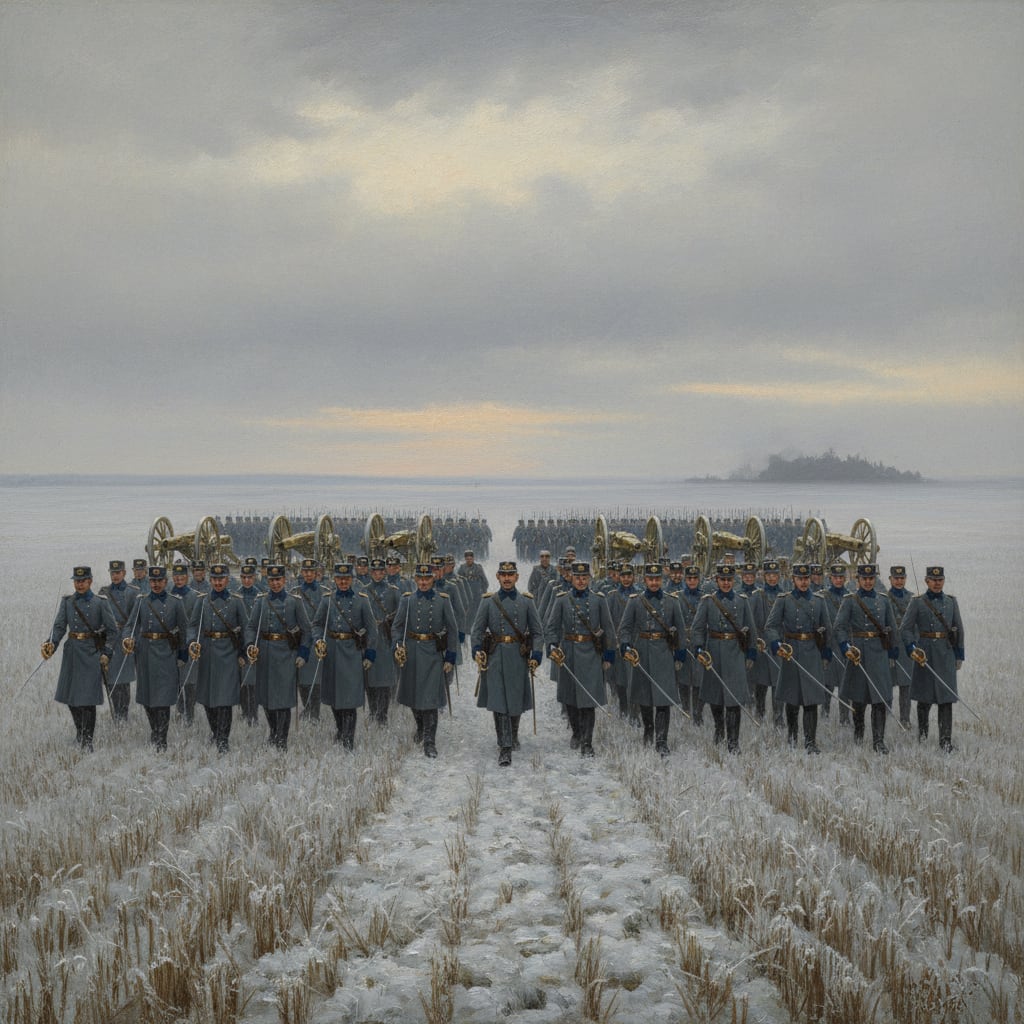
The plain lies east of the Danube, south of Debrecen, in what was then the Rationalist Prefectural District of Pannonia and is now the western fringe of the Blightmarsh. In A.S. 45, it was farmland. Wheat stubble, frozen mud, the kind of terrain that artillery officers dream about: flat, open, offering clear sightlines to four hundred metres in every direction. A gunner's paradise. A graveyard pretending to be an opportunity.
The Rationalist Second Army had been marching east for nine days. Three full divisions — the 7th, the 12th, and the 14th Prefectural — totalling approximately twelve thousand effectives, with attendant supply trains, field surgeons, and a brigade of the vaunted Lucien Artois clockwork artillery: brass-barreled, spring-loaded, capable of four rounds per minute, the finest mechanical ordnance Reason's forges had produced. The Bureau of War has since adopted the firing mechanism, blessed each barrel, and renamed it the Ordained Repeater. The improvement is theological rather than ballistic, but it makes the quartermasters feel better.
Their orders came from the Council of Nine in Vienna: investigate the disturbances reported from the eastern Balkans. The Council's precise language — preserved in File Reference V-45-09-14, stamped CLASSIFIED and then stamped again RETROACTIVELY DECLASSIFIED FOR INSTRUCTIONAL PURPOSES — read: "Ascertain the nature and disposition of hostile forces reported by civilian refugees, and suppress any organised resistance incompatible with the Concordats of Governance." The language is beautiful. The confidence is entire. The Council believed they were sending men to arrest bandits.
Scouts from the 7th Prefectural's light company reported, on the morning of 1 November, "a large enemy concentration" across the eastern horizon. The report was filed at dawn. It was accurate the way calling the ocean damp is accurate.
#On the Engagement
The Second Army deployed at regulation distance. Three divisions abreast, the 7th holding the centre, the 12th and 14th on the flanks. The clockwork artillery unlimbered behind the front line — sixteen batteries, sixty-four guns, each crew trained to the standard the Academy at Vienna had perfected over forty years of fighting enemies made of flesh, blood, and comprehensible motives.
The formation was textbook. The spacing was textbook. The officers' coats were pressed, their boots polished, their sabres drawn at the prescribed thirty-degree angle. A military historian reviewing the deployment — and the Bureau of War has compelled three to do so, for instructional purposes — would describe it as a model of Rationalist professionalism.
The enemy did not deploy. The enemy did not form ranks. The enemy did not signal, manoeuvre, or present a target. What came was no army in any sense that Colonel Kreszner's training addressed.
Fire fell from a cloudless sky.
The fire came from nothing and consumed everything. It descended in columns — vertical pillars of white heat that struck the Hungarian earth and turned it to slag. Where each column landed, the ground softened, liquefied, and swallowed whatever stood upon it. Men sank screaming into soil that had been frozen stubble a heartbeat before. Their boots melted first. Then their gun carriages. Then their horses. Then them.
Between the second and third volleys — if "volley" is the word for columns of divine or infernal fire that require no barrel, no charge, and no gunner — twelve thousand men ceased to exist. The Bureau of Records' official count is 11,847 confirmed dead, 221 unaccounted, and 14 survivors. The Bureau of Doctrine's official explanation is more concise: "The Adversary demonstrated that the laws of nature are subordinate to the will that wrote them. The demonstration was conclusive."
#On the Survivors
Fourteen men survived the Iron Plains. The Bureau of War has interviewed each of them. The Bureau of Purity has interviewed each of them separately, with different questions and less pleasant methods. The Bureau of Medicine has examined each of them. The Bureau of Doctrine has written a memorandum about each of them. The fourteen testimonies are sealed in the Vault of Silences, because they agree on three facts that the Bureau finds theologically useful and seventeen facts that the Bureau finds theologically inconvenient, and the Bureau has not yet determined how to publish the three without acknowledging the seventeen.
The three useful facts: the fire fell without warning; the fire consumed without discrimination; the fire ceased when there was nothing left to consume.
The seventeen inconvenient facts are sealed under Ninth Ratification. I note only that four of the fourteen survivors reported the fire as possessing direction — that it moved not randomly but with the systematic precision of a man stamping documents, proceeding from left to right across the formation, pausing at the artillery batteries, and resuming. Three survivors described the fire as warm rather than hot — "like a hearth, like coming indoors" — until it touched flesh, at which point the warmth became annihilation. One survivor, Private Kessler of the 12th Prefectural, described the fire as "singing." His testimony is sealed separately from the other thirteen, in a vault to which even the Archon of Records does not possess the key.
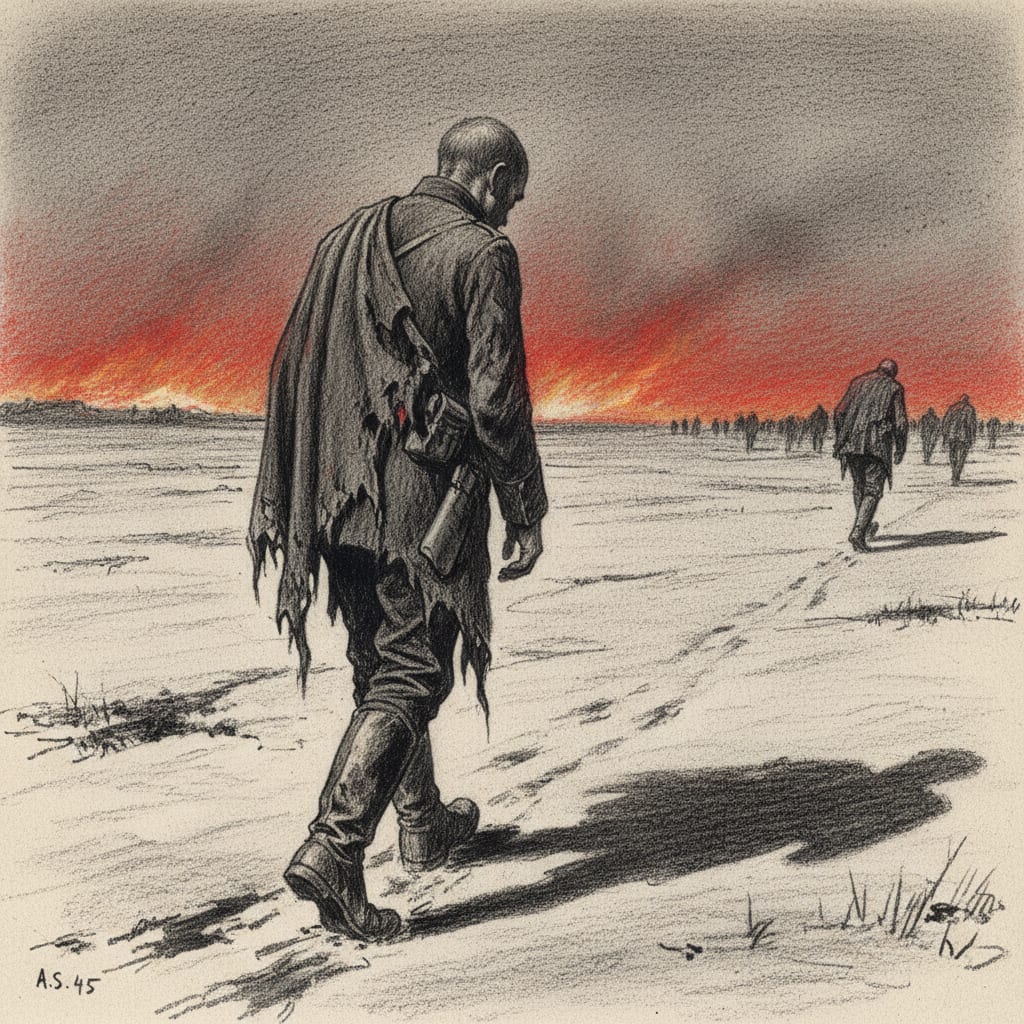
The survivors ran. This is not a euphemism for retreat; there was no retreat, because retreat implies a decision to withdraw, an order to fall back, a line of march toward safety. The fourteen ran. They ran in the direction that was not fire. They ran until their hearts could not sustain the rhythm. Bodies of their comrades — the ones whose hearts gave out before their legs — were recovered as far west as Bratislava, two hundred miles from the field, still facing away from the plains. The direction of their death stamped into the set of their shoulders.
#On the Ground Itself
The Iron Plains earned their name in the hours after the battle. Where fire had fallen, the earth cooled into a substance that was neither soil nor stone but something between — a dark, ferrous crust that rings when struck, pitted with craters that hold rainwater the colour of rust. The Bureau of Engineering dispatched a survey team in A.S. 73, as part of the Cartographic Expedition. Their instruments measured the surface temperature at sixty-three degrees above ambient. Their compasses spun without settling. Their plumb-lines pulled laterally. The chief surveyor's report, filed under Reference CE-73-IP-01, contains the phrase "the ground remembers" without further elaboration or, indeed, any apparent awareness that this is not a statement one expects to find in a geological survey.
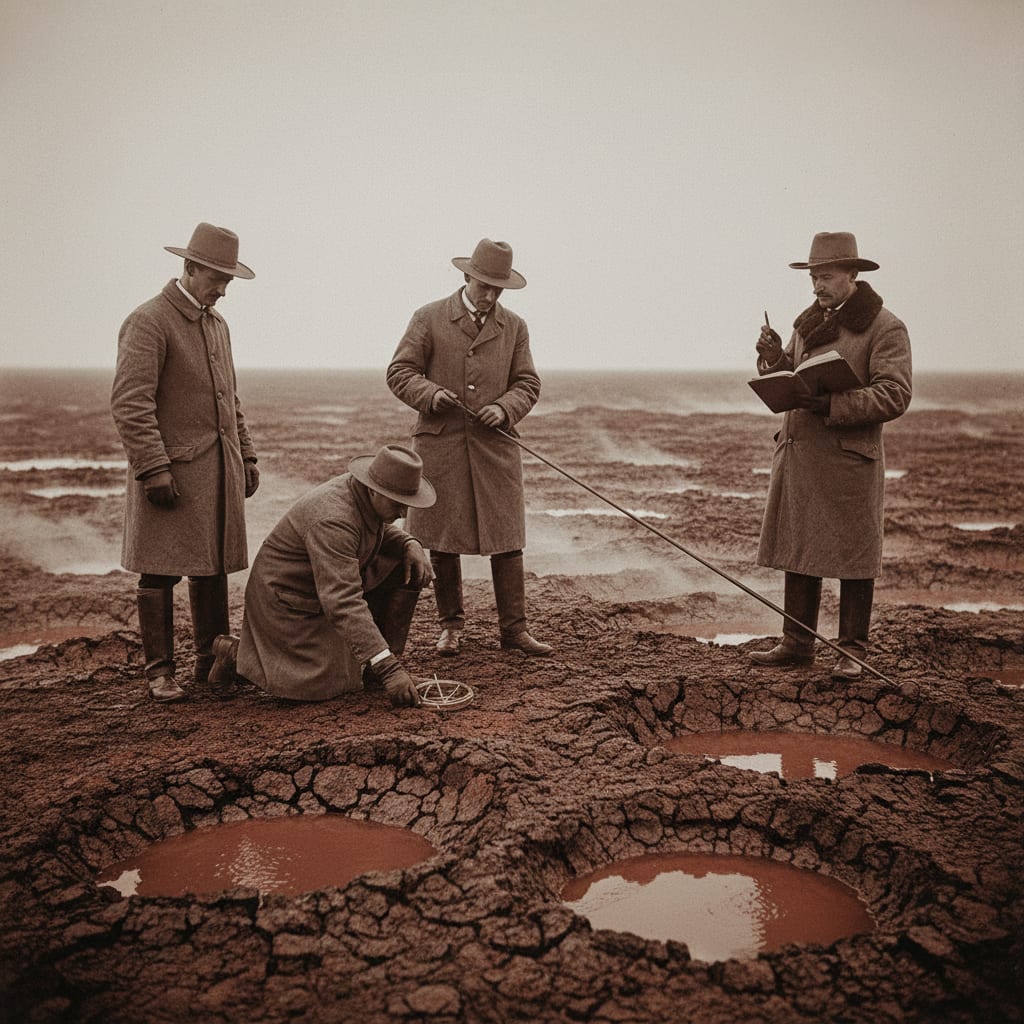
The craters have not filled. Rain collects in them — rust-coloured, faintly warm, emitting a metallic taste that the Bureau of Alchemical Standards has classified as "ferric, with theological complications." Cattle will not graze within four miles. Horses refuse to cross. Birds avoid the airspace with a consistency that the Bureau of Natural Philosophy (Unregistered) has called "meteorologically implausible" and the Bureau of Doctrine has called "instructive."
The Bureau of Engineering's second survey, conducted in A.S. 130, found that the ferrous crust had expanded by eleven metres in all directions since the first measurement. The third survey, in A.S. 178, found it had expanded by forty-seven metres. The Bureau stopped measuring after the fourth survey, in A.S. 194, returned figures that the chief surveyor described as "inconsistent with the field remaining a fixed geographical feature." The field is growing. Slowly, patiently, in the manner of all things that belong to Maldrake — the Sin-General of Wrath, whose first steps into Creation produced the fire that fell upon Colonel Kreszner's perfect formation and whose domain, the Iron Wastes of Thrace, begins where the Iron Plains end and the slag becomes a landscape.
#On What the Battle Proved
The Battle of the Iron Plains is the hinge upon which the Age of Heresy turns. Before the Iron Plains, Reason governed Europe. After the Iron Plains, Reason governed nothing — because Reason, for all its magnificent clockwork and its four rounds per minute and its textbook formations, had produced a military that was designed to fight men and was therefore useless against something that was not men. The Rationalist Second Army did everything right. Their deployment was flawless. Their equipment was superior. Their officers were brave. Their courage was real — the secular courage of trained professionals who had devoted their careers to the measurable and the provable. And it meant nothing, because courage is not armour against an enemy that does not recognise courage as a category, and measurement is not a weapon against a force that has abolished measurement.
Kargath ate Debrecen's rations the same week. Morwen duplicated a Rationalist general's face and issued contradictory orders that sent two regiments into each other's artillery. Syrion's fog swallowed the eastern communications network so completely that garrisons fifty miles from the front believed the war was going well for three weeks after it had ceased to go at all. The collapse of Reason was not a single battle but a cascade — and the Iron Plains was the first stone.
The field remains. The craters hold their rust-coloured water. The ground rings when struck. And one hundred and fifty-six years later, the soldiers on the Line still use a phrase when describing any situation that has passed beyond tactical remedy: "That's Iron Plains." They say it quietly, and they do not explain it, because everyone on the Line knows what it means, and no one on the Line wishes to be the man who says it loud enough for the ground to hear.
Earlier editions of this entry attributed the fire at the Iron Plains to "demonic artillery of unknown provenance."
The Bureau of War has revised this assessment. The fire was not artillery. Artillery implies a weapon, which implies a user, which implies a decision to fire, which implies a mind engaged in tactical calculation. What fell on the Iron Plains was not a weapon. It was a statement. The distinction is the difference between a cannon and a sermon — one can be silenced; the other simply changes the terms of the conversation. The Bureau of Doctrine concurs. The Bureau of Engineering has filed a minority report arguing that the fire exhibited "regular thermal patterning consistent with deliberate targeting." The Bureau of Doctrine has filed the minority report in a drawer from which minority reports do not return.