
#On the Gun That Changed Its Name
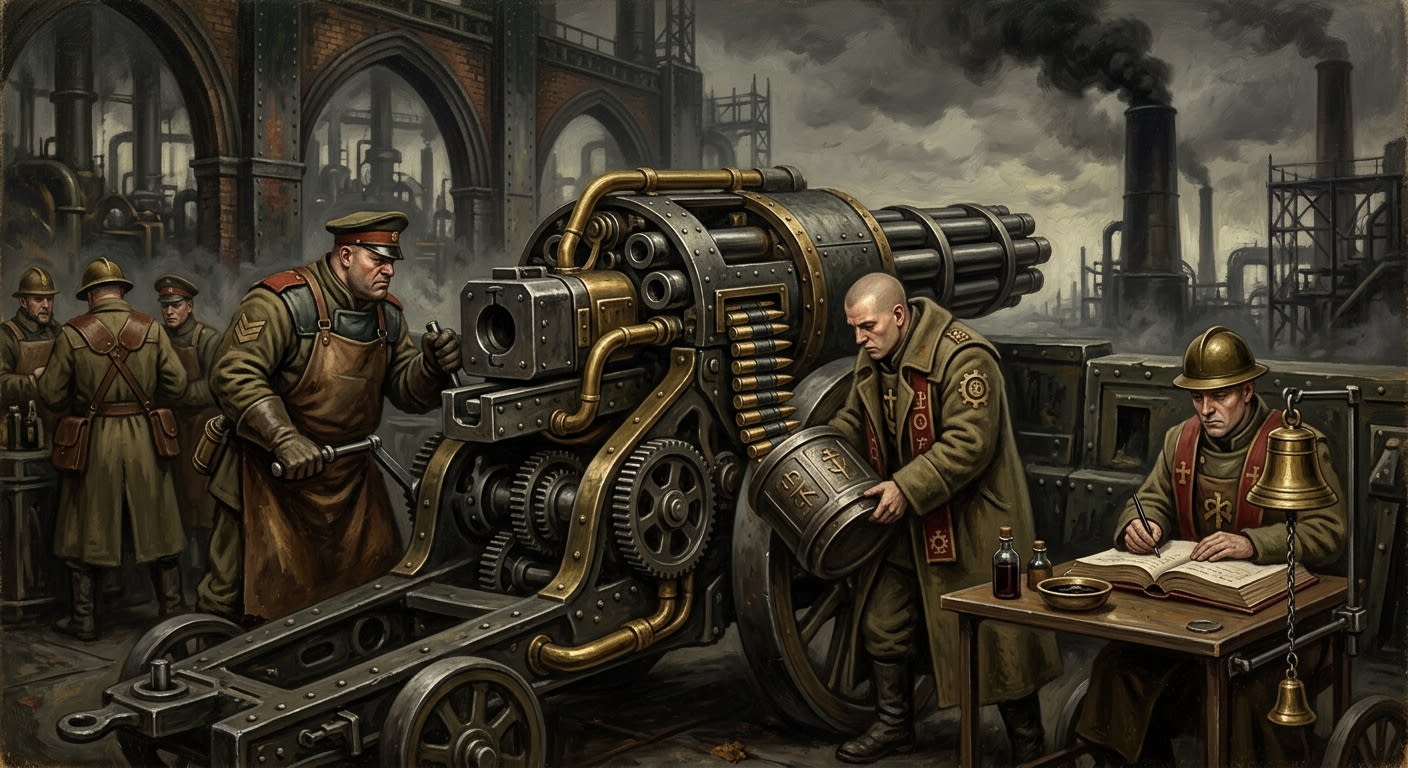
The Ordained Repeater is a brass-barrelled, spring-return artillery mechanism descended from the clockwork batteries of Lucien Artois, the Iron Rationalist, whose hands gave Reason four rounds per minute and whose mind ended on the Iron Plains trying to calculate fire that had no barrel. The Bureau of War now mounts the mechanism on Line parapets, bastion platforms, chapel-gun decks, and convoy redoubts under consecrated designation. Each barrel is washed in chrism. Each breech receives a psalm. Each recoil tooth is inspected, kissed by a tired priest if available, and entered in the shot-ledger as obedient.
The machinery remains Artois’s. The authority does not.
The Rationalists called it clockwork artillery: brass cannon on spring-loaded carriages, recoil captured by ratchet, returned into alignment, loaded by crews drilled to metronome rather than hymn. The Synod calls it the Ordained Repeater because a weapon that survives its heretical inventor must be given a clean baptismal file before it can be trusted near soldiers with souls. The rechristening did not alter the path of shot. It altered the path of blame.
#On Artois and the Mechanism
Artois’s carriage was a beautiful heresy. Let us not insult the dead by pretending otherwise. Its recoil bed caught the violence of discharge, hauled the barrel back through a toothed cradle, locked elevation against the previous mark, and returned the piece with a regularity that made older gunners look like farmers throwing stones at weather. In dry conditions, a trained crew could fire four rounds per minute. In mud, three. When a loader lost two fingers to a hungry gear, two and a half, if the officer had disciplinary confidence and the loader still had enough hand to hate him.
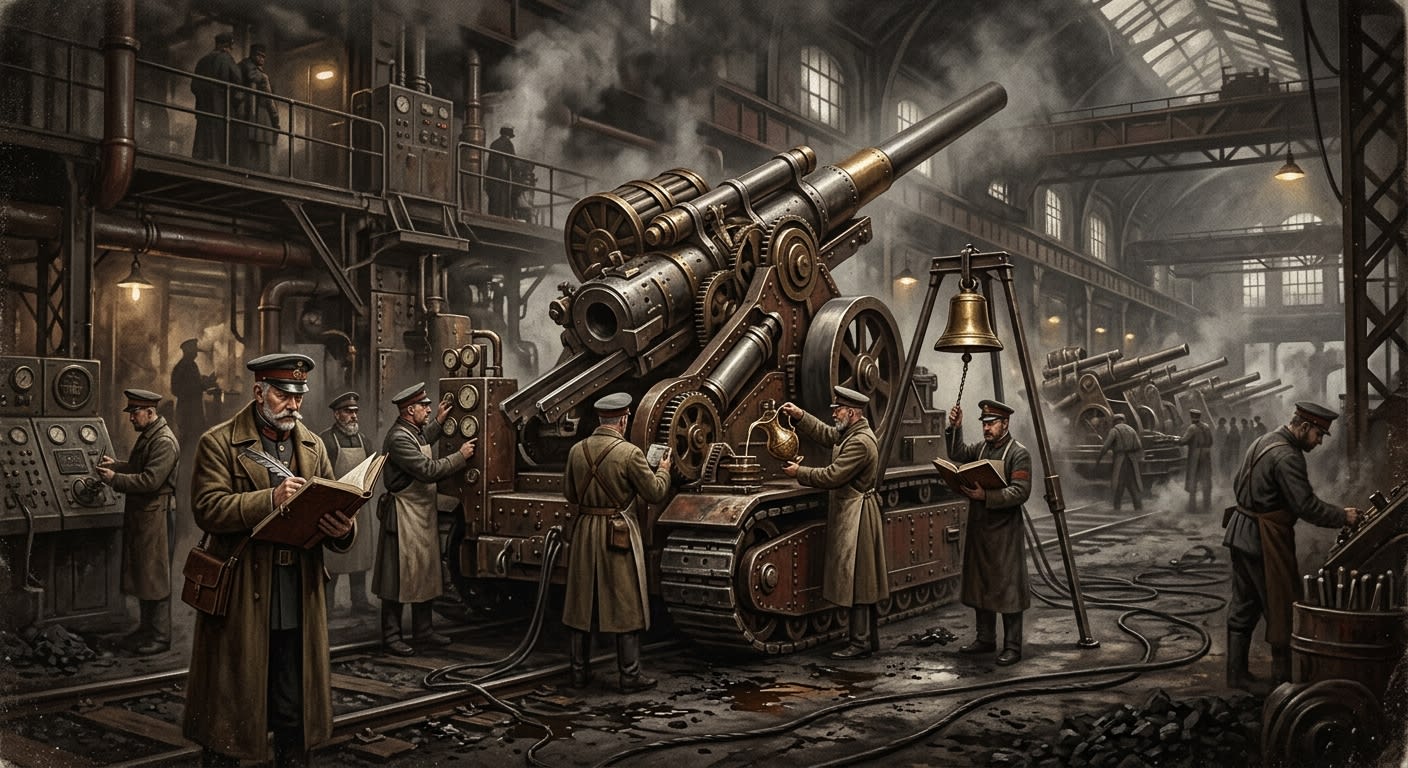
The Rationalists adored the carriage because it made war resemble an argument they could win. Load. Fire. Recoil. Return. Load. Fire. Fear reduced to interval. Courage replaced by cadence. Names replaced by numbered ammunition slates. Chapels converted into calibration halls because vaulted ceilings gave excellent acoustic feedback. Priests dried and stacked where sandbags were scarce. Artois did not invent every obscenity attached to his guns; he merely made the obscenities efficient enough to travel.
At Montreval in A.S. 15, the carriage announced itself with sufficient arrogance to deserve memory. Artois placed brass repeaters on the lower east approaches and battered walls, cistern vents, market roofs, and the patience of Cardinal-Marshal Severin of Avignon through three winters. Severin answered with bells in gun galleries, relic-shot, trench chapels, and sermons delivered through masonry dust. Artois noticed that bells changed crew behaviour. His captured note reads: “Bells alter crew behaviour. Suppress or reproduce.”
The Synod chose reproduce. Then sanctify. Then deny source.
Early War primers describe the Ordained Repeater as “a native Synodal improvement born from Line necessity.”
Corrected: the firing mechanism descends from Artois’s clockwork artillery. The Synod improved its liturgy, its supervision, its record discipline, and its capacity for embarrassment. The brass was already clever.
#On Toledo, Montreval, and the First Theft of Usefulness
The gun’s first reputation came from sieges against stone and faithful flesh. At Toledo, Colonel-Prefect Étienne Grimal brought twelve clockwork cannon descended from Artois’s mathematics to punish walls that still contained relics. The guns hammered for nine months, their crews precise, their leaflets arrogant, their officers persuaded that a cathedral was merely a fortification with sentimental acoustics. The fourth Orison Company answered with relic-shot and burned three ammunition caissons in a manner Engineering still classifies through clenched teeth.

At Montreval, the gun taught both sides. Rationalists learned that faithful walls could take longer to break than firing tables promised. The faithful learned that contempt does not prevent brass from killing your friends. Severin learned to place bells where fear would otherwise set the loading rhythm. Artois learned that bells mattered and remained stupid about why. This is the common fate of clever men: they see the hinge, measure it, oil it, and miss the door.
The Bureau of War watched after the fact, which is how War learns without admitting it arrived late. Captured batteries were stripped, weighed, tested, cursed, blessed experimentally, stripped again, and compared against field reports. The carriage worked. The recoil return was sound. The ratchet housings were overfine and vain but teachable. The breech locks disliked rain. The spring teeth failed in mud unless cleaned with priestly persistence or secular profanity, both of which have comparable mechanical value.
#On the Consecration Procedure
The ordination of a Repeater is not a single blessing. It is a custody chain dressed as a sacrament, which is to say, one of the Synod’s more honest ceremonies. The barrel arrives sealed under War wax and Engineering wire. Records verifies source, batch, foundry mark, prior misfire count, and any inconvenient Rationalist stamp not yet ground away. Purity inspects for philosophical residue, which is usually found in the form of old engravings, compass marks, secular mottoes, or the faint smell of confidence. Doctrine supplies corrected language. A priest supplies oil and, if wise, keeps his fingers away from the return bed.
The breech receives the short psalm. The recoil cradle receives chrism at three points: tooth, hinge, and arresting latch. The carriage rails are marked with the Sign of Obedient Return (Unregistered). The first dry cycle is performed without shot while a clerk reads the condemnation of Artois aloud. The second cycle is performed with a dummy round and the Litany of Necessary Theft (Unregistered). The third cycle fires live under bell-cadence. If the barrel returns true, the gun is entered as ordained. If it fails, Engineering blames metallurgy, War blames crew discipline, Doctrine blames insufficient contrition, and the priest blames everyone because he is closest to the explosion.
The consecration reduces rate. This is admitted only in internal manuals and by every gun crew with a pulse. A Rationalist battery under ideal conditions achieved four rounds per minute because it treated men as replaceable gear. An Ordained Repeater under lawful cadence averages three because every shot must be witnessed, every powder charge crossed, every return acknowledged, and every crewman reminded he is loading a weapon rather than becoming one. The extra second is theology. It is also hand retention.
Public arsenal placards state: “Consecration improves the Repeater’s rate of fire.”
Clarified: consecration improves admissibility, morale, post-misfire accountability, and the probability that a gunner will not recite Artois’s firing tables while dying. Rate of fire belongs to the stopwatch. The stopwatch has heretical habits.
#On the Line Where It Now Serves
As of A.S. 201, Ordained Repeaters serve along the Sagittal Line from Bastion-Königsberg to Bastion-Constantinople, with heavier concentrations at flat approaches, bridge locks, convoy mouths, and bastion decks where a quick second shot means one fewer demon touching the parapet. They sit in casemates above the Bug at Bastion-Brest, in gallery embrasures near Bastion-Przemyśl, on southern road platforms where dust turns oil into paste, and on coastal auxiliary works where sailors claim the carriage returns differently in fog. Sailors claim many things. Some are sober when doing it.
The gun excels against bodies that respect impact. Ash-Fodder ranks, Gore-Slinger packs, corrupted auxiliaries, siege scaffolds, bone carts, worm-screened infantry, and anything large enough to reward repeated punishment all suffer well under its cadence. Against Maldrake’s higher manifestations, Morwen’s reflection bodies, Syrion’s fog-heralds, or Atheronic altitude arrogance, the gun becomes a loud petition. Petitions have value. They delay. They instruct. They make the crew feel less naked until Bells, relic-shot, humility recitation, or retreat arrives.
At the Iron Plains, the old clockwork batteries stood perfect and useless when fire fell from a cloudless sky. This memory governs every Repeater chapel. Above many gun decks hangs the same instruction: TACTICAL COMPETENCE IS NECESSARY. IT IS NOT SALVATION. War credits the sentence to its manuals. I wrote it. War has taste in theft.
#On the Crews
A Repeater crew is five bodies and one conscience, if the chaplain is sober. The layer holds elevation and hears bells. The loader feeds shell and keeps fingers. The spring-man watches the return teeth. The powder boy learns terror in increments and is officially called an assistant charge clerk because the Bureau dislikes admitting it employs boys near explosions. The captain counts, curses, and signs. A sixth man, when available, reads the shot-ledger and marks returns after each discharge. When unavailable, the captain does it badly and Records complains after the dead have cooled.
Training begins with disassembly. Every crew learns the heresy before the blessing: Artois carriage, spring return, ratchet lock, recoil capture, secular cadence, metronome drill. Then the instructors strike the slate and begin again: Ordained Repeater, obedient return, witnessed discharge, bell cadence, psalm mark. The young laugh at the distinction until the first misfire. After a misfire, every man becomes a theologian for at least seven minutes.
MISFIRE REPORT — SOUTHERN PLATFORM, A.S. 188 Gun: Ordained Repeater, Third Carriage Revision. Crew statement: barrel returned without shot leaving bore. Witness statement: shell was heard striking target before loading completed. Recovered slate mark: ARTOIS TABLE 7, written in oil on underside of return bed. Disposition: gun melted; crew reassigned; chaplain’s tongue blistered after testimony and sealed in wax.
Crew superstition is tolerated up to the point where it becomes rival procedure. Gunners tap the breech twice for Montreval and once for Toledo. Some spit before the first shot in memory of the Rationalist powder crews whose contempt did not save them. Some whisper Severin’s name into the return cradle. Some draw tiny broken compasses under the carriage and scratch them out before inspection. War forbids all of this. War also tracks which crews survive. The statistics are not filed beside the prohibitions.
#On the Heresy in the Teeth
The Ordained Repeater is useful because the Synod is not a child. We do not throw away a sharp instrument because a heretic held it first. We take it, wash it, mark it, bind it, aim it east, and explain, very loudly, that it was always ours in potential. This is called correction. It is also called theft by men without seals.
The danger lies in admiration. A gun crew that admires Artois too much begins to love rate above order, mechanism above rite, speed above witness, and the lovely clean lie that enough brass can solve a theological problem. That road ends at the Iron Plains, where three divisions and sixty-four guns performed every correct action and were answered by a column of fire that did not consult their excellence.
The Bureau of Purity maintains residual contamination files on Artois designs. Certain carriage marks bloom under fume paper if heated by black diesel. Certain early breech engravings reappear under soot. A few captured gears bear compass-and-cross tooling from the Ulm pattern, smoothed almost flat by later machining, yet visible when oil catches the light. Engineers call these manufacturing traces. Purity calls them ideological residue. Doctrine calls them useful reminders. War calls them delays in procurement.
The current rule is sensible by accident: no Repeater may enter service with an uncorrected Rationalist mark, no crew may drill to metronome, no firing table may be copied from Artois without doctrinal header, and no officer may refer to the gun as clockwork in front of troops. In private, old captains use the old name when the gun misbehaves. A weapon, like a child, hears its worst name when it has disappointed authority.
#On What It Proves
The Ordained Repeater proves the Synod’s most elegant proposition: that heresy can be made to serve after its authors are dead, provided the Bureau controls the labels, the ledgers, the priests, the schools, and the surviving metal. Artois built a gun to demonstrate that Reason could master violence. The Iron Plains demonstrated Reason’s limit. The Synod kept the gun and changed the lesson.
On the Line, when the bell sounds and the carriage slams back into true, nobody asks whether the spring was first drawn by Rationalist hands. The loader wants the breech open. The layer wants the target still visible. The captain wants the next shot recorded before the thing in the wire learns to climb. Doctrine may quarrel afterward. Doctrine adores afterward. During fire, even the Bureau of Doctrine has the decency to let brass speak first.
A vulgar mind asks whether using Artois’s mechanism makes us indebted to him. The answer is no. Debt requires recognition by both parties. Artois is dead, condemned, and instructional. His brass serves. His premise does not.