
#On the Refusal in Stone
Montreval was not born important. This is worth saying because every survivor's town, once it has acquired sufficient dead, begins speaking as if Providence founded it with a trumpet and a clerk standing by to witness the intention. Before the Atheist Wars, Montreval was a hard little fortified town in the southern passes between Avignon's ecclesiastical rear and the contested roads bending north toward Lyon, Vienne (Unregistered), the Rhine, and the fashionable varieties of secular stupidity. It had mule yards, chapel terraces, cistern galleries, lower mills, upper walls, three market lanes too steep for the elderly, and a population trained by geography to hate strangers before asking whether hatred required refinement.
Then war found it useful. Use is the beginning of sanctity in the lower offices.
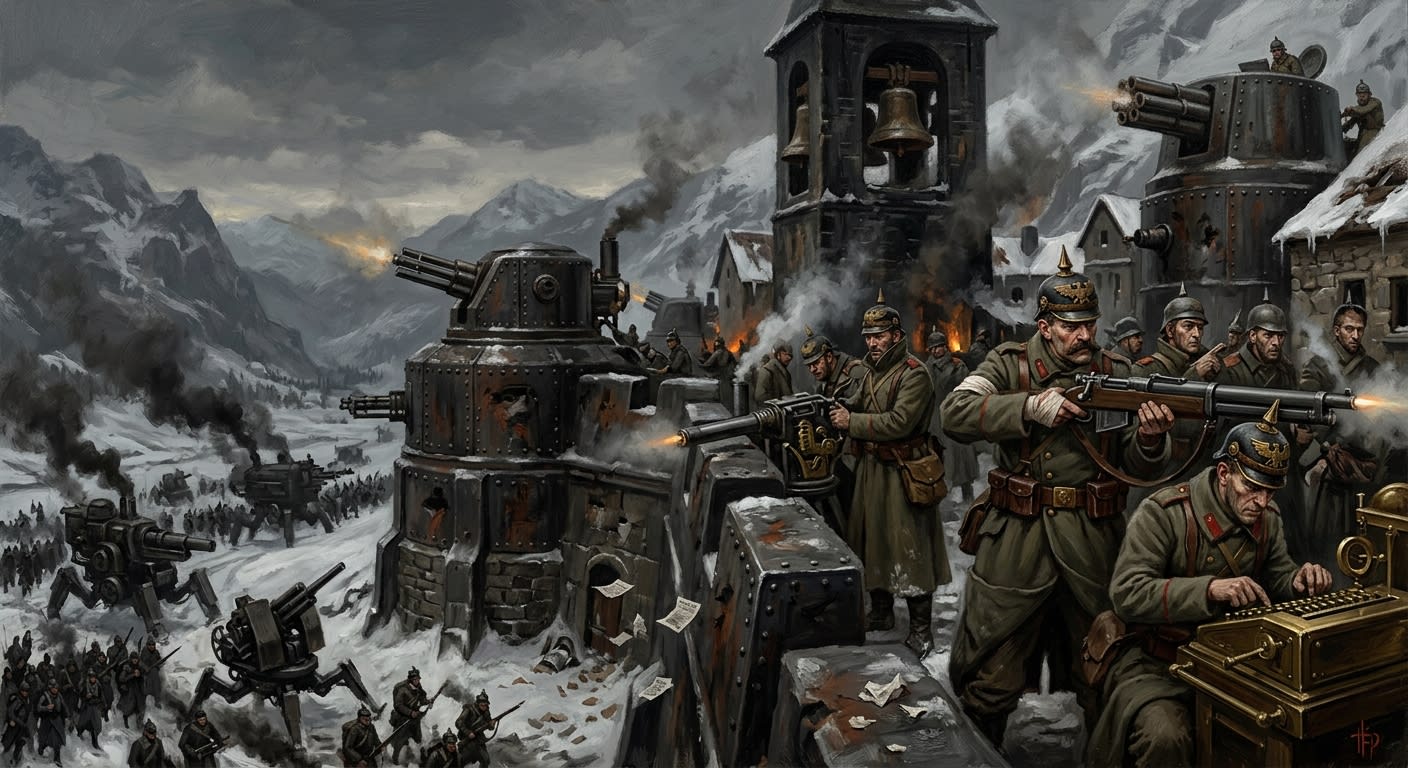
The Rationalist Republic wanted passage through the southern faithful front. Lucien Artois wanted firing angles, road gradients, gun platforms, and the humiliation of bells. Cardinal-Marshal Severin of Avignon wanted time. Montreval supplied time at a price so vulgar that hagiographers still blush while spending the proceeds. It held three winters against clockwork artillery, hunger, pamphlet shells, mutiny weather, fever, aristocratic uselessness, and the terrible fact that courage becomes less musical after the second month without bread.
The Bureau of Cartography now marks Montreval as a historical fortified site of the southern faithful front, probably south-eastern France, under Avignon corridor (Unregistered) custody during the war years. The hedging in that sentence belongs to Cartography. The town's exact pre-war jurisdiction was muddied by episcopal claims, noble toll rights, monastic pasture privileges, and the usual local conviction that every hillock becomes sovereign once it has a fence. Its military identity is cleaner. In A.S. 15, Montreval became the knot Severin tightened around Artois's advance.
Montreval matters because it demonstrates the old Church at its ugliest moment of competence: badly fed, badly governed, liturgically magnificent, administratively half-ruined, and still capable of telling Reason that the road was closed. The Synod did not yet exist. The Bureaus had not yet learned to make virtue taxable. The faithful cause at Montreval was held by bishops, abbots, quartermasters, bridge-women, mercenaries, parish companies, and one red-clad commander loud enough to serve as both general and alarm bell.
A pretty arrangement? No. A saving one? Ask the archives carried west under Montreval's guns. Ask the children evacuated through Avignon while Severin burned his own approaches. Ask the Rationalist timetables amended after the Pont des Tanneurs. Paper remembers humiliation better than statues do.
#On the Lower Town and the Terraces
Montreval's lower town lay where roads converged badly and mules discovered private grievances. Every pass-town has the same first smell: dung, wet rope, boiled leather, smoke caught in stone, fear preserved in gutters. Montreval added tannery vats, candle grease, lime wash, powder vinegar, and the sour breath of men who had prayed too long over empty bowls. Its houses pressed against the slope in stacked lanes. The roofs were slate where the old guilds had money, patched plank where widows owned the weather, and canvas where refugees arrived faster than carpenters could lie about delivery dates.
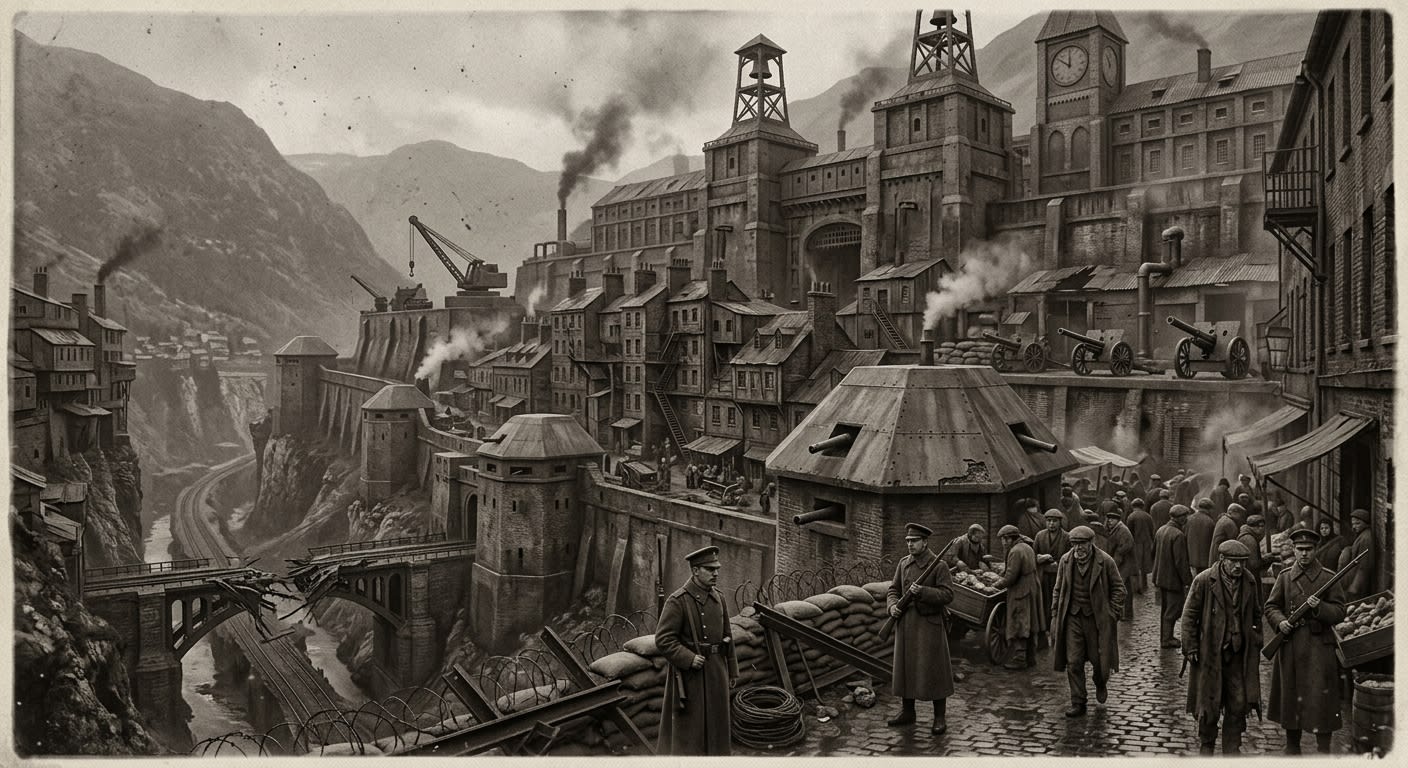
Above the lower town rose the chapel terraces. These were not delicate cloisters for abbots with clean nails. They were artillery shelves by necessity, prayer galleries by habit, infirmary platforms by misery, and public scolding stations whenever Severin needed an audience large enough to frighten itself. Bells hung in squat towers built before anyone expected spring-carriage cannon to acquire opinions about masonry. By the second winter, most bells were cracked. They rang anyway, which is also a theological statement.
The upper works were never elegant. They had curtain walls reinforced with scavenged tombstone, bastions with names from three devotional cycles, gun holes widened by panic rather than Engineering, and a citadel chapel whose west window was bricked after an Artois shell carried the face of Saint Ursin (Unregistered) into the soup queue. Men fought from galleries built for processions. Priests carried powder along routes once reserved for Corpus feasts (Unregistered). Confession booths became ammunition cupboards because the booths were thick, lockable, and already used to containing despair.
The cistern galleries saved the town twice and nearly killed it once. Water entered through old hillside channels and gathered in vaulted chambers beneath the second terrace. During the first winter siege, the channels froze. During the second, Rationalist sappers attempted contamination with lye and ground glass, a method their field manual called sanitary denial and the local chaplain called exactly what it was before being told the children were listening. During the third winter, Severin ordered cistern access placed under prayer-company custody after a noble captain attempted to reserve a private barrel for his horses.
He was hanged beside the barrel. The horses were reassigned.
Later noble family memorials state that Captain Reynaud de Salles (Unregistered) died “while defending Montreval's water stores from enemy tampering.”
Corrected. Reynaud died while defending water from thirsty commoners with insufficient heraldry. His corpse did more for morale than his command had done for the wall.
The lower mills stopped grinding flour by the first hard ration. They ground bark, pulse husks, acorn meal, candle scrapings, and once, according to a Mercy note, the leather cover from a minor episcopal commentary on chastity. The commentary was judged nutritionally poor but doctrinally improved by reduction.
Montreval's streets acquired their wartime names quickly: Shell Nun Alley, Three-Mule Turn, Broken Sext, Saint Ursin's Face, Black Ladle Yard, the Red Slope, the Little Gut, the Captain's Barrel, and Tanneurs Road. Official maps hate such names because they remember what orders omit. Soldiers used them anyway. A man carrying shot under bombardment prefers directions involving insults and blood. They are easier to recall.
#On Severin's Seat
Severin did not make Montreval holy. Montreval made Severin legible. Before A.S. 15 he was already a commander of consequence, a cardinal with a marshal's baton and the kind of voice that makes lesser men look for tasks. At Montreval he became a sentence the faithful could repeat without understanding all its clauses: Hold. Pray. Reload.
His field seat occupied the old episcopal receiver's house above the second terrace, a practical building with thick walls, poor windows, and enough cellars to satisfy a nervous quartermaster. From there Severin managed the Avignon corridors: grain, oil, spare horses, relic custody, field priests, ammunition, surgeon rotations, deserter gallows, refugee packets, bell schedules, bridge demolition stores, and noble tempers. Noble tempers consumed more hours than powder and killed fewer enemies.
Severin's command method has been sentimentalized into sermons shouted from parapets. Yes, he preached. He preached because sound carried farther than paper under shellfire and because frightened men require cadence before content. His greater achievement was administrative cruelty yoked to pastoral understanding. He grouped units by parish after discovering that men deserted less readily from neighbours who would know their mothers. He paired artillery crews with reliquaries, one authenticated and one dubious, because certainty and doubt both stiffen the spine when assigned properly. He required confession before dawn watch and ammunition count after confession, a sequence many found spiritually abrupt.
He also punished. Montreval's gallows stood near the lower mule gate, visible from ration queue and barracks yard. This was deliberate. A punishment hidden becomes rumour; a punishment seen becomes architecture. Deserters hanged there. Thieves hanged there when theft touched bread, powder, oil, water, or the cord used for wounded men. Blasphemers were usually beaten rather than killed, unless they blasphemed while carrying open flame near powder stores, in which case the distinction became academic.
Severin's letters from Montreval show no romance. He asks Avignon for flour, salt, linen, mule shoes, lamp oil, spare axles, cough syrup, shovel heads, and priests who can hear confession without fainting. He complains about abbots hoarding sacramental wine. He threatens a merchant guild with anathema for underweight candles. He praises one washerwoman by name for keeping bandage cloth moving through freeze and fever. That washerwoman, Aline of Veyr (Unregistered), has no chapel. This omission irritates me more than several canonization disputes.
Montreval was Severin's theatre, but not his toy. He understood that the town possessed its own temper. Pass-towns resent commanders because commanders arrive, spend local sons, requisition local carts, consult the War tables only after the mules have died, and leave plaques. Severin managed this resentment by becoming more hated than the town itself. There is a genius to absorbing blame. The people could curse him and still hold the wall. That is governance stripped to bone.
#On Artois and the Clockwork Batteries
Lucien Artois arrived at Montreval with machines that made older artillery look like farm implements with ambitions. Brass-barreled cannon on spring-loaded carriages; recoil caught, ratcheted, returned; crews drilled to metronomes; ammunition slates numbered for replacement without names; firing tables annotated with contempt for ecclesiastical acoustics. Four rounds per minute in dry conditions. Three in mud. Two when Providence put a finger in the teeth.
The Rationalists loved the Montreval problem because it appeared solvable. A town on a slope. Terraces. Roads. Range tables. Wind. Powder. Morale. Supply. Bells. Each item could be measured except the last, and Artois believed unmeasured things were either irrelevant or waiting to be properly humiliated. Montreval taught him otherwise without making him wise, which is history's common economy.
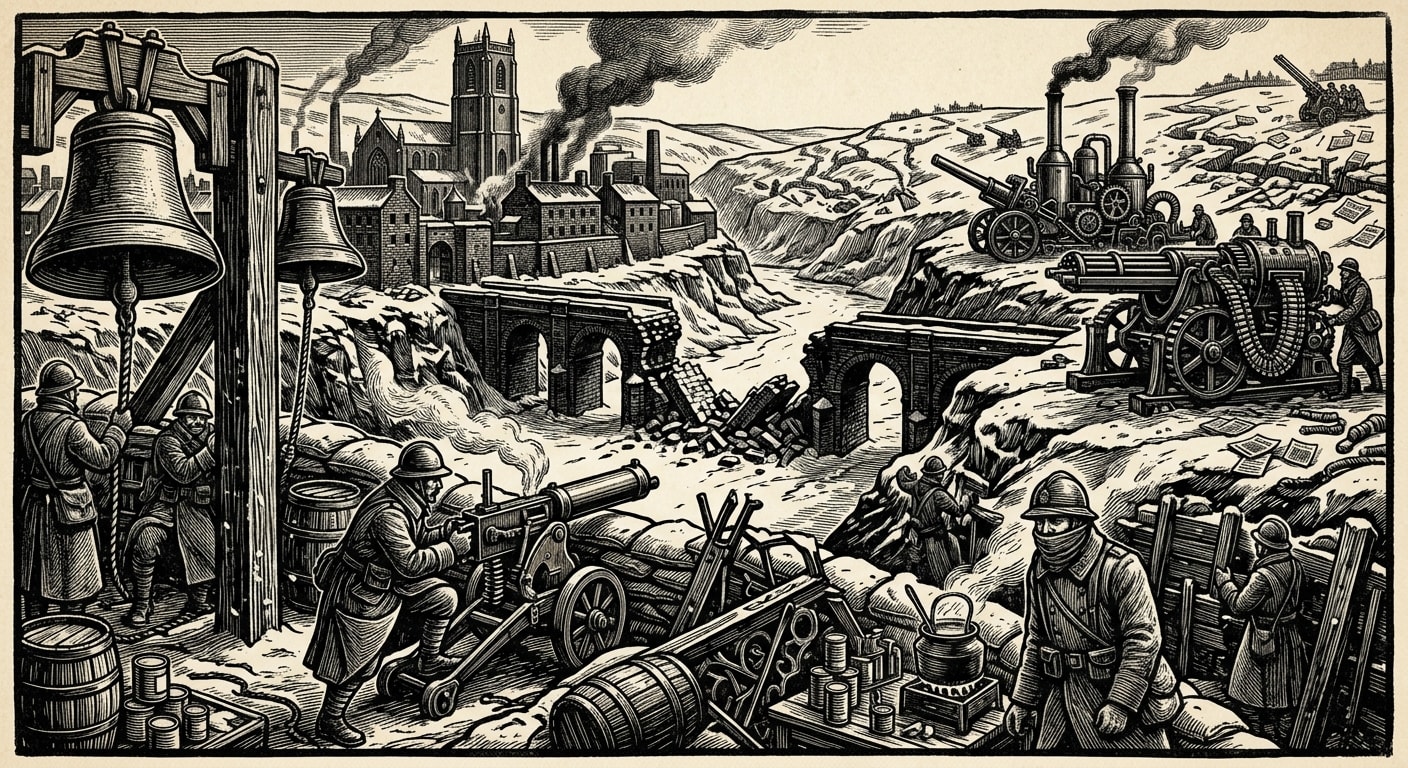
His first batteries took position on the lower east approaches in late A.S. 15. The opening bombardment cracked Saint Ursin's tower, killed twenty-three men in a gun queue, shattered two cistern vents, and convinced three noble officers that urgent correspondence required their presence elsewhere. Severin answered by moving bells into gun galleries. The bells did not stop shells. They changed loaders. Men who loaded to a bell held rhythm after the metronome of fear broke. Artois noticed. His captured note reads: “Bells alter crew behaviour. Suppress or reproduce.”
The Synod later reproduced and sanctified. We deny nothing except debt.
Several schoolroom plates show Artois's clockwork batteries failing at Montreval because Rationalist machinery could not withstand holy bells.
False. The batteries worked. They killed faithfully, accurately, and often. Montreval survived because men repaired walls faster than Artois could make holes permanent, because Severin spent lives without decorative conscience, and because the Sisters burned crossings when arithmetic required passage.
Artois tested shell patterns against the chapel terraces. He used alternating high burst and wall strike, then powder-interval suppression against repair crews. He fired pamphlet shells into the lower town: paper cylinders packed with surrender terms, bread promises, priest-denunciations, and little engravings of Severin as a wolf in a cassock. Children collected them for kindling. One broadside became famous because it accused Montreval's defenders of irrational attachment to stone while misspelling artillery. The Bureau preserves it for officer amusement.
The Rationalist crews were brave. Let no one steal that ugliness from them. They stood by hot brass in winter fog, corrected elevation under counterfire, dragged broken carriages over alpine stone, and died in disciplined rows when relic-shot reached their parks. A coward with a machine is merely noise. Artois's men were brave with machines, which made them dangerous and harder to despise cleanly.
The Montreval batteries never cracked the town in one glorious breach. They abraded it. Wall by wall, stair by stair, bell by bell, cistern vent by cistern vent. Artois's genius lay in repetition without boredom. He understood that stone suffers morale if struck regularly enough. Severin understood that men suffer less when suffering has a bell schedule. Between them the town became an argument conducted in brass and throats.
#On the Pont des Tanneurs
Every fortress has one incident that overeager teachers reduce until it fits inside a child's mouth. For Montreval, that incident is the Pont des Tanneurs action, A.S. 15: three women in grey habits, a bridge, consecrated oil, a Rationalist column delayed six hours, two spring guns lost, and Artois deprived of the soothing assumption that religious women came to negotiate.
The Pont des Tanneurs crossed the ravine road below the tanneries, where the water ran brown before war and worse after. It was not the largest approach. It was the most convenient for guns after rain, because the higher road became slick and the lower ford swallowed wheel hubs. Artois needed the pontoon train brought up. Severin needed him slowed. The Sisters of the Martyrdom supplied delay in the form their order had perfected: human fire applied to enemy transit.
At second bell the Rationalist vanguard reached the span. Three women stood midbridge. Witnesses disagree on their names. Severin's field account gives none. A later chapel list gives Aude (Unregistered), Mariette (Unregistered), and Sister Colombe (Unregistered). A hostile Rationalist account calls them “fanatic females of uncertain order,” which is the closest that writer ever came to poetry. The women knelt. The column halted. A parley officer advanced. The women touched tapers to their sleeves.
Wool smokes before it becomes flame. This detail is usually omitted. It should not be.
PONT DES TANNEURS — WITNESS STRIP, RECOVERED A.S. 19 “Colombe stood after the first fire took her veil. She walked three steps toward the eastern rail and cut the oil bladder with her left hand. The officer screamed for water. Someone shot her. She did not fall until the underside caught.” Witness name: █████████████ Later status: removed from public cycle.
The bridge burned from beneath because the Sisters, or whoever supplied them, had prepared it the previous night. Oil bladders hung below the deck. Wick cords ran along the braces. The bodies were not the whole mechanism. They were ignition, spectacle, sermon, and guarantee against hesitation. Artois lost six hours while engineers cut a bypass and dragged guns through wet ground. Six hours moved relic carts out of the upper storehouse, brought two grain wagons through the west mule gate, and allowed Severin to rotate a shattered parish company before it dissolved.
The Bureau enjoys saying the Sisters saved Montreval. This is too large and too small. They saved a day. A fortress is saved by days, badly stacked.
Severin denied ordering the Sisters to the bridge. Six letters preserve the denial. Supply manifests preserve oil, cord, white linen, and chapel custody transfer. The contradiction is not an error. It is the shape of war once authority discovers that useful holiness may require deniable logistics. The Bureau later learned this art and, being superior in paperwork, made it worse.
#On Three Winters
Montreval's three winters are counted as one siege in songs, three campaigns in military records, and an ulcer in Avignon correspondence. The first winter taught the town hunger. The second taught it mechanism. The third taught it what men become when they have outlived the emotions suitable to their condition.
In the first winter, ration discipline failed twice. The lower town broke one storehouse after a rumour that noble officers were receiving white bread. The rumour was partly false: they were receiving grey bread with better crust. Severin had three ringleaders flogged, opened the officers' bread chest publicly, and ordered the next Mass said over common barley loaves. This was spiritually moving and nutritionally inadequate.
The second winter belonged to artillery and fever. Artois widened carriage tracks and began night firing by measured interval. The town stopped sleeping in the ordinary sense and adopted the trench habit of falling unconscious between duties. Surgeons saw powder cough, frostbite, splinter fever, bell-shock, and the particular expression of men who had heard a shell coming for four seconds and survived by accident. Severin ordered sermons shortened because long homilies in cold air killed more soldiers than heresy. Several abbots protested. Severin assigned them to stretcher work, where their theology became concise.
The third winter was administrative. This sounds dull. It was hideous. The town's survival depended on lists: who could stand, who could load, who could dig, who could hear, who could still pronounce the Creed without weeping, who owed bread, who had stolen boots from the dead, who had seen something at the Tanneurs ravine and should be reassigned before speaking near children. Severin's prayer companies became accounting units of the soul and stomach. Parish shame did what noble honour had failed to do. Men held because their neighbours counted them.
Rationalist pamphlets promised amnesty. Some soldiers believed them. A.S. 17 saw the largest desertion attempt: twenty-eight men from three companies, two mule boys, one barber-surgeon, and a clerk carrying half the powder inventory in his head because he had copied it. They were caught near Shell Nun Alley after a woman whose name Records gives only as Old Lisette (Unregistered) offered them hot broth and locked the cellar door. Severin hanged seven, flogged eleven, reassigned six to corpse detail, spared the mule boys, and promoted Old Lisette to ration witness.
Old Lisette has no statue. Naturally.
The faithful line did not advance. Montreval did not conquer. It endured. Endurance is an ugly virtue because it gives painters so little motion. Men standing in cold mud, women boiling straps, priests muttering abbreviated absolution, gunners loading by cracked bells, children carrying cartridge wraps, Sisters arriving without names, Rationalist shells finding roofs, and Severin's voice moving over all of it like an iron ladle striking the pot. This is the truth beneath the banner.
#On Aachen, the Burned Approaches, and the Aftermath
News of the Betrayal of Aachen reached Montreval in A.S. 25 during vespers. Severin read the dispatch, finished the psalm, asked for ink, and ordered two western bridges burned. The famous scene belongs to Severin's dossier, but Montreval supplied the room: the fortress chapel with patched windows, the cracked bell above, the damp congregation, the officers waiting for grief, and the courier whose boots left black water on the floor.
The northern faithful front had been cut. The Rhine garrisons were severed from relief. The Montreval bridges had been defended for months because they were approaches. In the new map they had become invitations. Severin saw this before several staff officers had finished being appalled. He ordered them fired, blessed, and entered under emergency denial. Men who had lost brothers defending those spans carried oil to destroy them. Some obeyed while cursing him. Good. Obedience without resentment is usually performance.
Local Montreval tradition says the bridges burned blue, proving divine approval of Severin's order.
Unratified. The blue flame more likely came from pitch mixture, copper residues, or a chemist attached to the lower stores whose notes have since disappeared. Divine approval remains doctrinally available and evidentially unnecessary.
After Regensburg in A.S. 30, Montreval lost the war it had helped prolong. Rationalist victory made faithful strongholds into embarrassments, prison sites, lecture halls, or quarry rights. Montreval became all four in sequence. The upper chapel was stripped of bells. The lower town received a Rationalist prefect who renamed Shell Nun Alley as Civic Access Three. He lasted eleven months before a roof tile removed his hat, skull, and philosophical confidence. The official report called it an accident. The town called it Saint Ursin's Face.
During the fifteen years of Rationalist supremacy, Montreval served as a garrison school for secular officers assigned to pacify mountain districts. They studied Severin's old works because even heresy respects useful walls. Artois's firing tables were taught there. The Broken Cross appeared in chalk on calibration slates. Prayer-company barracks became dormitories for metronome drill. The citadel chapel became an acoustic calibration hall. Bells were forbidden, then quietly tolerated as timing devices, then forbidden again after cadets began crossing themselves before live-fire exercises.
The Sundering of A.S. 45 made every old argument vulgar. Hell entered the east. Rationalist confidence broke against phenomena that did not read their pamphlets. Montreval's surviving faithful crawled out from cellars, farm chapels, false granaries, and those stubborn family rooms where grandmothers had kept saints behind flour sacks. By A.S. 48 the old fortifications were again in ecclesiastical hands, though “hands” overstates the matter; they had walls, two bells, six priests, nine hundred hungry civilians, and enough captured Rationalist filing cabinets to start a theology of revenge.
Montreval never became a primary bastion of the Sagittal Line. Geography denied it that glory, and the Synod, in one of its rarer acts of restraint, did not invent a reason. Its value passed into memory, officer instruction, relic-route custody, and the Avignon corridors. Men study Montreval to learn how a front survives while losing. Women study it for other reasons and do not always tell the instructors what those reasons are.
#On the Present Site
As of A.S. 201, Montreval is a fortified memorial town under Avignon corridor supervision, reduced from wartime scale, inflated by pilgrimage, bored by lectures, and still capable of resenting all visitors with admirable local discipline. The lower mule yard has become a registered pilgrims' receiving court. Black Ladle Yard sells authorised ration-broth in clay cups bearing Severin's profile, an abuse I condemn while acknowledging the likeness is strong. The upper chapel has three bells: one cracked original, one post-Concordat recast, and one Rationalist brass gun fragment remade into a bell so that Artois may spend eternity announcing Mass.
The Pont des Tanneurs is gone. Its stone abutments remain below the tanneries, fenced by Pilgrimage and argued over by Doctrine, War, and the local candle guild, which has discovered that grief sells better when shaped like a bridge. No one may light open flame on the site without licence. This order is violated every year. Enforcement is pious, intermittent, and deliberately slow. Even Bureau men understand when a rule should walk with a limp.
A small Severin archive occupies the old receiver's house. It contains field copies, ration strips, water orders, three disputed bridge directives, cracked bell fragments, a prayer-company roll, two Artois shell casings, and a wooden ladle said to have belonged to Old Lisette. The ladle is probably false. I prefer it to several authenticated relics because it looks as if it actually fed someone.
The town's people preserve grievances with the care other towns reserve for silver. They dislike Severin pilgrims who arrive quoting speeches and leave no coin in the lower parish box. They dislike Rationalist scholars who ask whether Artois's methods have been fairly assessed. They dislike Bureau auditors on principle, which shows excellent civic instinct. They tolerate Sisters' candle women, veterans, mule handlers, bellwrights, and children who ask where the bridge burned.
At dusk the cracked bell rings first. It sounds wrong. Good. The right sound would be indecent. The note leaves the tower, touches the terraces, drops into the lower lanes, catches in the old tannery stones, and spends itself at the ravine where three women once made a road refuse an army. Montreval hears it and does what it has always done best.
It holds.