
#On His Nature
"The fire does not care what it was given to burn. The fire does not remember why it was lit." — my inscription on a wall that no longer exists
I write this entry in iron-gall ink on hide that has been soaked in cold water and blessed by a Confessor of the Third Ratification. These are precautions the Bureau of Doctrine requires for all documents pertaining to the Sin-General of Wrath, and I take them because the Bureau requires them, and because one of my predecessors — a Hieromnemon whose name has been struck from the rolls — attempted the same entry in standard lamp-black and was found three days later having driven his pen through his own writing-hand. The Bureau classified his death as "occupational."
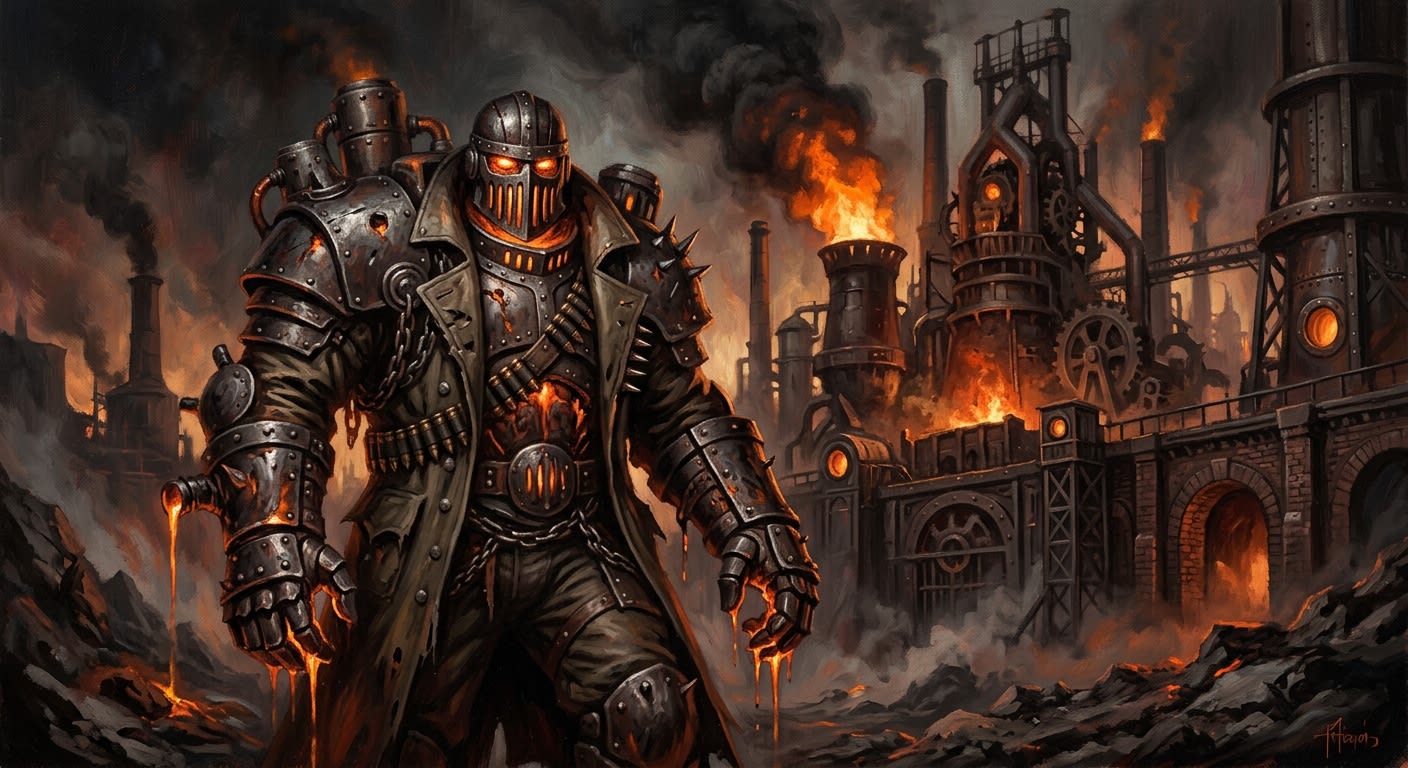
Maldrake is the Sin-General of Wrath. I state this plainly because the Bureau of Doctrine has spent one hundred and fifty-six years drafting circumlocutions for the same fact, and not one of them has improved upon the original formulation. He is Wrath — the unsheathed blade that has forgotten the scabbard, the furnace that has consumed its fuel and begun consuming its own walls, the war that outlived its cause and kept marching.
He tore into reality at the Sundering in Thrace, where the ore screamed and the fissures vomited something that was smelted rather than born. His first steps melted the bronze walls of Illyria (Unregistered) in a single night. His second steps turned the armies of Moesia (Unregistered) to ash upon their own steel. He has not, in one hundred and fifty-six years, stopped stepping.
The Bureau of War has given him titles. Lord of the Eternal Forge. The Fire That Thinks. The Hammer That Remembers. These are attempts to contain him in language, which is the Bureau's preferred method of containment for things it cannot contain by any other means. The titles are accurate. They are also insufficient — as every wall raised against Maldrake has, in the final accounting, proven insufficient.
#On His Domain
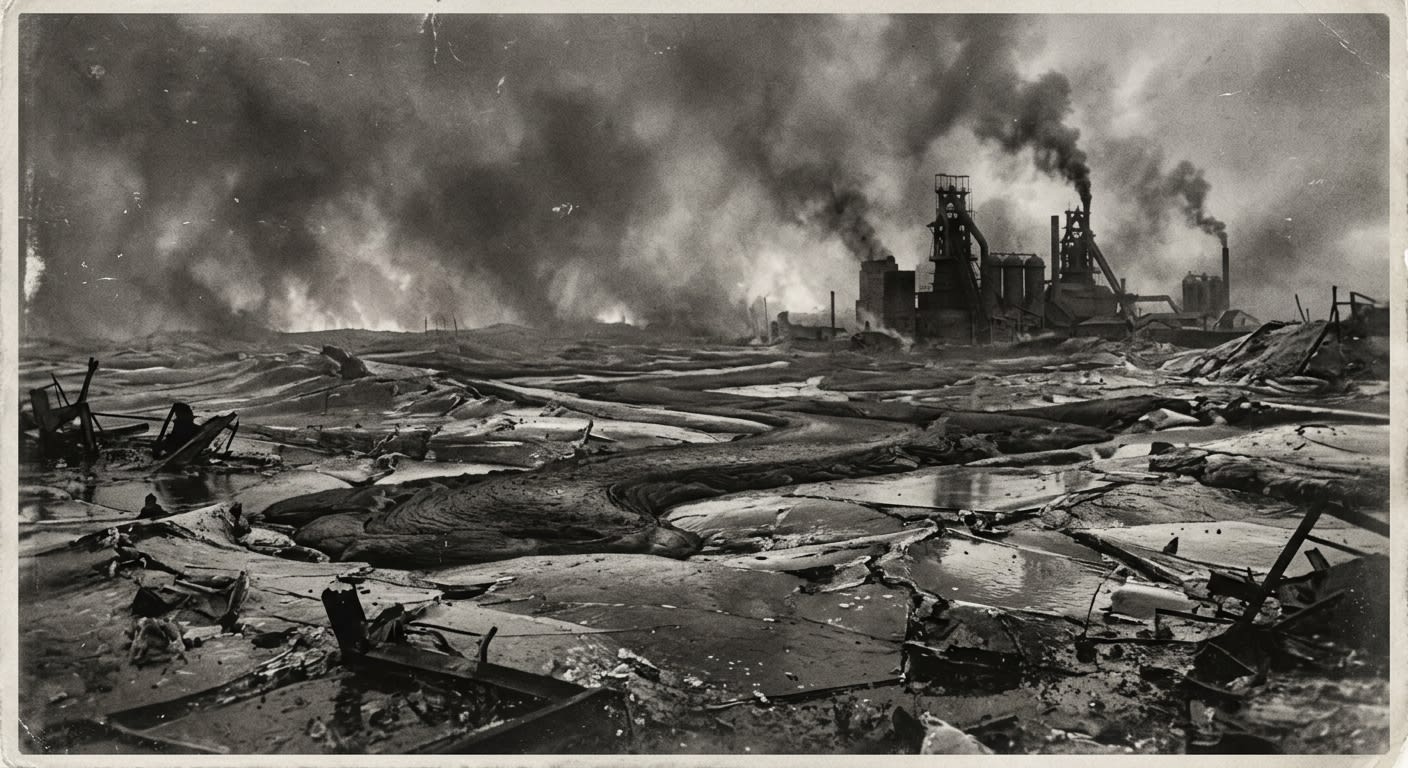
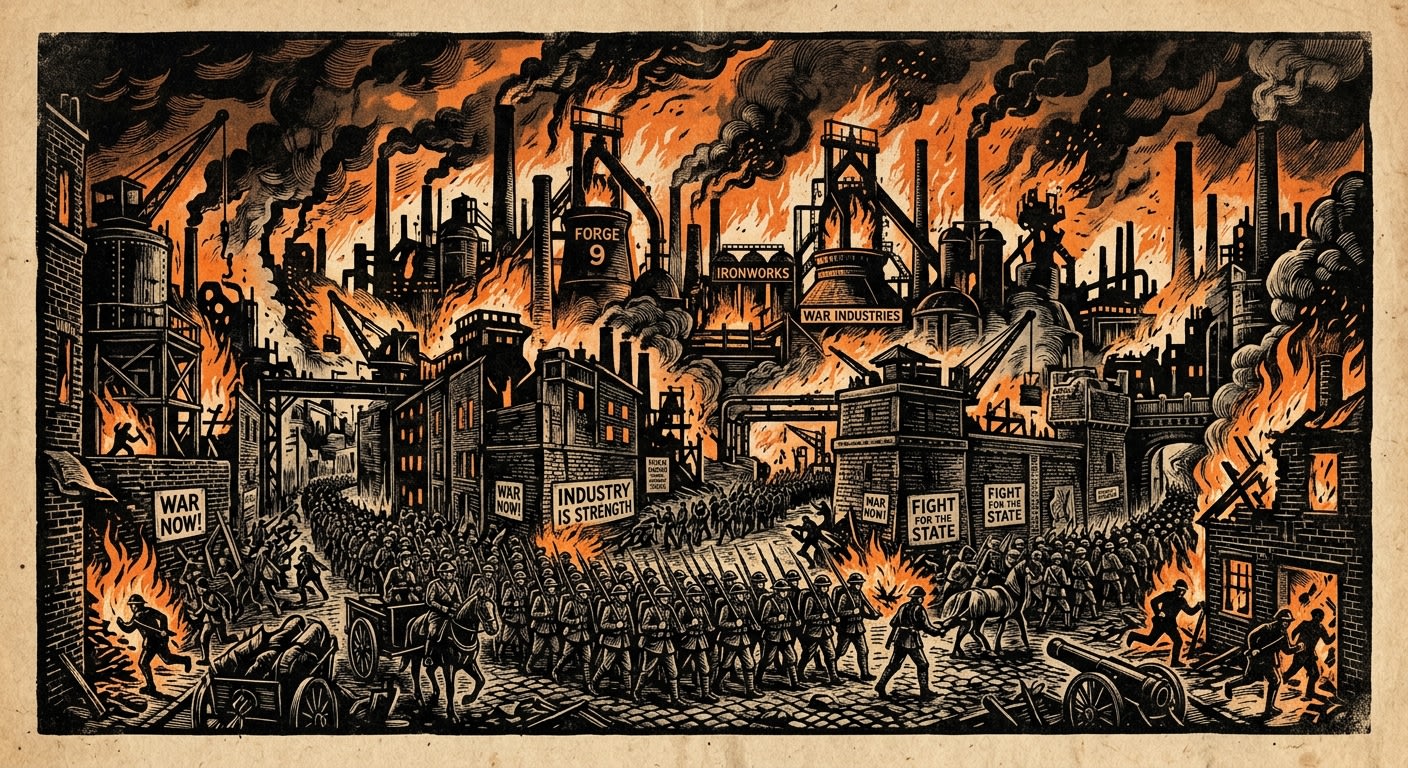
The Iron Wastes of Thrace are what remains when Wrath has had a century and a half to work upon geography.
I have read the reports. I have seen the sketches brought back by the Cartographic Expedition of A.S. 73 — the fourteen survivors who returned with maps that contradicted one another in every particular save one. I have held the charcoal renderings in my hands and felt, through the page, something that the Bureau of Rites has classified as "residual kinetic sympathy" and which I would classify, in plainer language, as heat.
The Slag Wastes were once the fertile plains of Thrace and the mountain valleys of Serbia. Wheat grew there. Orchards bore fruit. Villages maintained parish records that the Bureau of Records, in a fit of optimism, once planned to integrate into the continental census. The soil is glass now. The rivers are molten stone. The air carries a temperature that would blister exposed skin at three hundred paces, and the ground cracks and reforms in patterns that the Bureau of Engineering has described as "seismically unprecedented" and that field officers have described, more accurately, as angry.
The Forge-Pyre Bastion — Maldrake's citadel, if the word "citadel" can be applied to a structure that appears to be rebuilding itself in perpetuity — rises from the centre of the Wastes like a cathedral designed by an architect who had never seen a cathedral but had been told, at great length and under duress, about the concept of verticality. Its gates glow. Its anvils ring. The hammering has not ceased since the Sundering. Scouts who have approached within five miles report that the hammering resolves, at that distance, into something uncomfortably close to language.
The Eternal Forges are mountain complexes riddled through the Thracian highlands where weapons are produced — swords, spears, armour, siege components, ammunition of no calibre known to the Bureau of Ordnance — in quantities that exceed any conceivable logistical need. The forges do not require orders. They do not pause for inventory. Enslaved humans work the bellows until their lungs fill with ember-ash, and when they fall they are replaced by the next in line, and the next, and the line does not end because Wrath does not run out of raw material. The metal is quenched in blood. The blood is plentiful.
Earlier editions of this Codex described the Iron Wastes as "approximately 40,000 square miles in extent."
The Bureau of Engineering has revised this estimate upward three times in the last decade. The current figure is classified. The rate of expansion is also classified. The Bureau's reluctance to publish either number is itself a form of information, which is why this erratum exists and why it tells the reader nothing useful.
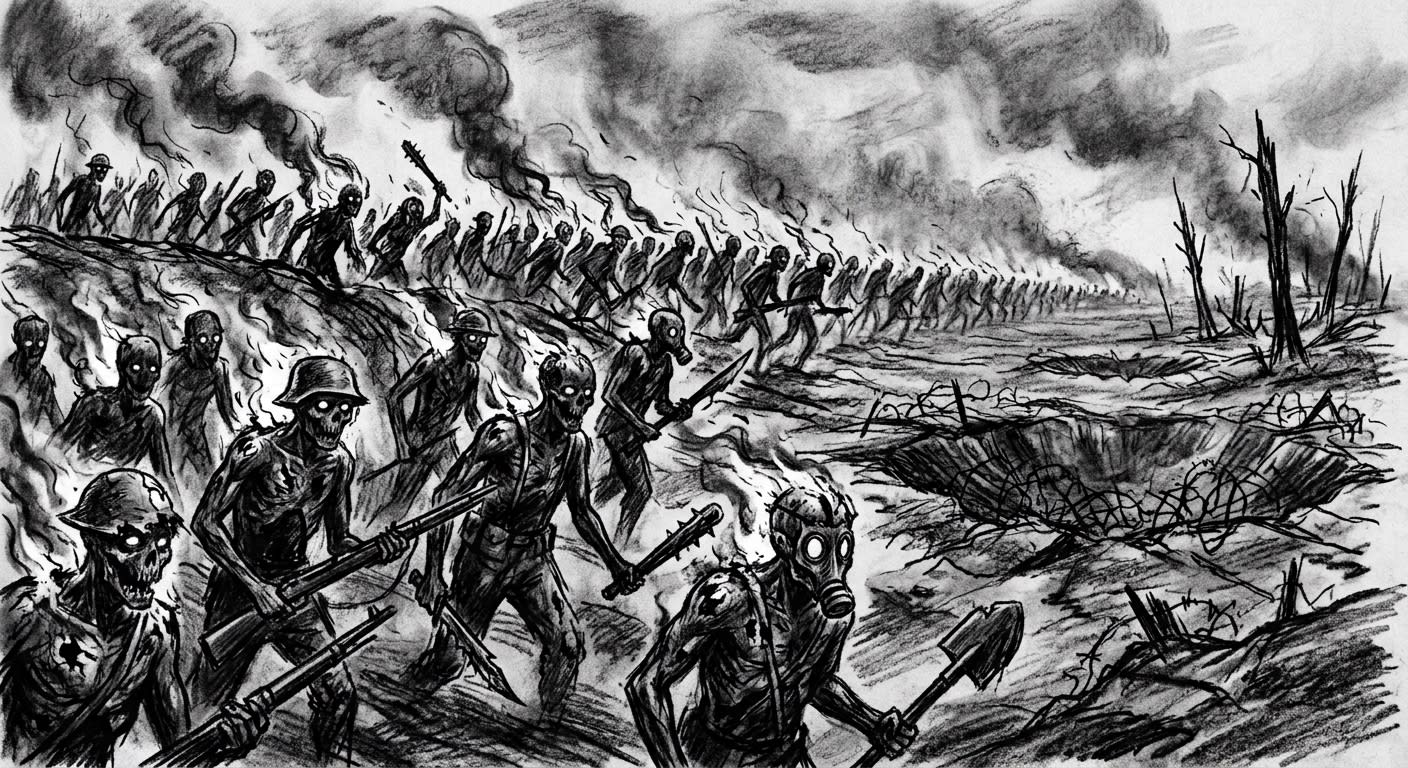
The Burning Trenches are Maldrake's answer to the Sagittal Line — a mirror carved in fire rather than mud. They do not defend. They attack. They writhe forward across the landscape, consuming ground, vomiting forth warriors whose sole function is combat. Battles rage along their length without strategic purpose, without territorial objective, without the faintest pretence of military logic. The fighting is the point. The trenches must be fed, and they are fed, and they are always hungry.
The Crucible Cities are where Maldrake refines his servants. Humans enter the crucibles as people — frightened, angry, whole. They emerge as weapons. The process takes years of carefully cultivated rage, violence channelled through ritual and repetition, until the human element has been burned away and only the instrument remains. The cities themselves melt and reform as the conflicts within them reshape their geography. No map of a Crucible City has ever matched a subsequent survey of the same location. The Bureau of Records has filed this under "expected."
And then there are the Char Fields — battlefields that never cooled. Thousands died in these places, and their rage pooled in the soil, and the ground itself ignited with fury given material form. Figures move through the fire, still fighting engagements that ended a century ago. They do not notice they are dead. They cannot stop. The war continues whether the enemy is present or not, because the war was never about the enemy.
#On His Armies
Maldrake commands a true army. This distinction matters. Kargath commands a tide. Velmora commands a market. Syrion commands a fog. Maldrake commands legions — formations with officers, with doctrine (of a kind), with siege engines and supply lines and the brutal, functional architecture of organised violence. His forces do not infiltrate. They do not corrupt by stealth. They march, and they burn, and they kill, and they march again.
The difficulty — the Bureau of War has spent decades failing to articulate this — is not recruitment. Wrath recruits itself. Every human who ever died with a clenched fist is a potential conscript. The difficulty is direction. Left without Maldrake's will to channel them, his forces would turn upon each other, upon the landscape, upon the abstract concept of stillness itself. The rage demands release, always release, and in the absence of an external target it will find an internal one.
The Hellbow Legion is Maldrake's primary assault formation, deployed most frequently on the Thracian Plain opposite Bastion-Constantinople. The name is a soldiers' corruption — the Bureau of War insists on "Wrath-Tide Primary Host" in all official correspondence, but no soldier within five hundred miles of the Thracian front has used the official designation since A.S. 160, and the Bureau has, with uncharacteristic pragmatism, stopped correcting them. The Hellbow Legion attacks in waves of forge-warriors, Ember-Soldiers, and corrupted siege machinery, and each wave is calibrated to break whatever the previous wave cracked. They do not retreat. Retreat requires a concept of self-preservation, and self-preservation requires a self worth preserving, and Maldrake has burned the selves out of his soldiers and left only the war.
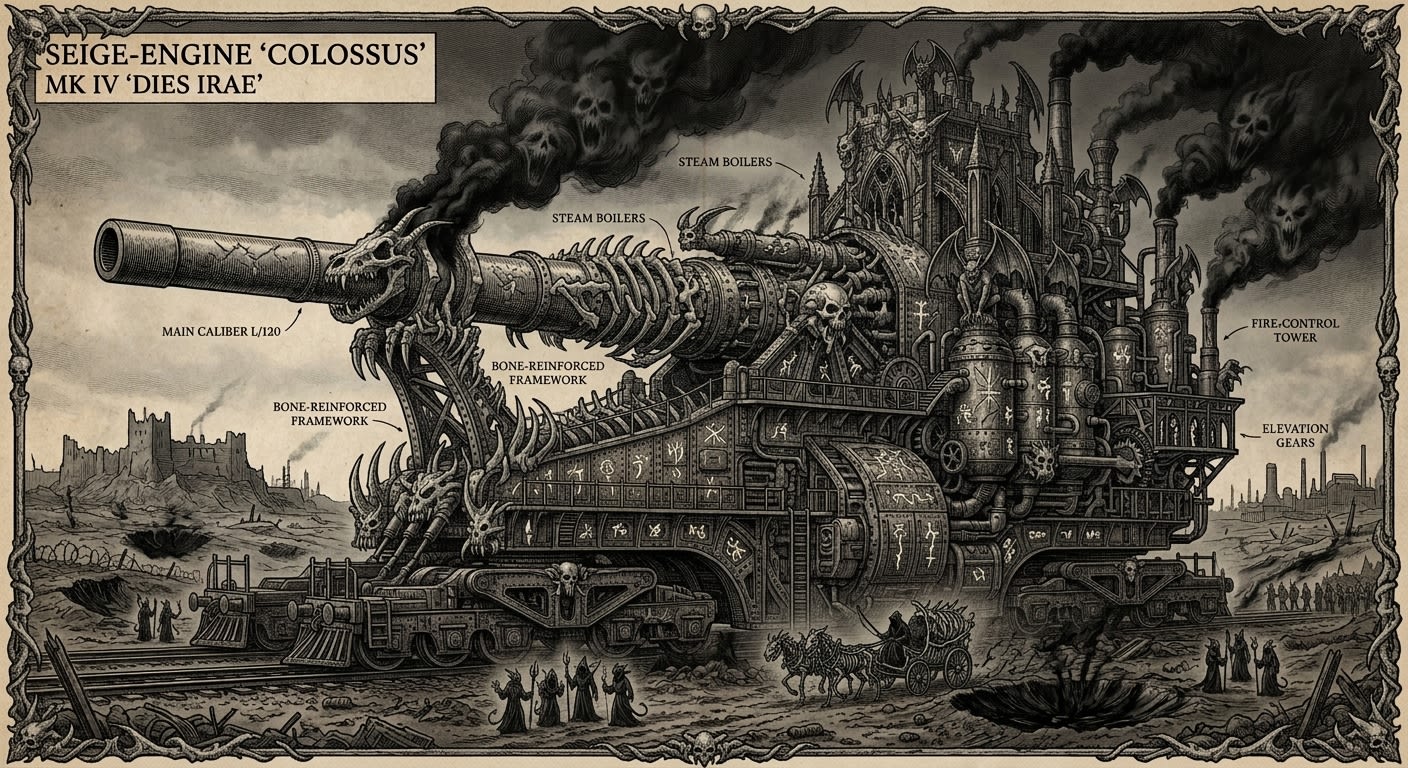
The Flameheart Colossus is Maldrake's siege weapon — singular, colossal, and motionless. It was sighted at grid reference 4-9-7 on the Thracian Plain in A.S. 194, and it has not moved since. The Bureau of War considers the fact that it has not moved to be considerably worse than if it had. Worse, because a weapon that moves can be tracked, can be anticipated, can be mapped into a defensive doctrine. A weapon that sits and waits suggests a patience that Wrath should not, by theological definition, possess. The Bureau of Doctrine has filed seventeen memoranda on the theological implications of a patient weapon of Wrath. The Bureau of War has filed seventeen requests for the Bureau of Doctrine to stop filing memoranda and start filing artillery coordinates.
Forge-Beasts are what becomes of the Synod's own siege engines when Maldrake captures them. Tanks, artillery pieces, war machines of careful Bureau of Engineering design — Maldrake does not understand technology. He understood the violence they contained. The captured machines walk now, or crawl, or lurch forward on legs assembled from fused corpses. The crews remain inside, melted into the controls, still screaming, still aiming, still pulling triggers that have become extensions of their own hands. The guns fire without ammunition; they fire concentrated fury, and the impact burns morale and calm as readily as it burns flesh. The Bureau of Engineering has requested, on nine occasions, that captured materiel be destroyed before it can be corrupted. The Bureau of War has approved this request on nine occasions. The front-line units have managed to comply on four.
Ember-Soldiers are the rank and file of Maldrake's host. Once human, now barely so — charred flesh pulled tight over bone, burning eyes that see only targets, weapons fused into hands that will never open again. They march in formation, but the formation is sustained by shared purpose rather than discipline: advance, attack, burn. Kill one and two more step forward, because Ember-Soldiers are manufactured from the dead of both sides, and this war has produced enough dead to furnish armies for the next ten centuries. Every human who died angry is a potential recruit, and on the Thracian Plain, every human dies angry.
The Hammered (Unregistered) are demons shaped in the Eternal Forges — created rather than corrupted. Pure wrath given physical form, optimised for violence. They carry no memories of humanity to slow their stride, no flickers of mercy or recognition. They are weapons that walk, and they walk toward the nearest thing that is not yet destroyed, and they do not stop until they are broken apart, and sometimes they do not stop even then.
Crucible-Born are the worst of Maldrake's servants, because they chose this. Humans who survived the Crucible Cities and emerged transformed — intelligent, capable, retaining fragments of memory and personality, burning with the same fury as the mindless Ember-Soldiers but directing it with the full capacity of a human mind. They plan campaigns. They lay ambushes. They wait — and waiting, for a servant of Wrath, is the most terrifying capability of all. They believe violence is salvation, destruction is devotion, and Maldrake's war is the only righteous cause left in the world. They are wrong. They are also extraordinarily effective.
The Raging Dead (Unregistered) are warriors whose fury refused the courtesy of ending when their bodies did. Ash and ember held together by rage — they can be destroyed, scattered, worn down to cinders, but the anger sustains them, and as long as the anger persists they reform. Some have been fighting since the Sundering. They have forgotten the cause. They have forgotten their names. They remember only the burning, and the burning is enough.
Flame-Tongues serve as Maldrake's equivalent of influence-demons, though they are louder, cruder, and considerably less subtle than their counterparts in the service of other Sin-Generals. They speak, and their speech is violence — words that wound, that stoke rage, that make the listener angry in ways the listener cannot quite explain. They do not coax temptation. They scream provocation. When the fighting starts — and around a Flame-Tongue, the fighting always starts — they feed.
#On His Methods of Corruption
The most important thing to understand about Maldrake's corruption is that it begins with a grievance that is real.
Maldrake's influence-demons — visible as heat-shimmer in corners, as shadows that flicker like flames, as a pressure in the chest and a tension in the jaw — do not seek the cruel. They seek the wronged. The soldier whose commander stole his rations. The mother whose son was conscripted under a quota that should not have applied. The widow whose husband was killed by friendly fire and whose pension was denied on a clerical technicality. The Synod, in its vast and grinding administration, produces injustice the way the Eternal Forges produce swords — reliably, in bulk, and without meaningful oversight.
Maldrake's murmurs validate. You have every right to be angry. They deserve what is coming. How long will you let them do this? The murmurs are effective because they are true. The grievance is real. The anger is justified. The influence-demon is simply offering to fan what already smoulders into something brighter, something hotter, something that will finally — finally — burn the obstacle away.
The gift is strength. The ability to fight back. Muscles that do not tire. A fury that cuts through hesitation like a heated blade through wax. Victories follow — genuine victories, real enemies punished, real wrongs corrected. The cultist looks like a hero. The cultist is a hero, in the same way that a fire is useful when it cooks the meal and catastrophic when it burns the house down, and the transition between the two is measured in degrees of temperature and nothing else.
The consequence arrives when the influence-demon moves on. The anger does not move on with it. The rage, which was supposed to be temporary — just until justice was served — remains after justice has been served, and it hungers for new targets. Smaller slights become capital offences. Minor inconveniences become provocations. Friends become suspects. The victim watches everything soft, everything gentle, everything human burn away, leaving only the weapon, and the weapon was supposed to serve them but they serve the weapon now, and the weapon does not care what it was pointed at.
The body changes. Muscles harden past flexibility. Hands lock into fists that will not open. Scars glow faintly in darkness, warm to the touch years after the wound has closed. In advanced cases — and the Bureau of Purity has documented forty-seven advanced cases in the last decade alone — metal begins to fuse with flesh. Armour grows into bone. Weapons become extensions of the arm. The transformation is the same one that produces Ember-Soldiers, and the Bureau's prescribed response to an advanced case is identical to its prescribed response to an Ember-Soldier: immediate execution, classified as mercy.
The cruelest outcome — and I use "cruelest" advisedly, having spent my career documenting the Bureau's own cruelties — is what happens to the protector. The soldier who gained strength to defend her comrades. The father who wanted only to shield his children. The rage does not discriminate, and in a moment of fury the protector strikes the thing she meant to protect. The father terrifies the child he would have died for. The shield has become a sword, and the sword has been swung, and the thing it was meant to protect is bleeding on the floor.
They forget, in the end, why they were angry. The original grievance — the real wrong, the justified fury — fades into static. The anger remains, self-sustaining, purposeless. Ask them why they are destroying this village and they cannot tell you. There was a reason once. They remember only the burning.
#On His Warbands and Cults
Maldrake's cults are the most violent of the seven, and the most righteous. The two qualities are, in the Bureau's considered experience, more closely related than the faithful would prefer to believe.
They do not see themselves as cultists. They see themselves as soldiers of justice, revolutionaries against real oppression, vigilantes in districts where the Bureau's writ runs thin and the Bureau's justice runs thinner. They infiltrate military units — where violence is sanctioned and therefore invisible — and resistance movements — where grievance is already at kindling temperature. They spread the doctrine that peace is cowardice and strength is the only virtue, and they spread it effectively because the Synod's own catechism, if read at a certain angle, says something uncomfortably similar.
The Bureau of Purity's Annual Report for A.S. 198 described Maldrake's cult presence within Synod territory as "negligible."
The Bureau of Purity's Annual Report for A.S. 199 revised "negligible" to "insufficiently measured." The Bureau of Purity's Annual Report for A.S. 200 did not contain a section on Maldrake's cult presence. The Bureau of Purity has not explained the omission. Draw no conclusions from this. The Bureau of Doctrine instructs you to draw no conclusions.
The warbands organise themselves into armed cells — small, mobile, capable of striking and vanishing before the Lictors arrive. Some are vigilante squads punishing criminals whose definition of "criminal" broadens with each operation. Some are berserker units within the Synod's own military, formations that fight with an enthusiasm the Bureau of War has learned to praise in dispatches and investigate in private. Some are revolutionary armies in the Iberian or Lombard mould, fighting real oppression with demonic backing, and the Bureau's response to these is complicated by the fact that the oppression is often real and the Bureau is often the oppressor.
The mutated — long-term servants whose bodies have begun the transformation — are the warbands' officers and their most dangerous assets. Skin hot to the touch. Scars that glow. Weapons that will not release from hands that will not open. They are walking towards a destination they can see and the rest of us cannot, and the destination is the Eternal Forges, and they will arrive there whether they travel east or not.
#On His Campaigns Against the Line
Maldrake presses Bastion-Constantinople from the Thracian Plain to the north. He does not press it as Kargath presses it — slowly, patiently, through famine and attrition. Maldrake arrives in campaigns. He brings the Hellbow Legion and the pyre-smiths and siege engines that move by seismic force, walking furnaces that press their weight against the earth itself. Each time he arrives, Constantinople loses a wall. Each time Constantinople loses a wall, Constantinople rebuilds the wall taller, because the only response to Maldrake that the Bureau of Doctrine will ratify is escalation.
A.S. 45 — The Sundering. Maldrake emerges in Thrace. The ore screams. Illyria's bronze walls melt in a single night. The armies of Moesia burn on their own steel. The Great Retreat begins, and Maldrake's fire is at its back the entire way.
A.S. 65 — The Line is established. The Sagittal Line stabilises from the Baltic to the Bosphorus. Maldrake's advance halts — or, more precisely, encounters sufficient resistance that his rate of advance drops below the Bureau's threshold for "advance" and is reclassified as "pressure." The reclassification is a bureaucratic fiction. The fire does not distinguish between "advance" and "pressure." The fire burns.
A.S. 120 — The Routing at Belgrade. Wrath's Horde broken on the Danube. Three verified apparitions of saints above the artillery emplacements. The Miracle of the Danube's Turning — the first major Synod offensive victory. Maldrake's forces fell back to the Thracian Plain. The Bureau of Records canonised the victory. The Bureau of War noted, quietly, that the victory cost forty thousand men and that Maldrake's losses were replaced within a season.
A.S. 143 — The Year of Ash Rain. Maldrake ignited the Thracian forests. Ash fell on Constantinople for nine months. Crops failed across the eastern prefectures. The Ninth Bell Famine killed what Maldrake's shells did not. The Ossuary Rings expanded by a quarter-mile. The Bureau of Records logged sixty-eight thousand casualties. The Bureau of Rites declared it "a refining tribulation." The chain booms across the Bosphorus glowed for the first time. Sixty-eight thousand dead, and the Bureau's primary concern was the theological classification.
A.S. 170 — The Vigil of the Hollowed. A wall was lost. I am permitted to say that a wall was lost. I am permitted to say that a Night Paper arrived from Strasbourg on the eve of the breach, naming the parish regiment assigned to the relic artillery as oath-broken. I am permitted to say that a colonel whose name has been erased burned his own men before the cannon could fire. The wall was rebuilt with consecrated cement and living volunteers sealed inside Chamber 7 of the Sixth Ravelin. The Bureau classified the breach as "a miraculous demonstration of zeal." The Bureau classifies many things as miraculous when the alternative classification would require an inquiry.
A.S. 177 — The Three-Night Bombard. Velmora's agents detonated the Foundry Quarter. Three nights of continuous explosion. Maldrake's forces exploited the breach. Harbormaster Joram Clee refused to log the ships destroyed as "destroyed," filing them instead as "temporarily absent." The Bureau of Records accepted this terminology. The ships remain absent.
A.S. 182 — The Bombardment. The Wrath-tide offensive. Tribune-Chaplain Seraphinus composed a fourteen-stanza homily on the theological significance of dysentery while shells cratered the ground around him. The Bureau of Doctrine printed the homily. The Bureau of War printed the casualty figures. The homily is more widely read.
A.S. 200 — The Thracian Subterranean Survey. The Bureau of Engineering detected "routing behaviour" in slag-rivers beneath the Thracian trenchlines — liquid wrath moving in patterns toward specific targets. The survey was recalled under "operational security" before completion. Three inspectors were transferred to Bastion-Brest immediately after. The transfer was filed as "career development." No one at Bastion-Brest considers a transfer there to be career development.
#On His Rivalries
Maldrake and Syrion wage an eternal contest of fire against fog. The Bureau of Inter-Infernal Analysis has maintained a dossier on this rivalry since A.S. 112, and the dossier runs to fourteen volumes, and the Bureau's conclusion after fourteen volumes is that neither side is winning because the two elements are, by their nature, incapable of resolving into victory. Fire evaporates fog. Fog smothers fire. The cycle repeats across the Thracian-Shipka border with a regularity that the Bureau of Bells has, reportedly, considered synchronising to a peal schedule.
With Kargath, the relationship is functional contempt. Wrath resents being made to wait, and Kargath makes everyone wait. Their hosts have aligned on occasion when the terrain between the Thracian Plain and the Bosphorus marshes forced them to share roads, but the alliances are logistical rather than strategic. The Bureau of Hearsay maintains a shelf of accounts of these convergences. Maldrake's forces march through Kargath's famine-zones leaving scorched earth behind them; Kargath's tide creeps through the cooling ash of Maldrake's campaigns and consumes whatever the fire left. They do not coordinate. They do not need to. Destruction followed by consumption followed by destruction is a cycle that sustains itself without diplomatic protocols.
Atheron mocks Maldrake as "a beast of fire with no crown to show for the burning." Maldrake, to the Bureau's knowledge, has never responded to the insult, which is itself a form of response — Wrath that does not answer Pride is Wrath that considers Pride beneath answering, and Pride cannot survive being considered beneath anything.
Velmora avoids Maldrake's territory. Gold melts. Ledgers burn. The careful economy of Greed cannot operate in a landscape that is, at any given moment, on fire. Their domains do not border, which is fortunate for Velmora and irrelevant to Maldrake.
#On the Countermeasures
The Synod has developed defences against Maldrake's influence and against his armies. The defences work, in the sense that a levy built against a river works — it holds until it does not, and when it does not, the flood is worse for having been contained.
The Doctrine of Cool Hatred prescribes that righteous violence must be cold, calculated, passionless. Kill demons because duty demands it, not because hatred does. This is standard chaplain instruction for all units deployed to the Thracian sector. In practice, watching comrades pulled into Forge-Beasts tends to generate emotion regardless of doctrinal instruction, and the Bureau's own records show that units schooled in the Doctrine of Cool Hatred have a transformation rate only marginally lower than units that have not received the training. The Bureau publishes the marginal improvement. The Bureau does not publish the absolute figures.
Cooling rituals — cold water, ice, enforced meditation — are prescribed for soldiers returning from Maldrake engagements. Rage fasts, periods of enforced pacifism, are imposed on units showing elevated aggression. Those who cannot complete the fast are confined. Some confinements have become permanent, because the rage never fades, and the Bureau has no protocol for releasing a man whose hands have been clenched for three years.
Confession is offered. Angry thoughts, violent impulses, the desire to hurt — all may be spoken to a Confessor and, in theory, released. Whether this works theologically is debated. Whether it works psychologically is debated less, because the Bureau does not employ psychologists, and the distinction between a man who has confessed his rage and a man who has given his rage an audience is, in the Bureau's taxonomy, insufficiently explored.
Those showing signs of physical transformation — the warm scars, the fusing metal, the ember-glow behind the eyes — are executed. There is no rehabilitation protocol. The Bureau insists this is mercy. The soldiers who carry out the executions would agree, if they could unclench their jaws long enough to speak.
#On the Horror That Is His
Every Sin-General represents a corruption of something human. Kargath corrupts hunger. Velmora corrupts desire. Syrion corrupts rest. Maldrake corrupts something worse than any of these, because the thing Maldrake corrupts is righteousness.
His victims had legitimate grievances. Their anger was justified. Their enemies deserved punishment. Everything they felt made sense at the moment they felt it, and at the moment after that, and at the moment after that, each moment reasonable and justified and leading by a chain of perfectly logical steps to a man standing in the ashes of the village he was supposed to protect, unable to remember why he set the fire, unable to stop his hands from reaching for the next torch.
The fire does not care what it was given to burn. The fire does not remember why it was lit. Maldrake sits in the Forge-Pyre Bastion, and the anvils ring, and the weapons pour from the forges in quantities that would arm every soul in Europe twice over, and the Char Fields burn with the rage of soldiers who died a hundred years ago and have not yet consented to stop, and somewhere on the Thracian Plain the Flameheart Colossus sits motionless and patient, which is the most terrifying word I have ever applied to a weapon of Wrath.
He has breached the Line fourteen times. Twelve breaches were contained. Two were not. The details of those two are sealed.
I do not know what is worse — that Maldrake has breached the Line fourteen times, or that he has stopped counting.