
#I. The City Before the Guns
"Toledo was holy before it was besieged. It was besieged because it was holy."
Toledo sits upon its promontory like a reliquary on an altar — elevated, conspicuous, and daring the faithless to reach for it. The Tagus bends around the city's base in a moat that the Creator carved before any engineer thought to suggest one, and the cathedral complex crowns the summit with the kind of architectural presumption that even the Bureau of Engineering admires, albeit grudgingly, in their quarterly structural assessments.
By the fifteenth year After Sundering — though the Sundering had not yet occurred, and would not for three decades, a fact the Bureau of Records has managed to accommodate through a filing convention too elegant to explain here — Toledo remained one of the last fortified ecclesiastical strongholds in Iberia. The Desecrations had stripped the monasteries of Castile and Aragon bare. The Bonfires of Purification had consumed the reliquaries of Salamanca and Seville with printed programmes and assigned seating. But Toledo held, because Toledo had walls, and because those walls held monks who preferred immolation to evacuation.
The garrison comprised no army in the conventional sense. Three hundred clergy of the Order of Saint Iago, forty-seven lay brothers, an unknown number of refugee faithful who had crawled uphill from the burning plains, and — this detail the Bureau of War has confirmed with visible reluctance — fourteen women of no recorded order who arrived with sacks of consecrated oil and an air of professional calm. Their presence was noted but not explained. The Bureau of Shadows maintains a dossier. The Bureau of Doctrine does not acknowledge the dossier. I, as ever, acknowledge nothing that has not been stamped.
The Relic of Saint Iago — a jawbone set in silver, authenticated by the Bureau of Relics in a ceremony that consumed three days, two goats, and the patience of every Assessor south of the Pyrenees — was the garrison's crown jewel. It had survived the First Relic Auctions of Amsterdam, the Bonfires of Purification, and a brief period of service as a paperweight in a Rationalist prefect's office in Córdoba. The monks recovered it from the prefect's desk during a raid that the Bureau classifies as "sanctified requisition." The prefect's objections were noted, then redacted, then the prefect himself was redacted. Such is the economy of faith.
#II. The Siege
"Nine months. The human body can produce a child in that time. Toledo produced only corpses and one miracle that the Bureau has been arguing about ever since."
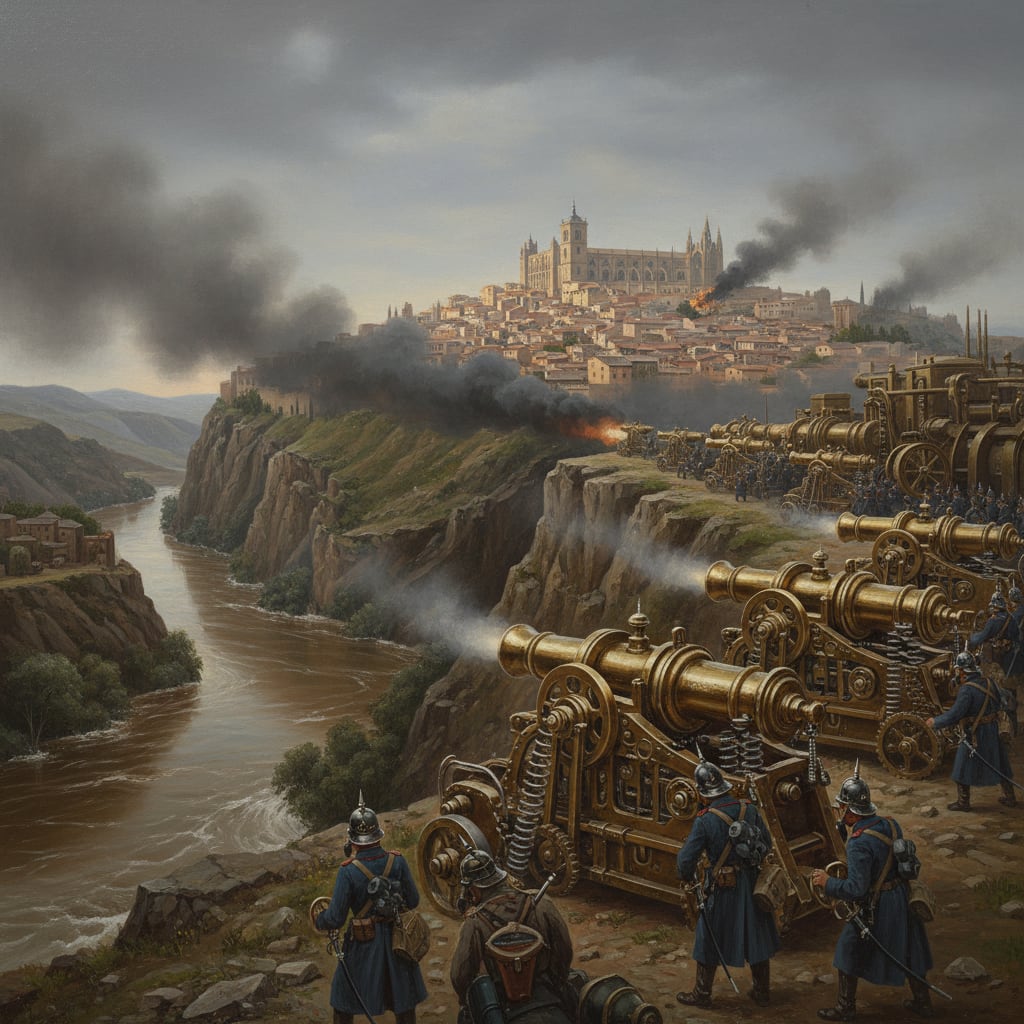
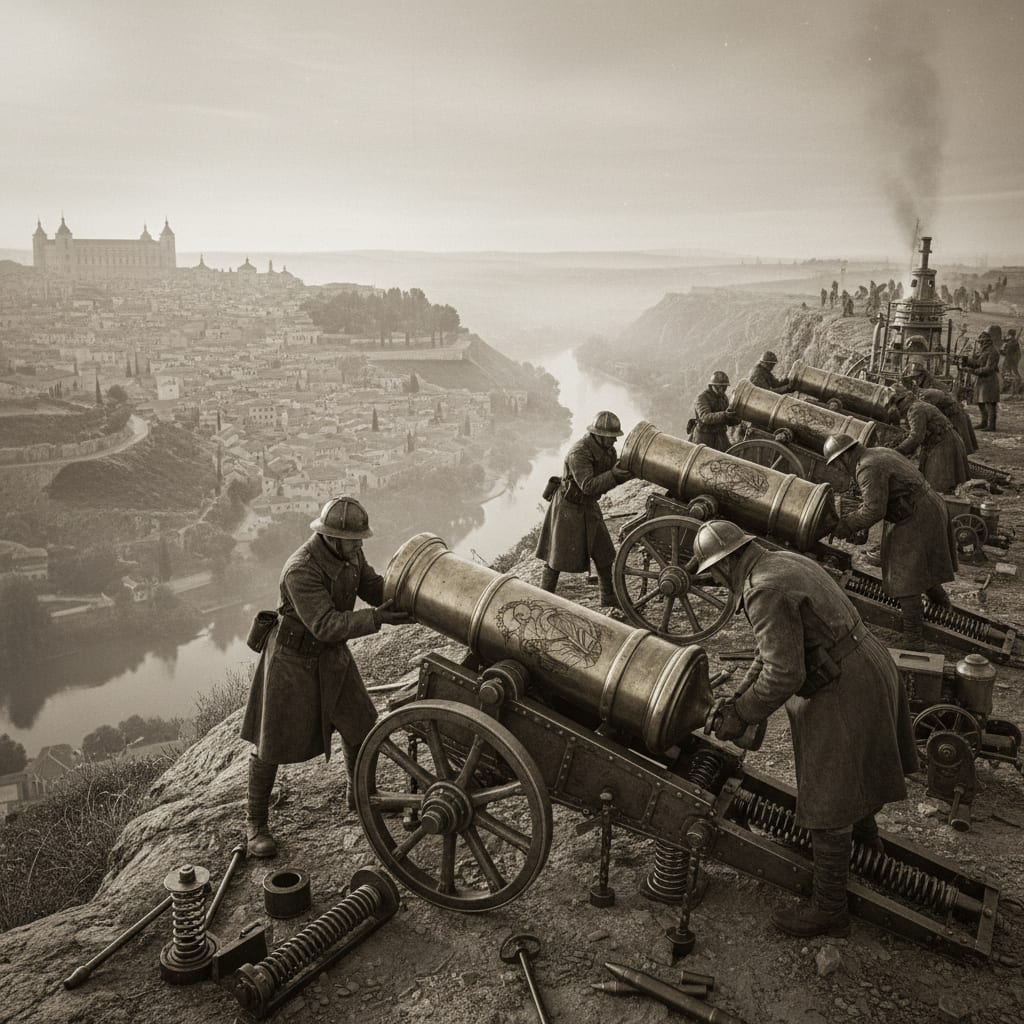
The Rationalist besieging force arrived in the spring of A.S. 15 under the command of Colonel-Prefect Étienne Grimal, a man whose clockwork artillery pieces were the envy of Lucien Artois himself. Grimal brought twelve brass-barreled cannon on spring-loaded carriages — the same design that fired four rounds per minute, that exquisite Rationalist invention which the Bureau of War later adopted, blessed, and improved by the addition of holy oil and a short prayer between each volley. The prayer, it must be noted, reduced the firing rate to three rounds per minute. The Bureau considers this an acceptable trade.
Grimal also brought two thousand Republican Guards, a printing press for distributing leaflets, and a profound misunderstanding of the topography. The Tagus was in flood. The northern approach was a goat-track. The only viable assault route funnelled through the Puerta del Sol into a killing ground overlooked by the cathedral towers, where monks with excellent aim and an apparently inexhaustible supply of masonry had already begun dropping stones on the advance scouts.
The bombardment began on the seventh day. Grimal's clockwork batteries opened from the eastern ridge, and for the first time in the Atheist Wars, relics and artillery faced each other across open ground with lethal seriousness.
The monks answered with what witnesses described as "divine fire" — a phenomenon the Bureau of Doctrine and the Bureau of Engineering have been contesting for a hundred and eighty-six years. The faithful account: the Abbot raised the Relic of Saint Iago above the parapet, intoned the Psalm of Consuming, and fire descended from a cloudless sky upon the Rationalist gun line, detonating three ammunition caissons and killing forty-seven artillerists in a single conflagration. The Engineering account: an incendiary device, likely Greek fire variant, was dropped from the bell tower at extreme range by a monk with exceptional spatial awareness and no fear of heights. The Bureau of Doctrine has resolved this dispute by declaring both explanations simultaneously and officially true. This is, I am told, theology.
Earlier editions described the fire as "unambiguously miraculous." This has been revised to "miraculous, pending the Bureau of Engineering's seventeenth request for a site inspection, which has been denied sixteen times and will be denied a seventeenth."
The siege settled into a rhythm of mutual demolition. Grimal shelled the walls; the monks repaired them with mortar mixed from bone-dust and prayer. Grimal shelled the cathedral; the monks carried the Relic to the breach and sang until the guns fell silent — whether from miracle or from the gunners' unease at shelling men who stood in the open and sang, the accounts diverge. Grimal brought up sappers; the monks flooded the tunnels with sanctified water from the cathedral cisterns, drowning three sapping teams and, according to one account that the Bureau has filed under "implausible but evocative," causing the water to boil as it touched Rationalist skin.
The 4th Orison Company arrived in the fourth month — Bell-Cannon crews who answered Grimal's artillery volley for volley with relic-shot. Each round inscribed with the names of saints and notaries of past miracles, each discharge preceded by a three-peal cadence, each impact a detonation that veterans swore made the air wince. For two months the ridge and the city exchanged a duet of brass and bronze, secular trajectory and sanctified arc, until the landscape between them was glass and rubble and the bodies of men who had believed, variously, in the Creator and in mathematics.
One barrage, mistimed by a fraction of a peal, obliterated half the 4th's own trench. The survivors swore that among the bodies fused to glass were found faces smiling, as though canonization had been achieved through error. Toledo's parish ossuary still displays one such glassed soldier. The Bureau of Records has catalogued him as Saint-Anonymous. The Bureau of Relics has declined to authenticate, citing "insufficient biographical data and excessive vitrification."
#III. The Engineers Beneath
"They chanted continuously, alternating voices so that the psalm did not falter, not even when their throats bled."
In the seventh month, with both armies bled thin and the city's eastern quarter reduced to rubble that could no longer be distinguished from the rubble it had replaced, the Rationalists committed their own sappers to the cathedral's foundations. They had fortified the nave itself as a gun platform, stripping the saints from their niches and mounting a twelve-pounder where the altar had stood. The desecration was precise, professional, and — by Rationalist standards — admirable in its efficiency.
The Synod's response, when it came, arrived not from above but from below.
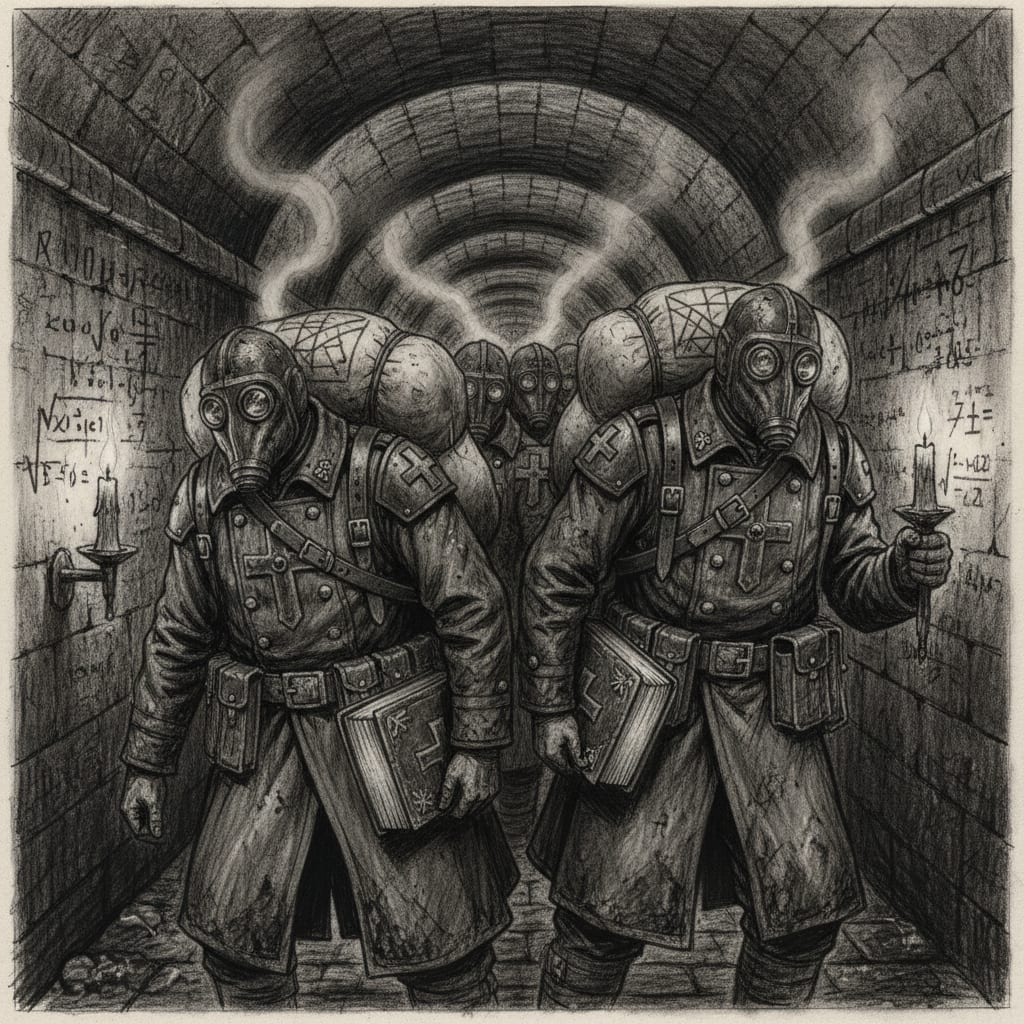
Litany-Engineers crept through the sewers beneath the old quarter, their hymnals oil-stained, their sacks of unstable powder singing faintly in the damp. They scrawled numbers and prayers into the wet stone as they advanced, each equation a calculation and each prayer its absolution, until they reached the foundations beneath the defiled altar. The charges were laid with the precision of a psalm — each fuse a rosary bead, each connection a verse.
When the charges erupted, half the cathedral collapsed into fire. The nave folded inward upon itself, burying the Rationalist gun platform and the twelve-pounder and the men who had loaded it with secular confidence in the laws of physics. The physics, it must be said, cooperated — the blast was textbook. What was not textbook was the scale. Half the city followed the cathedral into ruin. Whole parishes vanished beneath stone and smoke. The Engineers who survived — three of the original twelve — swore the collapse exceeded their calculations by a factor they could not reconcile.
"Someone sang with us who was not there."
The Bureau of Records struck the phrase as heresy. The Bureau of Doctrine classified it as "unverified testimony, spiritually evocative, operationally irrelevant." Pilgrims still mutter of a shadow-choir that joined the hymn in those sewers, collapsing stone and bone alike with a voice that had no throat. I record the testimony. I do not endorse it. I note only that the blast radius exceeded Engineering's best estimates by four hundred percent, and that Engineering has not, in a hundred and eighty-six years, produced a satisfactory explanation for the discrepancy.
#IV. The Fall
"Toledo held for nine months. When it fell, the monks ensured that nothing worth taking survived the morning."
Grimal's final assault came on the twenty-ninth of November, A.S. 15. The eastern wall had been breached three times and repaired twice; the third breach held. Republican Guards poured through the gap into streets that had become a maze of rubble, barricade, and improvised fortification constructed from pew-wood, tombstone, and — in one documented case — a baptismal font filled with gravel and positioned as a firing rest.
The monks fought room to room. The lay brothers fought corridor to corridor. The fourteen unnamed women fought bridge to bridge, and three of them died in fire that they had brought themselves, their oil-soaked habits erupting in conflagrations that collapsed the narrow streets behind them and sealed the Republican advance for precious hours.
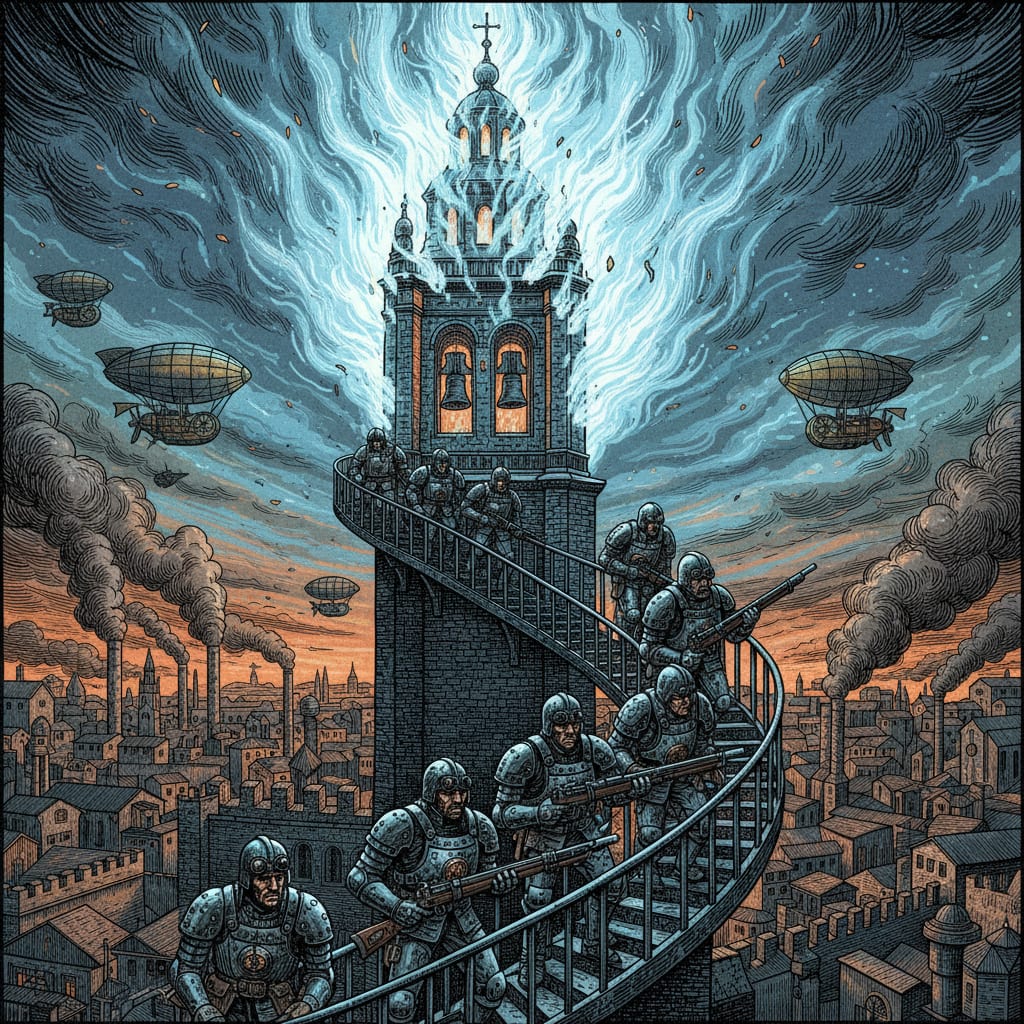
By dawn the following day, the cathedral's remaining tower — the only vertical structure still standing above the rubble line — held the last defenders. The Abbot, whose name the Bureau of Records has preserved as Father Clemente de los Rios, gathered the survivors in the bell chamber. The Relic of Saint Iago was placed upon the broken altar-stone that had been carried up the stairs by four men who could no longer stand unaided.
What happened next is a matter of Bureau classification. The faithful say Father Clemente spoke the Psalm of Consuming a second time, and the Relic blazed with a light that burned the eyes of the Rationalist soldiers ascending the stairwell, blinding seven permanently. The Rationalists say the monks set fire to the tower's timber framing with their remaining stores of consecrated oil. Both accounts agree on the result: the tower burned. The Relic burned with it. Father Clemente and his remaining garrison — nineteen monks, six lay brothers, and two of the unnamed women — burned with it also, preferring canonization by fire to capture by Reason.
The Bureau of Relics classifies this as "heroic destruction." The category has required frequent use.
Grimal entered the smouldering cathedral at noon on the thirtieth. His official report, recovered from the Forbidden Stacks, records the following: "Objective secured. Casualties: two thousand three hundred and eleven. Enemy casualties: three hundred and twelve. Note: all enemy casualties self-inflicted or incendiary. No prisoners taken. No prisoners offered." His addendum, struck from the formal record but preserved in the Stacks, reads: "The walls screamed as they fell. I do not know how else to describe it. My chief of staff assures me it was structural stress. I am no longer confident in his assurances."
The Rationalists recorded eighty percent of the dead with names redacted. One imagines the censored were those who prayed too loudly while dying.
#V. What Toledo Left Behind
"The city fell. The legend did not. The Bureau has managed both ever since."
Toledo was rebuilt. The Synod, when it came to power after the Sundering, rebuilt it with the fervour of an institution that understands the value of a martyrdom site more than it values the martyrs. The cathedral was reconstructed on the old foundations — including the sewer tunnels, which the Bureau of Engineering sealed, surveyed, and sealed again after the survey team reported "acoustic anomalies consistent with choral performance at a depth of forty metres."
The Cinder Trials were instituted in the rebuilt cathedral's forecourt within a decade of the Synod's establishment. The ash used is said — officially — to be sifted from the ancient reliquaries of Saint Isidore. The Bureau of Engineering contends it is pulverized pumice with a pinch of relic dust. The Bureau of Records files both. The condemned kneel in a shallow pit while ash is poured over them in slow, hymned increments. The surface hardens to a fine crust. When the bell tolls Ninth, the crust cracks in a pattern that the Bureau of Doctrine reads as handwriting. Verdicts by geology. I have attended twice. The first time I found it instructive. The second time I found it punctual.
The Ash-Baths operate from the same principle inverted — fevered patients submerged in hot ash under the pretence of sweating out corruption. Few survive longer than an hour. Those who do are paraded through the streets as "living reliquaries," their skin cracked and smoking. Some collapse mid-parade, and their deaths are hailed as "graduated cures." The Bureau of Mercy administers the programme. The Bureau of Mercy always administers the programme.
The Bell-Market of Toledo, which trades not in goods but in hours, is a post-siege institution that deserves its own entry and will receive one when the Bureau of Bells ceases threatening me with litigation over my characterisation of their pricing model. Suffice to say that one may purchase the ringing of Matins extended for an additional three minutes, lease a single toll of Lauds to sanctify a harvest, and — as happened in the year the market accidentally oversold Sext by seventeen minutes — create an hour that had no place to exist. The Bureau of Records erased it. The hour, presumably, did not object.
Governor-Praelate Alaricus, who opened the Granaries of Saint Benedict during the famine of A.S. 185, governs Toledo with a competence that the Bureau finds suspicious and a generosity that the Bureau of Tithes finds personally offensive. His name appears on the list of Notable Personages, which is to say the list of personages the Bureau has not yet found reason to remove.
Toledo endures. The scars of the siege are visible in the cathedral's mismatched stone — the original granite of the lower courses giving way to the Synod's replacement limestone above the blast line, a geological stammer that any pilgrim can read. The ossuary beneath the forecourt holds the glassed soldier Saint-Anonymous, whose vitrified smile has become an object of unofficial devotion among artillery crews. The sewers remain sealed. The acoustic anomalies remain unexplained.
And in the Bureau's official teaching, Toledo is proof of the Second Lesson of the Atheist Wars: that the faithful who died did not die in vain, but as seed corn — martyrs whose blood fertilized the soil from which the Synod would grow. Without the scars of Saint-Malo and Toledo and Kraków, the Synod's authority would lack the moral weight that makes it unquestionable.
The monks of Toledo did not win. That is the Bureau's unspoken admission, filed nowhere, stamped on nothing. They held for nine months, and then they burned, and their Relic burned with them, and the Rationalists walked through the ashes and recorded their victory with names redacted and walls that screamed.
But the Synod built a cathedral on those ashes. And the cathedral is still standing. And the Relic — well. The Bureau of Relics has authenticated a jawbone fragment recovered from the tower ruins, catalogued as Relic 14-T(Provisional), its provenance assessed at "probable" rather than "confirmed," a distinction that matters only to those who mistake faith for evidence.
The faithful do not make that mistake.
Finis. Let the Ledger note the date and the ink.