
#On the Yards and Their Trade
"If it settles, it's true." — Mournwater saying, repeated most often in the Yards, by men who never see the settling
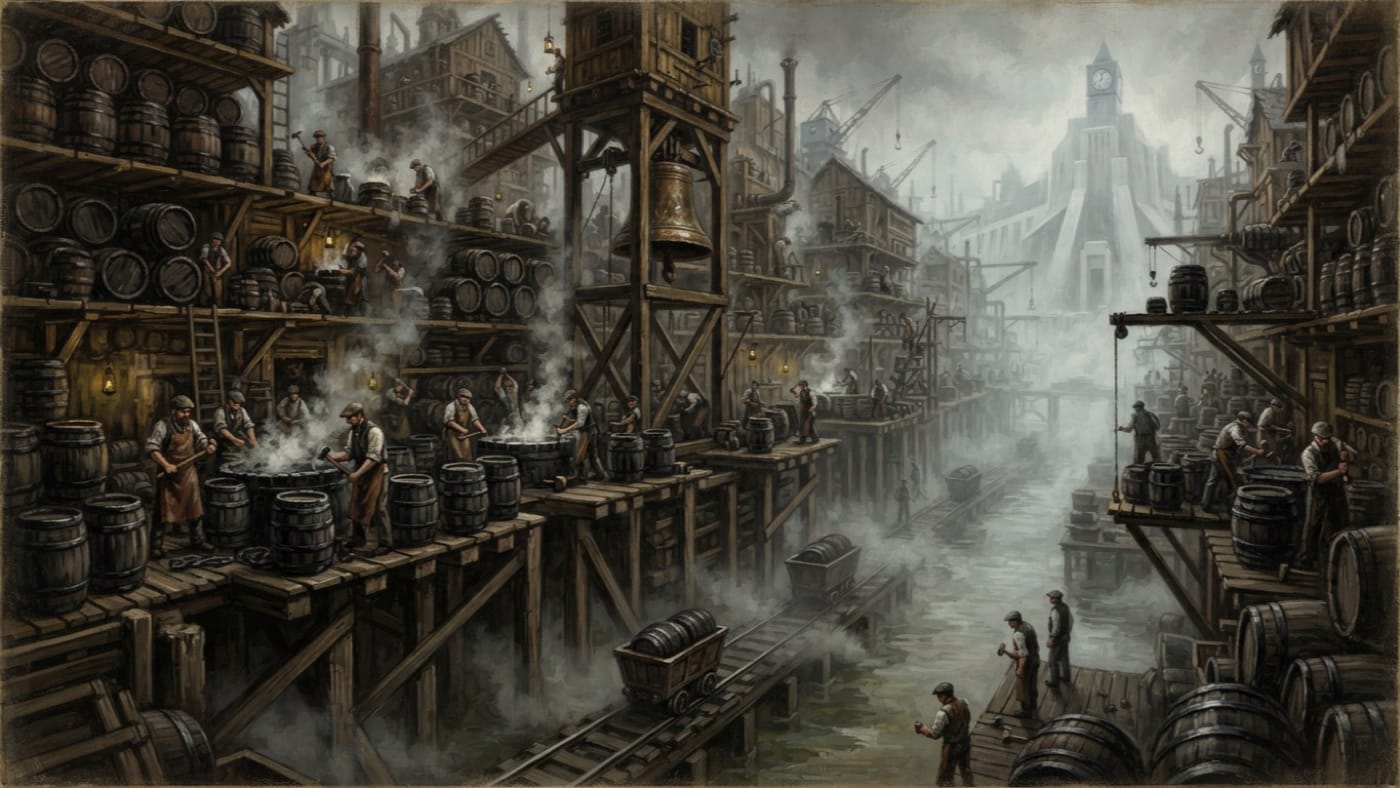
Of the seven districts of Mournwater, the Cooperage Yards are the oldest in trade and the least regarded in prayer. They smell of oak sap and pitch. They are full of men who cough, hammer and owe money, ranked by how loudly each can be heard. Every certified measure of saint-dust that leaves the town for the Sagittal Line leaves in a cask shaped here, and none of the coopers who shaped it may say whether its contents are holy.
The trade is older than the sanctity. Before the relics the Yards made barrels for the river: grain, lamp oil, the slow wet commerce of a lowland bend in the River-belt. No ledger I have been shown dates that ordinary cooperage, and I will not guess, because guessing is how the Bureau acquires founders. The ledgers do record A.S. 98, when forty-two reliquary jars capsized upriver and Mournwater found that its drying staves had soaked up something worth more than oil. They record, separately and with a good deal more wax, A.S. 104, when the Cooperage Compact's charter received joint ratification from the Bureau of Records and the Bureau of Purity. The first date made the coopers rich. The second told them how rich they would be allowed to become.
By A.S. 110, the year of the First Continental Levy, Mournwater had become a reliquary port that happened to make barrels. The Yards went on making them as before. What changed was the cost of a bad one.
#On the Pilings and the Work Floors
Mournwater runs along its river in a line, and the Yards are built upward. The cooperage tiers stand on timber pilings above the flood mark, stacked one over another. The Slurry Docks lie below the mark, where the water is expected to reach. In theory this keeps the Yards clean. The river does not follow the theory.
Each tier is a floor of planking worn black by barrel rims. Staves dry in lofts under the eaves, racked by the hundred and sweating sap into air that never quite dries. Catwalks cross between the stacks. Barrel carts grind along them on axles that ought to get grease and get pitch. Under the pilings the water is the colour of weak tea. Under the water are the flooded cellars and under-streets, where the coopers' trade becomes somebody else's once the lamps are hooded.
Oak comes in by water and so does resin. Both have to be bought, both are always short, and the Yards are organised around that shortage. Hoop-Smith Alley rings with hot metal. The Pitch Cisterns keep the resin hot enough to soften boot leather. I will not tell you where the Yards end and those places begin. No surveyor has drawn the line to my satisfaction, and the guild bailiffs move it according to who owes what.
The pitch runners carry heated resin from cistern to bench in buckets, at a trot, over planking slick with fog. They also carry burns on their forearms. Every Bureau has declined to count them, all for the same reason.
#On the Cask and Its Papers
Follow one cask through Mournwater and you will see liability divided as neatly as a confessor divides a penance.
The Yards make the cask: oak staves sealed with pitch and bound with metal hoops. At that stage it is empty. Elsewhere in town, in the Grading Hall of Settled Light, the graders put samples of dust in shallow glass dishes and watch them fall. Dust that settles into the layered rings they call rosary strata is accepted. The Yards have no part in this. A Master Cooper may read wood grain as long as he likes. He has no licence to read dust.
Certified dust is suspended in brine, and the slurry is sealed into the coopered cask under confession wax. The cask then gets its papers, which come from two separate houses and cannot be swapped for each other. The White Steps issue the purity seal, which says the contents are holy. The Compact issues the shipping manifest, which says the contents exist, in a certain amount, in a certain container, for a certain destination. The Slurry Docks load it. The lock provosts at the Seal Locks decide whether it may leave, and they charge for deciding. From there it goes on by waterway, railhead and convoy to the trench shrines of the Line, some of them as far as Bastion-Constantinople.
Each signatory vouches for something different. The cooper vouches that the cask will hold. The grader vouches that the dust settled. The Purity Office vouches that it is sacred. The provost vouches that his fee was paid. Nobody signs for the cask and its contents together at the far end, where somebody finally opens it.
#On Those Who Work and Those Who Sign
The people of the Yards are coopers, hoop-smiths and pitch runners. Graders and seal clerks come through on business. Slurry loaders wait below. Above all of them sits the Compact. In public it keeps the trade moving. In practice it holds the containers the whole relic economy depends on, and it rules through quotas, influence at the locks and debt papers.
The debt papers are the part to watch. A man in the Yards with a futures slip he cannot honour does not settle it in coin. The guild bailiffs collect, and the debt is paid in labour, in names, or in quarantine "volunteering," which is the Crumble Ward's word for it and a kind one. Everyone in town also owes a grading rotation. A cooper who bends staves one morning may be bent over a dish in the Hall before the week is out, holding his breath over something he is forbidden to stir. The Compact did not show me its quota figures, and I will not invent them on its behalf.
Master Cooper Vell Arno governs the Yards. He smells of pitch, as everyone here does, but on Arno it is the smell of rank, the way incense marks a bishop. He controls the barrel supply. Without barrels there is no slurry, and without slurry the trench shrines go empty, so his signature is worth more than most mitres. Before he signs anything he reads the grain of the table it lies on. His associates call this an eccentricity and his enemies call it a warning. I watched him do it once. A man who checks the table before the paper does not trust the paper, and that is the soundest theology I found anywhere in Mournwater.
What Arno fears is a pitch shortage. Resin is the Yards' choke point, and the town has not forgotten the warehouses of adulterated resin. He cannot afford for it to forget.
He does not rule alone. Sister Halvein's Purity Office decides what is pure, and a cask without her seal is just a barrel of brine with pretensions. Arno needs that seal before any of his casks become lawful, and she grants it from the White Steps, nowhere near the Yards. "Silt-Rook" Dema runs the backchannels, the counterfeit seals and the information that moves through the flooded under-streets, some of which pass beneath the Yards' own pilings. Officially Arno has no use for Dema. The cellars flood every spring, and the water does not ask whose casks it is carrying.
#On the Silence and the Taint
Once a day the Settling Bell tolls and the Yards stop. Adzes halt in mid-stroke. Carts halt on the catwalks. Pitch runners stand still with their buckets steaming at their feet. For the length of one prayer, a district that never stops coughing tries to stop breathing, while across town the dust in the Grading Hall's dishes settles. No cooper ever sees a dish, and every cooper waits on one. If the dust settles true, the bell rings again and the hammers start. If it does not, the Yards stay silent until the graders have finished. In A.S. 199 the graders took nine hours.
This is how a craftsman learns the order of precedence. He can hoop a perfect cask, and the Hall can still take his morning with a dish he will never see.
The ordinary hazards of the Yards are many: floods, mold fever, lung-rot, brine burns. The extraordinary one is contamination. In A.S. 194 the Bureau of Alchemical Standards classified Mournwater's anomaly as Irregular Settling Pattern, Category Two. The town calls it crumble-wrong. Tainted dust settles into shapes where it should settle into strata. When it is shipped, the dead of those who receive it break apart into a fine powder that moves with the damp. Among the living who work near the dust, the reported signs are grit in the teeth, voices that dry out, and hairline cracks in the skin. The Yards respond with lime washes, salt baths, sealed-sleep masks and burning pitch at the doorways. These are countermeasures. Nobody in Mournwater takes them for cures, though several people have been billed for them as if they were.
Officially, whatever grinds the bones upriver is Providence. Some graders filed sealed reports saying otherwise. The coopers, whom nobody asks, say the river makes new dust out of old bones. I record that as their saying and nothing more.
Mournwater never ships tainted.
The assurance is withdrawn from Bureau usage. It was always a local boast and never a charter clause. In A.S. 199 a shipment certified at Mournwater and sent to a garrison on the southern corridor caused that garrison's dead to crumble. The chaplain filed a report. The Synod denied receiving it. The cask, by every account I have seen, held.
#On the Present Condition
A.S. 201. The locks are open and casks are leaving the Yards. Staves dry in the lofts. Resin is short. The Settling Bell rings every day, and on most days the hammers start again afterward. The Cooperage Audit is pending. No findings have been published, and I will not predict any.
The parent account records that dust has begun "turning" in transit, settling wrong in casks that the Hall certified pure. The Compact blames handling and the Purity Office blames the weather. The coopers start the next cask, because the quota does not wait for theology, and the debt papers wait for nothing. The Bureau of Records files the manifests, and the casks go on toward the Line carrying a seal, a manifest and a provost's receipt, all of them valid.