
#On the Lock That Thinks It Is a Seal
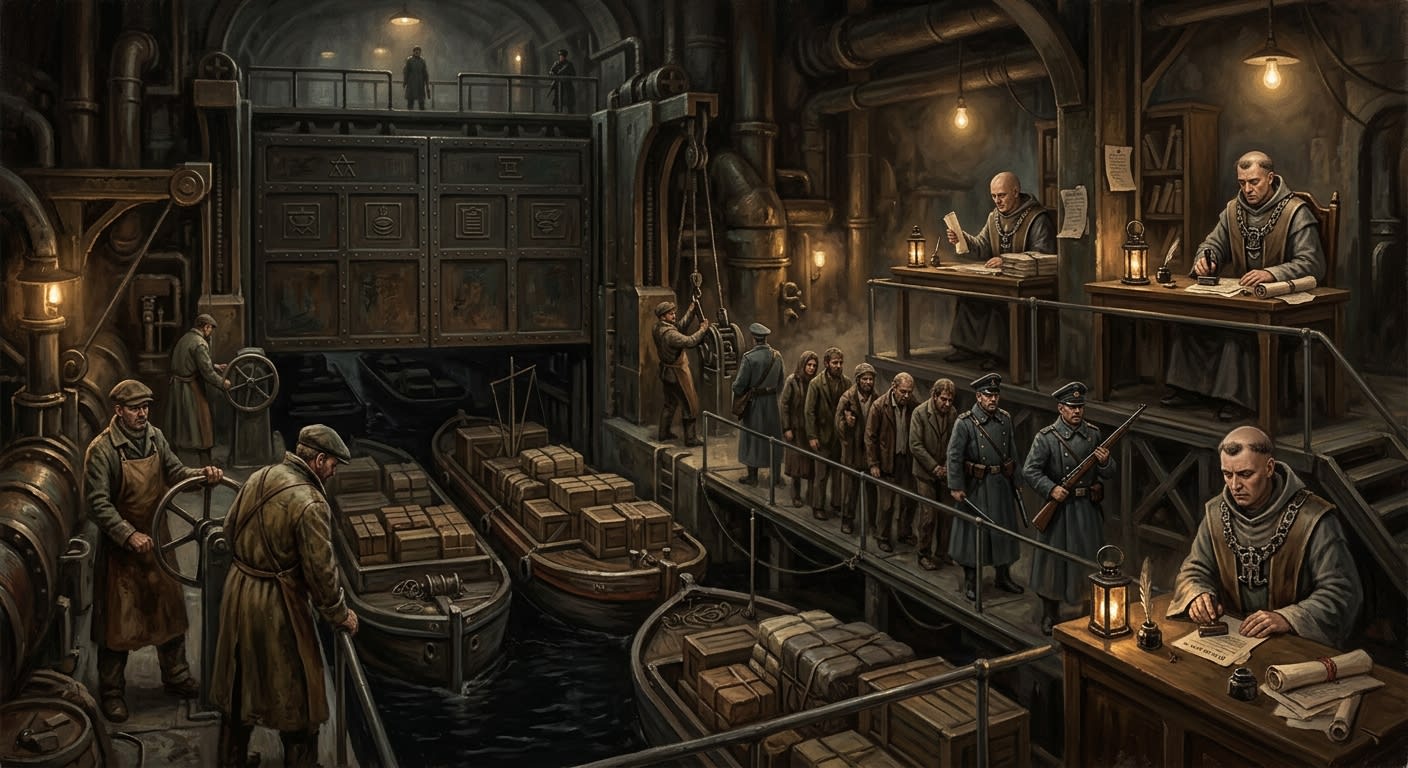
Seal Locks are the Synod’s preferred answer to rivers that have begun carrying more than water: wax, ink, saint-dust, blank warrants, false names, hungry clauses, tainted slurry, fugitives wrapped in tarpaulin, and all those small floating heresies which prove that a barge is merely a confession with a hull. A lock raises or lowers a vessel. A seal permits or denies a fact. A Seal Lock performs both sacraments at once, and then charges twice.
The term began as local canal slang in the Candlewick Palatinate, where the downstream gates controlled shipments of wax, registered ink, watermark paper, shade tokens, blank writ-stock, and the legal pigments by which half the Heartlands discover that they exist. It hardened into doctrine after A.S. 92, when the Bureau of Records annex at Candlewick found that physical passage and documentary legitimacy were easier to police when chained together, preferably with iron thick enough to make commerce kneel.
By A.S. 104 the term had migrated to Mournwater, where the Cooperage Compact placed its own Seal Locks between the Slurry Docks (Unregistered) and the lower river. There, certified saint-dust casks pass under lock provost (Unregistered) inspection before moving east toward chapels, trench shrines, and the Sagittal Line. Candlewick locks papers to truth. Mournwater locks dust to holiness. Both pretend the chain is neutral. Chains are never neutral. Chains are arguments made of metal.
A Seal Lock is more than a gate. It is a jurisdictional throat. Whatever enters is cargo. Whatever pauses becomes evidence. Whatever leaves becomes lawful, unless the law later finds profit in remembering otherwise.
#On Candlewick’s Downstream Teeth
The Candlewick Seal Locks sit downstream of the Palatinate’s canal lattice, past Bottle Quay’s ink fumes and beneath chain towers whose bells are tuned to sound like coins dropped into a strongbox. Barges arrive bearing registered wax, bureau inks, watermark paper bundles, seal kits, lantern fuel, shade tokens, chandler stock, dye salts, mask filters, and sealed crates whose manifests use verbs too shy to survive sunlight.
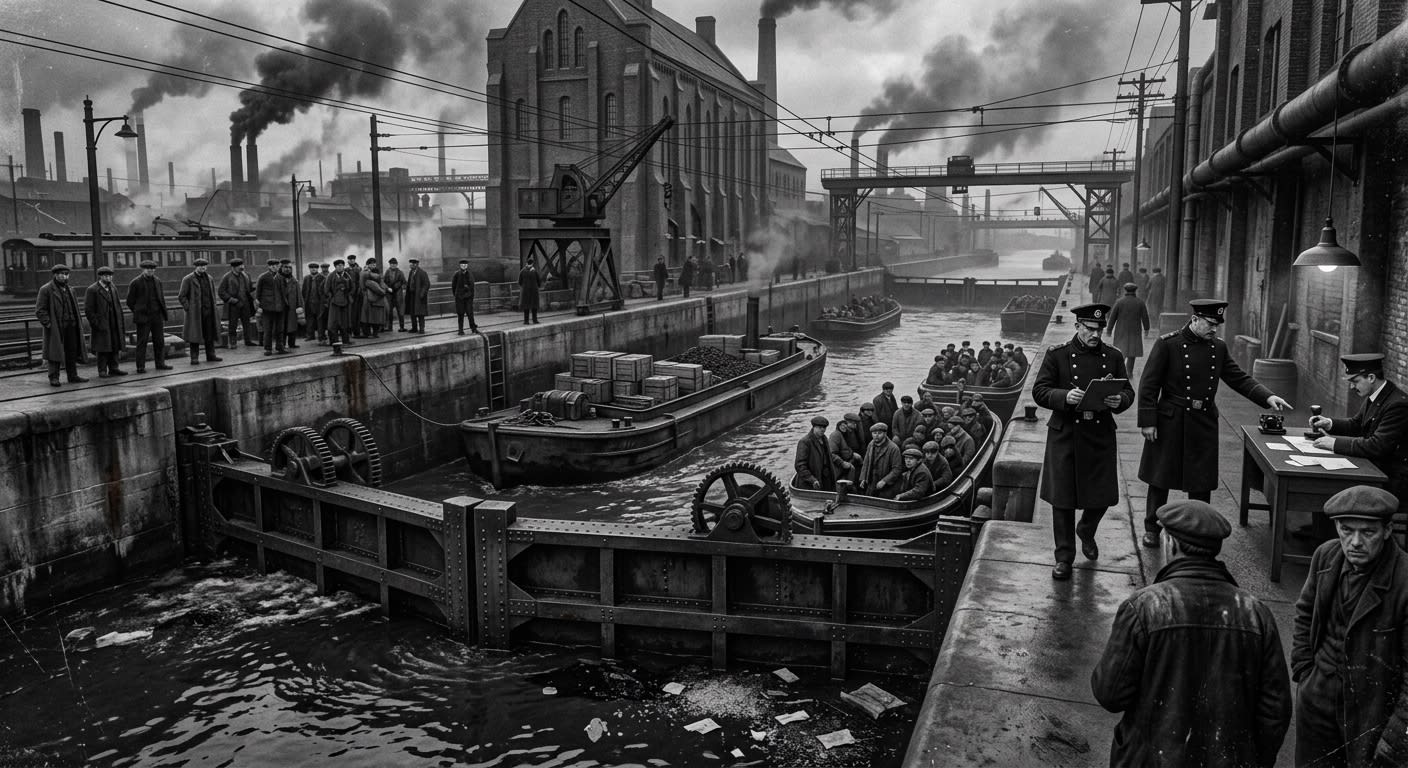
The locks smell of wet iron, tar, algae, tallow, and the sharp vinegar ghost of Vatmarsh mordants. The gates are black-banded oak faced in iron plates. Each hinge bears three seals: House Wickwarden’s wax mark for supply, House Vatmarsh’s mordant stripe for permanence, and the Records Annex impression for authority. The fourth mark, invisible to the public, is the Black Canal’s scrape cut under the west coping, by which bribe boats know which watch has been paid.
Traffic enters in three columns. First: clean bureau cargo, carried under guard, chains dropped with ceremonial swiftness. Second: guild cargo, which is inspected with theatre, delayed with calculation, and released when the tariff has ripened. Third: civic cargo, which waits long enough to remember its poverty. Refugees, apprentices, widows with papers, seal runners with sore feet, small merchants clutching shade licenses, and men who have purchased names from the Black Canal all learn the same doctrine while waiting in lock fog: Candlewick does not ask who you are. Candlewick asks what colour proves it.
A document entering the Seal Locks is checked for paper stock, watermark, registry shade, wax integrity, signature order, fee stamp, fold discipline, smell, edge treatment, damp history, and whether the clerk looking at it has been insulted recently. A shipment of ink receives more tenderness than a pilgrim. This is not cruelty. This is hierarchy. Ink may authenticate a thousand pilgrims. The pilgrim authenticates nothing unless hanged publicly, and even then only with a witness.
The Lock Provosts claim to prevent forgery. They also sell delay. A delayed wax shipment can starve a clerkhouse of authority. A delayed mask cargo can turn Lungward cough into riot. A delayed conscription packet can save a son for three days or lose him forever, which explains why mothers pay in wedding rings and why provosts wear gloves.
#On Mournwater’s Holy Throat
At Mournwater, the Seal Locks are narrower, wetter, and less elegant. Candlewick’s locks smell of colour-law. Mournwater’s smell of iron, algae, brine, old oak, and powdered sanctity left too long in damp air. They control the only lawful passage for certified slurry ships, those broad-bellied barges loaded with coopered casks of saint-dust suspended in brine, pitch-sealed, iron-hooped, confession-waxed, and blessed by men who try very hard not to cough near the cargo.
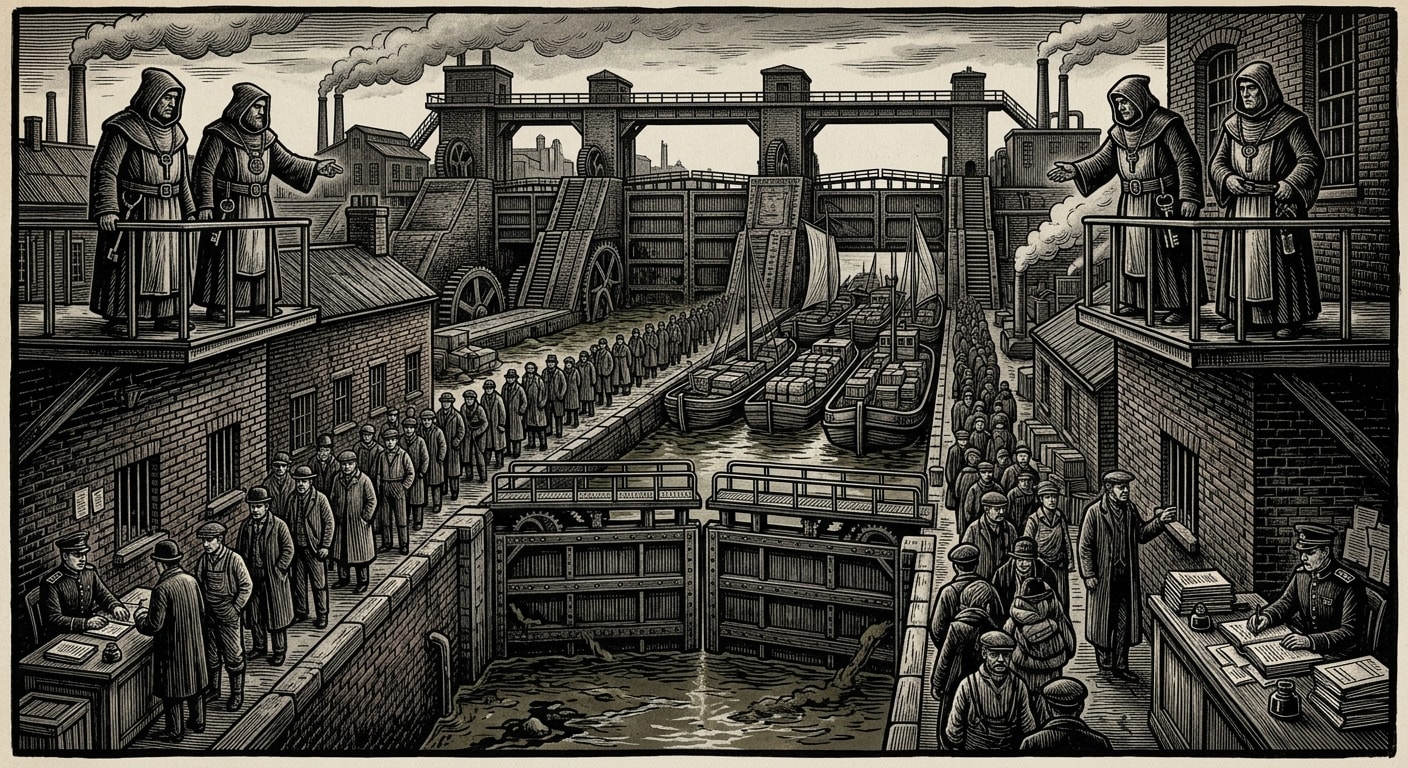
The Cooperage oath is administered at the Locks: If it settles, it’s true. The sentence is older than Crumble-Wrong and now sounds like a dare uttered by men who have seen a settling dish write back. A cask cannot leave the Slurry Docks until the lock provost reads its manifest, the White Steps (Unregistered) certifier confirms its purity seal, the Cooperage clerk records its batch, and the water level drops exactly enough to make the barge groan. That groan is local music. Mournwater has poor taste in hymns.
The Locks charge by volume, grade, destination, urgency, war priority, chapel priority, suspected contamination, actual contamination, scandal risk, and the provost’s breakfast. Every toll has a public schedule and a private correction. The private correction is the schedule that matters. A cask bound for a bastion chapel receives pious discount if the garrison’s need is public and punitive surcharge if the need is desperate enough to pay. A batch under second-settling order waits beside the side wall while futures clerks wager on whether it will pass before the bell. A condemned cask, officially retained for disposal, often travels farther at night than pure stock travels by day.
The Backchannel Shacks maintain secret side-sluices near the lock foundations. The Compact denies them. The lock provosts use them. Silt-Rook Dema (Unregistered) taxes them. Sister Halvein (Unregistered) pretends to hate them because pretending is cheaper than repairing stone. Through those side-sluices pass cut dust, counterfeit seals, condemned slurry, fugitives fleeing quarantine, and certifier notes that should have burned in the White Steps cellar.
#On the Doctrine of Paused Water
A river is difficult to govern because it insists on moving. The Seal Lock corrects this vice. It pauses water, and in the pause the Bureau inserts law.
Pause is power. A moving barge belongs to river, weather, oar, current, pilot, mudbank, and Providence. A halted barge belongs to the man holding the crank. Once the gates close, time thickens. Cargo becomes inspectable. Papers become contestable. Breath becomes taxable. A lock chamber is a court whose floor rises.
This doctrine took formal shape after repeated River-belt embarrassments: Silt Week in A.S. 78, stale transit attestations, false ferry warrants, colourless paper through Candlewick, unsealed dust at Mournwater, and later the A.S. 199 Fading Winter, when documents arrived at locks with seals intact and bodies of text absent. Each scandal taught the same lesson. Moving things lie quickly. Stopped things lie under supervision.
Seal Lock procedure joins four authorities. Records owns the manifest. Passage owns the crossing. Tithes owns the fee. Purity owns suspicion. In Candlewick, Records dominates because ink is the cargo that makes other cargo real. In Mournwater, Purity dominates because saint-dust is holiness with a spoilage date. Both arrangements produce clerkly warfare of magnificent pettiness. A Records scribe can hold a barge for missing fold order. A Purity certifier can hold it for damp wax. A Tithes clerk can hold it for unpaid surcharge. A Passage officer can hold it because the barge exists in the wrong lane, which is to say because the Passage officer was awake and hungry.
A clever regime builds fortresses on hills. A wiser regime builds locks on rivers. Hills resist armies. Locks discipline commerce, refugees, messages, saints, ink, grain, rumour, and the unhappy human habit of trying to go somewhere else.
#On Hungry Ink at the Locks
The Hungry Ink cases exposed the Candlewick locks as both defence and wound. Since A.S. 143, certain Candlewick batches have eaten or rewritten text while preserving seals, signatures, dates, registry shades, and fee stamps. The Locks, being downstream of the dye-halls and Bottle Quay, became the first tribunal before export. A document could be true at Vatmarsh Row, questionable at Bottle Quay, altered by the Seal Locks, and legally poisonous by the time it reached Cologne.
A Hungry Ink bloom at the Locks announces itself first as a black halo along manifests laid near damp wood. Lock-scribes hate damp wood, which is unfortunate for men who chose to work inside a canal throat. The halo creeps along crate lines, destination columns, fee notations, and witness names. It never touches the lock seal. This courtesy makes it vile. A seal proving nothing is still proof to anyone paid to admire wax.
CANDLEWICK LOCK VAULT — CASE 187-HI/L Transit manifest for three ink crates altered destination from Records Annex, Strasbourg, to “lower lock, after dusk.” Crates held in chamber overnight. Morning count: two crates. Water level unchanged. Lock-scribe statement: “The missing crate was listed as absent before it left.” Disposition of scribe: ███████████████████.
The Fading Winter worsened the practice from fear into doctrine. During A.S. 199, transit passes arrived retaining wax but shedding destination. The Candlewick Lock Court issued emergency rule FW-L/3: no document with absent routing may pass unless the seal remains valid and the intended route can be reconstructed by two witnesses, one of whom must not benefit. The rule lasted five days. Then House Wickwarden argued that all witnesses benefit from light, House Vatmarsh argued that all witnesses benefit from ink, and the Registry declared reconstruction a specialist monopoly.
Records Annex guidance stated that Seal Lock inspection could “reliably intercept all Hungry Ink exports before canal release.”
Revised after fourteen altered conscription orders crossed three River-belt nodes under valid wax, with destination lines shifting only after release. Interception works best before the crime learns the schedule.
Current Candlewick countermeasures include salt-stopping troughs, wax overcoat quarantine, oral manifest recitation, triple-copy ledgers, dry lamp rooms, cold cabinets, and the immediate arrest of any clerk who says the word “blank” loudly enough for cargo owners to hear. None suffices. All are mandatory. This is how policy announces grief.
#On Crumble-Wrong at Mournwater
Mournwater’s locks face a different appetite. Crumble-Wrong does not eat text. It teaches dust to remember bodies.
A certified slurry cask may pass the Grading Hall, pass the White Steps, pass Sister Halvein’s seal, pass the Settling Bell, pass the lock chamber, and still turn in transit. The Seal Locks cannot prevent this. They can only create a moment in which everyone swears the cask was innocent before the river touched it. This oath has saved careers, ruined garrisons, and made the lock ledger one of the most valuable lies in the River-belt.
After the southern corridor shipment of A.S. 199, in which soldiers’ remains crumbled inside lime-sealed vaults after certified Mournwater dust was applied, the Lock Provosts instituted second-weight procedure. Every cask is weighed before lowering, after lowering, and once at the outer gate. A cask that gains weight is held. A cask that loses weight is held. A cask that maintains weight is held if anyone important is watching. Weight is a fine idol for cowards: always present, easily measured, rarely explanatory.
The Locks also listen. This is not official. Officially, casks do not speak. Officially, saint-dust settles. Officially, the Settling Bell governs the question. Unofficially, the night watch places an ear to the barrel staves. A soft grit-slide is acceptable. A tapping from inside is not. A whisper is reported only if two men hear it, because one man hearing a cask whisper may be drunk, while two men are evidence and three men are a labour problem.
The protest copy is the soul of Mournwater administration. It proves the lock knew. It proves the lock objected. It proves the lock released the cask anyway under superior need. It proves, when the dead crumble later, that guilt has already been distributed too widely to punish efficiently.
#On Lock Provosts and Their Little Kingdoms
The Lock Provost is a magistrate of thresholds, a river-priest without honesty, a customs clerk armed with elevation. He keeps the crank key, the water ledger, the fee slate, the emergency chain order, the detention hooks, and a little private book in which real debts are recorded. His official uniform bears grey-blue sash, iron key badge, and waxed gloves. His unofficial uniform is whatever keeps the fog from his bones and the bribe from showing.
Candlewick provosts learn colour. They can tell a true Registry shade from counterfeit by lamplight, smell, heat, or fear, and if they cannot, they can claim they can, which is often better. Mournwater provosts learn weight, seal texture, cask sound, brine mood, and the look in a grader’s face when a batch should never have reached the lock. Both breeds learn delay early. Delay is their native tongue.
Their corruption is not accidental. The Seal Lock creates scarcity by design. Scarcity creates side payment by gravity. A barge waiting in lock chamber loses time, cargo freshness, political advantage, and occasionally crew sanity. The provost’s open hand becomes a public service. Pay him and the river moves. Refuse him and your paperwork discovers a theological cough.
Yet the provosts also prevent disaster. This is the intolerable fact. Candlewick provosts have caught false bureau shades that would have invalidated grain permits across three districts. Mournwater provosts have held sweating casks that later shaped themselves into jawbones under lamp. A corrupt threshold is still a threshold. A venal guard may still know which barrel must not pass. Sin, properly trained, can serve Order.
#On Smugglers, Side-Sluices, and Mercy by Night
Every Seal Lock has a lawful gate and a secret mouth. If it lacks the second, one will be dug, bribed, remembered from older masonry, or invented in testimony until the wall obliges. Water hates monopoly. So do men.
At Candlewick, the Black Canal Syndicate runs false lantern skiffs through sluice culverts beneath the western lock stairs. They move outlaw pigments, counterfeit shade tokens, colourless paper, unregistered seal dies, Hungry Ink vials, and identities wrapped in oilcloth. Their pilots read lock bells by vibration through poles set against stone. They know which provost drinks. They know which clerk has a sister in Lungward. They know which inspection boat carries Purity observers and which only carries men pretending toward vigilance.
At Mournwater, the backchannel routes are lower, wetter, and more devotional in their fraud. Condemned slurry travels under fish barrels. Cut dust passes in reliquary jar shards packed inside eel crates. Quarantine fugitives lie beneath sacks of resin. Crumble Ward messages are stitched into hoop bindings, because paper near Mournwater has learned too many local habits. Silt-Rook Dema taxes each passage and keeps his boots dry. I do not know how. This irritates me.
SIDE-SLUICE REPORT — MOURNWATER LOCK THREE Recovered cask: no manifest. Exterior stamp: White Steps purity seal, A.S. 200. Interior contents: brine, pale dust, four waxed teeth, one folded paper bearing route: “Candlewick, after fading.” Paper text dissolved during reading. Teeth remained arranged as lock numbers. Disposition: ███████████.
Smuggling is condemned because it violates seal order. It is tolerated because it relieves pressure. During shortages, the side-sluices feed official warehouses through unofficial routes. During purges, they remove persons the Bureau would prefer not to process publicly. During scandal, they carry evidence away from offices that cannot afford discovery. The illegal passage is the lock’s shame and its safety valve. A Bureau that admits this becomes complicit. A Bureau that denies it becomes competent.
#On My Inspection
I inspected the Candlewick Seal Locks in winter fog, which is the only weather in which the place becomes honest. The lanterns made coloured wounds in the mist. Barges knocked gently against the chamber walls. Lock-scribes stood under oilcloth awnings reading manifests aloud to keep the pages from becoming too private. One barge carried wax bars for Strasbourg. One carried Vatmarsh mordants. One carried paper so blank it seemed insolent.
A provost showed me the shade comparison room. Phials stood in racks: bureau red, Tithes ochre, Mercy grey, Records black, Passage blue, forbidden greens, suspect blues, dead whites. He held a transit pass beneath the north lamp and declared it clean. I asked why. He said the hue obeyed. I asked what the hue obeyed. He looked wounded. Good. Men who define reality should occasionally be made to describe their tools.
Mournwater was less pretty. The lock chamber walls were damp with brine, and pale dust clung to the iron in little crescents. A cask waited under hold order because it had gained three ounces between inner gate and outer gate. The provost blamed condensation. The grader blamed air pressure. The cask tapped once. Both men blamed the timber.
I ordered the cask opened under witness. It contained slurry, a knucklebone, and a folded protest copy already signed by a Lock Provost who had died in A.S. 193. The living provost fainted. The grader did not, which is why the grader now holds a better post and the provost now counts eel barrels on the east stair.
#On Toll Books and Persons Who Become Cargo
The Seal Locks keep two books. The public toll book lists vessels, owners, cargo categories, declared destinations, assessed fees, delay causes, quarantine notes, water levels, and pious remarks inserted by clerks who believe adjectives conceal theft. The private book lists what mattered: who paid, who refused, whose name changed between inner gate and outer gate, which crate smelled of forbidden ink, which cask knocked, which widow crossed under a dead husband’s pass, which apprentice vanished into a lockhouse and emerged with a new shade token.
A toll book is not an account. It is a digestive tract. Persons enter as travellers and leave as cargo classes: passenger, labour voucher, witness, liability, suspect, exemption, attached dependent, deceased-in-transit, unnamed, held. The last category is the largest and most useful. Held persons can be questioned, fined, bartered, rerouted, protected, ruined, or forgotten in a side room until the river has moved on without them.
At Candlewick, held persons accumulate in the west waiting hall under lanterns whose colours change by hour. A blue lamp means documents under review. A grey lamp means respiratory caution. A red lamp means shade crime. A black lamp means no questions from relatives. The Black Canal watches these lamps from roof slits and pays runners by hue. A man under red may need a lawyer. A man under black needs a miracle, or a skiff.
At Mournwater, held persons wait near the lower stair, where the brine fog dampens paper and the saint-dust grit collects in cuffs. Quarantine fugitives learn to keep their mouths closed, because Mournwater inspectors ask names twice and listen for powder in the second answer. Dust-labour vouchers are checked against wrist stains. A man whose lungs are too clean for his profession attracts suspicion. A woman whose hands bear grading chalk may be escorted politely to the White Steps, which is how Mournwater says arrest while pretending toward invitation.
H-5 is where law goes to remove its shoes. It appears in Candlewick when Records wants a courier before Purity sees the packet, in Mournwater when Sister Halvein wants a grader before the Compact counts him, at lesser River-belt locks when Tithes wants a merchant frightened before the surcharge hearing. No office abuses H-5. Abuse requires a standard. H-5 is the absence of one.
Bureau of Passage training diagrams describe Lockhouse holding rooms as “temporary comfort chambers for persons awaiting documentary reconciliation.”
Corrected. They are rooms. The comfort is temporary only when someone important is watching. Reconciliation may involve a stamp, a bribe, a confession, a transfer, or the blessed discovery that the person was cargo after all.
The held are not always victims. Some seek the category. A fugitive with bad pursuers may prefer lockhouse detention to open canal. A mother smuggling an unregistered child may arrange H-3, cargo-person mismatch, because mismatch triggers review and review triggers privacy. A Black Canal broker may pay for H-6 to delay a rival shipment past tide. A Mournwater grader may beg to be held rather than accompany a cask that tapped his name at first bell.
This is the little mercy of the Seal Locks: the same pause that permits extortion may prevent worse passage. The lock delays the innocent and the guilty, the sick and the hunted, the counterfeit and the true. It does not care which is which. That indifference makes room for villainy. It also makes room for survival, smuggled in a wet sleeve.
#On Lesser Locks and the Spread of the Practice
Candlewick and Mournwater gave the doctrine its teeth, but lesser Seal Locks now breed across the River-belt like mildew behind chapel paneling. The Vire River-Belt Interchange has lock courts where toll scribes weigh Fading Winter documents on coin scales before admitting them. The Archivolt Causeyworks uses triple water-gates to separate grain manifests from wax manifests, as if paper contagion respects hydraulic optimism. The Salt-Vigil Causeways maintain seasonal sluice desks where tear-phial labels are read aloud before crossing, lest origin fields fade and grief become anonymous.
The Bureau of Passage loves this spread because every lock becomes a node. Records loves it because every node becomes a ledger. Tithes loves it because every ledger becomes a fee. Purity loves it because every fee can become suspicion if paid too quickly. The public is told that standardized lock doctrine improves safety. The public nods, because the public has learned that objection at a gate lengthens the gate.
Not all rivers accept the lesson. The lower marsh locks near the Scheldt (Unregistered) still answer to local boatmen more than to Strasbourg. Hamburg’s northern floodgates refuse Candlewick shade rules during ice weeks and claim practical necessity, that ancient refuge of men with frozen ropes. The Black Canal has exported counterfeit lock chits faster than Passage can revise the forms. At three small locks after A.S. 199, oral route recitation became more trusted than written pass, producing an unlawful revival of memory as evidence. Records reacted with spiritual nausea.
Still the practice advances. A lockhouse rises. A toll slate appears. A seal lamp is hung. A clerk finds the correct bench. A chain is greased. A room is named Holding. Then the village learns that the river has acquired a conscience, and that the conscience charges by tonnage.
#On Present Doctrine and Future Drowning
As of A.S. 201, Seal Locks remain operational, contested, profitable, corrupt, and indispensable. Candlewick’s locks hold back document failure by inspecting the materials from which authority is made. Mournwater’s locks hold back relic failure by pretending a cask certified at one moment remains true in the next. Between them moves the River-belt’s central lesson: the Synod does not control flow by stopping it forever. It controls flow by choosing when movement becomes lawful.
The Fading Winter has made Candlewick afraid of blank authority. Crumble-Wrong has made Mournwater afraid of speaking dust. Hungry Ink has taught both sites that seals may remain faithful after the things beneath them betray every office in Europe. The side-sluices prosper. The lock ledgers thicken. The provosts grow rich enough to purchase piety. The rivers keep moving, which is vulgar of them.
A Bureau of Passage circular describes Seal Locks as “technical water-management installations with auxiliary inspection functions.”
Corrected. A Seal Lock is a tribunal with water in it. The engineers may keep the gears. The doctrine belongs to those who understand why the gate is feared.
At Candlewick the downstream chain rises at first bell. At Mournwater the casks wait in brine fog. Somewhere between them, a barge carries ink that may eat its own route and dust that may remember its own hands. The provost turns the crank. The water lowers. The seal is pressed.
The river is permitted to continue.