
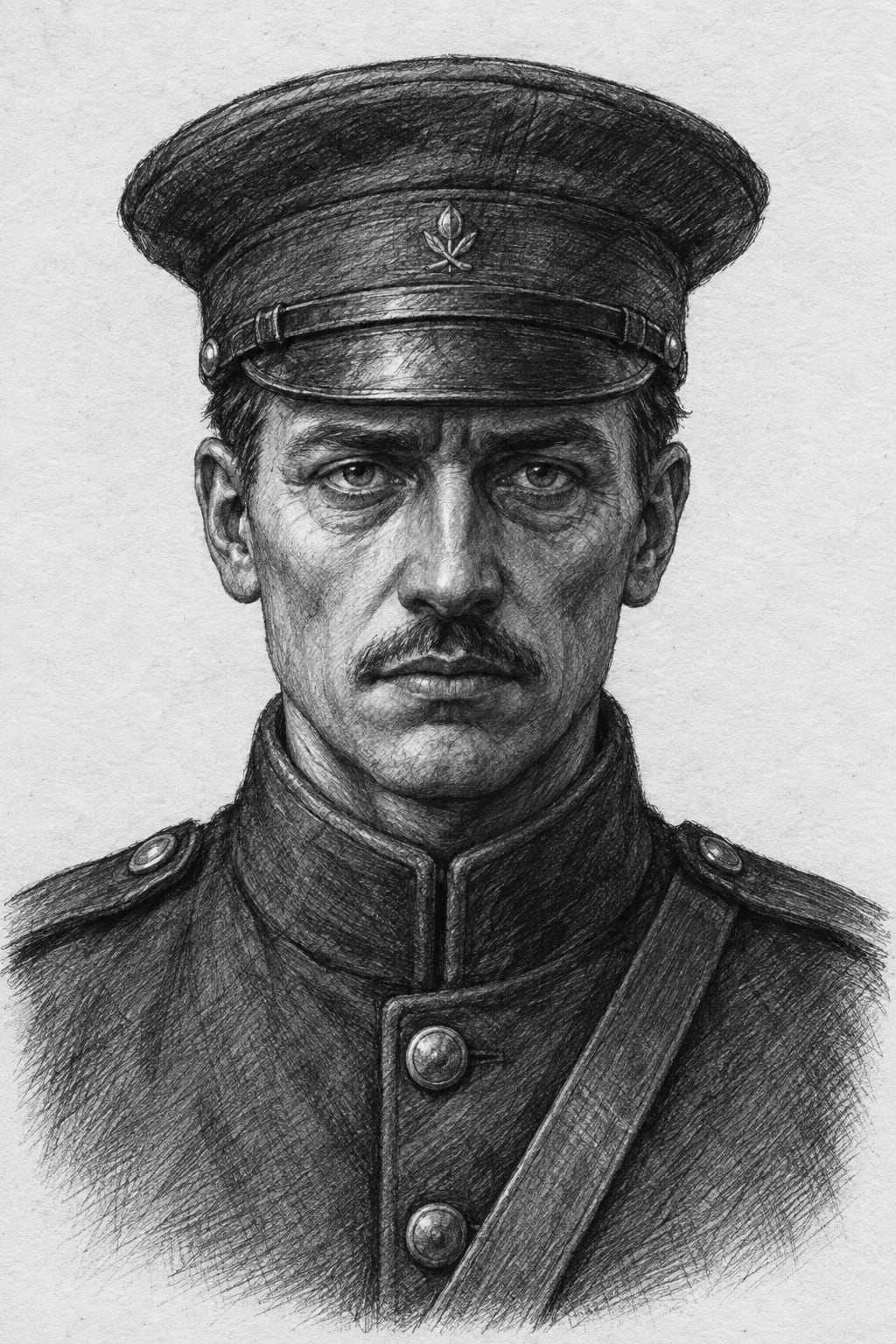
#On His Station
The Ledger knows him as corporal-registrar H. Mace. It knows him by that title, by that single initial, and by one charcoal plate, and it knows him by very little else. I have looked. A reader who wants a dossier in the ordinary manner, with parish of birth, oath-date, postings, commendations and a cause of death entered in a tidy hand, should go and read about a bishop. Bishops leave paper. Corporals leave testimony, when someone thinks to take it.
What survives is this. In A.S. 197, testimony credited to him was used to render a charcoal illustration of Hollow-Walkers approaching the eastern perimeter of Bastion-Constantinople during the fourth watch. The plate now hangs in the Codex entry on Kargath, in the section on his legions, where it does honest work among considerably grander company. Its caption names the corporal-registrar. It also does something captions in this Codex seldom do: it records a request.
The title itself is a small puzzle. By the shape of the words, a corporal-registrar held a rank and also kept a list. The surviving record does not say which list, or what was on it, and I decline to supply one. The Bureau of Records already holds enough fictions without my adding a duty roster.
#On the Fourth Watch
The relevant part of the caption reads: The corporal requested we note that one of them spoke to him in his mother's dialect.
That is all of it. He did not ask the Codex to note how many creatures came, the hour, or his own conduct in the trench. Those particulars were given, or reconstructed, and they are in the plate. The one thing he asked to have written down was the speech.
I have read a great many depositions in my office. Deponents ask for things. They ask that their commanding officer be told of their courage, that a misreported ration be corrected, that their name be spelled properly, or that their name be left out. I had never before met a deponent whose only recorded request concerned the grammar of the enemy.
The caption does not tell us what the creature said. It does not tell us whether Mace understood the words or knew only their sound, the way one knows a voice through a wall. It does not tell us whether he answered. Those gaps are not mine to fill, and I will not fill them. The reader may take only what the corporal-registrar chose to have kept. Something came toward him out of the dark beyond the eastern wire in the fourth watch, using the speech his mother used, and he wanted the Theocracy to know it.
#On the Hunger at the Perimeter
Kargath presses the southern anchor from the Bosphorus marshes and the Black Sea approaches. His sin has been misread in public materials for sixty years as the vice of the fat man at the banquet. The Bureau of Doctrine's corrected formulation, which cost fourteen months of committee review, is need that grows with feeding: famine, spoiled stores, and the abundance that is worse than famine because it is believed.
In the Bureau of Doctrine's classification, the Hollow-Walkers are the class of his forces our soldiers meet most often. They are humanoid, emaciated beyond anything the Bureau of Medicine will certify as possible, and drawn across the marsh by the smell of rations and livestock. The classification holds that they were human once, or something like it. Bureau depositions record that they sometimes try to communicate, and sometimes to ask for help, in recognizable languages and in dialects not spoken for three generations. Then the hunger takes over, and the deposition usually ends.
Consider the man at the wire. He is on ration, because the Synod treats rationing as spiritual discipline. He has been taught the Doctrine of Enough, under which wanting more than his share is itself a fault. Opposite him comes a figure starved down to its frame, wanting, and asking in words. The Bureau would prefer not to enter that exhibit into evidence. Corporal-registrar Mace entered it anyway.
The fortress has other enemies. Maldrake's Wrath presses Bastion-Constantinople on its own account. Nothing in the record connects the corporal-registrar to that front, and I have not troubled to invent a connection.
Earlier editions of this Codex, and the Lore Book they leaned on, set Kargath's nearest pressure against a western wall held by Bastion-Lorraine.
The southern anchor of the Sagittal Line (Unregistered) is Bastion-Constantinople, at the Bosphorus. "Bastion-Lorraine" survives in songs, veterans' testimony and pre-correction plaques. It does not survive on maps. Readers who have been confused should know that so were the cartographers.
#On the Recorded Dialect
A dialect is not a person. Thousands hold it in common: a valley, a parish, a generation of women at a well. When a Hollow-Walker speaks one, it proves that the dialect was spoken. It does not prove that the creature was the corporal-registrar's mother, a relation, a neighbour, or anyone he had ever met. The caption makes no such claim, and the corporal-registrar, as recorded, made none either. He asked that the dialect be noted. That is a narrower thing, and a harder one to forget.
How the creature came to have the speech is not established. The classification that calls them former men suggests one route. Doctrine has opinions about others, and Doctrine's opinions are not mechanics. I will not present any of them in this dossier as the truth of the fourth watch. Nothing on the record shows that the creature reached into anyone's memory, wore anyone's face, or was compelled to say what it said.
I have looked for the Bureau's ruling on the matter and found none. I have looked for an inquiry and found none of that either. The request was kept in a caption. I report the absence. I do not decorate it.
#On the Charcoal Record
The plate and the incident are different objects, and the reader is asked to hold them apart.
The plate shows three emaciated figures approaching a trench at night. One has an arm raised. Synod soldiers watch. That is the drawing's count and composition. Whether the testimony counted three, or more, or fewer, the caption does not say, and the charcoal cannot. The raised arm may be beckoning, begging or warding off. Nothing in the plate shows which figure spoke, and I will not draw an arrow where the artist drew none.
Charcoal cannot render a dialect at all. That is the plain reason the caption carries what it carries. Everything the corporal-registrar saw could, with labour, be put into charcoal. The one thing he heard could only be put into words, so the words went under the picture, credited to him, for as long as the entry stands.
#On the Limits of the Dossier
The designation is retained as recorded: corporal-registrar H. Mace. The initial is not expanded. The testimony milestone is A.S. 197, and that is the only date this dossier claims.
The record does not establish his given name, his parish, the list he kept, his posting before or after the eastern perimeter, his health, any promotion, or whether he lives. It does not establish the day or month of the approach. It does not establish what the creature said, beyond the dialect in which it was said.
His file contains one sentence of his own wishes, and the Codex has kept it. Most men on the Line are entered with less.