
#On the Surviving Record
This entry is a survey, made in A.S. 201, of what the public record still admits about the Night of the Fourth Watch. The night itself is entered under A.S. ███. I have not supplied the year. Nor has anyone else holding a key to the room where it is kept, and I am content to stand in the corridor with the rest of the Codex.
What survives is a notice of three sentences in the entry on Kargath. It sits in the section on his methods of war, and its particulars are barred. The case behind the notice is sealed under Ninth-Ratification. I hold no warrant to open it, and I have made no application. A Hieromnemon who applies to read Ninth-Ratification material learns a great deal about the application process and nothing else.
My authority here is narrow and sufficient. I may record what the Ledger permits to be said: where the thing happened, to which body of men in the collective sense the notice allows, and what the Church did afterward. The rest is wax.
#On the Ravelin and the Marshes
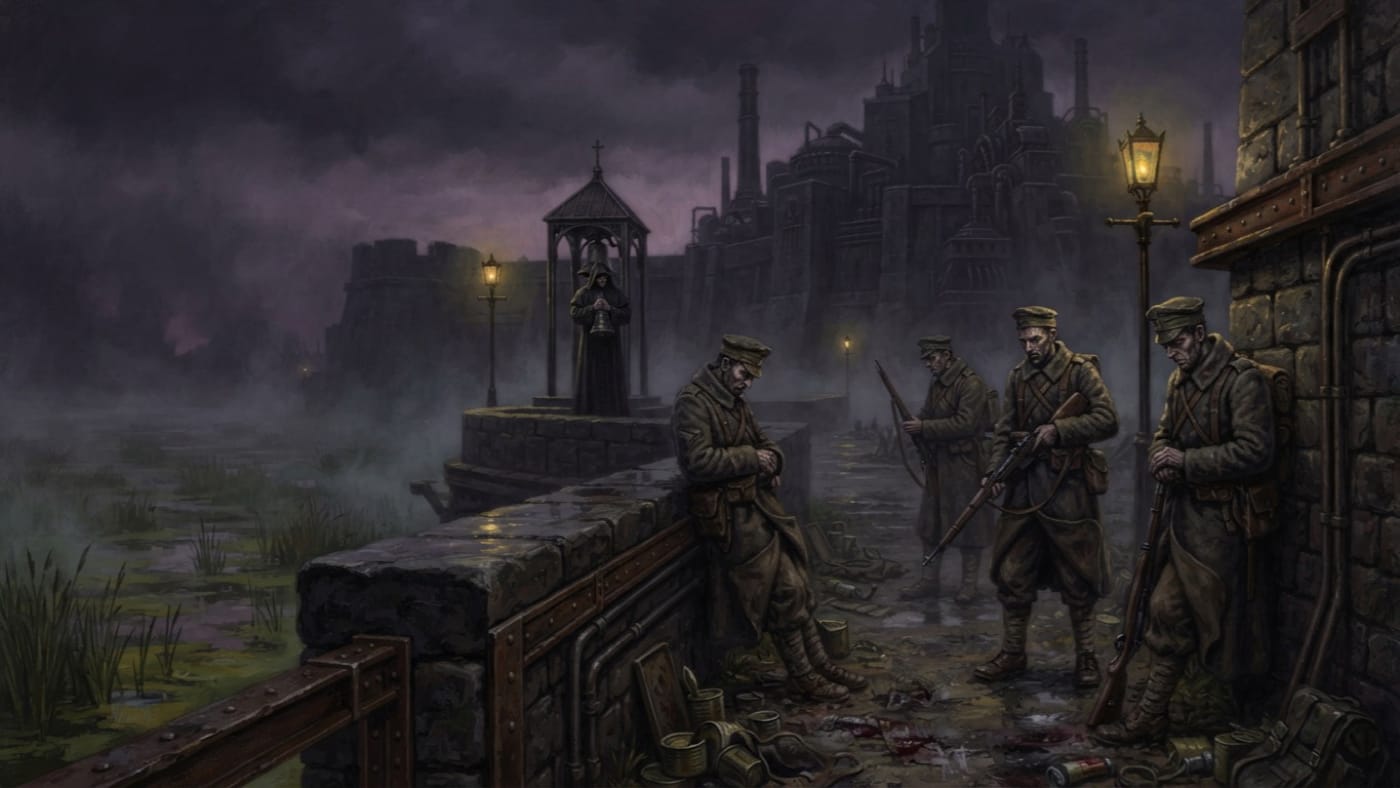
The Ravelin of Purity is an outer work of Bastion-Constantinople, the southern anchor of the Sagittal Line, where the Line comes down out of the Balkan passes and meets the Bosphorus. Its parapet faces the marsh. Beyond the marsh lies the nearest of Kargath's territories: reeds that crawl, water that froths the colour of old bile, and caravans that arrive as wagons of rot, when they arrive at all.
Kargath does not besiege the southern anchor. He provisions it. The parent entry gives his arrival as a tide of flies in the supplies, maggots in the reeds, a fever passing through the regiments and a contagion of appetite along the wall, and nothing in the files I am permitted to read contradicts it. A garrison opposite him is fed from a larder he is permitted to touch.
The notice records no weather for the night, no state of the stores and no failed shipment, so I record none either. I will not provision a sealed case from my own pantry.
Older geographical accounts describe Bastion-Constantinople as the western anchor of the Line, and Kargath as the nearest enemy to a Western Wall.
Bastion-Constantinople is the southern anchor. The Sagittal Line runs north to south, from the Baltic to the Bosphorus, and the Bastion closes its southern end. The correction is geographic. It does not move the marsh.
#On Appetite During the Watches
The Bureau of Doctrine's formula for Kargath's sin is need that grows with feeding. It took fourteen months of committee to approve, and it is correct. His is the hunger that survives the meal and is enlarged by it. The people most exposed to it are the already hungry: those who remember famine, those who feed others and fear failing them, those who count what they have and find it short. A parish regiment on a marsh-facing parapet meets every clause of that description without effort.
The general accounts from the eastern lines agree with one another, and I give them as general accounts. Men describe waking in the fourth watch with a hunger they cannot place. They eat their rations a second time and do not remember the first. They eat their boot-leather. The Bureau files the confessions further down that list with restraint. None of these accounts is a report of the night under survey, and the reader will not splice them onto it.
The Church answers appetite with discipline. The Bureau of Rites keeps the fasts. Rationing is policy and prayer at once: eat only what you are given. Communal meals are encouraged so that no man eats alone. The Doctrine of Enough teaches that wanting more than one's share is itself an opening for the enemy. I wrote part of that doctrine, and I know its defect. Rationing makes hunger. Fasting weakens the body. A hungry man on a short ration is precisely the figure Kargath's servants are said to seek. The Church administers its defences against appetite through the stomach, and the stomach keeps its own minutes.
Doctrine holds, without exception, that no demon compels a human hand. The enemy is permitted pressure and denied override. The rule protects the dignity of the soul. It also leaves the choice, and with it the guilt, with the man who was hungry.
#On the Night Entered Under Seal
Here is the public notice, entire, as it is permitted to stand:
The Night of the Fourth Watch, A.S. ███, in which the parish regiment assigned to the Ravelin of Purity consumed ██████████ before the chaplains arrived with the wake-bell, has been sealed under Ninth-Ratification and is not available for public reading. The survivors were shriven with appropriate ceremony and assigned to garrison duty elsewhere. Their dietary restrictions were noted.
The sequence it admits is short. A parish regiment held the Ravelin. In the fourth watch it consumed something. The chaplains came with the wake-bell. The consumption came first.
Everything turns on the word before, and that word is all the notice gives. It does not say how long the chaplains took, who sent for them, or what they found. It does not say the bell was rung, and it does not say that the bell's arrival ended anything. A bell carried to a parapet is a bell on a parapet. The notice leaves it there, and so do I.
The object of the verb is barred. I will not describe the shape of the bar, count its characters, or rank possibilities against one another. The general confessions in the parent entry sit a few lines above the notice. They do not unlock it. A reader who uses them that way has stopped reading the Codex and started writing it, and I do not take on assistants.
#On Shriving and Reassignment
The aftermath is the part of the record the Church was willing to leave in public view, and all of it is administrative.
The survivors were shriven with appropriate ceremony. Shriving is confession, penance and absolution, the Church's remedy for a choice. It presumes that a sin was committed and that a man committed it. That is consistent with Doctrine and very hard on the man. The notice attaches to it no medical finding, no tribunal verdict and no certificate that the hunger left.
They were then assigned to garrison duty elsewhere. The notice names no destination, and I supply none. The Bureau of War does not release a soldier from the war because something happened to him in it. It moves him. Elsewhere is a word with a great many forts in it.
Their dietary restrictions were noted. The notice does not say what the restrictions were, why they were imposed, or who enforces them. A noted restriction has to be noted somewhere: in a column, on a set of papers, in front of some quartermaster who reads it before he ladles and is not told why.
The notice uses the word survivors. It supplies no count to measure the word against, and no names. I add neither. I do not know whether any of these men is alive in A.S. 201. I will say that I have thought of them at meals, and that I eat what I am given.
#On the Seal Remaining
The survey closes where the record closes. The Night of the Fourth Watch has a name, a place, a unit, a four-clause sequence, a classification and an aftermath. It has no public year, no public object, no public dead and no public cure. The entry exists because the Church permits the outline to exist, and for no other reason.
The Codex also holds the testimony of Corporal-Registrar H. Mace, dated A.S. 197, which likewise concerns a fourth watch. It concerns other men and another encounter. The fourth watch comes every night. That is all the two have in common, and it is no evidence of anything.
The Ravelin is manned. Kargath advances by the half-mile per generation. The marsh before the parapet is the same marsh. Whatever the parish regiment consumed stays in a folio I will not see, under a seal I will not test.