
#On the Ascent
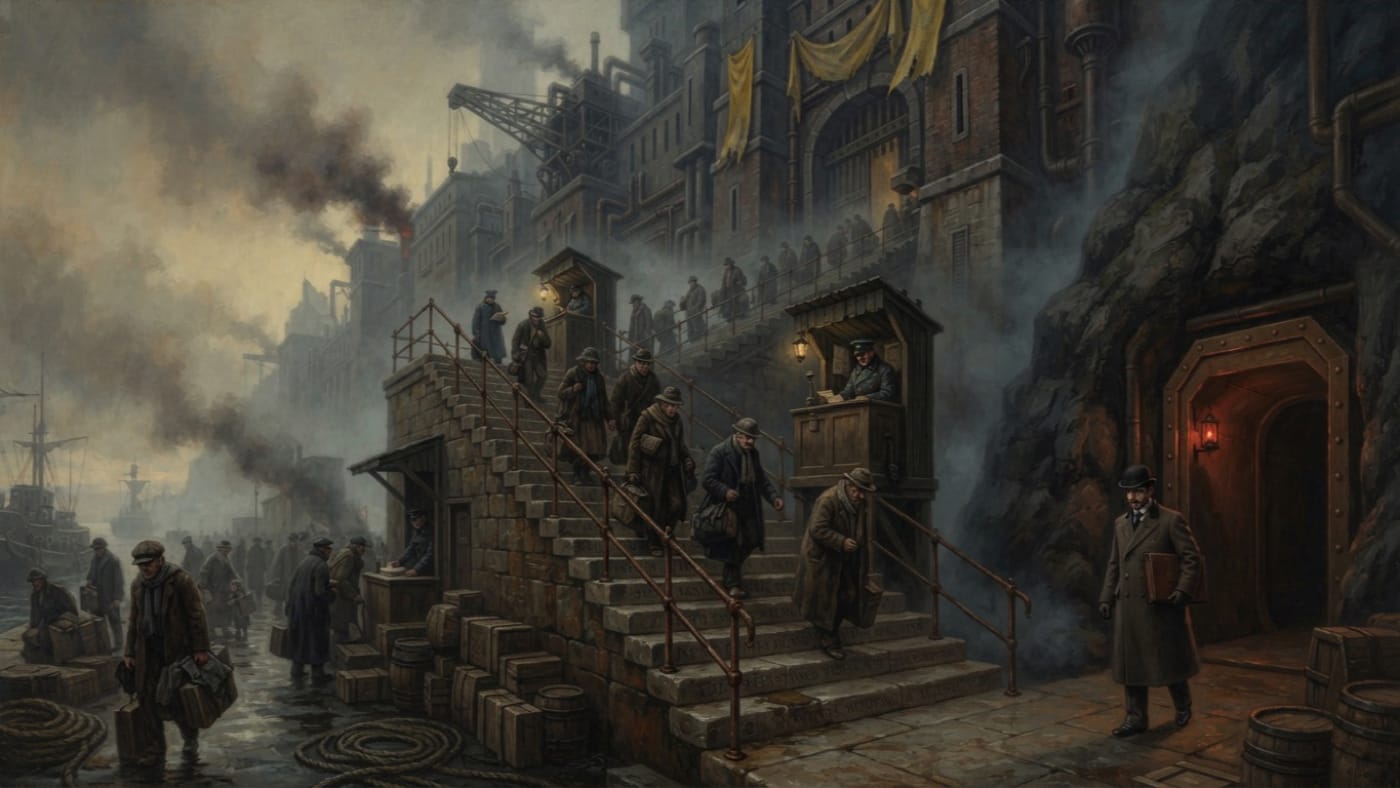
The Duesstairs begin where the quay runs out of excuses. At Saffron Gate, where the inland road meets the harbor road, the traffic from both directions becomes a single obligation and is sent uphill. One hundred and forty-seven stone steps climb from the quay to the upper terraces of Saffron Bastion, and each step has a tax category cut into it. The pilgrim reads them on the way up, one tread at a time. By the top the pilgrim has learned the only language spoken on the terraces.
The stairs open at dawn. In the same hour the salt pans are tallied and the quarantine line starts to form along the Causeway, so the Bastion wakes and counts in one motion. I found no closing hour in any record I was shown. At Saffron that kind of omission may be carelessness or policy, and the clerks file both in the same drawer.
The district smells of wet rope and ink, with hot wax underneath. The rope smell drifts up from the moorings on the mist. The ink is already drying on the dues invoices before the first foot reaches the first step. The wax is the reason anyone bothers, because nothing at Saffron is true until it has been sealed, and nothing sealed is cheap. Salt-stained brick and bone-lime cement close in on either side of the ascent. The clerks work from tarred-timber booths. A rust-iron rail runs where some earlier official mistook a railing for a kindness. The iron is cold at dawn, and the hands on it are cracked from salt.
This stair is for persons. Barrels go up by cart and by the rope lifts on the cliffs, and get their wax at the Third Quay. The living, with names and lungs, climb the Duesstairs, and this is where the Bastion keeps its accounts on everything that breathes.
#On the Dues
"The steps tell you what you owe. They do not tell you how much." — a dues clerk at Saffron Gate, to the author, A.S. 197
The carvings name categories. They do not name sums, and the gap between the two is the whole profession of the men and women in the booths. A category is carved in stone. A sum is decided that morning.
I will not transcribe the steps. The Quay Chapterhouse has never supplied an authenticated reading, and a pilgrim's memory of the stone, recited at the top in tears, does not meet the standard of the Bureau of Records. The harbor's charges are recorded elsewhere: salt dues, berth fees, salvage tithes, pilgrim intake fees, confession tithes, and a storm levy in bad seasons. No single traveler owes all of them. A pilgrim without a ship pays no berth fee. A salvage diver answers to the salvage tithe and has never been mistaken for a pilgrim.
The steps' genius is that they show the whole list to everyone. A tariff kept in a ledger frightens only people who can read ledgers. A tariff under your feet frightens everyone who can read at all. Those who cannot read are told by those who can, in the queue, at length, for free.
The record fixes one charge. The pilgrim inspection stamp issued on the Quarantine Causeway costs one salt-token, and the token is paid at the Duesstairs. What the token itself costs is a separate question. It costs whatever the Duesstairs says, which means whatever the Quay Chapterhouse needs it to cost this morning. The stamp is always one token. The token is a different token most mornings.
Payment comes in the instruments the harbor recognizes: coin, stamped berth chits, local salt tokens and dock-union oath-notes. Each is accepted wherever a clerk agrees to accept it. The booths stamp a dues invoice for whatever has been paid. The invoice is a receipt. It certifies that money was received and nothing more, which pilgrims usually learn later in the morning.
Elsewhere in the Church, the Tithe of the Gate takes coin and the Creed from foreigners at gates and bridges, under the authority the Bureau of Tithes holds over such tariffs. Saffron's dues belong to the Bastion and answer to the Chapterhouse. The Creed is welcome on the Duesstairs. It is not legal tender.
#On the Papers
"Without a dry-pass, a person at Saffron Bastion is cargo." — the author, on a previous occasion, correctly
Money, papers and permission to move are three separate possessions at Saffron, and the harbor sells them at three separate counters. A pilgrim can have plenty of the first and still sit in the waiting yards for nine days.
Each paper does one thing. The dues invoice proves payment at the stairs. A berth chit belongs to a ship and its berth and does nothing for a passenger. The cargo seal is struck at the Third Quay Sealhouse on manifests and goods. It attests that a barrel has been weighed and waxed, and it has never cured anyone's cough. The inspection stamp records that tongue and lungs were examined on the Causeway. The paper that counts is the dry-pass, the clean release slip of the Quarantine Prefecture. It releases the bearer from quarantine, and it passes as currency in all nine districts because in practice it is worth more than coin.
Paying for the stamp buys an examination. Release comes only when the examination is passed and Prefect Halden Greaves's clerks write the slip. I decline to fix the order in which a pilgrim collects the rest. I never heard two clerks agree on it.
Those who fail are saffroned. A hold suspends the person's legal standing for as long as it lasts. The held may not trade, petition, own, testify or leave. The Prefecture administers their goods "in trust" and may conscript their labor for sanitary purposes. Their names go into the fever logs, and the fever logs go where fever logs go.
Debt follows the climb wherever there is a ledger to record it. At Saffron it can end in berth denial for ships, quarantine holds and labor conscription for persons, and liens entered at the Insurance Courts against wages not yet earned. Writ-Lector Odrin Vale presides over the court where those liens are written. Canon-Marshal Veyra Sable commands the harbor where they are enforced. Neither has ever needed to stand on the steps.
ERRATUM — Quarantine Prefecture, public assurance: For "quarantine is applied equally," read "quarantine is applied equally to everyone who uses the stairs."
#On Those Who Pass
Many turn around. Pilgrims who have walked in from the interior, or come in on a pilgrim ship, read the categories, count their purses and go back down. The quay takes them back without ceremony. Some take ship again. Others go into Low Nets, under the terraces, where dock labor needs bodies and asks fewer questions about lungs, and where forged dry-passes sell at prices that rise with fever season. The Prefecture's burn crews sweep the undercity for counterfeits, and anyone caught holding one is conscripted into quarantine labor. The stairs turned these people away. The yards take them in by a lower route.
The district has had its stamp riots. The record mentions them in the plural and goes no further. It gives no year, no count of the injured and no names of agitators worth burning, and I will not supply what the record leaves out. A crowd that riots over stamps has at least worked out where the power at Saffron sits, which is more than most pilgrims manage by the hundredth step.
Then there is the tunnel.
Somewhere at the Duesstairs, and the record says no more than that, a toll tunnel carries the rich into the Bastion without passing through quarantine. It charges a toll, so it is lawful in the only sense Saffron recognizes. It bypasses quarantine, so it contradicts the stated purpose of the whole climb above it. Its entrances, keepers, price and age appear in no ledger I was allowed to read. The Bureau considers this a sign of good bookkeeping somewhere.
On the stairs, a pilgrim pays a token for a stamp, submits tongue and lungs, waits for a slip and may be held. In the tunnel, an entrant pays once and arrives. On the stairs, quarantine is a public health measure. In the tunnel, health is a private matter.
The tunnel should not be confused with the old tide culverts that run under the sea walls into Low Nets. Those flood at spring tide and carry people with no money. No one has reported the rich arriving wet.
#On the Present Condition
In A.S. 201 the Duesstairs open at dawn. The saffron flags are up over grey water. The clerks have ruled their invoices and warmed their wax. The first pilgrims of the morning are already reading the bottom steps with moving lips, and the provosts are already telling them to read faster. The Chapterhouse has priced today's token. Nobody on the stairs has been told the price, and everyone on the stairs will pay it.
Every pilgrim bound for the southern bastions of the Line goes through the Causeway, and a great many of them climb the Duesstairs afterward with a stamp, a receipt and whatever is left in their purses. At the top, the terraces of the Bastion take them in as they are now: inspected, invoiced and either released or held. The people at the bottom who turned back are not counted on the terraces. They are counted in Low Nets, eventually, by the burn crews.
An audit is expected elsewhere in the harbor, concerning the Insurance Courts' writs and the Lanternline's pattern books. It has asked nothing about the steps. The steps would have answered in stone. I asked the Bureau of Records for a survey of the tunnel. The Bureau replied that the tunnel was outside the scope of any survey it had been asked to conduct, and attached an invoice for the reply.