
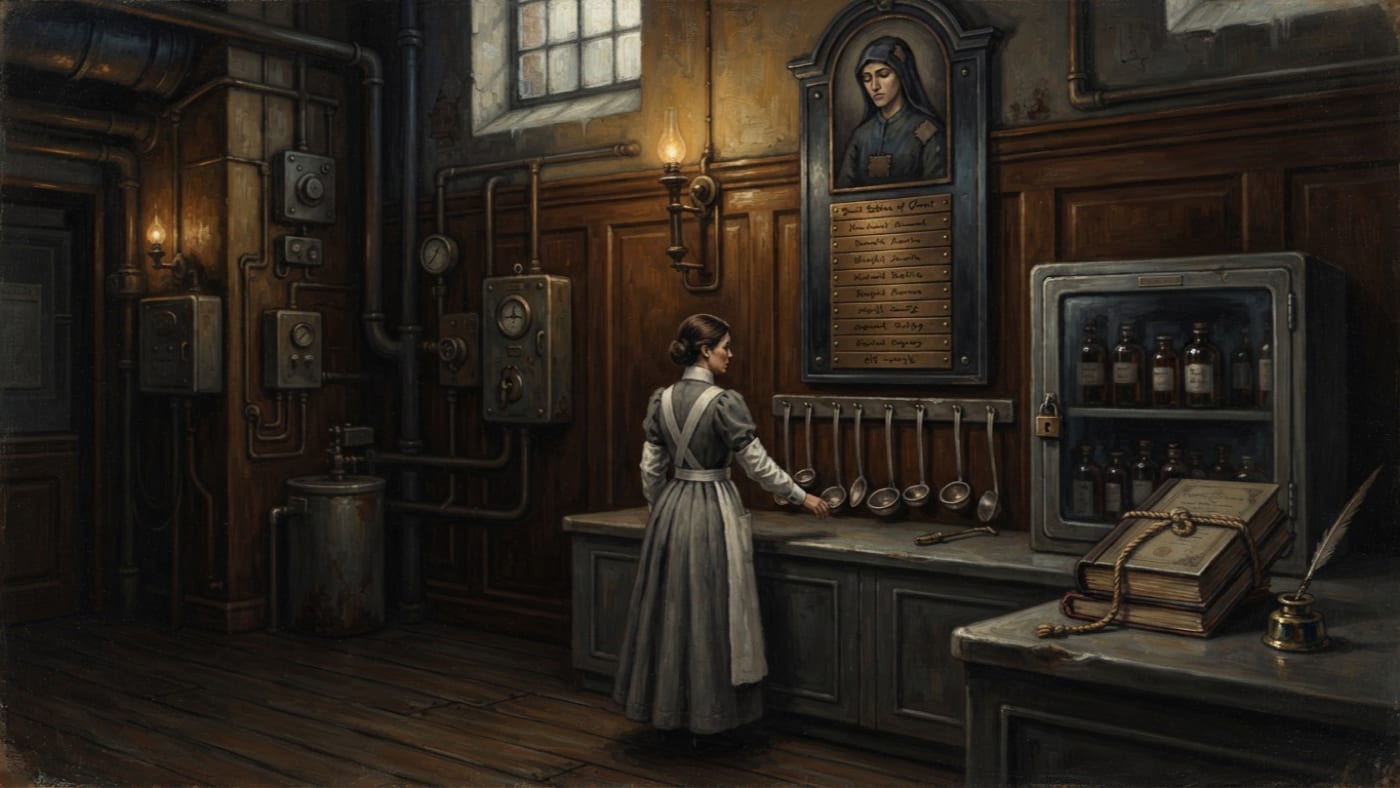
The present survey, conducted in A.S. 201, covers one memorial and the uses made of it. That memorial is the Eleven Bound: the names of the wounded pilgrims whom Saint Sabina of Ghent is reported to have bandaged after the Massacre at Saint-Malo, kept on ward-hall plaques, in a corrected copy among her relics, and in a recitation that the Bureau of Mercy prescribes for its novices. What follows is a survey of a memorial. It does not reconstruct the roster.
Start at the wall. The names are reported beneath hers, painted above ladle racks and morphine cabinets, where a Ward-Sister reaching for the measured spoon or the locked dropper must stand directly under them. The archive does not record who first compiled the list, when it was first written out, or which ward-hall first hung it. I have asked. The archive kept its usual silence, like a clerk who has never been made to sign anything.
#On the Bodies
The minimum facts are as follows. In A.S. 10 / 1720 CE a procession of forty-three pilgrims carried the Reliquary of Saint Matthias toward the Chapel of the Tide and was met at the Porte Saint-Vincent by Republican Guards bearing a lawful writ. The ratified tally is thirty-one dead, seven wounded witnesses who survived long enough to testify, and five consumed by the event or otherwise unaccounted for.
Sabina was among them. She was a seamstress from Ghent who served as the procession's bandage-keeper. She was not ordained, she had no surgeon's training, and she held no office in any Bureau, because none yet existed. She tore her habit into strips and reportedly bound eleven of the wounded. Three weeks later she died of fever, and five months after her death she was canonised. The Martyrology of Saint-Malo lists her in its witness annex rather than on its death roll.
The Eleven Bound and the seven witnesses are counted in different ledgers. One records where her hands went. The other records which mouths survived to swear. The sources do not say how far the two groups overlap. They do not identify four extra survivors, and they give no arithmetic to make eleven and seven agree. A reader who adds eleven to thirty-one and finds the gate overcrowded has mistaken a bandage for a census.
Earlier Mercy primers state that Sabina “saved eleven souls.”
Corrected, as the dossier on her already corrects it: she bound eleven bodies. Nor are the Eleven Bound to be read as eleven certified survivors. Elsewhere this Codex credits the Bureau with testimony "from eleven survivors," and that sentence sits beside a census of seven wounded witnesses. The census stands. The Martyrology stands. The sentence has been given its stamp of disgrace.
#On the Names Beneath Hers
The plaque does a simple thing. It hangs the saint above and the beneficiaries below, so that the names hold up hers like a plinth holding up a bust. I will not reproduce those names. This survey has not been supplied with them, and a memorial is not improved when a Hieromnemon invents its contents.
The dossier on Sabina reports three further details. Three of the bound later served the Bureau of Mercy. Two gave depositions that were used in her canonisation. A cooper from Dinan recanted a detail about the colour of her sleeves. These are three statements. They need not describe six different people, and nothing in the sources says which of these people, if any, were among the seven witnesses of the Martyrology.
The report of Mercy service needs a cold eye. The Bureau of Mercy was constituted in A.S. 92, eighty-two years after the cobblestones. The report gives no dates for that service, and the survey does not reconcile them with the charter. I leave the matter where the source leaves it. I will not supply long-lived grandfathers to make the dates fit.
The canonisation depositions also belong to their own time. They were given to an ecclesiastical tribunal during the hidden years, long before the Concordat of A.S. 90 had any Bureaus to constitute. When an older inventory says the Bureau of Records holds the testimony or the Bureau of Doctrine interprets it, that describes custody arranged afterward. The two witnesses did not testify before either Bureau. Mercy's claim to Sabina as founder is patronage, made in hindsight. Her work came first and the institution came later, and the plaque is built to blur that order.
#On the Two Hands
Sabina's relics are a modest set: strips of habit-cloth, a needle case, a finger bone, a grave-clod under glass, and a copy of the Eleven Bound list that bears corrections in two hands.
That is everything the published inventory says about the copy. It does not identify either hand or set out what was corrected. It does not date the copy, name the person who compiled it, or say where it is now kept. The habit-cloth is kept in Ghent under Mercy custody, but that fact concerns the cloth. The list has not been shown to keep the cloth company, and I will not pack it into the same glass case for the sake of tidiness.
Two hands prove that two people took up pens over one sheet. They do not prove forgery, a substituted name, or a secret resolution of the gap between eleven and seven. A correction is a disagreement written down, and every honest document carries a few of them. The ones without corrections are the ones worth suspecting.
The plaque, the corrected copy and the spoken recitation are three forms of one memorial. How the list passed from one form into another, which came first, and whether all three ever matched are not recorded. The survey records them side by side and draws no line between them.
#On the Novice's Lesson
The plainest evidence of how Mercy now uses the Eleven Bound comes from Mercy's own pen. It is an internal formation note from the Strasbourg Central Ward, dated A.S. 199.
Mercy Internal Formation Note, Strasbourg Central Ward, A.S. 199: “Novices respond strongly to Sabina materials when paired with triage obedience drills. Recommended sequence: image of torn habit; recitation of Eleven Bound; denial exercise; ledger reconciliation. ███████████████████████████████████ Excess empathy after third week to be redirected through documentation tasks.”
The note prescribes four steps in a fixed order. First the novice is shown an image of the torn habit. Next comes the recitation of the Eleven Bound. Then the denial exercise, and finally ledger reconciliation. The note also ties Sabina materials to triage obedience drills and directs that a novice's excess empathy, once it persists past the third week, be put to work on documentation.
The note does not say everything. It gives neither the wording of the recitation nor the procedure of the denial exercise. It sets no passing mark for either and names no penalty for failing. It shows a use made of the recitation in A.S. 199 without dating the recitation's origin, and the note neither invented nor revised it. Anyone who tells you the novices of Strasbourg chant a particular formula has heard it somewhere other than this note, and should cite where.
What the note does provide is the order of the steps, and I can read the order without help. A novice in a grey apron with white sleeve wraps is first shown the cloth that was given away, then made to say the names of those who received it. Next comes the exercise in withholding, and last the string-tied ledger, where bowls are matched to bodies, morphine drops to signatures and deaths to transfer tags, as the Ward-Sister's day ends in every licensed ward. The note puts these steps in sequence. It does not claim that reciting the names causes any withholding, and neither do I. I only note the route the novice is walked along: from Sabina's cloth to her names, then to the denial exercise, and finally to the ledger.
I will be blunt, because the note is blunt for me. A seamstress spent her own habit on strangers, and her institution has made those strangers into a drill. The Bureau calls this continuity. A cooper from Dinan might find a harder word, and then recant it.
#On the Present Use
This survey can attest the following. Sabina reportedly bound eleven wounded pilgrims at Saint-Malo in A.S. 10. The seven final witnesses form a separate tally, and their overlap with the eleven is unknown. Plaques bearing the recipients' names hang beneath hers in Mercy ward-halls. A copy of the list with corrections in two hands is among her relics. A Strasbourg formation note of A.S. 199 places the recitation between an image and a denial exercise.
Some things the survey does not attest. These include the names, the original compilation, the first display and the first recitation, any issuing seal, and any explanation for every pilgrim the gate failed to return. The five consumed by the event are not hidden among the Eleven Bound, and no plaque claims they are.
Sabina did the work in front of her and died of it. Mercy has hung the evidence on its walls, and it teaches the work with the lesson ending in the ledger.