
#On the Grey Apron
“Write the mercy, or it did not happen.” — Ward catechism (Unregistered), third response
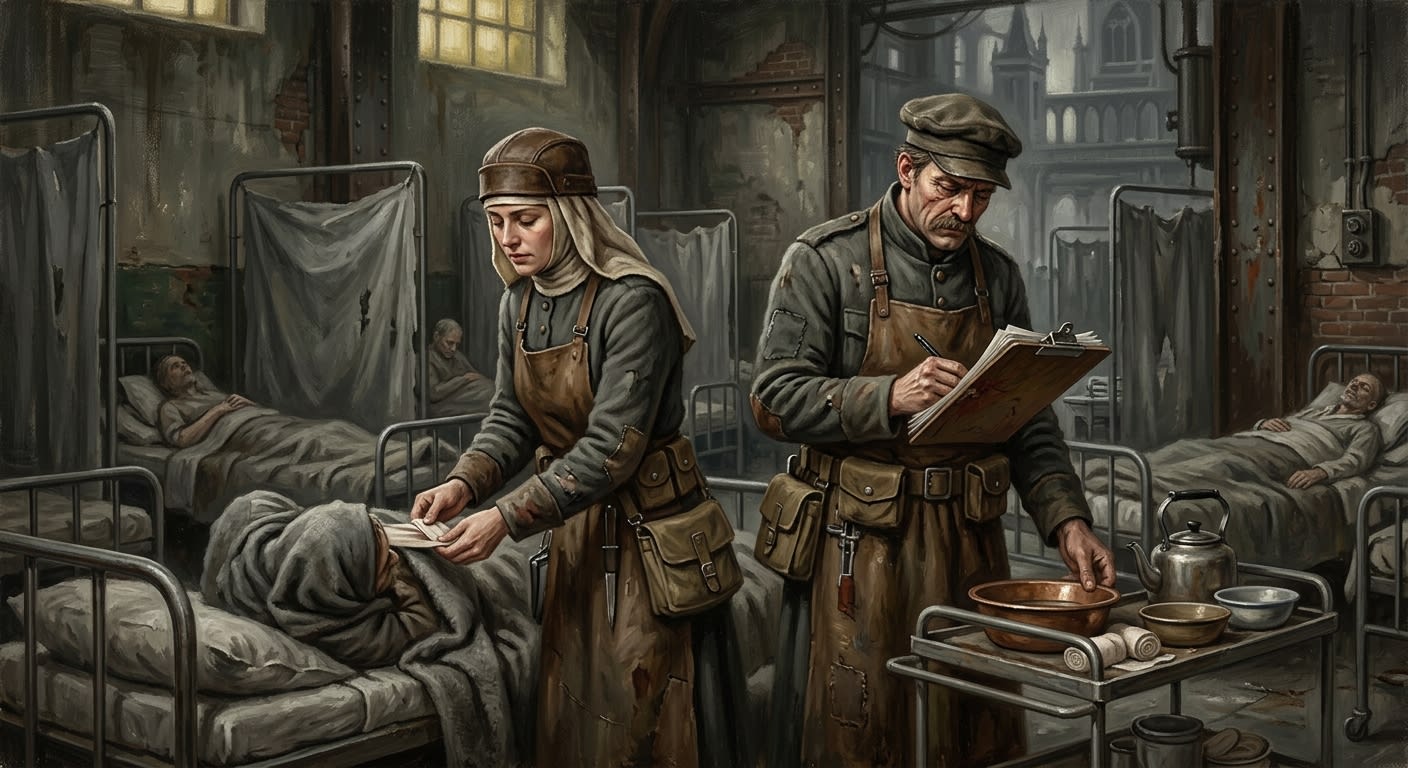
The Mercy Ward-Sister and Mercy Ward-Brother are the Synod’s sanctioned hand upon the fevered brow: nurse, rationer, washer, clerk, witness, gatekeeper, and, in certain corridors after midnight, the last warm creature between a human being and the black arithmetic of policy.
Do not be misled by the apron. The grey apron is no promise of softness. It is uniform, warrant, warning, and confession cloth. Beneath it stands one of the most dangerous minor officials in the Synod: a licensed servant of Mercy empowered to decide who receives broth, who receives linen, who receives morphine, who enters the clean zone, who waits in grey, who is carried behind the black screen where speech grows useful to Records and the body becomes a timetable.
Their station exists wherever the Synod’s bodies fail faster than Doctrine can explain: bastion infirmaries along the Sagittal Line, quarantine annexes, trench intake halls, broth-kitchens, Hospices of Departure, ossuary triage corridors, and the grey stone Mercy Wards where boiled grain, bleach, old blood, damp linen, paper dust, and exhausted prayer have formed an atmosphere so thick that even incense enters humbled.
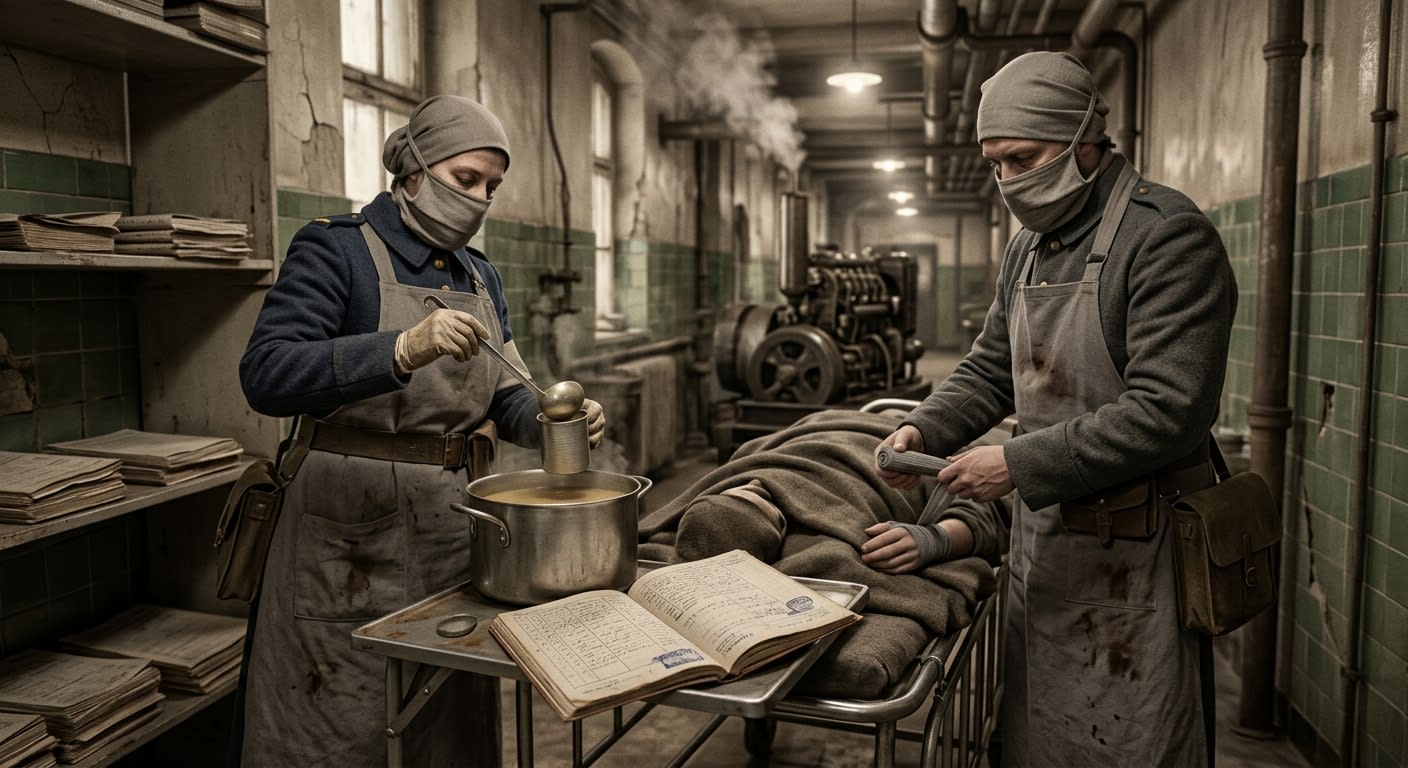
A Ward-Sister ladles broth. A Ward-Brother binds wounds. Both write. That last action is the office entire. Every calorie, every wash, every poultice, every prayer spoken according to schedule, every confession received before a fever took the tongue, every morphine drop surrendered from inventory into flesh: all must be entered in the string-tied ledger and sealed before shift-end. Compassion without record is indulgence. Indulgence without sanction is heresy. Heresy, as ever, simplifies the staffing problem.
#On the Origin of Counted Compassion
The Bureau of Mercy tells children that the Ward-Sister descends from Saint Sabina of Ghent, who bound pilgrims on the stones of Saint-Malo while Rationalist Guards reloaded. The story has merit. It has blood, cloth, tenderness, witnesses of uncertain employment, and a canonisation brisk enough to leave scorch marks on the registry.
Ward-hands, after salt-wine and sufficient distance from inspectors, tell the coarser truth. The office descends from panic.
Between A.S. 48 and A.S. 65, during the Great Retreat after the Sundering, disease ate the refugee columns with better discipline than the enemy. Cholera in wagon trains, typhus in winter camps, dysentery in forward depots, trench-fever in every ditch whose name survived long enough to be misspelled by a clerk. A camp without care became a riot within three days. A city that believed its sick had been abandoned became heretical within three weeks. The Mercy Ward was born because fear spreads through a population like bad doctrine through a university: eagerly, noisily, and with footnotes.
The early ward-hands were widows, field nuns, failed apothecaries, amputee orderlies, soup women, penitent surgeons, and priests who had discovered that a man bleeding from the belly prefers pressure to sermon. They saved lives with rags boiled in kettles, bandages stripped from shirts, ladles marked by thumbnail, and lists kept on crate wood. Then the Concordat of Strasbourg came. Then the Bureaus came. Then Mercy received its charter in A.S. 92, and the soft acts acquired hard edges.
Earlier devotional primers described the Ward-Sister’s office as “the spontaneous flowering of pious charity in the war-hospitals of the Great Retreat.”
Corrected: the office began as emergency crowd control under conditions of epidemic collapse, later sanctified because the Synod prefers its necessities perfumed.
The decisive change followed the Broth Riots of A.S. 112, when winter grain shortages across the northern bastions collapsed the Mercy supply chain and three garrison populations attempted, with admirable theological directness, to storm the granaries. The Bureau of War restored order with rifles. The Bureau of Purity restored silence with arrests. Mercy restored obedience with the Ledger Laws.
Every ladle counted. Every bandage measured. Every dose signed in triplicate. Every death stamped against a cot number. Need became classification. Clean received full allotment. Grey received enough to remain quiet. Black received “sufficient,” a word so thin one can see the skull through it.
#On the Day’s Labour
The Ward-Sister’s day begins before mercy has warmed its hands.
At Lauds she washes to the wrist: hands, nails, knuckles, the cracks where dried antiseptic hides and judgement begins. She counts ladles. She taps the ward bell once even if no bell-hour is due, for the old superstition says a broth pot that has not heard metal will go silent in the night. She recites the Mercy Line under her breath. Some say, “A fed body is an obedient body.” Some say, “If it is not stamped, it is not mercy.” The better ones say nothing and begin.
Morning is broth. The line forms before steam lifts: soldiers with trench-rot under their wraps, pilgrims coughing into ration cloth, children holding expired papers, mothers carrying infants too quiet for comfort, old men who have learned to groan in the register most likely to draw attention without attracting guards. The Ward-Sister speaks the approved consolations while counting ladles by measure. The ladle bears a stamp. The pot bears a seal. The ledger bears the names. The hungry bear everything else.
Midday is intake crush. Carts arrive from the trench roads. Families arrive from the quarter gates. Conscription sends boys whose lungs failed the march but whose papers still insist upon usefulness. Medicine sends memoranda no one at the desk has time to read. The Ward-Brother triages under a clerk’s gaze and a guard’s impatience: clean, grey, black; treat, hold, isolate, transfer, release, ossuary. He touches foreheads, checks gums, smells wounds, watches eyes for demon-glass flicker, and marks the tag before pity can interfere with penmanship.
Late day is reconciliation. Bowls to bodies. Morphine drops to signatures. Linen lengths to laundry returns. Deaths to tags. Confession packets to sealed tray. The clean zones are reset. The grey zones are reassessed. The black zones are scrubbed with a thoroughness that fools no one.
Night is when the ward tells the truth. Gangs offer clean cloth for morphine. Families beg at service doors. A soldier asks to be listed under his brother’s name because the brother has pension rights and he has none. A child asks for one more ladle. The Ward-Sister checks the form before she checks the face, and if she has been in service long enough, hates herself only after the line has moved.
#On the Three Zones
Every Mercy Ward is divided into clean, grey, and black. The architecture may vary — stone halls at Przemyśl, damp annexes at Shipka, overfull corridors in Marrowgate, converted barracks at Brest — but the moral geography does not.
Clean is for the recoverable. The clean patient receives full broth, measured draughts, decent linen, a cot whose stains have been defeated by bleach or replaced by darker stains of acceptable age. Clean-zone staff are watched by auditors because recoverable citizens cost money and produce statistics. A good survival rate pleases Mercy. A rate too good pleases no one, since it suggests either fraud, hoarding, or unauthorised competence.
Grey is for uncertainty. Grey holds the coughing man who may yet live, the fevered woman whose dreams contain names, the child with a rash that resembles a map, the soldier whose wound smells ordinary until the ninth bell. Grey saves the ward, as the ward-hands say, because compromise keeps the corridors from becoming confession pits.
Black is terminal, contagious, anomalous, politically inconvenient, or beyond allotment. Black-zone staff are either specialists, penitents, or people whose compassion has offended a supervisor. They carry hidden salt in apron seams and diesel rags beneath their masks. They do not speak loudly. They do not sing lullabies unless the ward bell is sounding, because several black-zone lullabies have later been identified, to general embarrassment, as unregistered melodies under Orison jurisdiction.
BLACK-ZONE INCIDENT REPORT, BASTION-████, A.S. 196: Broth pot fell silent during night outage. Patients in twelve cots woke simultaneously, reciting the same childhood prayer in voices belonging to their mothers. Four Ward-Sisters continued distribution. One wrote every word. The transcript remains sealed because the prayer included names absent from all natal registries.
The novice thinks the zones measure sickness. The veteran knows they measure cost.
#On Confession and the Useful Dying
No one enters a proper Mercy Ward without approaching confession. The clerk at the desk may not be a priest. The patient may not be conscious. The confession may be brief, coerced, interrupted by vomiting, or reconstructed from witness statement. It is still confession because the form says so, and the form has better standing than the body.
The Ward-Sister is trained to listen while working. A dying man mutters that his wife keeps coin beneath the hearthstone. A fevered girl names a brother erased by the Index Damnatus. A deserter confesses a false oath. A mother admits that the child beside her was never registered because the tithe would have taken him. The Ward-Sister wipes a mouth, changes a cloth, nods with such tenderness that even I, who know the machinery, have found myself momentarily moved. Her other hand writes.
Those packets move quickly. Records receives the names. Purity receives the suspicions. Tithes receives the hidden coin. Conscription receives the unregistered boy. Mercy files the act as pastoral care.
Standing instruction once directed Ward-Sisters to “comfort the dying so that the soul may depart unburdened.”
Current language reads: “facilitate voluntary disclosure in a pastoral context.” The pillow has not changed. The quill has been sharpened.
This is why soldiers love Ward-Sisters and fear them in equal measure. The hand that brings broth may ruin a family before dawn. The voice that says “rest now” may be taking dictation for the white-mantled men in the corridor. The profession’s kindness is real. Its consequences are also real. Adults should be capable of holding two facts without making a chapel scandal of it.
#On Fraud, Salt, and Other Tendernesses
Every ward contains two ledgers. One lies on the desk, string-tied, sealed, available to audit. The other lives in memory, favour, bribe, debt, glance, and the small criminal mathematics by which decent people remain decent inside an indecent system.
Ghost bowls are registered for patients who do not exist, so broth can be siphoned to those whom the schedule has abandoned. Split signatures blur responsibility when a morphine drop goes where mercy rather than allocation demanded. Recovery slips are backdated. Quarantine passes are delayed for families who need one more hour. Extra salt changes hands under the bandage cart. Clean linen, more precious than many relics and less honestly adored, vanishes into black-zone cabinets.
The Bureau calls this mercy fraud. The ward-hands call it breathing.
Corruption grows in the same cracks. A Soup-Snitch (Unregistered) sells confession scraps to a gang. A Pity-Clerk (Unregistered) withholds clean-zone tags until the family produces fuel chits. A Black-Zone Specialist learns that deaths can be misfiled profitably. A Quarantine Master (Unregistered) grants exemptions to the beautiful, the connected, the bribing, the useful. Mercy becomes a market, and the Bureau’s outrage becomes difficult to distinguish from professional jealousy.
Punishments are instructive. Demotion to black-zone. Public penance. Reassignment to trench infirmary. Immurement for audit-critical falsification. Erasure, in scandal cases where the Bureau must prove that compassion has boundaries and that those boundaries are load-bearing.
Yet the hidden bundle remains: salt, cloth, a sweet for the unexpected child. Every veteran carries one. If she denies it, she is lying; if she lacks it, she is already gone.
#On the Iron Sleeve
Ward culture divides itself into soft hands and iron sleeves.
Soft hands are novices: vow-takers, hungry daughters, repentant sons, widowers seeking useful grief, minor clerics reassigned after sermons too tender for Doctrine’s taste. They arrive believing that proximity to suffering will make them holy. This is corrected. First by smell. Then by paperwork. Then by the first body whose life depends upon a stamp the novice cannot find.
Iron sleeves have survived three years. Their apron straps have grooves in the shoulder. Their fingers are permanently inked. They can stop a broth-line riot with a voice, a stamp, and one perfectly timed exemption. They know which guard will accept linen, which auditor drinks, which boiler foreman can be bribed, which cough means ordinary death, which cough means seal the ward and pray the vents do not begin singing.
They joke about paper healing faster than poultice. They say clean hands lie. They say count your drops. They never joke about the black-zone lullabies.
The profession’s internal war is as old as the Ledger Laws. Mercy-first staff break policy cleanly, one lie at a time, and protect the ward from becoming a machine with lungs. Ledger-first staff believe the form is what prevents chaos, plague, riot, and Purity intervention, which is to say they are often correct in the most spiritually damaging way. Old ward hands despise new vow-takers. Clean-zone staff fear black-zone staff. Confession liaisons are tolerated the way one tolerates a necessary drain.
Burnout has its own posture. The voice flattens. The hand counts without looking. Bells make the shoulders flinch. Salt packets accumulate in drawers. Compassion remains, but only as a line item, legible, priced, and filed.
#On the Present Service
As of A.S. 201, seven hundred and twelve registered Mercy Wards operate across Synodal territory, with forty-three contested by Records on grounds of absent paperwork, vanished staff, impossible addresses, or the stubborn refusal of certain buildings to appear where their charters insist they stand. Mercy insists the wards exist. Records insists existence should submit quarterly proof. Both parties are right in the usual useless way.
Front-line wards along the Line run beyond capacity. Königsberg freezes its broth in transit. Brest treats trench-foot by the cartload. Przemyśl sends tunnel-crushed men and wire-burned boys. Irongate sends patients whose teeth vibrate after too many hours near the Gasket Choir. Shipka sends sleepers who wake older, younger, or speaking in last week’s voice. Constantinople sends everything.
Marrowgate remains the great inland mouth of the profession: casualty hub, quarantine court, civic triage mill, and warehouse of groans. Its Sanitation Chapter draws cordons. Its Civic Triage Tribunal argues whether illnesses are natural, doctrinal, suspicious, or budgetary. The clean paper plague of A.S. 199 exposed forged health certifications across the corridor and proved, for the nine millionth time, that a system built upon paper becomes diseased through paper first.
The Ward-Sisters continue anyway. The Ward-Brothers continue anyway. They ladle, wash, stitch, stamp, lie, confess, conceal, report, and endure. Their private mercy keeps the wards human. Their public ledger keeps the wards open.