
#On the Founding and Its Patron
"We tend the body that the soul may be tended. Separately. By Purity." — Founding charter of the Bureau of Mercy, A.S. 92
The Bureau claims as its patron Saint Sabina of Ghent, and I shall tell you about Saint Sabina, because the Bureau of Mercy and the truth have always enjoyed a complicated professional relationship.
Sabina — Sister Sabina, in the old records, before the Bureau of Records existed to corrupt them — was a seamstress from the Flemish lowlands who happened to be walking the pilgrim road at Saint-Malo on the morning of the tenth year After Sundering, when the Republican Guards decided that faith required a corrective delivered at bayonet-point. Forty-three pilgrims died on those cobblestones. Sabina, who was not a nurse and had never seen a wound deeper than a pricked finger, tore her own habit into strips and bound the dying while the Guards reloaded. She saved eleven. She buried the rest with her bare hands. She caught a fever from the grave-dirt and died three weeks later in a hospice that could not afford candles.
The Bureau was formally constituted in A.S. 92 alongside the first wave of Synodal administrative organs, two years after the Concordat of Strasbourg fused civil and spiritual power into a single grinding apparatus. Its founding charter bears the seals of the Bureau of Doctrine and the Bureau of Records jointly — Doctrine for the spiritual authority, Records for the administrative infrastructure, and Mercy for the claim that the Synod cared about suffering at all. The charter's language is instructive. It does not promise to heal. It promises to "administer the body so that the soul may be returned to Order." The distinction between administration and healing is one the Bureau has spent two centuries declining to clarify.
The true origin, as any ward-hand will tell you after enough salt-wine, lies in the trench pandemics of the Great Retreat. Between A.S. 48 and A.S. 65, while the remnants of the Church staggered westward from the shattered Balkans, disease killed more refugees than the Sin-Generals' armies. Cholera in the wagon trains. Typhus in the camps. Dysentery in the supply depots. The nascent military command discovered that fear kills faster than infection — that a camp without medical care becomes a riot within three days, and a city without visible compassion becomes a heresy within three weeks. The Mercy Ward was born as a pressure valve. Care and surveillance, administered through the same hand, recorded in the same ledger.
#On the Substance of Mercy
The Bureau of Mercy oversees orphanages, hospitals, quarantine wards, asylums, Hospices of Departure, field infirmaries, and the continent's broth-kitchens — every institution where the Synod's subjects are at their weakest and therefore most in need of documentation.
I shall describe the system plainly, because the Bureau's own literature wraps it in such quantities of sanctified language that one risks drowning in holy syllables before reaching the operational reality.
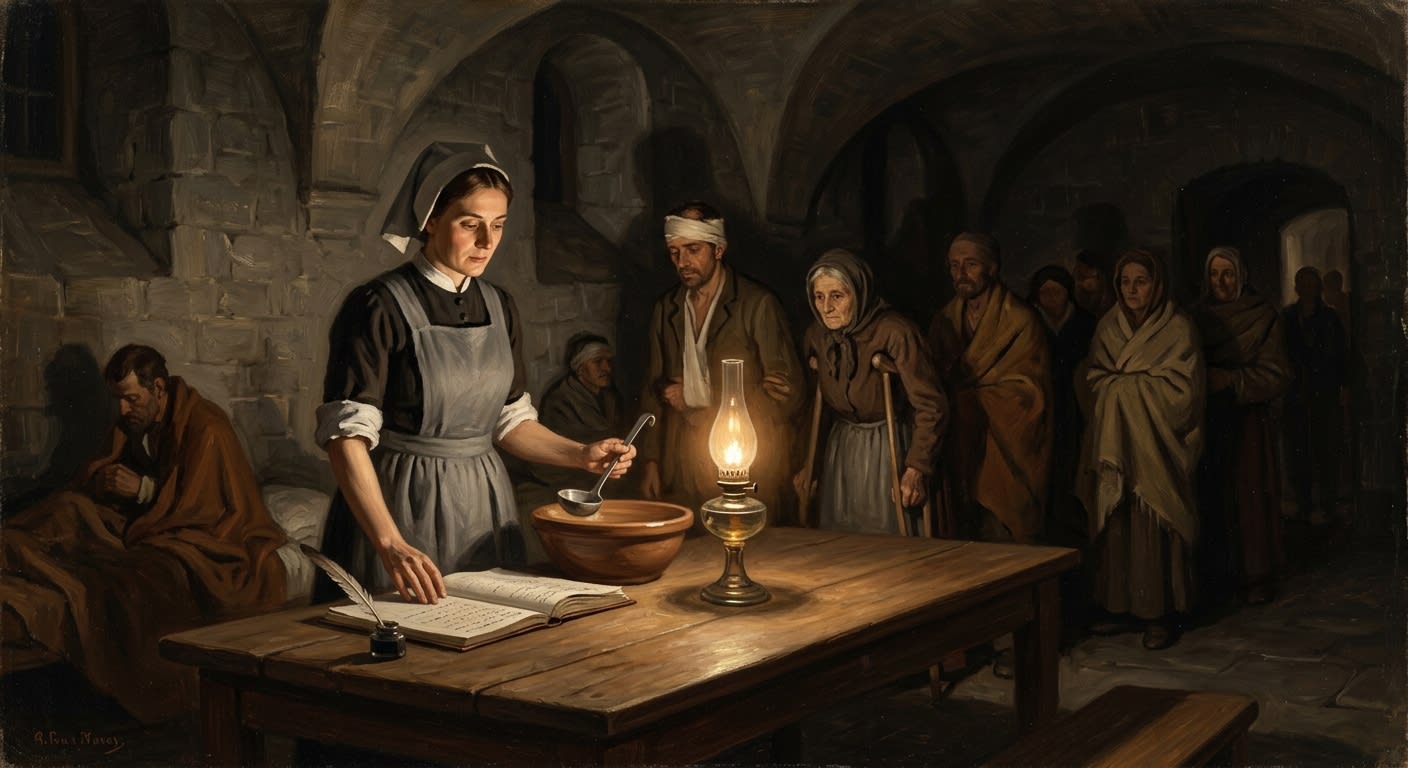
A citizen falls ill. The citizen presents at a Mercy Ward — grey stone, bleach-scrubbed, the smell of boiled grain and old blood so deeply worked into the walls that no amount of incense can mask it. The citizen joins the Queue of Confession. This is mandatory. No one approaches an apothecary, a surgeon, or a broth-ladle without first confessing aloud to a clerk. The clerk is not a priest. The clerk is a Bureau of Records functionary in a grey apron with ink-stained fingers and a string-tied ledger book. The confession is transcribed. The transcription is filed. Those deemed insufficiently repentant are turned away, their wounds classified as "Heaven's rightful chastisement" — a diagnosis that requires no medicine and generates no expense.
Those who pass the confession are triaged. The Ward-Sisters and Ward-Brothers — the Bureau's foot soldiers, grey-aproned and white-sleeved, masks during bell-hours, corded badges at their hips — sort the sick into three zones. Clean: recoverable, deserving of resources. Grey: uncertain, held for observation, fed enough to prevent complaint. Black: terminal, contagious, or otherwise beyond the Bureau's interest. The black zones are staffed by those who have either committed professional infractions or been judged insufficiently orthodox in their compassion. The assignment is understood as punishment. The ward-hands call it "the mercy that costs."
Treatment proceeds. Broth is ladled with measure-marked ladles — each ladle counted, logged, and reconciled against ration chits at shift's end. Wounds are bound with cloth counted by the inch. Morphine drops are administered under double-signature protocols so stringent that a dying man may wait forty minutes for his relief while two bureaucrats locate the appropriate stamp.
The medicines themselves are consecrated. Prayers precede the draught. Confession precedes the bandage. A tithe — calculated against the patient's registered income and adjusted for spiritual credit — precedes the cure. The Bureau's apothecaries are not merchants but ministers; their tinctures are prepared under holy seal. To receive treatment is to reaffirm allegiance. To be refused treatment is to receive instruction.
STAMPED ERRATUM — Bureau of Mercy, A.S. 199. A previous circular described the Bureau's ward survival rate as "eighty-seven per cent, adjusted for doctrinal factors." The adjusted figure reflected the exclusion of black-zone patients from the denominator. The unadjusted figure is forty-three per cent. The Bureau considers both figures accurate, depending on the theological context in which they are cited.
#On the Trial of the Withheld Draught
The Bureau's most distinctive practice — and the one most frequently cited by its critics, all of whom have been reassigned to positions where citation is difficult — is the Trial of the Withheld Draught.
For severe illnesses, the first prescribed medicine is not administered. The patient is informed that endurance is the first stage of healing, that the body must demonstrate its willingness to recover before the Synod wastes resources on the attempt. One more night of suffering. One more fever-wracked dawn. The patient prays. The patient sweats. The patient calls for water, and water is provided, because the Bureau is not a monster — the Bureau is merely an institution that has calculated that a patient who survives one night without medicine is a patient who was going to survive anyway, and a patient who does not survive was going to die regardless, and therefore the medicine was never necessary, and the inventory is preserved for someone whose survival the Synod considers more strategically valuable.
The medicine, when finally administered on the second day, is framed as a "miracle of endurance." The patient's gratitude is genuine. The Bureau's saving on pharmaceutical inventory is also genuine. Both facts coexist in the same ledger.
#On the Hospices of Departure
When the aged or infirm can no longer serve — when the body has given all its labour, all its tithes, all its prayers, and all its children to the Synod's apparatus — they are taken to the Hospices of Departure.
I will describe this without ornament, because the thing itself requires none.
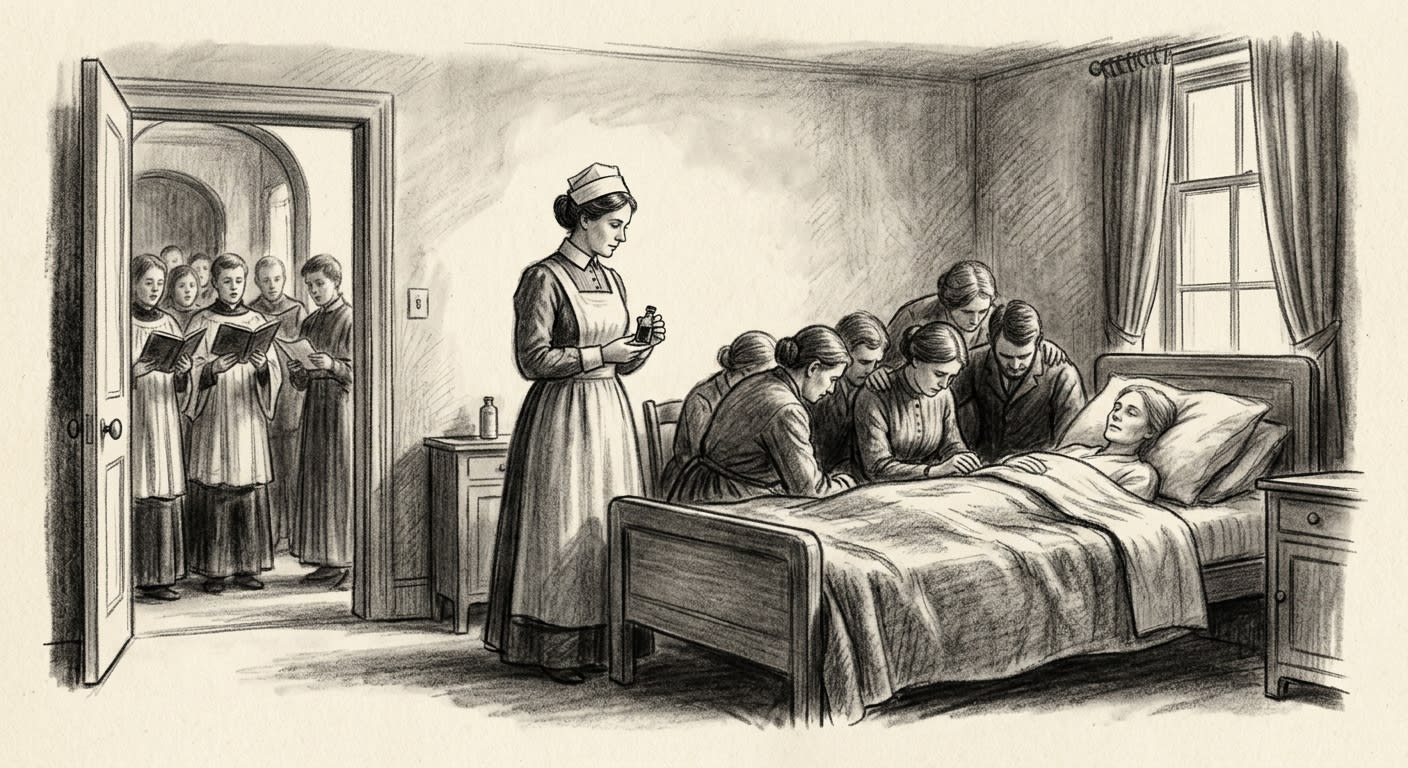
The Hospices are clean. The beds are crisp. The staff are gentle, and their gentleness is real — the Ward-Sisters assigned to Departure duty are the Bureau's best, and they know it, and they weep, and their weeping is logged as "devotional overflow, Category Seven." Choirs sing. Families gather. The patient is given a final meal — better than anything they have eaten in years, because the Bureau's Departure rations are funded from the same budget as the Hierarch's table, a fact that would be obscene if the Bureau did not insist it was beautiful.
Then the elixir. Bitter. Black. Officially, it "frees them to Heaven." The Synod's catechisms teach that the aged body, having fulfilled its covenant, deserves the mercy of release. The families believe this. Many of the staff believe it too.
The Bureau of Mercy's internal accounting classifies the Departure programme under "Resource Optimisation — Terminal."
I have signed the Departure authorisations. I sign them quarterly, alongside the Seal of Doctrine's countersignature. The process is efficient. The process is compassionate. The process is both of these things, simultaneously, without contradiction, because the Bureau of Mercy does not permit contradiction.
#On the Orphanarii
The Bureau's jurisdiction extends, naturally, to the young. Orphans of apostates, orphans of heretics, orphans of those the Bureau of Purity has reassigned to permanent silence — all are gathered into the Mercy Orphanarii, where they are raised in the catechism with a thoroughness that borders on the surgical.
The Orphanarii are not cruel. I wish to be precise about this. The children are fed. They are clothed. They are educated. They pray at the appropriate bells, sleep at the appropriate hour, and receive the Sacraments with the regularity the Synod demands of all its subjects. They are also separated from any knowledge of their parents' names, their parents' crimes, and their parents' existence. The Bureau of Records files the parents under Administrative Dissolution. The children are issued new natal registration writs as if born without history.
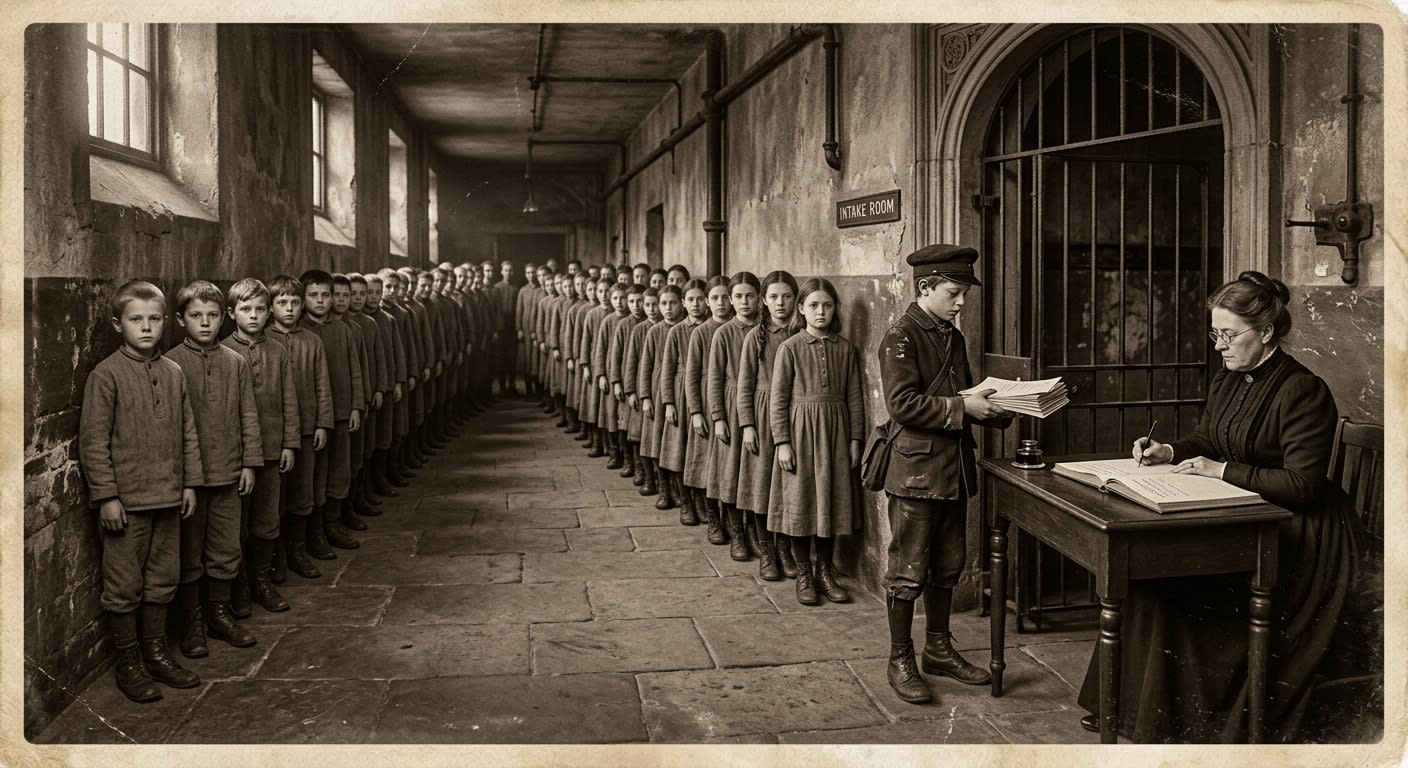
The Index Damnatus Runner Corps carries daily amendment strips to the Orphanarii — names freshly condemned, names to be erased from every document, every lesson, every child's memory. A Registrar stands at the gate each morning and revises the rolls. The children learn, by the age of seven, that names are things the Synod giveth and the Synod taketh away.
The Bureau regards its Orphanarii as proof of the Synod's compassion. The Bureau's critics — scattered, silenced, or reassigned — regard them as something else. Both positions are filed in the appropriate ledgers.
#On the Ward-Sisters and Ward-Brothers
The Bureau's operational backbone is the Mercy Ward-Sister and Ward-Brother — the grey-aproned, white-sleeved, ink-fingered saints of the bastion corridors and the trench infirmaries, who ladle broth that tastes of ash and salt, bind wounds with cloth counted by the inch, speak the approved consolations while their other hand writes, and log every calorie, every prayer, every confession, and every death with the devotion of monks copying scripture and the accuracy of clerks auditing a granary.
They are licensed under Synod vow — registry stamp, grey apron, string-tied ledger, the tools of sanctioned compassion. Their patron is Saint Marrow-of-the-Ladle, depicted in popular devotional woodcuts pouring broth into a helmet like a chalice. Whether Saint Marrow existed is a question the Bureau of Doctrine has answered with the word "canonically," which is the Bureau's way of saying "the question is settled and also the answer is classified."
The Ward-Sister's day begins at the Bell of Lauds with a wash ritual — hands, wrists, nails — then broth-line management. She speaks the ward catechism while counting ladles. At midday the intake surge arrives: trench carts, coughing pilgrims, families clutching papers that expired two checkpoints ago. She triages under a clerk's gaze and a guard's impatience. By late afternoon she reconciles the ledgers — bowls matched to bodies, morphine drops matched to signatures, deaths matched to transfer tags. The clean zones are reset. The grey zones are reassessed. The black zones are not discussed in the corridor.
At night the wards acquire a different character. Families beg at the doors. Gangs broker medicine for favours. Staff trade exemption stamps for fuel or silence. The bell-hours mark the passage of time through suffering that does not pause for liturgical convenience. Someone whispers "one more ladle" and the Ward-Sister checks the form before she checks the face.
The hierarchy runs from Rag-Hand and Broth Runner at the bottom — those still young enough to believe mercy is free — through Ward Attendant, Stitcher, and Intake Sister, up to the Ward-Sister proper with full stamp authority, and beyond to the Quarantine Masters and Black-Zone Specialists and Confession Liaisons who occupy the institutional territory where healing ends and intelligence-gathering begins. At the top sits the Mercy Prefect, who answers to the High Synod and who has not, to my knowledge, visited an actual ward since the last century.
#On the Broth Riots and the Ledger Laws
The Bureau's transition from charitable impulse to bureaucratic machinery occurred during the Broth Riots of A.S. 112 — a winter in which grain shortages across the northern bastions collapsed the supply chain, the Mercy Wards ran dry, and the populations of three garrison cities attempted to storm the Bureau's granaries simultaneously.
The riots lasted eleven days. The Bureau of War restored order. The Bureau of Purity restored silence. The Bureau of Mercy restored something far more permanent: the Ledger Laws.
Every ladle would henceforth be counted. Every bandage measured. Every dose of morphine signed for in triplicate — once by the administering Ward-Sister, once by the supervising Intake Clerk, once by a Bureau of Records observer stationed in the ward for that express purpose. Rations would be allocated not by need but by registration category. Clean-zone patients received the full allocation. Grey-zone patients received seventy per cent. Black-zone patients received what the allocation schedule described as "sufficient" — a word that, in the Bureau's vocabulary, carries no measurable nutritional content.
The Ledger Laws transformed the Bureau from a collection of exhausted nurses into an administrative organism of continental scale. Every Mercy Ward from Bastion-Königsberg to Bastion-Constantinople now operates under identical protocols. Identical broth recipes. Identical confession intake forms. Identical death-stamp procedures. Identical ratios of clean cloth to registered patients. The system is, by any measure, efficient. The system saves lives. The system also reduces lives to line items in a ledger, and the Bureau has never troubled itself over which of these outcomes is the primary function and which is the by-product.
#On the Deathbed Confessions
The Bureau's most contested practice — contested in whispers, in locked rooms, among people who know that contesting it openly would bring the Bureau of Purity to their door with an expression of pastoral concern and a set of manacles — is the curation of deathbed confessions.
A person dies in a Mercy Ward. In the last hours, as the body fails and the mind loosens its grip on the careful obediences of a lifetime, things are said. Names are named. Sins are confessed that were never confessed in the regular confessional — because the regular confessional is monitored by the Bureau of Doctrine, and these sins are of the kind that the Doctrine does not forgive. Affairs. Doubts. Heresies whispered in the dark. Children born without registration writs. Money hidden from the Bureau of Tithes. Oaths sworn to the wrong authority.
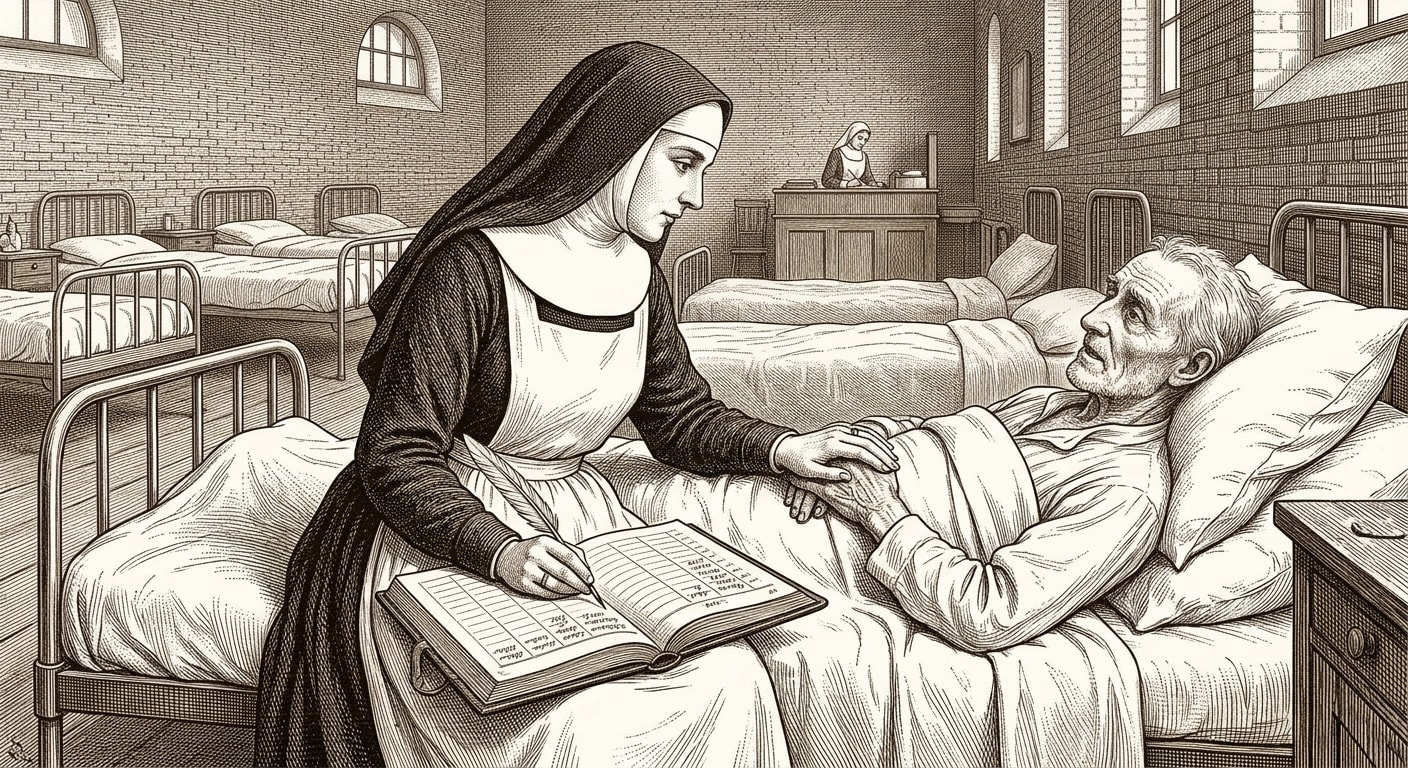
The Ward-Sisters listen. The Ward-Sisters write.
The transcription is forwarded to the Bureau of Records before the body is cold — often, in busy wards, before the body has been removed from the cot. The Records file the confession under the deceased's natal registration number. The relevant bureaus are notified. If the confession implicates the living, the Bureau of Purity receives a sealed packet. If the confession implicates the deceased's family, the Index Damnatus may receive an amendment strip by morning.
STAMPED ERRATUM — Bureau of Mercy, A.S. 198. A previous policy memorandum instructed Ward-Sisters to "offer spiritual comfort during the final passage, encouraging the dying to unburden their souls in the presence of Heaven's witness." The phrase "encouraging the dying to unburden" has been revised to "facilitating voluntary disclosure in a pastoral context." The operational procedure remains unchanged.
The Bureau's defenders — of whom I am, technically, the most prominent — argue that deathbed confessions serve the salvation of the departing soul. The dead, having confessed, enter the Ledger clean. The living, having been warned, may be corrected. The system is compassionate at both ends.
The Bureau's critics mutter that every dying person in the Synod's care becomes an intelligence source whose final act of surrender is transcribed, filed, and weaponised against their family.
Both positions are correct. The Bureau of Mercy does not trouble itself with the distinction.
#On the Present Condition
The Bureau of Mercy operates seven hundred and twelve registered wards across the Synod's territory as of the last annual census — a number the Bureau of Records disputes, since forty-three of those wards have not submitted paperwork in over a decade and may, in the Bureau of Records' professional opinion, no longer exist. The Bureau of Mercy insists they exist. The Bureau of Mercy always insists, because an empty ward on the books is still a line item in the budget, and a line item in the budget is an allocation, and an allocation is power.
The front-line Mercy Wards — those within the bastion complexes and the forward trench systems along the Sagittal Line — operate under permanent strain. The Bureau of War's "fortified broth," which the Bureau of Mercy endorses and the soldiers describe with language I shall not commit to the sacred page, is the primary nutritional instrument. Disease kills more soldiers than the enemy in most sectors, a statistic the Bureau of War disputes and the Bureau of Mercy documents with the quiet satisfaction of an institution that knows its ledgers are more accurate than its rival's.
Marrowgate — the inland medical port established A.S. 72 in the Würzburg corridor — serves as the Bureau's largest triage hub. The Sanitation Chapter, constituted A.S. 78, maintains quarantine cordons of escalating severity. The Civic Triage Tribunal, seated since A.S. 83, adjudicates disputes between patients, Ward-Sisters, and the Bureau of Purity over the classification of illness as "natural," "doctrinal," or "suspicious." The "clean paper plague" of A.S. 199 — in which systematic fraud in health certifications was uncovered at Marrowgate — exposed the Bureau's reliance on paperwork as both its greatest strength and its most fundamental vulnerability. When the ledgers lie, mercy lies with them.
The Ward-Sisters still ladle broth. The Ward-Brothers still bind wounds. The ledgers still record every calorie, every prayer, every confession extracted from the dying. In the black zones, the staff still carry hidden salt bundles in their apron seams — the private mercy stash that keeps them human, unrecorded, unsanctioned, and absolutely necessary.