
#On the Northern Crest
"Both functioned. Both saved convoys." — The surviving account of the First and Second Lights, as entered in the founding record of Third Light
First Light was a signal tower on the northern crest of the Carpathian Beaconchain. It was one of the first two relay stations raised above the passes that supply Bastion-Przemyśl, and it has about two years of documented service. Where anyone remembers it, it is remembered as the first number in a sequence whose third member now has a hamlet, a Loghouse and its own entry in this Codex. First Light has a paragraph. I have read the paragraph many times, and it does not get any longer.
Its position was the whole of its argument. A tower on a crest can see down both faces of a ridge. A convoy climbing from the valley staging grounds cannot see past the next switchback, and a mule does not care what waits beyond it. From the northern crest, a keeper could see weather gathering and could tell whether a road was open or blocked. He could then signal what he saw down to the mid-ridge saddle, where Second Light stood. That made two towers on one sightline. It was a modest arrangement, but on a mountain where the alternative was guessing, it decided whether a convoy arrived or became an entry in a loss register.
There is a difference between a light and what a light permits. A lantern burning on a crest is only a lantern, and any wagon-master may read it however he likes. A signal is an instruction, and an instruction implies some authority that will answer for it later. First Light was raised while the frontier already had lanterns and was still building that authority.
#On the Convoy and the Raising
In the winter of A.S. 72, which is 1782 by the common count, a convoy left the low valley staging grounds for Bastion-Przemyśl and never arrived. The surviving account lists its contents with a clerk's affection: eleven wagons, three hundred mules, grain, lamp oil and fourteen crates of consecrated ammunition. The passes took it, and nothing in the passes gave it back.
The account says that searchers found the mules three weeks later, alive and standing in a circle. The men were gone and so were the wagons. The cargo seals lay scattered, and every one was unbroken.
I set those sentences down as they reached me and add nothing to them. The Carpathians offer plenty of candidates for whatever takes eleven wagons and leaves the animals. The file names none of them, and I decline to improve on the file.
At that date the Line was defensible but incomplete. Its bastions held, its practices were still being standardized, and it was still learning, one loss at a time, which of its supply roads it could not watch. The wartime authority now catalogued as the Bureau of War did what such authorities do and commissioned a survey. The surveyors went up into the passes, examined the ridges and recommended towers.
This is the only survey recommendation in the archive that was carried out with anything close to haste. By A.S. 74, First Light held the northern crest, Second Light held the saddle, and both were operational. Between the commission and the first lit lantern lie two years, a ridge and an unrecorded quantity of stone. Men carried that stone uphill, and nobody counted their names as part of the cost.
#On the Work of the First Light
The account records what First Light achieved in four words, and I put them first because they deserve it: both saved convoys. No tally survives. Nobody recorded how many convoys were saved, which ones they were, or what they carried. The archive keeps exact counts of everything it can tax. It keeps no count of the men who reached Bastion-Przemyśl alive because a lantern on the northern crest told them to wait an hour.
The work itself can be described from what the wider network did. Beacon chains of this kind passed messages from tower to tower along a sightline: route clearances, storm warnings, convoy permissions and timing. The master lore adds that the chains were lit in sequence when Abominations stirred. A crest station saw the weather and the road first and passed that word along. The trade is simple to describe and miserable to perform. Keepers carried lamp oil up by hand, cleaned their glass in wind full of grit, and kept watch through long hours in which nothing happened, for the sake of the one hour in which something did.
The account does not say whether First Light burned a relic-lantern, a plain oil lamp or a fire in an iron basket. It had no bell-signets, which arrived in A.S. 89, thirteen years after First Light stopped needing anything. If it kept logs, they came before the procedures standardized in A.S. 82, and none have reached my desk. Its keepers wore no oath-collars. No clerk on that ridge has had that mercy since A.S. 94.
The station had no recorded master, no count of the lives it saved and no surviving log entry, and it still did the job it was built for. The Church owed it one sentence of credit. The account pays that sentence once and in full.
#On the Storm of A.S. 76
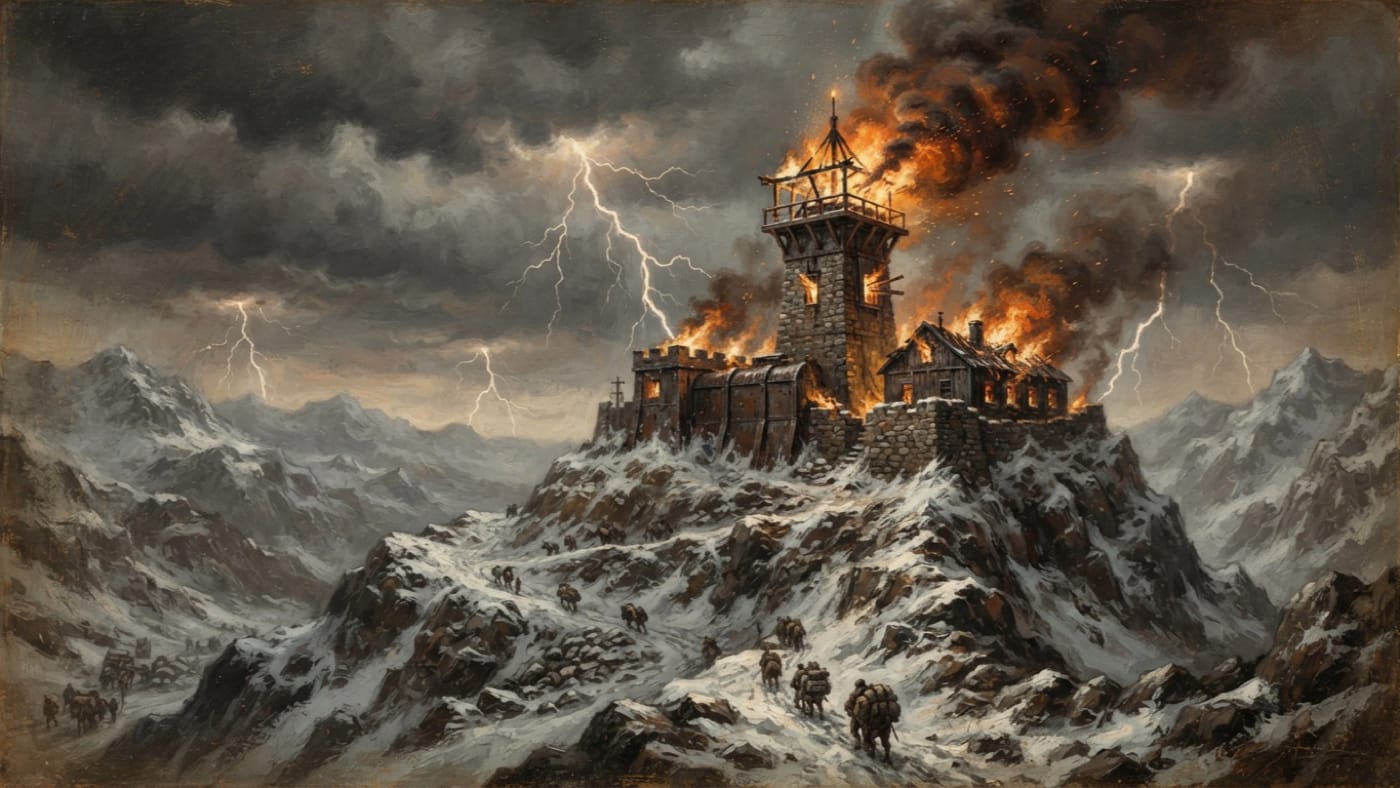
In A.S. 76, a single lightning storm destroyed both towers. The account is exact about one detail and silent about the rest: the storm came from below the ridgeline.
Mountain men say weather climbs. Clerics say lightning falls. On a Carpathian ridge both may be true at once, and the record does not settle which one applied that day, or that night, since it does not give the hour. It records only the direction. That direction was wrong for towers designed on two assumptions: that danger comes over the crest, and that the sky stays above the lantern.
First Light burned, and Second Light burned on its saddle in the same storm. The account does not say which tower burned first. It also leaves out how many keepers were on the crest, who reached the valley and who did not, and what was carried out of the ash. I record the missing casualty roll as missing. A file that names no dead has not proved there were none. A Warden of the Sacred Ledger who supplied a figure would be lying in a register that will outlast him by centuries, and I prefer to tell my lies in shorter-lived documents.
There is an institutional difficulty here, and the Church has always handled it the same way. The towers were commissioned to protect convoys under the authority of a Church at war. Such an authority cannot easily admit that one storm knocked its protection off a mountain. It can, however, build higher. Usefulness goes into the ledger as an achievement, and failure goes in as the reason for the next appropriation. Both entries are true, but only the first ever gets gilded in the presentation copy.
The storm did prove one thing, and the next builder took it seriously. A tower on a ridge is a lightning rod with a congregation at its foot.
#On What Followed
Third Light was built in A.S. 77 on higher basalt, with grounding chains sunk forty feet into the rock. Someone had read the account of A.S. 76 with professional attention. The new station became the sightline nexus of the network. On a clear day it can see both the northern passes and the southern switchbacks, which First Light never could, and which a chain that had lost its first link badly needed. Second Light was rebuilt on its saddle in A.S. 79.
Then the paperwork arrived. Log procedures were standardized in A.S. 82 and bell-signets introduced in A.S. 89. The formal Synod was constituted in A.S. 90, after which the Bureau of Records and its sister bureaus held the frontier's memory under seals of the present form. Oath-collars for clerks followed in A.S. 94. Every one of these reforms now operates on the ridge at Third Light, which has four hundred-odd souls, its own fog, and enough trouble for a volume of its own. None of them was ever installed at First Light, because First Light had already burned.
The record stops here. It says that Third Light was built and that Second Light was rebuilt, and it says nothing more about the northern crest. A rebuilding that nobody recorded has not thereby been disproved. A silence in the register does not prove abandonment either. I have handled too many stations marked abandoned that were burning lamp oil at the time of marking.
Until someone climbs to the northern crest and reports in writing, First Light stays in the Ledger exactly as the account leaves it. It was commissioned after a loss, operating by A.S. 74, useful while it stood, burned in A.S. 76, and replaced by a tower that learned from it. That is more of a record than most towers get.