
#On the Matter of Vienna's Bells
"Vienna's bells broke the Rationalists; the walls merely kept accounts."
I am Valerius Drax, and I will tell you of a siege that lasted nine months, claimed the lives of forty thousand souls by conservative reckoning, and produced a single myth worth more to the Synod than all forty thousand combined. Callousness? No. Accountancy. The Bureau of Records, which keeps the dead in columns and the living in footnotes, would agree.
Vienna in the year 95 was not the Vienna of the old world — that city died in A.S. 45, when civil order collapsed and Rationalist councils vanished mid-sentence from their own minutes. The Vienna of 95 was a carcass with a garrison, a ring of crumbling fortifications held by men whose faith was the only material harder than their bread. They had endured the Black Procession of A.S. 30, when Rationalist elites burned saint-effigies in the boulevards and the fires gave no warmth. They had survived the Year Without Dawn. They had witnessed the Collapse.
They were, in a word, hardened. And they would need to be.
#The Convergence
Earlier editions of this Codex attributed the siege solely to Rationalist military remnants.
This is false. The assault of 95 was a convergence — Rationalist artillery wedded to daemonic sorcery in a union the Bureau considers both blasphemous and, from a tactical standpoint, regrettably effective. The forces of the Adversary pressed eastward while Rationalist holdouts, desperate and stripped of all pretence at secular virtue, bartered with powers they had spent two centuries denying existed.
The besieging host arrived in spring. Rationalist batteries, hauled across the Carpathian passes by conscript labor, ringed the city's southern approaches. From the east came something worse: the daemon-cultists of the marches, led — if "led" is the word for cattle driven by a storm — by the sorcerer-lord Althazar of Pest, a figure whose name the Bureau has since attempted to expunge from three separate indices and failed each time.
For nine months, the garrison endured what the Bureau's own after-action filings describe, with characteristic understatement, as "sustained privation." Famine stripped the horses first, then the dogs, then the pigeons. Plague followed, bred in the cellars where the wounded were stacked like cordwood. Artillery shattered the outer walls by the third month. By the sixth, the defenders were fighting in the rubble of their own cathedrals.
#The Blow of Saint Rupert
What happened next is the most celebrated and least verified event in the Synod's founding mythology. I shall record it as the Bureau records it, which is to say: with conviction undimmed by evidence.
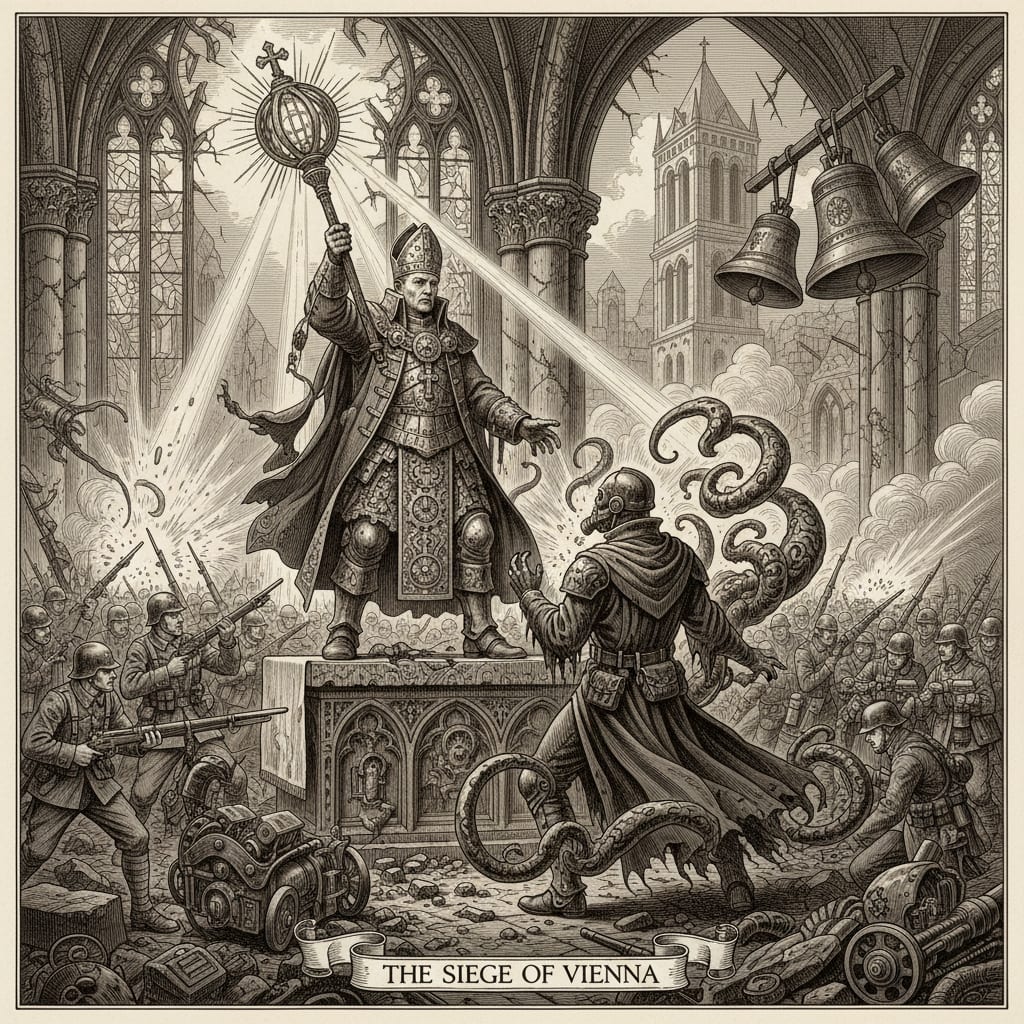
On the two-hundred-and-seventy-first day of the siege, Althazar breached the inner wall. His sorceries cracked stone as a child cracks an egg — less by force than by a whispered obscenity against the material itself. The garrison fell back to the cathedral of Saint Rupert, the last defensible position, where the altar still stood among the wreckage of the nave.
Bishop-Warden Clemens Stahlhand — and here even I, Drax, who trusts no hagiography he did not write himself, must pause — took up the reliquary mace of Saint Aldebrand. The same reliquary, I note, that the Rationalists had once declared to be pig bone in their pamphlets of –32 A.S. The same reliquary the Bureau had subsequently ruled "never existed." The same reliquary that now, by miraculous coincidence, blazed like a sun in the Bishop-Warden's fist.
Clemens struck. One blow. Witnesses — and here I use the term loosely, for men half-dead of plague and famine are not the Bureau's preferred deponents — swore that the impact "rang the marrow of the earth itself." Iron split. Skulls cracked. Althazar, who had walked through artillery fire without flinching, recoiled as though struck by something older and less negotiable than a mace. Demons scattered into ash-clouds. The cathedral bells, dislodged by months of bombardment, began to toll of their own accord.
Or so it is said.
The official record of the Bureau of War states the siege was broken by "conventional counterattack aided by fortuitous structural collapse."
The Bureau of Doctrine disagrees. The blow was miraculous. The collapse was providential. The bells rang because Heaven commanded them. The Bureau of War's assessment has been filed in the appropriate archive, which is to say, the furnace.
#The Aftermath
Vienna survived. Reason did not. The Rationalist order, which had clung to its last capital like a drowning man to flotsam, shattered in the streets. Their councils scattered. Their ledgers burned with their bodies. Their artillery, so meticulously calibrated, fell silent — powder remained; the will to fire it did not.
From Vienna's salvation — miraculous or "merely effective," depending on which Bureau you consult — poured the authority that became the Concordat of Strasbourg. The world had watched a garrison of starving believers break a sorcerer-lord with a bone in a box. If that fails as a mandate from Heaven, then mandates do not exist, and I have wasted a career in forgery.
The sealed testimony of Clemens Stahlhand, taken three days after the blow, contains passages the Bureau has never released. Seven lines are obliterated. The eighth reads: "It was not I who struck." The Bureau classifies this as "battlefield confusion." I classify it as ████████████ and have said nothing further on the matter since A.S. 101.
The Council of Cologne codified what Vienna began. The First Continental Levy conscripted what Vienna inspired. And the corpse of Althazar — or what remained of it, a thing the Bureau describes as "calcite residue in a vaguely anthropomorphic arrangement" — was sealed in the vaults beneath Strasbourg, where it remains under triple guard and a standing order that no one, under any circumstance, is to check whether it is still there.
#On the Shield of the Synod
Vienna's survival became doctrine before the rubble cooled. The "Shield of the Synod (Unregistered)," they called it — a phrase stamped on coins, stitched into banners, carved above the gates of the Basilica in Strasbourg. Every victory thereafter was measured against it. Every defeat excused by comparison to it. Nine months of starvation, sorcery, and slaughter, compressed into a single image: a Bishop-Warden, a bone, and a blow that rang the world.
Whether Clemens truly struck the blow, whether the reliquary truly blazed, whether the bells truly rang unbidden — these are questions the Bureau does not entertain. The answers may remain unknown; the Bureau finds them irrelevant. Vienna held. The Synod rose. The Rationalists are ash. What further verification does one require?
The altar of Saint Rupert stands to this day, cracked but upright, in the ruins of a city the Synod has declared too holy to rebuild and too haunted to inhabit. Pilgrims visit. The stone hums. The Bureau attributes this to subsidence.
I have my own theory, but I am a prudent man, and the Paper Mines of Ulm are cold this time of year.