
#On the Survey and Its Subject
"Never clear a cough." — saying of the gate crews, attributed to nobody who would want the credit
This is a survey, made in A.S. 201, of a winter that nobody dated. The First Quarantine Winter survives in the record of the Gatewarden-Notary of Passage as one sentence of catastrophe with nearly two centuries of consequence behind it: a plague in the early decades of the Sagittal Line, convoy camps turned to charnel pits, and gates that came out of it holding medical authority they have kept ever since. The year is lost and the place unrecorded. The sickness has no name in any ledger I have been allowed to open, and I have been allowed to open a great many.
What follows is an inventory of an inheritance whose will has gone missing. The estate is intact and the executors are armed. I have surveyed the estate. Where the will should be, I have left the space empty, because the Synod has spent two hundred years teaching its clerks that empty space on a document is where the trouble starts.
#On the Convoy Camps
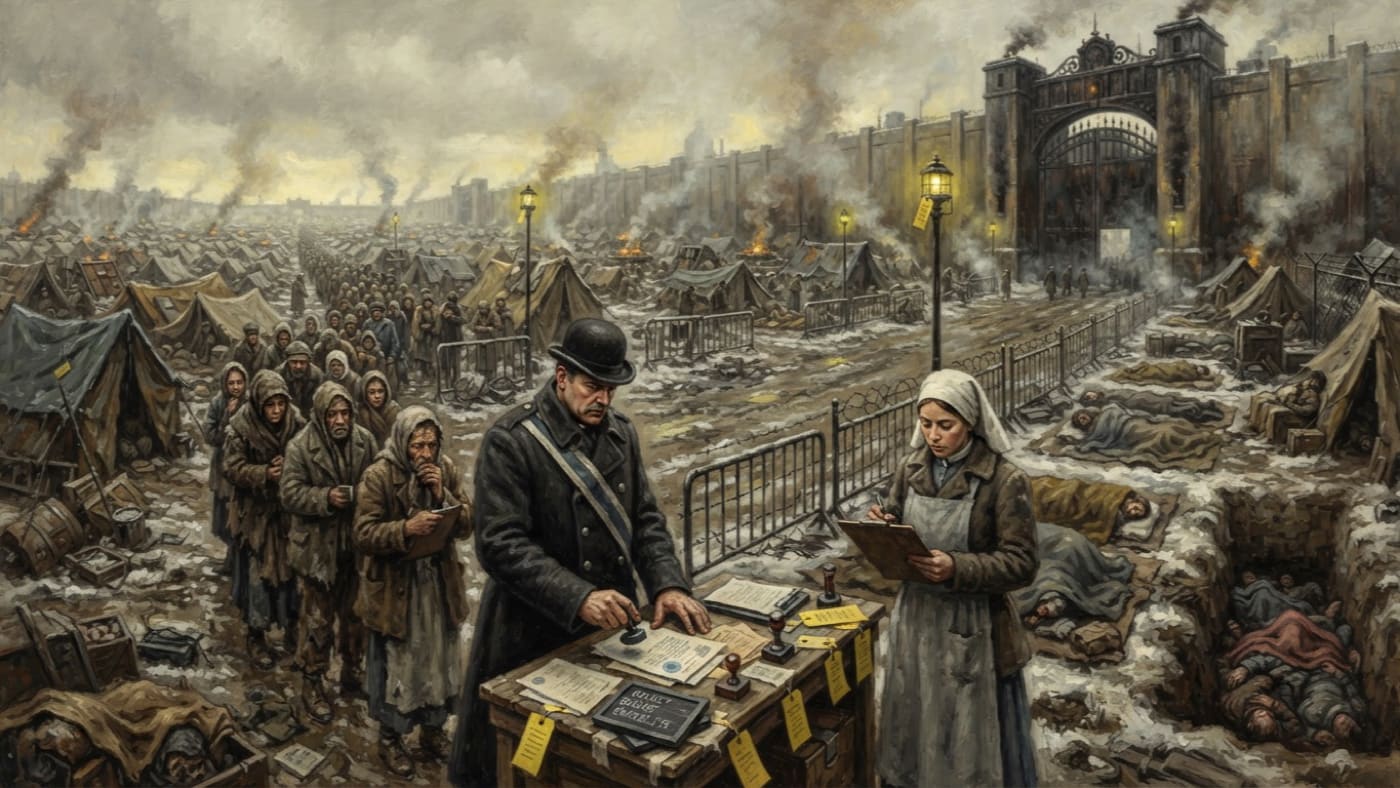
The account keeps the camps and very little else. In the early Line years, convoys gathered outside the walls the way penitents gather outside a confessional screen: in numbers, in poor order, and with no idea how long the priest would take. They waited for entry, for escort, or for the road ahead to clear. Then, according to the surviving account, the camps became charnel pits. The dying was severe. The record will say that much, and I decline to say more on its behalf.
What I can describe without forgery is the ground such camps stood on, because the ground has not changed. Any holding yard of my own century will do. It smells of wet wool, horse piss, smoke from the burn pits and brine disinfectant. Iron bars go cold enough in the wind to take skin. Quarantine lamps burn a sickly pale colour, and the gatekeepers say coughing carries further than shouting. I give you these details from the yards of A.S. 201. The winter's own smells are not on file, and I will not pass off the present as an eyewitness to the past.
Readers who know the hagiography of Saint Neral of the Narrow Door will see a caravan camp, a plague year and a sealed wall, and will want to staple his folio to this one. Do not. The hagiography is its own professional tradition, revised four times by Doctrine for its own reasons, and it never names the First Quarantine Winter. Two documents that share a season do not share a docket.
#On the Authority That Remained
Before the winter, the gate controlled passage: who, what and when. After it, the gate controlled bodies as bodies. The question at the counter was no longer just whether a man's paper was in order. It was whether the man himself was a hazard that had to be held. The account calls the winter the turning point. I record it as one.
What did the turning, I cannot tell you. My files contain no first decree, no ratifying council, no officer who put his seal to the change, and no original wording against which to measure today's practice. The people who kept those gates were soldiers, clerks, or something in between. I call them notaries only as a courtesy of hindsight. The licensed office, with its ranks, seal audits and annual renewals, came later and was built in stages, and none of those stages needs to have existed in the winter for the winter to have mattered. So nobody should assume that every power a notary uses in A.S. 201 was written into some order issued in that season. There is no order on file to check against. Powers build up the way sediment does in a ledger-room, one layer of usage at a time, each layer certain it was always there.
One distinction deserves its own line. The gate acquired the right to declare a body dangerous. It did not acquire medicine. No notary learned to lance a bubo or read a fever from that day to this. The Bureau has never confused jurisdiction with skill, and it has never let the difference cost it a single hold.
#On the Present Hold
Now to my own century, where the record is generous to a fault.
According to the published profession survey, any notary of Permit rank or above may impose a quarantine hold on any traveller, for any length of time, on grounds of "suspected contamination, spiritual or physical." Permit Notaries sit in the middle of the profession, alongside the Cargo and Quarantine Notaries, above the Lane Wardens and Page-Runners, and below the Gatewardens who run whole gate segments. So the authority to stop a living body at the wall belongs to a middling official with an ink-stained thumb, a seal cord across his chest and, in my experience, a grievance about his housing allocation.
The equipment is modest. There are quarantine tags in quarantine yellow, each with a serial number the auditors check. There are holding yards, quarantine sheds, docket slates and release orders. There is also the "release by exception" slip, which auditors check first because exceptions are where everything hides. A flag goes up, the yard locks, and from then on the most important instrument at the gate is the notary's signature, or the lack of it.
The work divides cleanly, at least on paper. The notary decides that a body will be held. The Bureau of Mercy decides what that body is. The Mercy Ward-Sisters and Ward-Brothers, in grey aprons and white sleeve wraps, take the held traveller through intake: symptoms, papers, a rating of his behaviour, and then a tag reading treat, hold, isolate, transfer, release or ossuary. The Ward-Sister examines and the notary signs. The release depends on the second signature and is informed, on a good day, by the first examination.
The phrase "spiritual contamination" carries most of the weight. It is a ground in doctrine and in administration. It needs no rash, no fever and no witness who can say what he saw. It also proves nothing about the winter. I make no claim that the dead in those camps were taken by anything other than whatever killed them, and nobody wrote that down. Doctrine may hold its own opinion. Doctrine usually does.
#On the Price of Waiting
"Delay is purity." — the profession's second motto
The published survey gives an example, and I reproduce it because it is economical. A merchant offends a Gatewarden-Notary. The merchant is held for three weeks while the Ward-Sisters, overworked as Ward-Sisters always are, decide whether his cough is plague or merely inconvenient. When the hold lifts, his cargo has spoiled, his contracts have lapsed, and his competitors have already sold their goods at the prices he meant to charge.
Notice what was taken from him. His body was returned in more or less the condition it was held in. His time was not, and at the gate time is the commodity. The profession's own working notes list what a notary can get that other men cannot: movement, delay, release, confiscation, protected escort, official quarantine exemption, and, at the bottom of the list as though the clerk were embarrassed to write it, time itself.
Out of this comes a trade with its own slang. The "quarantine shuffle" is holding someone "for health" in order to extort him legally. A notary who makes a habit of it is called a Quarantine Rat, behind his back and usually in front of him. Quarantine suppliers live alongside the gate and do well out of a full shed. Exemptions can be had, at a price. The Quarantine Doctor is on the list of people one bribes to stop a signature landing. When a sick man buys an exemption, the shed is lighter by one body and the wall is weaker by one plague.
Fairness obliges me, and the ledger requires it, to record that not every hold is a shakedown and not every notary is for sale. The gates have their zealots, who would hold every cough on the road, and their merchant-friendly crews, who know that a city's bread comes through the same arch its fevers do. The craft teaches both sides the same lesson: quarantine early, release late, and you will keep your career. The zealot and the Rat fill the same yard by different reasoning. The merchant inside cannot tell which kind of man locked the gate, and the paperwork will not tell him.
#On the Surviving Account
This is what can be known. There was a winter. It killed people in camps outside walls during the early decades of the Line. Gate officers came out of it with authority over sick bodies, and that authority runs today from Permit rank upward, in yellow tags, release slips, and sashes cut in two.
This is what cannot be known from anything on file: the sickness, the place, the span of the season, the first person to die, the number of dead, the first order and the hand that sealed it. I have left each of those spaces blank, and I have counted the blanks. They reconcile. The Bureau cares less about whether a ledger is complete than about whether it balances, and this one balances: the cause on one side is small and undated, the consequence on the other is enormous and in force.
The authority outlived its occasion, as authority generally does when nobody records the occasion. A gate that cannot cite its reason for holding you cannot be made to give that reason up either.