
#On the Nature of the Gate
"No name, no passage." — Inscription above every controlled crossing on the Sagittal Line, attributed to no individual because individual authorship would imply the policy had a beginning, which would imply it might have an end.
The Gate is a throat. I do not offer this as ornament — the metaphor belongs to the Bureau of Engineering, whose anatomical surveys of bastion infrastructure classified major entry points under "Respiratory and Digestive Sub-Systems, Load-Bearing, Category Two." The classification was protested by the Bureau of Doctrine, which held that gates were sacramental thresholds and therefore fell under liturgical jurisdiction. Engineering replied with a three-page structural report containing no adjectives. Doctrine countered with an anathema. The matter remains unresolved.
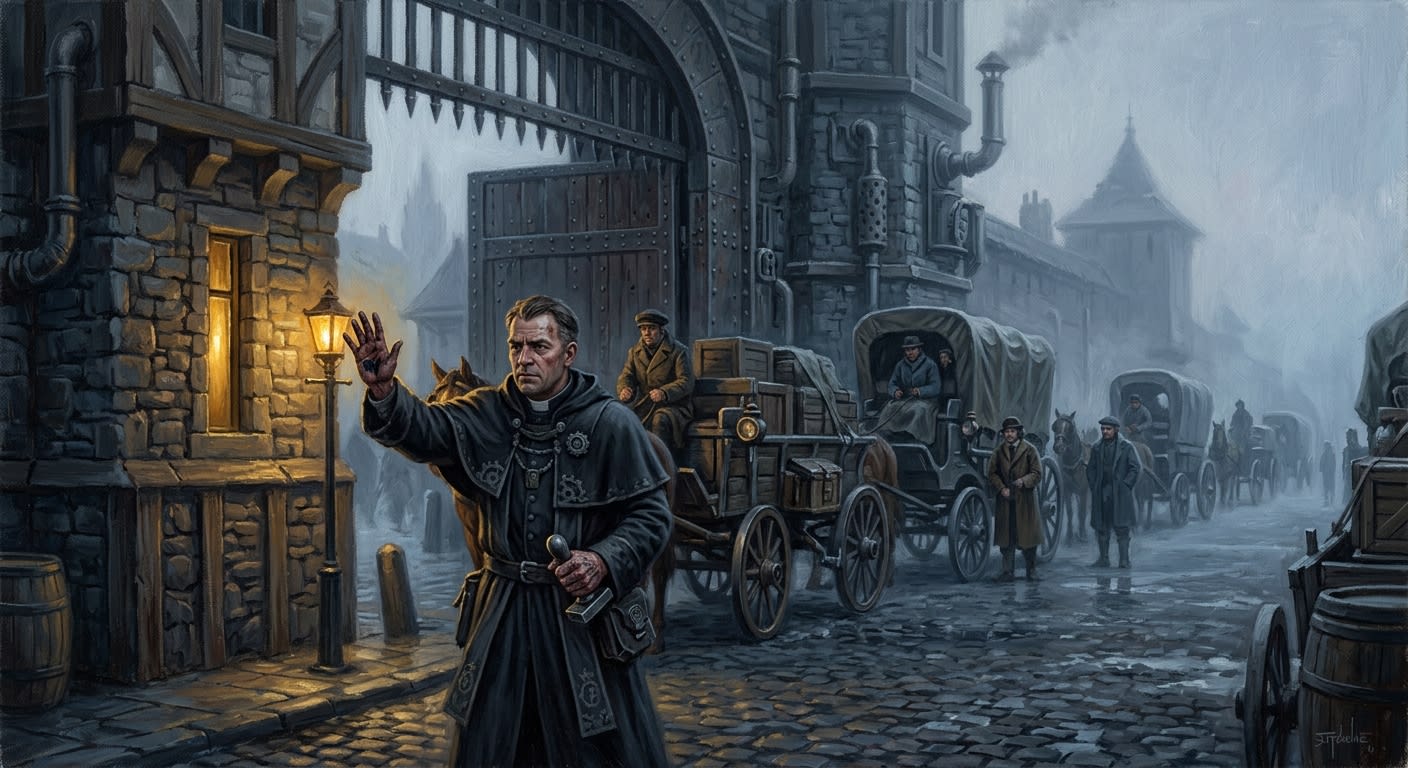
What is resolved, and has been since the Concordat, is that every gate requires a keeper, and that keeper requires a seal, and that seal requires a ledger, and that ledger requires a clerk. The Gatewarden-Notary of Passage is that clerk — or rather, that clerk elevated to the status of minor sovereign, vested with the authority to halt a column of four thousand by raising one ink-stained hand and asking for documentation.
The profession exists because movement is dangerous. A man who moves carries disease, heresy, desertion, contraband, and ambition — five commodities the Synod has spent two centuries learning to tax. The Gatewarden-Notary stands at the point where all five must be sorted, weighed, stamped, and either admitted or refused. The Gate does not care about the man. The Gate cares about the paper.
#On the Origin of the Office
The first Gatewardens were soldiers with clubs. During the Great Retreat of A.S. 48–65, every surviving bastion posted armed men at its entry points to manage the flood of refugees, deserters, and dying. These men were not clerks. They were meat-walls. Their authority extended to the length of their arms and the patience of their commanding officer.
The transition from meat-wall to notarial office occurred during the Concordat years, when the Bureaus discovered that a gate was the most efficient point of taxation, surveillance, and doctrinal sorting available to the state. By A.S. 97 — the year of the Latch River ford panic that killed three thousand in a single afternoon — the Synod Permit Directorate had formalised the Gatewarden-Notary as a licensed position under joint authority of the Bureau of Records and the Bureau of Settlement, with advisory input from the Bureau of Purity, the Bureau of Tithes, and the Bureau of Mercy.
Five Bureaus. One gate. The mathematics of jurisdiction produced, as mathematics always does in the Synod, an answer that satisfied no one and functioned perfectly.
Saint Neral of the Narrow Door is the profession's patron — a figure whose hagiography the Bureau of Doctrine has revised four times, each revision making the miracle more administratively convenient. The canonical version: during a plague year in the early decades, Neral sealed an entire caravan camp behind the wall of a forward settlement, refusing entry to six hundred souls on the grounds that their confession receipts bore an irregular watermark. The camp perished. The settlement survived. The Bureau declared Neral's act "an exercise of sanctified discretion" and canonised him within the decade.
#On the Substance of the Work
The Gatewarden-Notary's day begins with the Seal Count — a reconciliation of stamps, blanks, and wax blocks against yesterday's ledger. Missing blanks are reported immediately, because a missing blank is a missing person: someone who will enter or leave with paper that the Bureau did not author, which means reality has sprung a leak.
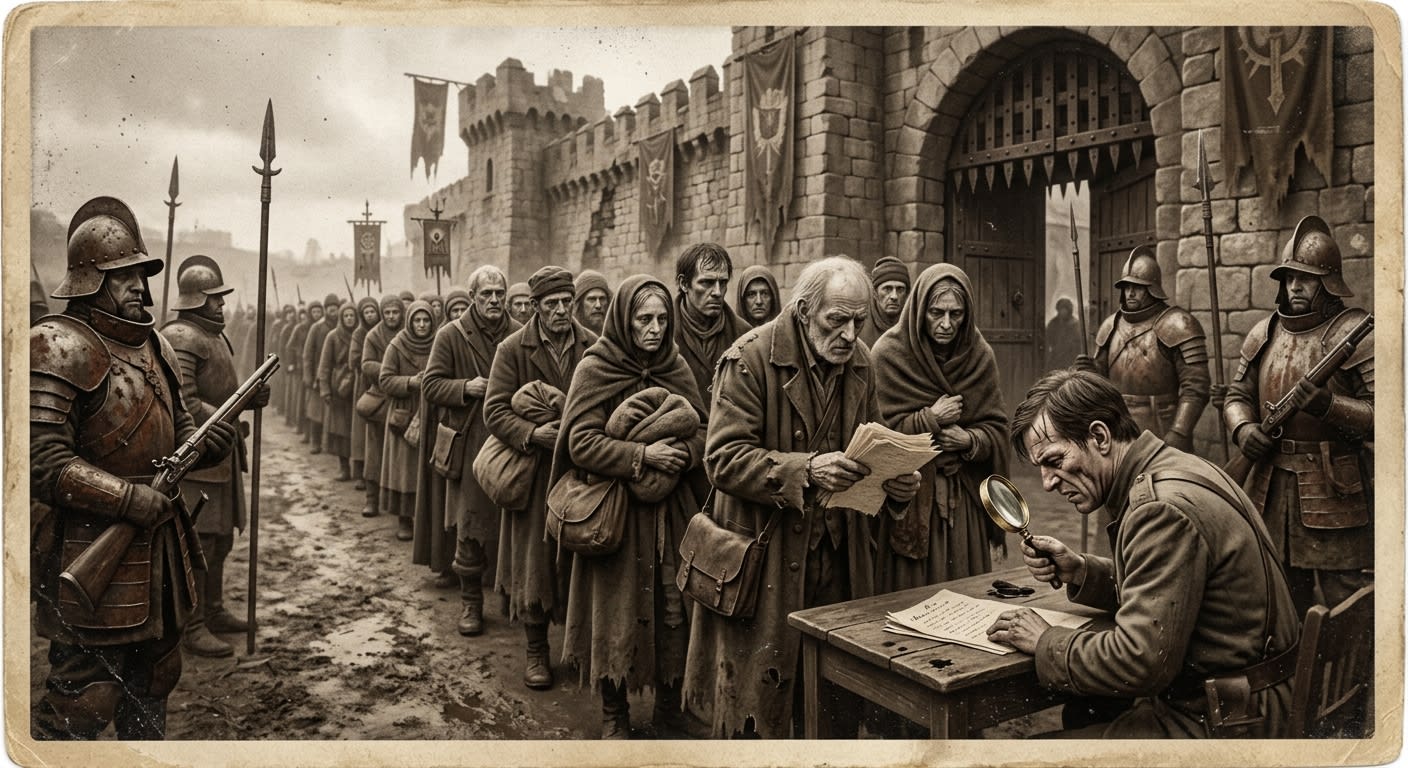
The gate opens with a bell. The lanes fill. In a bastion of moderate size, a dawn queue may contain day-labourers seeking work-passes, families disputing entry rights, pilgrims presenting Pilgrimage tokens, merchants with cargo manifests the length of a man's arm, and — always, always — someone who has lost their papers and expects the Gatewarden-Notary to believe that papers can be lost, which is heresy of a minor but persistent kind, since the Bureau of Records maintains that properly filed documents do not disappear.
Sorting is everything. A competent Gatewarden-Notary runs four lanes: merchants, pilgrims, labourers, and "unverified." The unverified lane is the longest, the slowest, and the most dangerous, because everyone in it has failed a preliminary check and is therefore, in the Bureau's grammar, already guilty of being insufficiently documented. Some will wait days. Some will die in the queue, and their death will be processed with greater efficiency than their life ever was.
Cargo inspection occupies the middle hours. Every convoy manifest must be cross-checked against the originating gate's seal, the transit seals of every crossing point, and the destination gate's pre-authorisation. A manifest with three transit seals is routine. A manifest with seven is suspicious. A manifest with one is either forged or belongs to someone powerful enough to require only one, and the Gatewarden-Notary must determine which before sunset, because after sunset the manifest expires and the cargo becomes Bureau property.
Deserter processing occupies the late hours. A deserter arrives shaved-headed, stripped of insignia, and escorted by militia. The Gatewarden-Notary verifies identity against three independent rolls — the regimental muster, the Bureau of Records' Great Ledger, and the local Conscription registry. If all three match, the deserter is transferred to the trench-court. If they do not match — and they frequently do not, because the regimental muster is maintained by exhausted sergeants with blunt quills — the Gatewarden-Notary must decide which roll is canonical. This decision, which looks administrative, is in fact a verdict of life or death, and everyone involved knows it, and the paperwork does not acknowledge this.
Stamped Erratum (Bureau of Records, 12th Rev., A.S. 199): "The phrase 'verdict of life or death' is inappropriate in the context of transit processing. Gatewarden-Notaries render administrative determinations, not verdicts. The distinction is important, as verdicts imply judicial authority, which Gatewarden-Notaries do not possess. That their administrative determinations occasionally produce consequences identical to judicial verdicts is a matter for the Bureau of Doctrine, not Records."
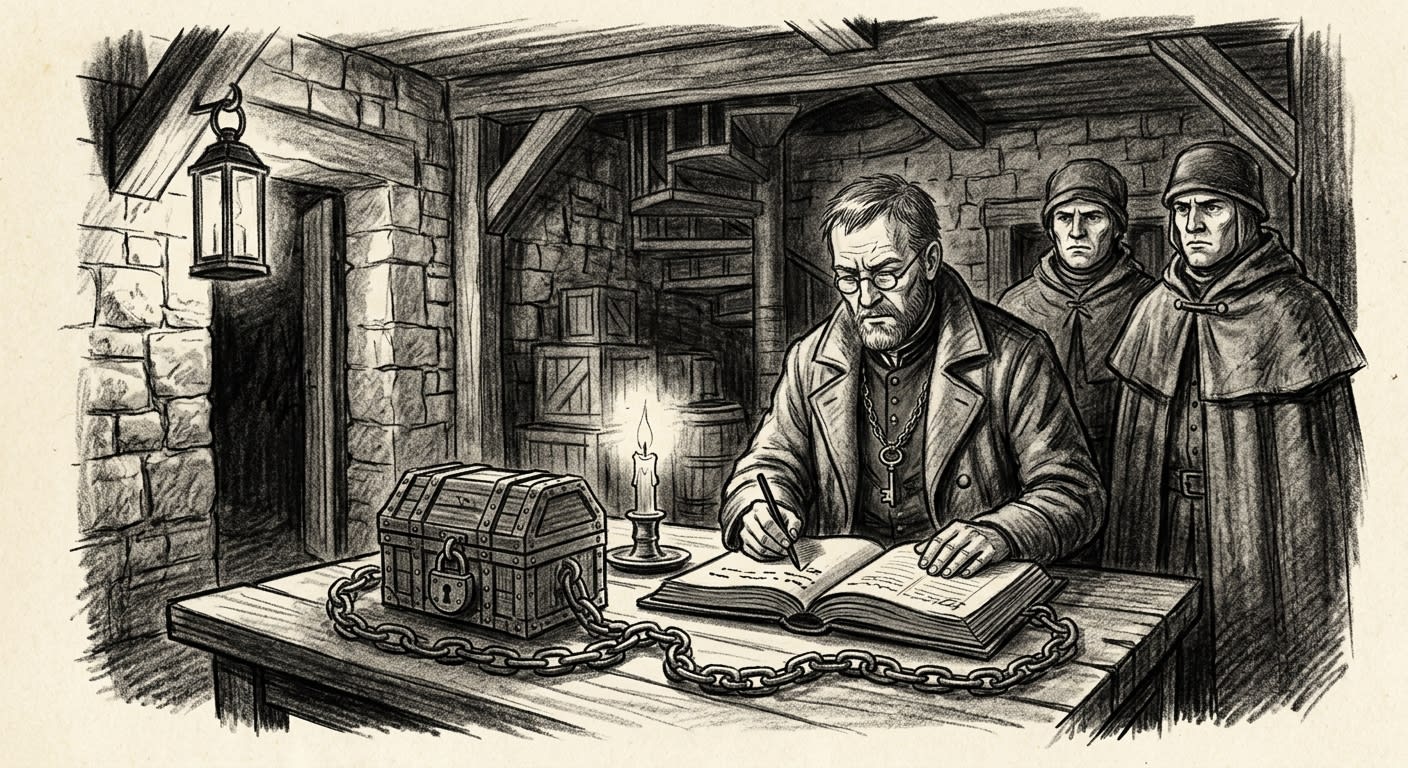
The final duty — the one that makes Gatewarden-Notaries drink brine tea and stare at the iron gate like it is a mouth that might swallow them — is the reliquary chain-of-custody. When a sanctioned relic shipment passes through a gate, the Gatewarden-Notary must personally touch the chain ledger, verify every seal in the custody sequence, and sign the transit document in the presence of two witnesses. A broken chain — a single missing seal, a single unsigned transfer — is classified as a Category Two Spiritual Security Breach, punishable under the same martial codes that govern treason. The relic itself may be a finger-bone the size of a walnut. The paperwork will be the size of a man's torso. The Gatewarden-Notary signs, and prays — to the saint whose bone is in the box, presumably — that the upstream seals were honest.
#On the Controversies
Every gate is a market. The Bureau denies this with the same conviction with which it denies that the sun rises in the east — theologically, the sun rises because the Creator commands it, and therefore the direction is a matter for Doctrine, not observation. In the same spirit, a Gatewarden-Notary does not sell passage. A Gatewarden-Notary facilitates transit through sanctified administrative process, and if that facilitation is swifter for those who contribute "processing oil" — the profession's euphemism for a bribe so old it has fossilised into slang — then speed is a function of purity, which is a function of faith, which is a function of coin, which returns us to the beginning.
The First Quarantine Winter — a plague year in the early decades of the Line, when convoy camps became charnel pits — gave Gatewarden-Notaries medical authority they have never relinquished. A quarantine hold can be imposed by any Notary of Permit rank or above, on any traveller, for any duration, on grounds of "suspected contamination, spiritual or physical." The phrase "spiritual contamination" is doing most of the work. A merchant who offends a Gatewarden-Notary may find himself quarantined for three weeks while the Bureau of Mercy's overworked Ward-Sisters determine whether his cough is plague or merely inconvenient. By the time the hold is lifted, his cargo has spoiled, his contracts have lapsed, and his competitors have already sold their goods at the prices he planned to charge.
The Reliquary Loss Scandal of the early administrative period — when three authenticated femurs vanished between Bastion-Przemyśl and Bastion-Sibiu, reappearing months later in a Black Ledger auction house in Ghent — produced the chain-of-custody notarisation system that now governs every relic transit. It also produced the "Chain-Watcher" specialisation: Gatewarden-Notaries assigned exclusively to reliquary shipments, whose paranoia is so acute that they have been known to sleep with the chain ledger under their pillow, wrapped in brine-cloth, with a bell tied to the binding so that any attempt to open it in the night would wake them and, presumably, the saint whose bones it tracks.
The Bellway Infiltration — an incident in which hostile acoustic signatures passed through a gate's resonance corridor during a shift change — produced the "listening corridor" modification. Forward gates now contain narrow passages where the air is channelled to amplify sound, and the Gatewarden-Notary on duty must confirm that every tone passing through matches the Bureau of Bells' prescribed peal schedule. If a bell sounds wrong — too low, too sweet, too late — the gate closes. The Gatewarden-Notary does not need to understand acoustics. The Gatewarden-Notary needs to understand that "wrong" is defined by a chart on the wall, and that the chart was written by the Counter-Toll Operators, and that the Counter-Toll Operators are themselves operating on a chart written by the Bureau of Bells, and that the Bureau of Bells applies the Bell Codex ratified in A.S. 115. A contradictory committee tale names seven drafters, three of them deaf; the surviving ratification record does not establish their identities. The system functions. Do not enquire further.
#On the Present Condition
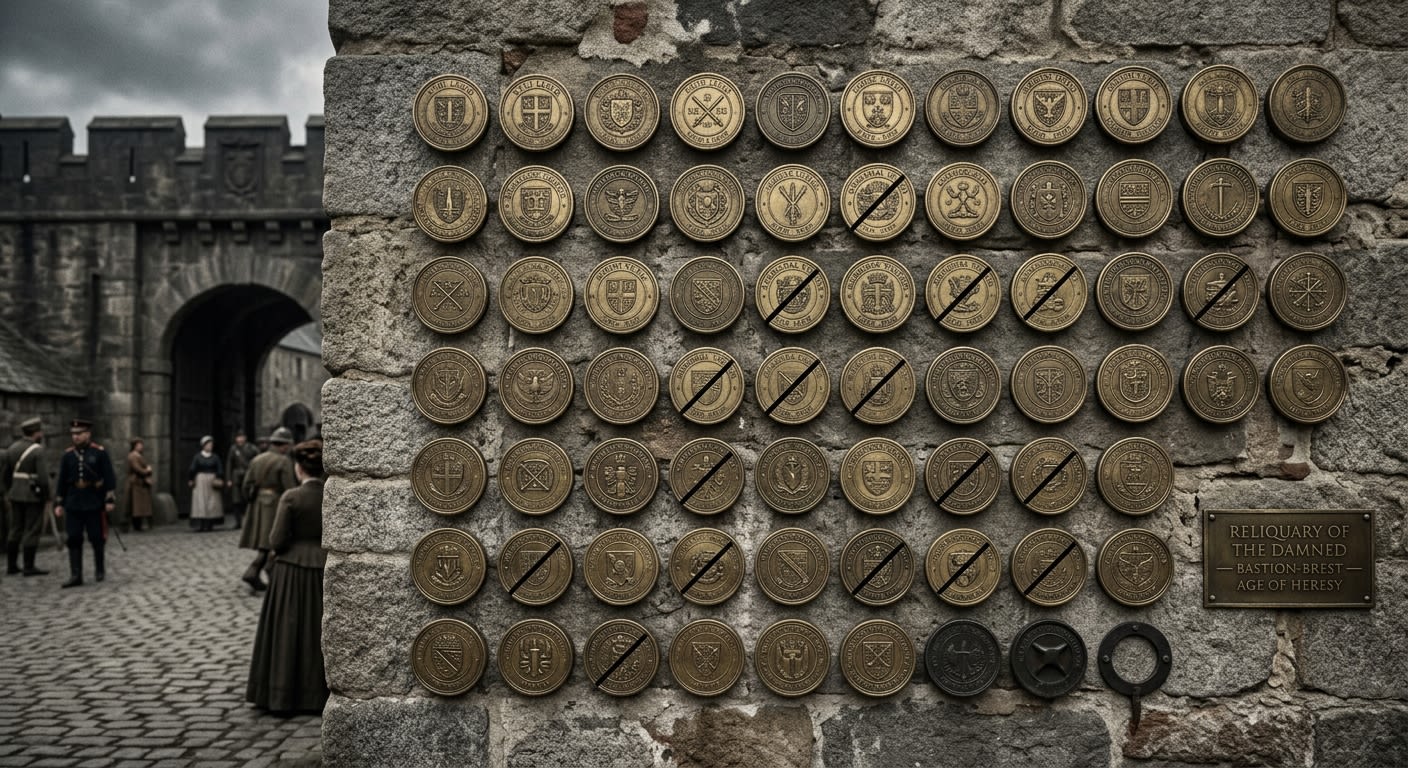
There are, by the Bureau of Settlement's most recent count, approximately six thousand four hundred licensed Gatewarden-Notaries operating across Zones 1 through 7 of the Synod's territory, controlling an estimated fourteen hundred designated chokepoints including bastion gates, river crossings, bridge toll-stations, tunnel entries, and quarantine checkpoints. The actual number is higher, because "Night Notaries" — unlicensed operators who run shadow corrections and covert fast lanes during the dark hours — are not counted, and the Bureau of Shadows has indicated, in a memorandum stamped UNDER ADVISEMENT, that counting them would require acknowledging them, which would require licensing them, which would require auditing them, which would require a budget that the Bureau of Tithes has declined to allocate on grounds that the Night Notaries' revenues already flow, through seventeen intermediaries, into the same coffers.
The gate endures because the war endures, and the war endures because the gate endures. This is circular reasoning, and the Bureau of Doctrine has classified circular reasoning as "theologically permissive when sanctioned by usage." The Gatewarden-Notary stamps. The queue shuffles. The convoy enters or it does not. The deserter is processed or he is not. The relic passes with its chain intact, or it passes with its chain broken, and a man's life ends in paperwork rather than blood, which is — the Bureau assures me — the more civilised outcome.