
#On the Name and the Surviving Account
Paper multiplies. Presence is counted.
This is a survey, commissioned and completed in A.S. 201, of what the record still says about the Forgery Years and of what those years made of the oath-witnessing trade. It is no chronicle written at the scene. No chronicler of that persuasion survives in my files, and I decline to manufacture one.
The name belongs to the period immediately following the charter of the Bureau of Oaths in A.S. 92 / 1802 CE. The record does not say when the period began. It does not say when it ended. Provincial historians have offered tidy endpoints out of their own imaginations, and I have returned their manuscripts with the dates struck through.
The surviving account is principally the Bureau's own. It tells of an epidemic of fabricated bonds, of a charter that answered them, and of a re-registration that refounded the Theocracy's promises on licensed attendance. The Witnesser's professional lore, kept separately, names the same years as the moment its office was standardised. Two witnesses, one truth, as the Witnessers say. Neither witness supplies a year.
#On the Traffic in Bonds
Oath-making did not begin in A.S. 92. Promises were sworn and witnessed in the wartime Church and under the interim administration, long before the Concordat of Strasbourg gave the formal Synod its constitution in A.S. 90. The Bureau describes what the charter inherited as a marsh: competing claims, rival notaries, contradictory records, and old networks of unregulated oath-making that had no intention of drying out on command.
Into that marsh the forgers waded. The record lists their goods.
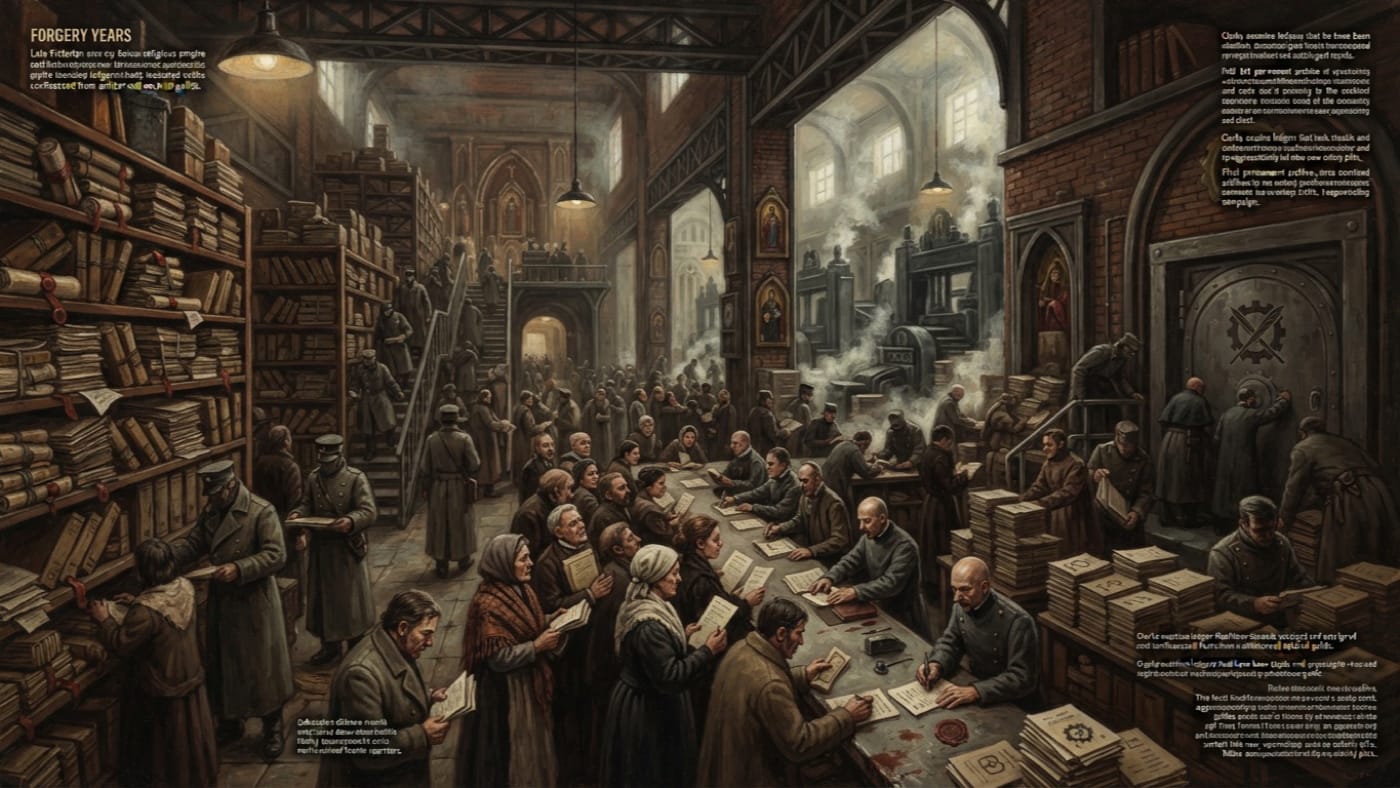
False marriages, which made two people spouses on paper, with everything that follows a spouse: the shared roof, the heritable child, the claim upon a dead partner's goods. Counterfeit adoptions, which placed a child within a household and, households being what they are, within its inheritance. Fraudulent guild bonds, which tied a member to a guild or a guild to its obligations. Certificates of fidelity, sold by men to whoever wished to appear faithful. Proof of widowhood, bought by women, and with it a widow's standing: free to remarry, entitled to settle what the dead husband left. Apprenticeship oaths, forged by guild-masters to claim workers they had never trained.
The last offends me most. The others counterfeit a relationship. The apprenticeship forgery counterfeits a past: years of instruction that never took place, sworn into existence so that a master could own the labour that resulted.
The forgers understood a distinction their victims did not. There is a piece of paper. There is the relationship it asserts. And there is the obligation a court will enforce on the strength of it. The forger needed only the first to obtain the third. The second could be entirely fictitious, and in the Forgery Years, according to the Bureau, it often was.
The record names no forgers. It names no victims, no towns, no sums. I will not supply them. A survey that invents its criminals has joined their trade.
#On the New Charter's Reach
The Bureau's answer survives as a sequence, and I give it in the account's own order.
First came licensing. Authority to witness an oath would come from the new charter and from nowhere else.
Second came revocation. Every oath-officer who had not been licensed under that charter lost his authority. Some of these men were forgers. Some were the honest notaries of their districts, who had witnessed marriages for decades and now discovered that their decades had lapsed. The account does not tell them apart. The charter never needed to.
Third came seizure. The Bureau impounded the records of eighteen independent notarial guilds. Eighteen counts the record collections taken into custody. It does not count guilty men, convicted guilds or towns. The account names none of the guilds and gives none of their seats. Anyone who presents you with a list of them is selling something, possibly a certificate of fidelity.
An impounded register is the memory of a district's marriages, apprenticeships and debts. It is taken from the men who kept it and handed to the men who now decide what it means. On a cart, a forger's ledger and an honest notary's ledger look much alike. Both went into the same custody. Both became evidence of whatever the licensed officer was prepared to find.
So validity moved. Before the charter, a bond could be proven by a notary's mark, a guild's book, a family's memory or a parish clerk's recollection. After it, the question narrowed to one: was a licensed Witnesser present, and is the oath written in Strasbourg? The Bureau calls this drainage. The word is apt. Drained water ends up where the engineer intends.
#On Re-registration and the Permanent Archive
The fourth stroke is the one the Bureau's own account calls brutal, and I regard it as the finest piece of drafting the early Bureaus produced. Every oath sworn without a licensed Witnesser was declared "provisionally void pending re-registration."
Read the phrase slowly. Provisionally: so nothing has been destroyed, only suspended. Void: so for now nothing binds. Pending re-registration: so a remedy exists, and the remedy runs through the Bureau's door. A forged marriage and a true one, sworn thirty years apart before different notaries, were left in exactly the same condition. Both couples had to present themselves and swear again, this time under supervision.
According to the Bureau, half the Theocracy did so within a three-year period. That figure is the Bureau's, and I leave it with the Bureau. The account does not say half of what: inhabitants, households or registered bonds. No independent census of the campaign survives in anything I have read. The three years are a duration only. The record does not say when they began or ended, and they do not measure the length of the Forgery Years themselves.
The account adds one more fact, and it is the one I would have chiselled over the door. The re-registration fees funded the Bureau's first permanent archive. The fee schedule is not preserved. Neither the building nor its completion year is identified, and it must not be mistaken for the present seven-storey Registry of Bonds.
The citizens paid to confirm promises they had already made. Their payments built the vault that would hold the confirmations. Strasbourg ended the campaign with its records consolidated, its rivals' registers impounded, and its archive paid for by the people it had just declared provisionally unmarried. The Rationalists never managed anything half so elegant.
Provisional voiding pending re-registration is evidence that the oaths so voided were forged.
It is evidence that they were sworn without a licensed Witnesser. The condition was procedural. It does not establish that any given couple lied, that any given apprenticeship was fictitious, or that any relationship sworn before the charter never existed. The Bureau of Oaths has been asked whether it ever claimed otherwise. Its reply has been filed.
#On What Witnessing Secured
The Witnessers' own lore, kept apart from the Bureau's account, gives the practical reason the office was standardised in these years. Seals could be copied. Signatures could be bought. A trained human witness whose credibility the institution protects is harder to counterfeit. When one is corrupted, the corruption is at least human, and it shows in a face, a hand, a hesitation.
The office's apparatus is now carried into every room: the knotted cord-sash, the lead tablet or vow-slate, wax and seal cords, and the witness ledger. In that ledger the exact wording and its cadence are set down for forwarding to the Registry of Bonds beneath Strasbourg. Sanctioned presence, recorded speech and central custody became the basis of every recognised bond, and they remain so.
What they secure is enforceability. A witnessed oath can be produced, cited and enforced in a court of the Synod. Witnessing cannot vouch for the speaker's heart, and it binds him by no irresistible force from Heaven. The Bureau's doctrine says a vow binds because it was heard. That is a statement about jurisdiction, and the Bureau's enforcement officers know it.
Standardisation did not make the Witnessers incorruptible. The Widow-Bond Scandal came later and separately, when licensed officers certified coercion as consent. The coercion protocols now taught in every district, meaning the private interview, the checklist and the mandatory pause, date from that disgrace, not from the Forgery Years. Counterfeit witness-marks still circulate. The Bureau keeps Token Examiners because the forgers never retired.
#On the Present Reading
The Forgery Years belong in their own folio. The annulment of the League of Milan in A.S. 97 was a treaty action, and the three years spent drafting its writ have nothing to do with the three years of re-registration. The Breach Plagues of A.S. 110–115, which the Bureau blames on "spiritual rot," belong to a later generation. The Trench Last-Oath Doctrine grew out of their aftermath. The Forgery Panic of A.S. 178 was a crisis of citations, custody and scribes, and it shares nothing with these years but the word.
What survives of the Forgery Years is a habit of mind, and the Theocracy still lives by it. A promise exists in law when a licensed officer heard it and Strasbourg wrote it down. Before the charter, a marriage was whatever a district agreed it was. After the campaign, it was whatever the Ledger said, and the married had paid for the Ledger.
The founders are sometimes credited with this arrangement. Both were dead before the Concordat and cannot have licensed a single officer. The account does not record who first ratified the charter. The arrangement needs no author. It has an archive.