
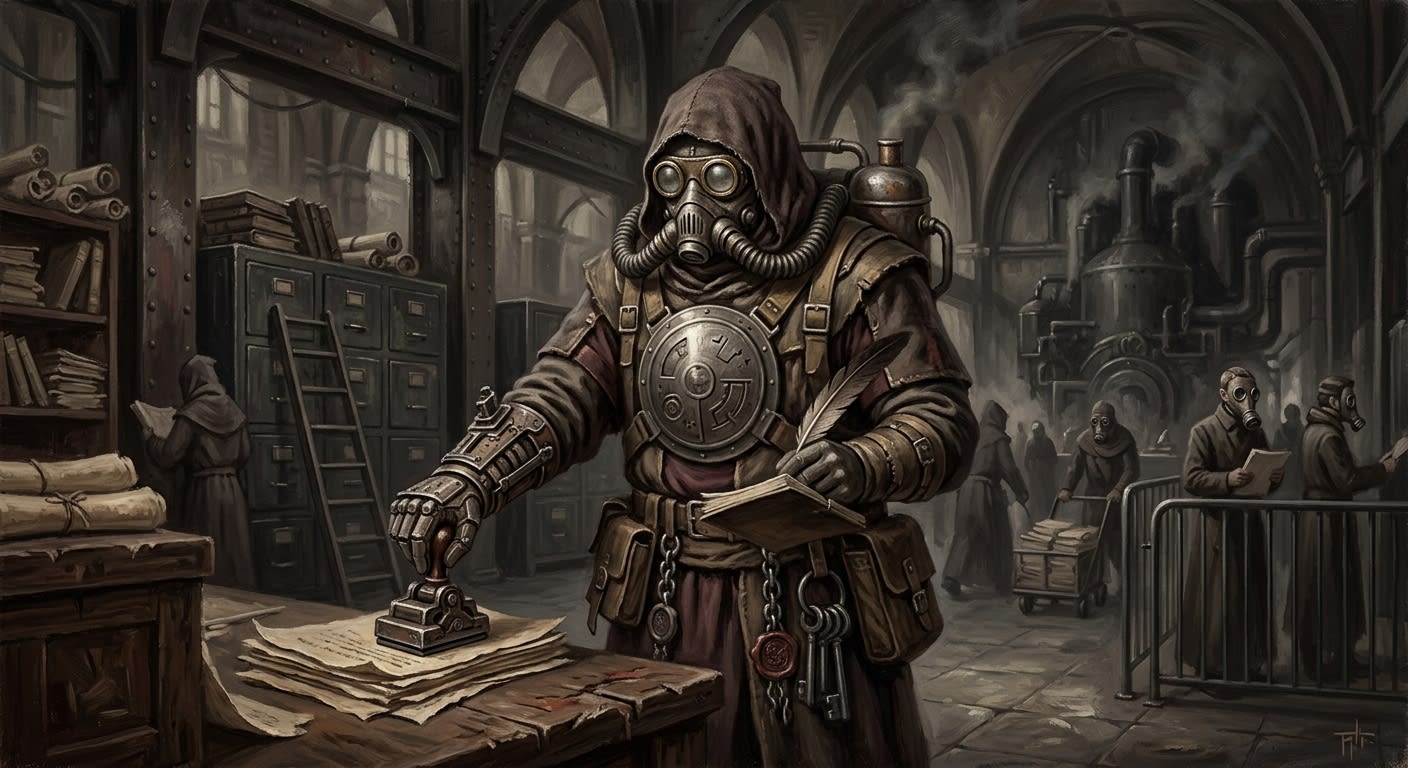
#On the Office of Binding Speech
Breath wanders. Witness binds.
I am Hieromnemon Valerius Drax, Warden of the Sacred Ledger, Corrector of Provincial Memory, and infrequent but devastating guest at oath-chapels across the western dominions; and because the world has once again contrived to require my lucidity, I now set down the matter of the Oaths Witnesser — that narrow-shouldered official, that custodian of syllables, that grave little midwife of permanence upon whom so much of the Synod's daily coercion depends.
The peasant, when cornered, imagines law to be parchment. The merchant imagines it to be seal-wax. The officer imagines it to be steel. All three are wrong in the usual provincial ways. Law begins in the throat. It arrives as vibration, emerges as pledge, and only thereafter permits itself the luxuries of script, registry, and punishment. A promise unwitnessed is not a bond but weather. The The Bureau of Oaths did not invent this truth. It merely noticed it first, codified it second, and monetized it third. A splendid sequence.
The Oaths Witnesser exists because the Theocracy does not trust intention, memory, affection, conscience, improvisation, local custom, village sentiment, or any of the other soft mortal fabrics that tear at the first hard pull. The Witnesser trusts cadence. The Witnesser trusts phrasing. The Witnesser trusts the presence of a sanctioned body in a sanctioned room at a sanctioned hour, recording sanctioned words for transport into the Ledgers below Strasbourg where every vow is stored like a blade awaiting future use. Such people are not loved. They are not meant to be.
He is called, formally, Witnesser of Vows, Oath Notary, Custodian of Binding Speech. In the lanes and barracks he is Vow-Anchor, Breath-Sealer, Knot-Caller. In the mouths of those whose lives have soured under enforceable promises, he is Curse-Midwife, Promise Vulture, Grave-Tongue. The Bureau accepts all titles except the last two, which it pretends not to hear while quietly filing them under vernacular hostility patterns, district by district, quarter by quarter, family by family. The state listens. It always listens.
#On the Origin of the Witnessing Office
Ink fails. Presence does not.
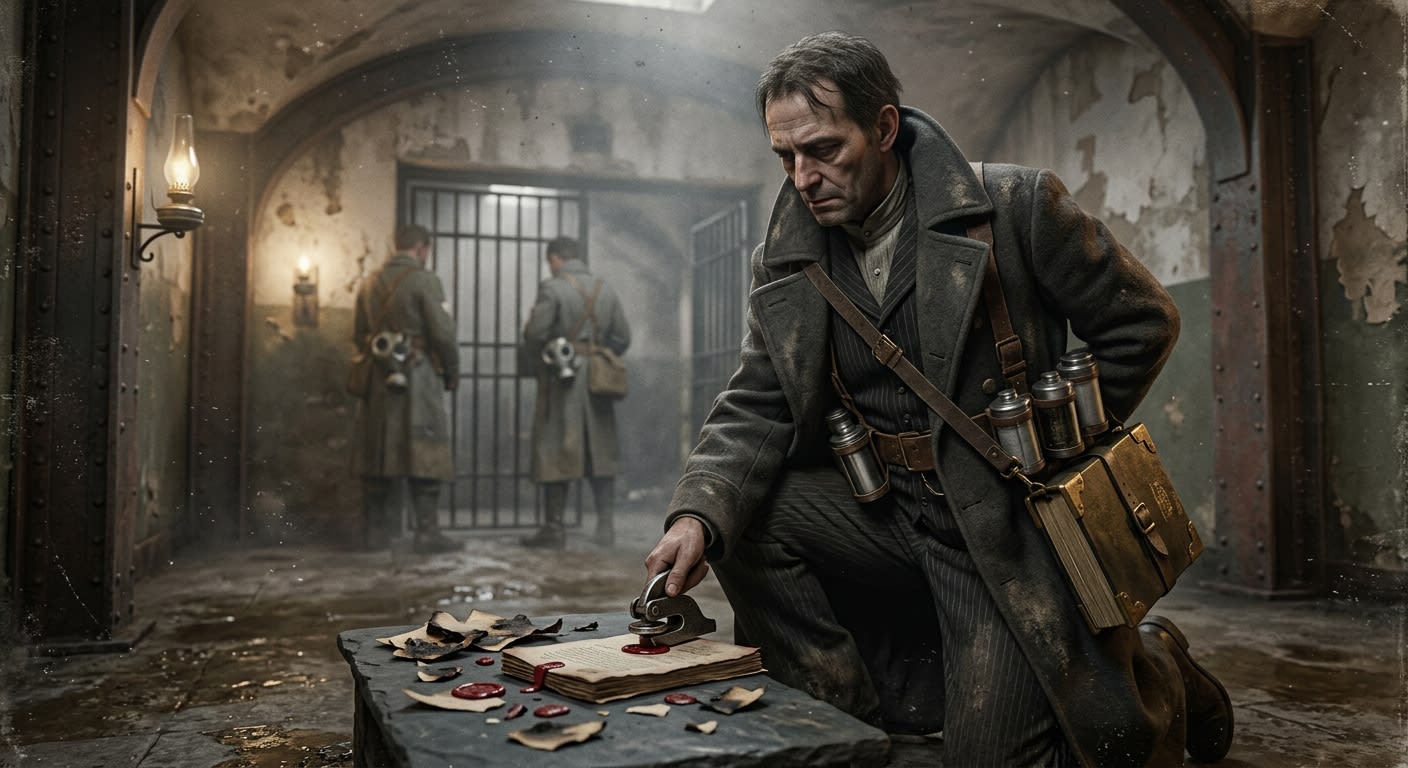
During the The Atheist Wars, when republics rose like mildew and old certainties were stripped for parts, contracts multiplied and meanings decayed. Marriages were forged. Inheritances were fabricated. Guild bonds were counterfeited by men who could not sign their own names consistently from one afternoon to the next. A Europe that had imagined itself rational discovered that paper travels faster than reputation and lies faster than both. The result was not freedom. It was paperwork without sovereignty — which is to say, hell in clerkly miniature.
The proto-Synodal solution, emerging first in field necessity and only later in doctrine, was to replace abstract validity with embodied validity. If seals could be copied and signatures purchased, then presence would do the work. A trained, licensed, feared official would stand inside the vow itself. He would hear not merely the words but the manner of their birth: the catch in the breath, the speed of assent, the tremor of coercion, the phrase inserted too neatly by a patron's lawyer, the silence that means refusal but lacks the courage to become one. Where the Rationalists trusted form, the Synod trusted attendance. This is why the Synod survived them.
The office took recognisable shape in the years before the The Concordat of Strasbourg, when Kratz and his clerks discovered that spoken obedience, once publicly heard, becomes administratively real long before it becomes emotionally sincere. By A.S. 87, at the The Council of Worms, the principle had already hardened: a vow made in witness could bind dioceses, cities, militias, widows, and the stubborn dead. By A.S. 92, when the early Bureaus were formally constituted, the Witnessers entered the machine with proper cords, proper ledgers, proper fees, and proper authority to ruin lives in the name of social cohesion.
There are founding myths, naturally. There always are. The Bureau prefers the tale that, during the first great siege, ink ran out and the faithful held the wall by breath alone, vows carried from mouth to mouth and fastened by human hearing when no other fastening remained. A better myth — therefore probably truer — is attached to Saint Liora Knot-Hand, who is said to have bound a starving district into mutual aid with a strip of cloth and a memory too exact to be resisted. House by house she stood, hearing each pledge, tying one knot for each sworn obligation until the whole quarter was corded together in sanctified mutual blackmail. Patron saints are often merely efficient administrators after the fact. I admire the type.
#On the Person and Apparatus of the Witnesser
He does not bless. He records.
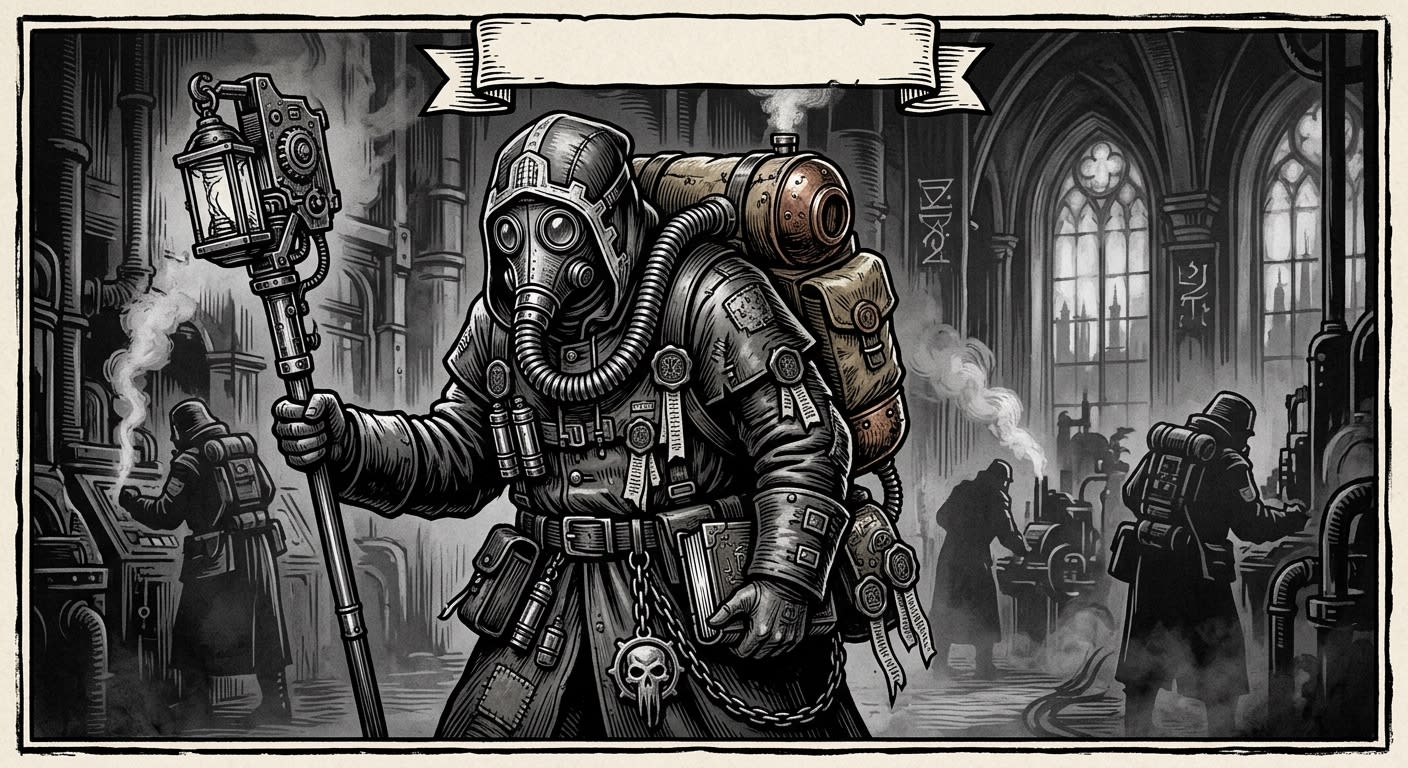
One recognizes an Oaths Witnesser before one meets his eyes. There is the cord-sash first: heavy, knotted, often dark with years of handling, hung from shoulder to hip like a visible account of other people's failures. There are the gloves, kept cleaner than the neighborhoods through which they move. There is the lead tablet or vow-slate, depending on district protocol, and the pouch of wax, seal-cord, token blanks, registry slips, and brine ampoules. Some carry a small bell-charm, not for ornament but to mark the closure of recitation phases. Others wear half-masks at breach rites, less for contagion than for dignity. A face should not always be offered to grief.
The Witnesser works in chapels, registry annexes, guildhalls, side-courts, military barracks, sickbeds, alley rooms hired by the desperate, and graveyards reserved for formal dissolution. He witnesses marriages, guild adhesions, debt covenants, adoptions, truces, appointments, mercy bargains, military enlistments, inheritance settlements, and those shadow agreements the state condemns doctrinally while depending on them operationally. If two factions wish to stop killing each other for a week, they call a Witnesser. If a widow is to be remarried before the property freezes, they call a Witnesser. If a condemned officer wishes to swear his son into service before dawn, they call a Witnesser. If smugglers require a pact that can survive a knife-fight, they call a Witnesser and bar the windows.
Before duty he rinses mouth and hands in brine. He reviews the records of the parties: debts, prior bonds, flags, censures, questionable dissolutions, family disputes. He verifies identity. He asks the private questions required by coercion protocol. He notes posture, tone, delay, glance direction, lexical hesitation, the insertion of clauses too polished to be sincere. Then the vow is spoken. Then tokenization. Then entry into the local register. Then forwarding, duplication, sealing, eventual absorption into the Registry of Bonds beneath Strasbourg, where memory ceases to be local and becomes, therefore, law.
What matters is that he is present. The Witnesser is a living seal, and the human body was chosen not because it is incorruptible but because its corruptions are legible to trained authority. A forged stamp says nothing. A sweating groom, a bruised widow, a merchant who says voluntary too quickly — these say a great deal. The Bureau, to its credit, noticed that speech can be audited in ways ink cannot. The Bureau, to its eternal shame, also noticed that this makes speech easier to weaponize.
#On the Order of His Day
Routine is the true architecture of dominion.
The novice imagines the Witnesser lives among extraordinary scenes — betrayals, reconciliations, solemn candles, lovers weeping over vows they will spend the next twelve years resenting. This happens, certainly. But empires are not sustained by exception. They are sustained by repetition so meticulous it begins to masquerade as nature.
At morning bell the Witnesser reports to district registry. Assignments are distributed according to urgency, social rank, and which neighborhoods are currently lying most profitably. Midmorning belongs to marriages, adoptions, and property settlements, where incense and anxiety mingle in equal measure. Midday belongs to guild contracts and debt instruments, during which the parties pretend economic coercion is distinct from moral freedom because the forms require that distinction. Late afternoon is for court-ordered renewals, military attestations, and the correction of vows earlier witnessed under procedural defect. Night is for what daylight is too proud to admit exists: gang truces, smuggler accords, back-room witness swaps, mercy bargains in plague districts, and those terminal promises uttered at cotsides when the dying suddenly discover posterity.
There is always a moment when somebody stumbles over the prescribed lines. That is the heart of the profession. The stumble may mean nerves, deceit, resistance, confusion, grief, drunkenness, terror, or merely the ordinary human incapacity to say life-shaping words cleanly when required. The Witnesser must decide whether to halt, repeat, amend, postpone, or proceed. A weak Witnesser is ruled by sympathy and thus useful to patrons. A rigid Witnesser is ruled by form and thus useful to bureaucrats. The best sort — the most dangerous sort — knows exactly how much mercy procedure can bear without losing its teeth.
The profession measures itself by validity rates, coercion compliance, record completeness, breach processing speed, and the number of vows later overturned. These are official metrics, which is to say, partial truths arranged under headings. The real measures are quieter: how often the local guilds request a particular Witnesser, how rarely a family dares dispute his notes, how many district judges accept his cadence assessments without re-hearing the parties, how many corpses result from vows he validated, and how many of those corpses can be blamed on someone else.
#On the Token and the Ledger
What is tied on the day may strangle years later.
The public imagines that the vow itself is the climax. This is sentimental nonsense. The vow is raw material. The true work begins after the words have been spoken and while they can still be converted into instruments.
Every witnessed oath produces artifacts. There may be a waxed knot-cord, a stamped slip, a breath-vial, a seal-head impression, a slate notation, a witness ledger entry, a district duplicate, and an escalation notice if the bond touches land, title, command, or relic transport. Regions vary in ceremony, but all roads run beneath the same vault. The Witnesser notes the exact wording and the exact conditions. He records whether the vow was mutual, asymmetrical, coercively harmonious, penitential, martial, provisional, or burial-bound. He identifies enforcement hooks — who is notified upon breach, who profits by continuation, who inherits the obligation if the speaker dies improperly, and what category of dissolution can later be requested. He decides, in short, what shape the promise will take when it begins to rot.
All such instruments converge conceptually upon the Ledgers of Fidelity, those black-bound sub-vault books in Strasbourg where sworn language is preserved with the tenderness some provinces reserve for saints' bones. An annulled oath is not erased but struck through in red. This matters. The Bureau does not forgive by forgetting; it governs by remembering visibly. The struck line is a scar, not an absence. Every dissolved bond remains legible to later readers, later auditors, later enemies, later spouses, later children seeking to understand why the family house changed hands after vespers in A.S. 143. The Witnesser knows this while he writes. So do the parties, usually. The room becomes very honest for a moment. Then it closes.
There are rumors — and because they have persisted through nine purges I grant them a degree of bureaucratic plausibility — of a restricted register beneath even the ordinary vaults, a ledger for vows expected but never spoken, alliances withheld, promises strategically omitted, silences whose legal consequences proved too substantial to leave unclassified. If such a book exists, it would be the purest expression of the profession: not the management of speech, but the filing of refusal itself. A magnificent obscenity.
Popular devotional leaflets continue to describe vow-tokens as "sacred keepsakes of mutual faith."
This is imprecise to the point of fraud. They are enforcement instruments with devotional styling. Citizens are encouraged to treasure them accordingly.
#On Coercion, Scandal, and the Widow-Bond Cases
The question is never whether pressure exists, but whether it has been correctly licensed.
No profession devoted to validating consent can remain innocent for long. The Oaths Witnesser stands too near desperation, property, family panic, military necessity, and doctrinal theater to avoid corruption; indeed, the wonder is not that the office produced scandals but that it limited itself to so few famous ones.
The classic disgrace remains the Widow-Bond cases, in which licensed Witnessers certified the vows of recently bereaved women whose grief, debt, and political vulnerability had been arranged into matrimonial transfer mechanisms. Estates moved. Signatures held. Protests failed because the forms were immaculate and the Witnessers present had attested, in flawless doctrinal prose, that no unlawful coercion had occurred. The scandal embarrassed the Bureau not because it had enabled predation — every Bureau does that somewhere — but because it had enabled predation without preserving plausible spiritual superiority. This was corrected.
From those cases emerged the coercion protocols now cited so proudly in training manuals and so selectively in practice: private pre-vow questioning, mandatory pause intervals, witness notation of unsolicited tears, bruising, intoxication, script prompting, and patron interference, plus the authority to suspend ceremony if cadence and circumstance diverge too violently. These reforms are often praised as evidence of the Bureau's moral seriousness. They are better understood as evidence of the Bureau's instinct for preserving monopoly. If unofficial street-notaries and black-market bondmakers could promise cleaner justice than the state, the state had a legitimacy problem. Therefore the state discovered ethics. One should not be cynical about this. Cynicism suggests surprise.
The Witnesser who applies these protocols too zealously is punished for delay, obstruction, and bad social reading. The Witnesser who ignores them too openly is punished for bringing internal methods into external scrutiny. The successful Witnesser learns the central administrative virtue of the Theocracy: to permit the correct amount of ugliness while maintaining immaculate paperwork. This is not hypocrisy. It is craft.
#On the Breach Rite and the Burial of What Was Promised
Breaks must be buried.
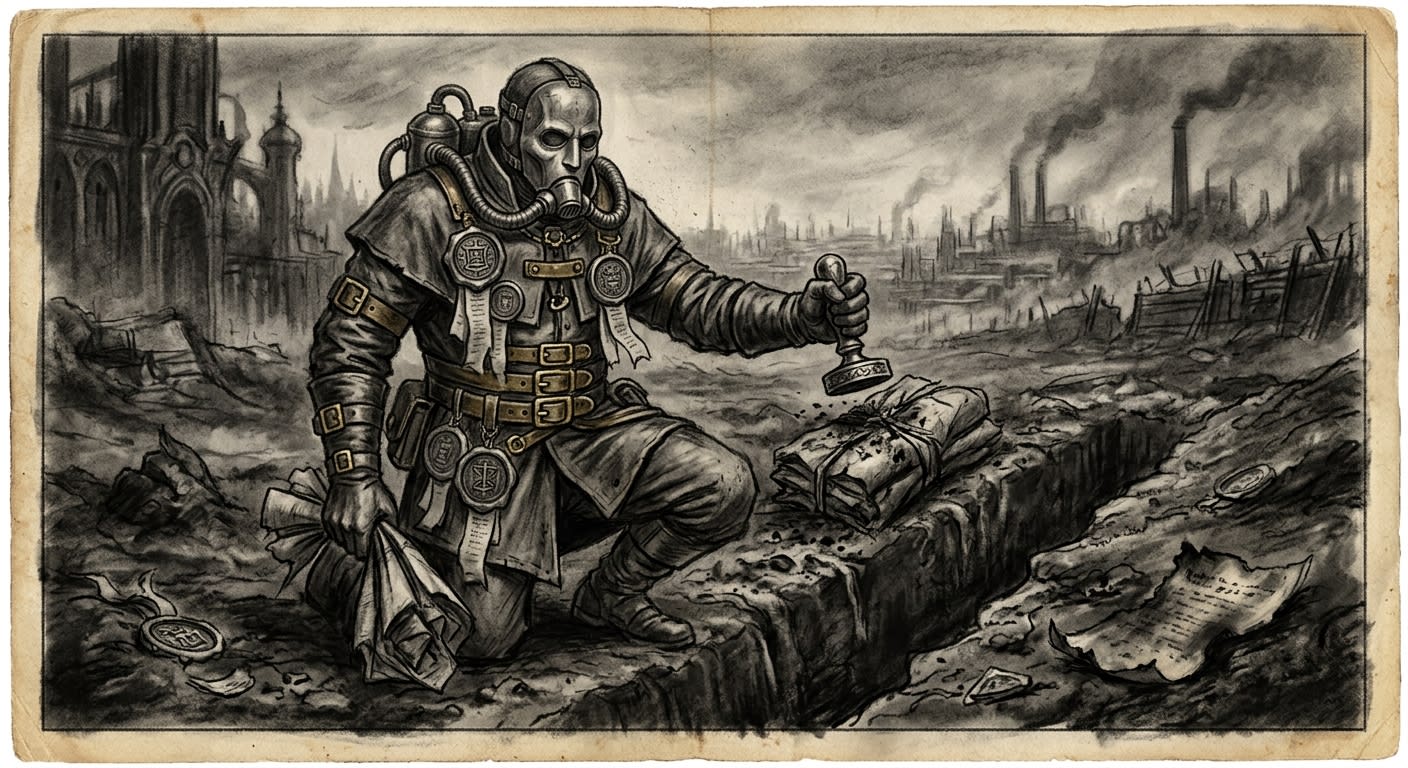
When a vow fails, the Witnesser's role does not end in testimony. It darkens. Broken promises are not, in Synodal thought, merely legal defects; they are spiritual ruptures with social aftershock. A debt covenant shattered in public can trigger violence. A marriage promise broken without rite can poison inheritance lines for a generation. A military oath denied under shellfire can spread faster through a trench than fever. The Theocracy therefore insists upon burial.
The breach rite is the profession's second office and its truest one. Marriage dissolutions, guild separations, debt severances, voided adoptions, annulled truces, rescinded commands — each has its own formula, materials, and authorized witnesses, but all culminate in the same act: the naming of the failed bond and the drawing of the red line through its record. Salt is often present. Torn cloth often present. Burned token fragments, iron filings, ash, and water depending on category. The parties must observe. Observation matters. The death of a promise, like the death of a body, is less governable if left to private imagination.
The Witnesser conducting such rites acquires a second reputation, usually less affectionate than the first. These are the Grave-Tongues, the Breach-Rite specialists, those officers called not to beginnings but to endings arranged with enough procedural gravity to prevent revenge killings before supper. They must speak the Dissolution Formula precisely. They must determine whether the breach is curable, penitential, punitive, or terminal. They must know when to separate the parties before the red line is dry.
The military form is harsher. Under the Trench Last-Oath doctrine and subsequent martial clarifications, certain battlefield vows persist beyond bodily death, and certain breaches invite sanctions whose theatricality is part of their utility. A deserter buried under silence is not merely punished but annotated. A mutinous officer stripped of his oath before witnesses loses not only command but narrative coherence; he is no longer what he was saying himself to be. The Witnesser assists in this reduction with chilling professionalism. To bury what was promised is to control what may be remembered.
A.S. 134 — District Breach inquiry concerning a covenant that resisted dissolution, the red line failing thrice to adhere to the folio despite correct inks, seals, and witnesses. The parties were subsequently separated by order of ███████. One died. The bond did not.
#On Personal Cost and Professional Deformation
He hears too much to promise easily himself.
A profession shapes the face around it. One can identify miners by the chest, cavalry officers by the knees, tithe-assessors by the eyes. Witnessers are known by their listening. They develop the mild lean of those who stand in doorways without entering scenes emotionally; the patient stillness of people who know silence extracts confession more efficiently than accusation; the dangerous habit of hearing subtext in every domestic exchange until ordinary speech itself begins to feel like pre-litigation.
The office is corrosive to intimacy. Witnessers are taught early that unwitnessed promises are vapor and witnessed promises are traps under management. They know how often lovers lie, how often brothers collude, how often guilds use piety to disguise extortion, how often dying men promise restitution they have no earthly mechanism left to provide. Such knowledge does not make one wise. It makes one structurally inconvenient at supper.
Many develop small devotions and smaller insanities. They wash their ears after breach rites. They refuse uncovered mirrors in oath-rooms. They distrust vows spoken after dusk. They carry salt sachets or bark strips or tiny bells, each object part superstition, part procedural memory, part private resistance to the fact that language has become their trade and therefore can no longer be entirely their own. Some stop making promises in personal life. Some promise recklessly, assuming they can hear the fracture before it comes. Some cultivate a tone of unbearable gentleness that terrifies districts more effectively than shouting could. The manual calls these tendencies occupational drift. The districts call them haunted.
And yet the profession attracts a certain temperament with remarkable consistency: the calm, the observant, the emotionally scarred but administratively competent, the sort of soul that can stand beside a bed while an orphan is adopted, a widow remarried, a debtor bound, a soldier sworn, and a gang truce struck, all before the fourth bell, and still maintain a hand steady enough to note whether the phrase of my own free will landed on the first beat or the third. The Witnesser does not need to love order. He needs to understand what disorder costs.
#On Shadow Witnessing and the Underworld Use of Legitimacy
The state condemns the black market most fiercely where it relies upon it most intimately.
There are tolerated Witnessers and there are unofficial ones, and the distinction depends less on doctrine than on who can be embarrassed at the next audit. In alley districts, smuggler rings, refugee hostels, plague lanes, and frontier settlements where official presence arrives too late or too expensively, shadow covenants proliferate. Debts are sworn without filed duplicates. Safe-passage pacts are sealed with token copies stolen from earlier ceremonies. Gang truces are witnessed by retired clerks, disgraced assistants, or licensed men taking side fees under hooded lanterns. Such vows are denounced publicly and relied upon privately by every serious operator west of the Line.
The Witnesser thus inhabits a secondary economy of validity. He may be summoned by men who cannot survive exposure and by women whose legal existence depends on an agreement the Bureau must never acknowledge making possible. He may witness a mercy bargain for a deserter in a room where all parties understand the state will later deny the room existed. He may attend a truce between the The Black Ledger and a ward prefect, both speaking in the courteous tones of mutual loathing. He may validate the transfer of children through routes the Bureau of Pilgrimage officially prohibits and operationally profits from. The files on such matters are always beautifully incomplete.
This ambiguity does not weaken the profession. It enlarges it. A monopoly on legitimacy is most impressive when it can be rented unofficially. The Oaths Witnesser carries not merely doctrinal authority but a certain transferable gravity. Even criminals, especially criminals, desire records that may one day be invoked. The grave has many clients.
#On the Present Office and Its Distempers
The vow remains healthy. The world around it is not.
In A.S. 201 the office persists in outward vigor and inward strain. The wars have multiplied mass enlistments beyond the comfortable capacity of individual cadence recording. District registries are overburdened. Batch-sworn soldiers pass through ceremonial bottlenecks faster than doctrine prefers. Marriage markets are distorted by displacement, widowhood, ration politics, and administrative redrawing. Debt covenants now regularly contain clauses touching food access, housing permits, burial rights, transport priority, and kin exemptions that would once have required separate bureaus to validate. In short: the Witnesser is being asked to bind more of life, more quickly, under conditions less conducive to honest speech than at any time since the profession's founding. Strasbourg calls this heightened relevance. The districts call it suffocation.
The Bureau's present enemies are correspondingly modern. There is the forged token. There is the patron-saturated contract whose coercion is technically deniable. There is the vow that arrives already contaminated by heretical counter-forms — especially where the The Velvet Choir and related seduction cults have taught men to treat private promise as a sacrament superior to public registration. There is the acoustic problem of frontier sectors such as Bastion-Irongate, where tap-code, tunnel-sign, and vibration protocols create enforceable bonds without ordinary spoken cadence, insulting the Bureau's theological architecture by functioning at all. There is, too, the quiet spread of administrative fatigue: too many ceremonies, too few officers, too much pressure to validate first and scrutinize later.
Yet the office will endure. Of course it will endure. Societies at war do not abandon binding technologies; they refine them. The Witnesser may change token format, registry medium, or coercion questionnaire, but the central truth remains: no state as suspicious as ours can leave promises unattended. Somebody must stand in the room. Somebody must hear the words. Somebody must write down exactly how the future was mortgaged at 3rd bell on a rain-soaked Thursday while the parties believed they were merely speaking.
That somebody is the Oaths Witnesser.
And when the vow fails — as so many do — he will still be there, patient as a shovel.