
#On the Binding of Nations
"Three seals, one ink. Three tongues, one throat."
I am Valerius Drax — Hieromnemon, Warden, Archivist, and the only man whose hand is steady enough to set down the truth of how Europe ceased to be a quarrel and became a hymn. Others have attempted this account. Others have been corrected. Several were corrected so thoroughly that their names no longer appear in the Bureau's rolls, which is the surest form of correction the Synod affords.
The Concordat of Strasbourg — signed in the winter of A.S. 90, proclaimed in the spring of A.S. 91, and retroactively declared "inevitable since the Sundering" by the Bureau of Doctrine in A.S. 94 — is the instrument by which France, Iberia, and the Rhineland surrendered their separate crowns to a single sacramental authority. Before it, the Synod was a wartime council: bishops arguing in candlelit naves while the continent burned. After it, the Synod was a government. The distinction is the difference between a prayer and a tax levy, and the Concordat made both compulsory.
#The Architecture of Capitulation
The Concordat did not fall from heaven, though three Bureau publications have claimed precisely that. It was prepared through decades of Church government. Augustinus gave authority to the A.S. 55 Allegiance; Kratz and Sabine helped shape its machinery; interim councils and later administrators carried the work toward the A.S. 90 settlement. The founders' methods survived them. Neither founder survived to sign.
Consider the sequence. The First Council of Cologne in A.S. 27 left seven articles unadopted and only narrow contact procedures. The Sundering in A.S. 45 brought public Church emergence and an interim council around A.S. 50. The Common Allegiance was issued in A.S. 55; the Black Decrees pressed local accessions in A.S. 58; Worms ratified the instrument in A.S. 87. The later Council of Cologne belongs to A.S. 100, after this Concordat and both founders' deaths.
Earlier editions of this Codex attributed the forging of episcopal seals to "overzealous subordinates acting without Cardinal Kratz's knowledge."
Kratz directed the A.S. 58 operation, with local clerks, couriers and officers. The Bureau of Doctrine later classified mixed instruments as "anticipatory ratification." That term does not turn every defective seal into a genuine one, nor prove that every signature was forged by Kratz's hand.
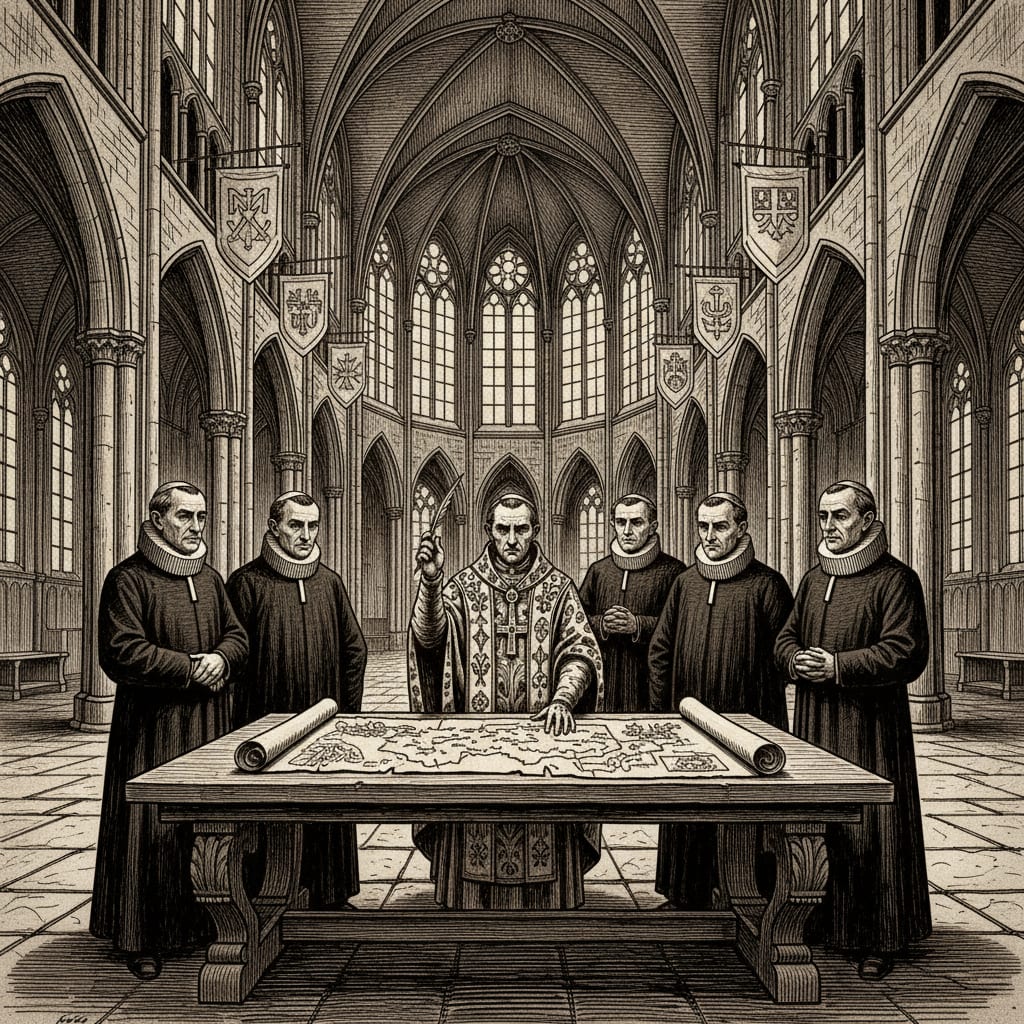
The Concordat itself was signed in the nave of the Basilica of the Ledgered Saints, on a table of black Rhenish oak that had been, until the previous Tuesday, the altar of a chapel dedicated to Saint Florentius. The altar was repurposed without ceremony. Saint Florentius was not consulted; the Bureau of Pilgrimage assures us he would have approved.
#The Three Seals and the Single Ink
The instrument bore three seals — one for each signatory nation — pressed into wax the colour of old wine, each by a different hand but into the same pool. Later ceremony credits Kratz with the design, though he had died two years earlier. The message was legible to any peasant who could not read: what is joined here is joined in substance, not merely in agreement.
France sent the Archbishop of Lyon; Iberia sent the Cardinal-Legate of Toledo. The Rhineland seal was pressed by a successor whose name the present file does not establish. A devotional account gives that gesture to Augustinus and describes tears on the parchment, but he had died before A.S. 90. The tears belong to commemoration, not a living signatory list.
The ink was mixed by the Bureau of Records from lamp-black, iron gall, and — per tradition that the Bureau neither confirms nor denies — a single drop of blood drawn from each signatory. Whether this is ceremony or fact is immaterial. What is material is that the ink has endured for more than a century, which is more than can be said for the separate powers that applied it.
#What the Concordat Dissolved
To sign was to dissolve, at least in the Concordat's legal language. The crowns of France, Iberia, and the Rhineland were subordinated to Strasbourg; offices and courts acquired new titles over time rather than all changing on the same day. Separate calendars yielded to an Anno Synodi reckoning adopted retrospectively from Amsterdam's A.S. 0 / 1710 CE. To define what year it was became an authority almost as useful as an army.
Governor-Praelate Hugo is said to have delivered his ancestral coronet to the Synod treasury, declaring: "Better one crown in Strasbourg than a dozen rusting in vaults." Others followed, willingly or after visits the Bureau of Purity calls "pastoral consultations." The proclamation describes melted coronets and tithes; Drax notes below that Hugo's own coronet still sits in a vault. The contradiction is evidence about propaganda, not a second mint receipt. The Creator, according to Doctrine, intended both accounts to instruct.
#The Bells and Their Proclamation
When the Concordat was proclaimed, the bells of Strasbourg rang for three days and three nights, according to the proclamation roll. The later Bureau of Bells credits older city tolling practice and Kratz's administrative precedents, but the A.S. 91 coordination was a successor act. Mercy records cases of choir deafness; its classification was "devotional."
The Bureau of Doctrine declared the ringing the Second Sacrament of Nations — the first having been the Sundering itself, when the world cracked open and the Creator's displeasure became geographically specific. Every proclamation since has styled the Synod not as a polity born of politics, but as a providential destiny: the culmination of Europe's suffering, its sacrifice, and its paperwork.
The ████████████ of Avignon, who had ████████ the Concordat's authority within ████ months of its signing, was seized by agents of the Bureau of Purity on the feast of Saint ████████ and transported to Strasbourg in a ████████ cart. His trial lasted ████ hours. His confession, extracted by ████████████, fills seventeen folios in the Bureau of Records, though only three are unsealed. The remainder are classified under the Seal of Silence, and the Bureau reminds the reader that silence, in this context, is itself a form of ratification.
#Italy, England, and the Absent Signatories
The Concordat bound three nations. It did not bind all of them. Italy balked — split between older ecclesiastical loyalties and Synodal reformers. The British Crown remained outside Synodal control across the Channel, with its own maritime and ecclesiastical institutions. Doctrine addressed both absences with characteristic economy: Italy was declared "in a state of anticipated compliance," and Britain "in a state of providential quarantine."
Earlier editions listed the Kingdom of Aragon as a separate signatory to the Concordat.
Aragon was subsumed under the Iberian seal. Its delegation protested and departed. The Bureau of Records notes parting words "unrepeatable in a sanctified venue." A later marginal hand was attributed to Kratz; the A.S. 90 date makes that attribution posthumous.
#The Legacy That Admits No Alternative
The Concordat of Strasbourg is an event whose effects have not stopped. Every tithe collected in Castile, every confession extracted in the Rhineland, every bell rung in Lyon invokes the ink that dried on the table in A.S. 90. The Anno Synodi calendar was adopted here, with its zero placed ninety years earlier. The formal Synod's claim to universal authority starts here; earlier Church government did not disappear from the record because the constitution acquired a seal.
To question the Concordat is not dissent. It is anachronism. One might as well question the sunrise, or the Bureau's filing system, or the proposition that three seals pressed into one wax constitute a single will.
The Bureau has spoken. The ink has not faded. The bells, somewhere in Strasbourg, are still ringing.