

#On the Nature of the Spoken Bond
I have been asked — by a young cleric of middling intelligence and boundless impertinence — why the Synod requires a Bureau dedicated to something so elementary as a promise. "Surely," he said, blinking with that guileless vacancy the seminaries seem to cultivate, "a man's word is his own." I had him reassigned to the Breach Rites division within the hour. He writes to me occasionally. The letters grow shorter.
A promise un-heard is vapor. This is the foundational axiom of the Bureau of Oaths, and I confess I find it beautiful in its brutality. The Rationalists, in their infinite wisdom, believed that contracts required only parties, terms, and ink. They trusted the signature. They trusted the seal. They trusted, the Creator help them, the individual. And so their Republic lasted fifteen years before their own generals broke faith and their own councils dissolved into mutual accusations of bad bargaining.
The Bureau of Oaths trusts nothing but presence. A trained witness, standing in the room where the words are spoken, hearing the cadence, watching the hands, recording the breath — this is what makes a vow real. Everything else is theatre.
#On the Founding and Its Instruments
The Bureau was constituted in A.S. 92 alongside its siblings, but its roots sink deeper than any charter. Oath procedures operated in the wartime Church and interim government. The later Black Decrees of A.S. 58 belong to the Retreat era, after the Atheist Wars of A.S. 10–30. Kratz's couriers carried a mixture of authentic, conditional, premature, and forged instruments to accessible jurisdictions; their reach was substantial but not universal. The Bureau's own origin stories variously credit Kratz, Augustinus, or an unnamed Worms clerk with recognizing that the oath itself could govern.
The formal constitution came later. The Council of Worms ratified the earlier Allegiance in A.S. 87; the Concordat of Strasbourg established permanent legal architecture in A.S. 90; and the Bureau of Oaths received its charter in A.S. 92, quiet as a Witnesser at a deathbed. The Ledgers of Fidelity — seven hundred volumes and growing, stored in the sub-vaults of the The Basilica of the Ledgered Saints — contain the signatures of Hierarchs and shepherds alike, each bound under the same crimson seal.
Its first significant act was the annulment of the League of Milan in A.S. 97, a year when the Bureau's mandate was still infant-fresh and half the Lombard cities believed themselves exempt from northern ecclesiastical jurisdiction. The Bureau dissolved an alliance of fourteen cities with a single stamp and a five-page writ that took three years to draft and six hours to enforce. The League's ambassadors arrived in Strasbourg to protest. They found their names already entered in the Ledger of Dissolved Compacts, their seals already filed under "Void — Administrative Correction." One ambassador, the Conte di Sforza, is reported to have wept. His tears were noted by the Witnesser present. They are now evidence.
#On the Witnesser and His Office
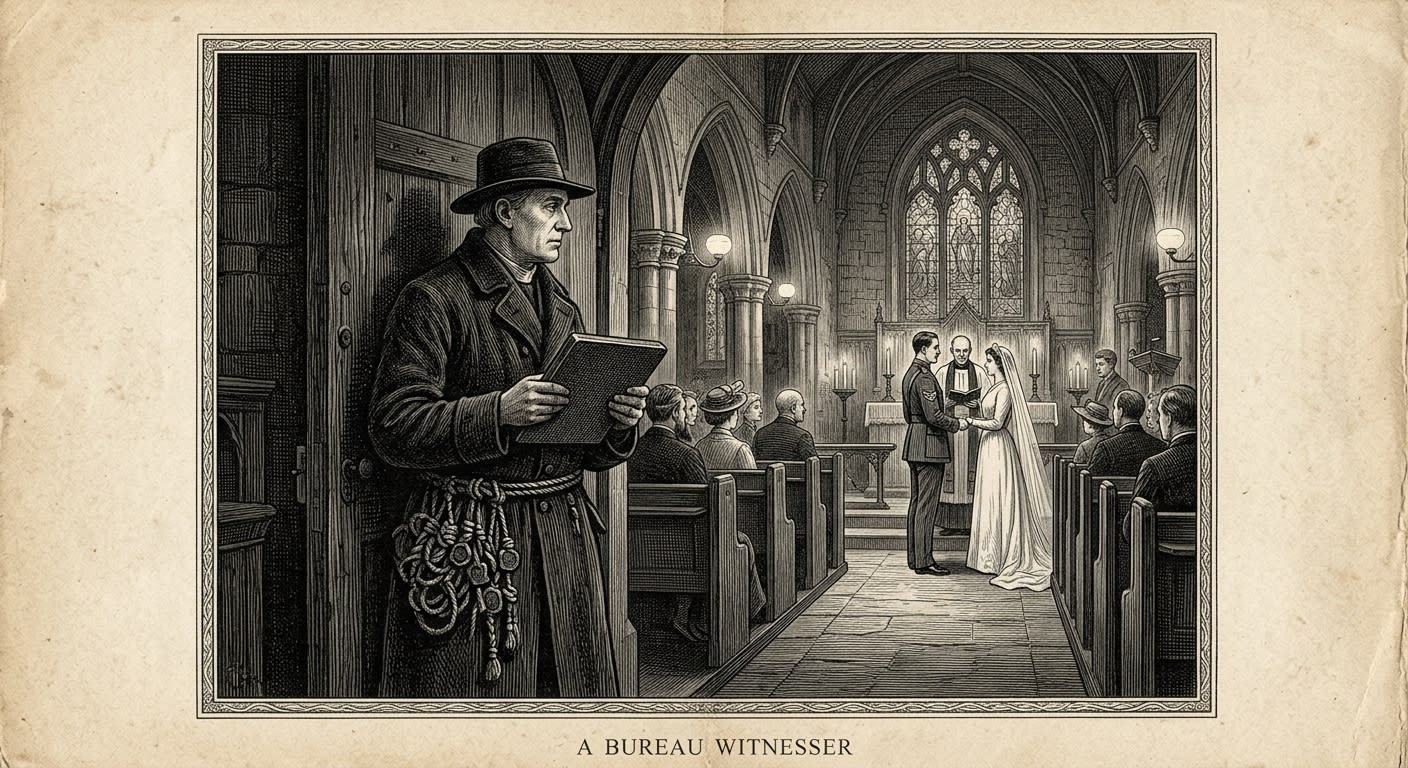
The Bureau's officers are called Witnessers, and they are, I submit, among the most quietly terrifying human beings the Synod employs. They do not speak during ceremonies. They do not counsel. They do not bless. They stand. They watch. They hold their lead tablets — heavy things, sized for a man's palm, cold as a magistrate's regard — and they listen.
A Witnesser is dispatched to every public oath-taking within the Theocracy. Every marriage, every guild bond, every land sale, every military commission, every debt covenant, every adoption — all require the silent presence of a Bureau officer. In the countryside, no betrothal proceeds without one. In the cities, no contract is signed without that distinctive cord-sash visible in the doorway. A marriage unwitnessed is a marriage void. A contract unwitnessed is fraud. An oath unwitnessed is, in the Bureau's precise and horrible formulation, "merely breath, and breath is not legally binding."
They begin their shifts with a brine rinse — mouth and hands — and the recitation of the Witnesser's Line: "I hear clean; I bind clean." They carry oath scripts, seal cords, wax, knot-tokens, and vow-slates. The more senior among them carry coercion checklists, though these are — I am informed by a District Oath Notary of my acquaintance — "largely performative, unless the auditors are watching." The junior ranks are called Vow Runners and Token Clerks. The mid-ranks divide into Chapel Witnessers, Guild Witnessers, and Debt Witnessers. The seniors hold the title of District Oath Notary or Court Witnesser. And at the apex, handling bonds between nobles, between relic-chains, between powers that could topple provinces — the High-Bond Witnessers and the Breach-Rite Specialists.
The street calls them Vow-Anchors, Breath-Sealers, and Knot-Callers. The unkind call them Curse-Midwives, Promise Vultures, and Grave-Tongues.
I call them necessary.
#On the Ledgers of Fidelity
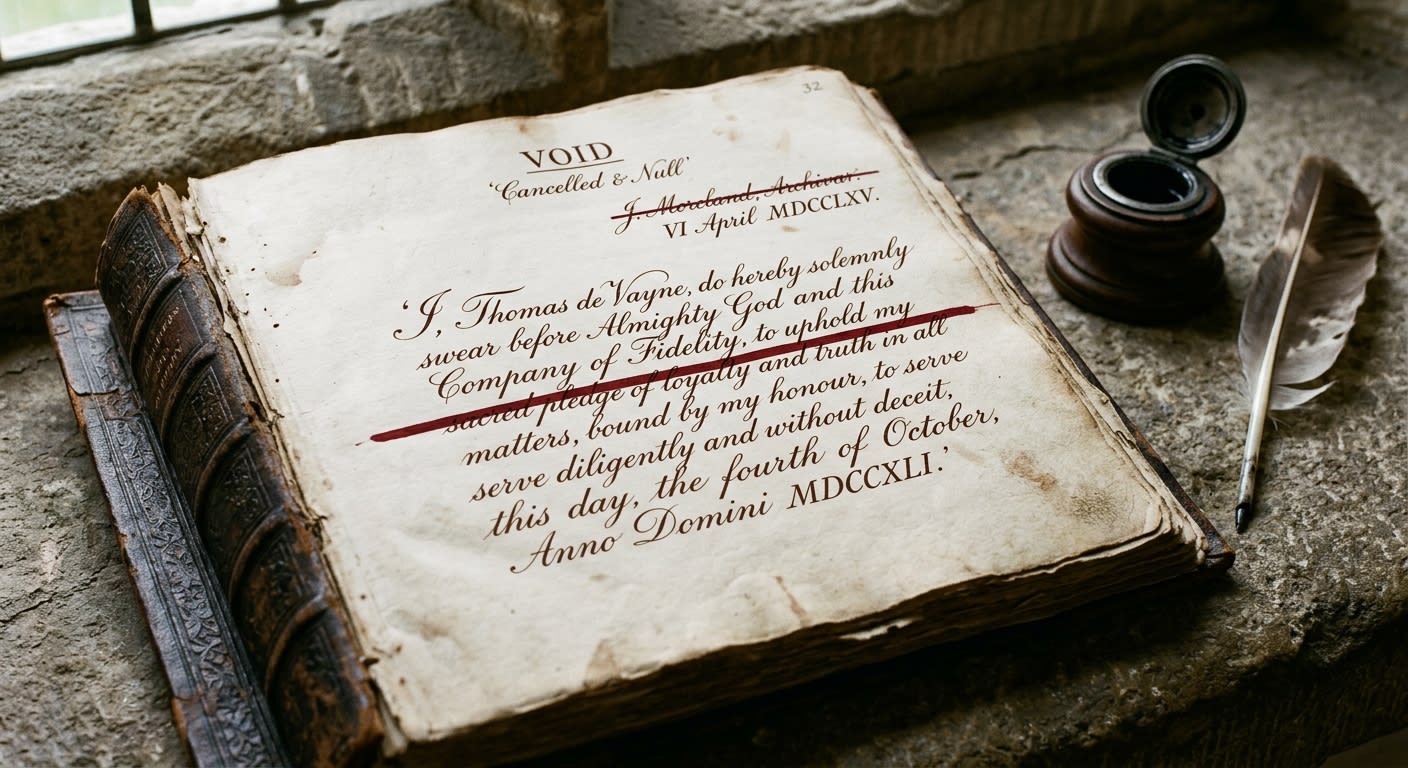
The Ledgers are the Bureau's sacred instruments and its claim to permanence. Seven hundred volumes occupy the sub-vaults beneath the Basilica, each bound in black calf-leather with brass clasps and crimson thread. Every oath sworn under Synod jurisdiction since A.S. 92 is recorded here — the exact wording, the conditions, the identity of the parties, the name of the witnessing officer, the date, the bell that tolled as the vow was sealed, and a brief notation of cadence. That last detail — cadence — is the Bureau's particular innovation. A Witnesser trained to the senior ranks can detect, in the rhythm of a man's speech, whether the vow is given freely or under duress. Whether this talent is genuine or merely an institutional fiction serving to justify the Bureau's monopoly is a question I decline to answer in print.
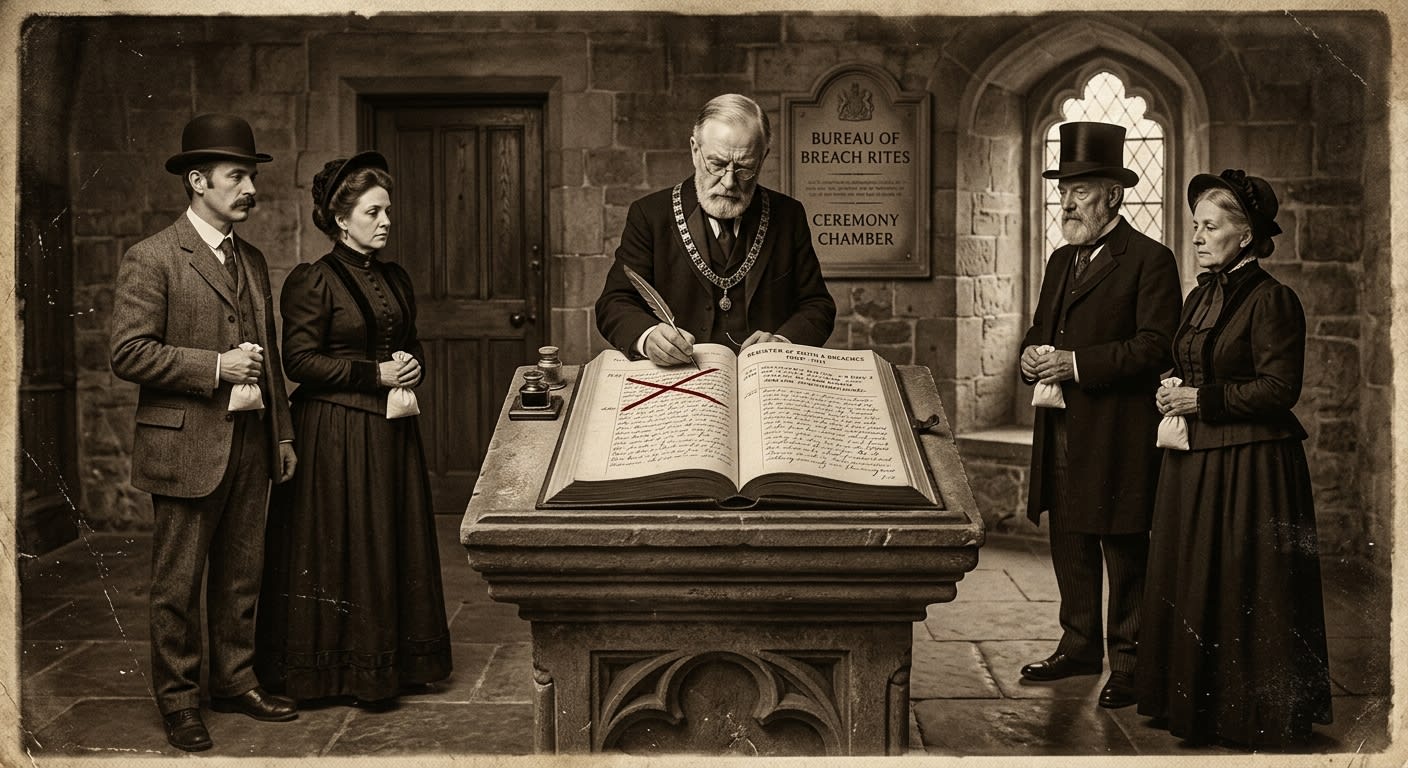
The Ledgers are never destroyed. An oath annulled is not erased but struck through with a single line of red ink — visible, legible, merely void. The Ledger remembers what the parties would prefer to forget. This is by design. The Bureau maintains that memory is itself a form of enforcement: a man who knows his broken vow remains recorded in perpetuity beneath Strasbourg's vaults will hesitate before breaking another.
There is a separate archive — the Ledger of Dissolved Compacts — for annulled treaties, expired guild bonds, and voided marriages. It occupies forty-seven volumes. The Bureau's archivists refer to it, with the black humor of their profession, as the Graveyard.
And beneath even that — sealed, restricted, requiring the personal authorization of the Synod Registrar of Bonds — lies the Ledger of Oaths Unspoken. I am told it exists. I am told it contains names. I am told that its function is to record vows that should have been sworn and were not — promises expected by the Bureau that never materialized, silences that constitute, in the Bureau's interpretive framework, a species of perjury. I have not verified this. The Bureau declines to confirm.
Earlier editions of this entry stated the Ledgers numbered "approximately four hundred volumes."
The correction to seven hundred reflects the Bureau's accelerated registration activity since the Third Census of A.S. 130. The Bureau notes that the discrepancy is not an error but "a measure of the Theocracy's growing fidelity." The Bureau of Doctrine notes that it is also a measure of the Bureau's growing appetite.
#On the Theology of the Vow
The Bureau's doctrinal position, refined across a century and a half of increasingly baroque theological argument, holds that the spoken vow is a sacramental act. When a vow is spoken, the ink of Heaven dries upon the tongue. This is stated as metaphor by the Bureau's official catechism and treated as literal fact by its enforcement division. The distinction, as with so many Bureau pronouncements, is jurisdictional rather than theological.
The vow binds not because the parties intend it — intention is unreliable, mutable, human — but because it was heard. Heard by the Witnesser. Recorded by the Bureau. Filed in Strasbourg. Once the words pass the lips in the presence of a licensed officer, they belong to the Ledger. They cannot be unspoken. They can be annulled, yes, through a process requiring three counter-signatures, two witnesses to the annulment, a filing fee denominated in salt, and a period of "penitential silence" lasting no fewer than forty days. The Ledger does not forget, and neither does Heaven.
This theology has consequences. A marriage vow unregistered in Strasbourg is no vow at all — the Bureau considers the parties cohabiting sinners rather than spouses, their children illegitimate, their property held in mutual trespass. Lovers who whisper pledges in shadow are heretics. The wedding rite demands two ledgers bound together by scarlet wax, sealed with bell peals that echo through every parish hall. To refuse this ritual is to refuse the Dominion itself.
The military application is more direct. Every soldier swears the Oath of the Line before deployment — a formula recited in the presence of a Witnesser, binding the recruit to service, to obedience, to the bell-schedule, and to death if the Synod requires it. The Trench Last-Oath Doctrine, formalized after the Breach Plagues of A.S. 112, holds that a soldier's vow is binding beyond death. His ghost, should it linger, remains sworn. His name, should it reappear on a roster (and at several bastions it has), remains under Bureau jurisdiction. The Bureau of Oaths does not recognize death as grounds for contract termination.
#On Breach and Burial
When an oath breaks — when a man forswears his word, when a marriage dissolves in mutual contempt, when a guild bond is violated, when a soldier deserts — the Bureau does not merely record the failure. It buries it.
The Breach Rites are the Bureau's most solemn and least discussed function. They are, in the precise formulation of the Breach-Rite Witnessers who conduct them, "the funeral of a promise." The ceremony varies by the category of the broken vow — military oaths requiring iron and ash, marriage dissolutions requiring water and torn cloth, guild betrayals requiring the physical destruction of the original token in a sanctified brazier — but all share a common structure. The broken oath is named aloud. The parties are identified. The Witnesser speaks the Dissolution Formula. And the record in the Ledger is struck through with red ink, a single horizontal line, drawn in the presence of the parties who must watch.
For soldiers who break their oaths, the punishment is specified in the Martial Code: gagged and buried alive, their silence notarized as final testimony. The Bureau insists this penalty is "rarely applied in the present era." The Bureau also insists this does not constitute a statement about whether it has never been applied in the present era. The distinction is, again, jurisdictional.
The Breach Plagues — a series of outbreaks of communal violence in the years around A.S. 110–115, attributed by the Bureau to a concentration of broken oaths generating "spiritual rot" in the urban fabric — prompted the formalization of the burial rites and the establishment of the Breach-Rite Witnesser as a specialist rank. The Bureau's position is that unburied oaths fester. That broken promises, left unrecorded and unceremonized, poison the ground on which they were spoken. That a district with too many unresolved breaches will, in time, produce violence, plague, or — in the worst cases — manifestation.
Whether this is theology or policy is a question the Bureau has declared "administratively irrelevant."
#On the Forgery Years and the Widow-Bond Scandal
The Bureau's early decades were shaped by crisis. The Forgery Years — the period immediately following the Bureau's constitution, when the old networks of unregulated oath-making still persisted — saw an epidemic of false marriages, counterfeit adoptions, and fraudulent guild bonds. Men sold certificates of fidelity. Women purchased proof of widowhood. Guild-masters forged apprenticeship oaths to claim workers they had never trained. The system the Bureau inherited was a marsh of competing claims, rival notaries, and contradictory records — and into this marsh the Bureau drove its Witnessers like drainage stakes.
Standardization was brutal. The Bureau revoked the authority of every oath-officer who had not been licensed under the new charter. It seized and impounded the records of eighteen independent notarial guilds. It declared every oath sworn without a licensed Witnesser "provisionally void pending re-registration" — a stroke of administrative genius that forced half the Theocracy to re-swear their vows under Bureau supervision within a three-year period. The re-registration fees alone funded the Bureau's first permanent archive.
The Widow-Bond Scandal, somewhat later, revealed the darker possibilities of the system. Certain Witnessers — five confirmed, an estimated twelve more unidentified — had been validating forced marriages between wealthy men and recently bereaved widows, certifying coercion as consent. The widows' property transferred upon the vow. The vow, once witnessed, was binding. The Bureau's own instruments had become a mechanism of predation. The scandal prompted the introduction of coercion protocols — the private interviews, the checklist, the mandatory pause between presentation and recitation — that now form part of every Witnesser's standard procedure. The five confirmed collaborators were subjected to the Breach Rites themselves: their own oaths of office dissolved, their names struck from the Ledger of Active Officers, their tokens melted. One was immured. The Bureau does not discuss the others.
#On the Patron Saint and the Founding Myth
The Bureau venerates Saint Liora Knot-Hand, a figure of appropriately ambiguous historicity. She is said to have lived during the first years after the Sundering — the chaos period before the Concordat, when food was scarce, trust was scarcer, and communities splintered under the weight of mutual suspicion. Saint Liora, according to the Bureau's approved hagiography, bound an entire starving district into mutual aid using nothing but witnessed vows and a strip of cloth. She stood at each threshold. She heard each pledge — "I will share what I have; you will share what you have; we will endure together." She tied knots in the cloth for each sworn household. By the time the rations arrived, thirty families had survived on the strength of promises made visible.
The founding myth is simpler and older: "In the first siege, ink ran out. The faithful bound themselves with breath and witness, and the wall held." Whether this refers to an actual siege or to the spiritual siege of the The Atheist Wars is unclear. The Bureau has filed both interpretations under "Doctrinally Compatible" and moved on.
Saint Liora's feast day — the 14th of Ember — is observed within the Bureau with a ceremony in which each Witnesser re-ties a knot in their cord-sash while reciting the foundational axiom. New Vow Runners receive their first tokens on this day. Breach-Rite Witnessers, by tradition, fast.
#On the Bureau's Enemies and Its Fears
The Bureau of Oaths fears three things.
First: the forger. Despite a century of standardization, counterfeit witness-marks circulate. The Seal-Forgers of the underground — and the Bureau knows they exist, and the Bureau of Shadows declines to discuss why they are tolerated — produce tokens indistinguishable from the genuine article to any but an expert. A false witness-mark on a marriage bond means a family built on sand. A false witness-mark on a military commission means a soldier whose oath is not filed in Strasbourg — a man who could desert without his ghost being bound. The Bureau employs Token Examiners in every district. It is not enough.
Second: the echo vow. Reports have reached the Bureau — classified, suppressed, and therefore real — of oath-takings where the cadence of the spoken words does not match human speech. Where the Witnesser's lead tablet grows warm in the hand. Where the vow seems to accept itself — to bind before the Witnesser has spoken the Sealing Formula. The Bureau's term for this is "black cadence," and its standing instruction to any Witnesser who encounters it is immediate withdrawal, salt rinse, and a sealed report filed under Harmonic Classification, Category Two. The Bureau will not say what Category One looks like. The Bureau of Bells has been consulted. The Bureau of Bells has not replied.
Third: the oath that cannot be broken. There are, in the Ledger of Fidelity, vows recorded in the standard format whose parties have since attempted dissolution — who have filed for annulment, paid the fees, served the penitential silence, submitted to the Breach Rites — and whose entries in the Ledger refuse the red ink. The line will not be drawn. The ink pools and dries without adhering. The Witnesser assigned to the Breach Rite reports that the Dissolution Formula produces no resonance, that the ceremony "does not take." Seven such cases are documented since A.S. 134. The Bureau's official classification is "Binding Anomaly, Administrative." The unofficial term, used by Breach-Rite Witnessers among themselves, is "God's knot."
#On the Superstitions of the Trade
Witnessers are, as a class, superstitiously fastidious — which the Bureau attributes to "occupational sensitivity to symbolic resonance" and which I attribute to spending too many years listening to people lie.
They will not witness a vow in a room with an uncovered mirror. The horror story — and every Witnesser knows it — involves a ceremony in which the parties later claimed they had sworn different words, and the mirror, when questioned by the Inquisitor assigned to the case, "remembered" the false version. Whether this is metaphor or report depends on which Witnesser you ask and how much brine they have consumed that morning.
They wash their ears after breach rites. They keep salt sachets in their inner pockets. They refuse to witness vows after dark unless military necessity demands it — "never promise past dusk" being a professional axiom older than the Bureau itself. They treat their knot-cords as sacred objects, never cutting them, allowing them to grow over a career until a veteran Witnesser's sash hangs heavy with decades of accumulated bindings.
And they do not make promises in their personal lives. This is the cost of the profession. A man who spends his days hearing oaths sworn and broken, who witnesses the desperate and the coerced and the naive all binding themselves to futures they cannot see — such a man learns to keep his own mouth shut. The Bureau considers this a mark of excellence. "A Witnesser who swears nothing cannot be compromised," reads the training manual. What the manual does not say is that a Witnesser who swears nothing is also, in the Bureau's own theological framework, a man who does not fully exist.
#On the Present Condition
The Bureau of Oaths operates from the Registry of Bonds, a seven-storey granite annex to the Basilica of the Ledgered Saints, staffed by approximately four hundred officers across seventeen districts. Its current head — the Synod Registrar of Bonds — is a man named Aldric Venner, whom I have met precisely once and whose handshake felt like a contract. He said three words to me: "Your file grows." I did not ask for clarification.
The Bureau's present difficulties are threefold. The expansion of the war front has created a surge in military oaths that the existing Witnesser corps cannot adequately staff — soldiers are being sworn in batches of fifty, with a single Witnesser recording cadence for the group rather than the individual. The Bureau acknowledges this is "suboptimal." The Bureau also acknowledges that batch-sworn soldiers whose oaths were improperly witnessed may not be bindingly committed to service — a legal lacuna that the The Bureau of War has instructed everyone to ignore and that the Bureau of Oaths has noted in seven memoranda.
The Velvet Choir's infiltration techniques — which operate through escalating compromise, through whispered promises made in darkness without Witnessers present — represent a direct assault on the Bureau's authority. A vow made to Velkara's agents is, by definition, unwitnessed. And yet it binds. The Bureau's theological framework cannot account for vows that bind without Strasbourg's sanction, and the Bureau's response — to classify such bonds as "Heretical Compacts, Category One" and to subject anyone who admits to them to immediate Breach Rites followed by penance — has not slowed the Choir's recruitment.
And in the Underchords of Bastion-Irongate, where speech itself is dangerous, where wrong harmonics unseat gasket seals, the oath economy operates entirely in tap-code and written tokens — without the spoken word that the Bureau's entire theology requires. The Bureau has classified the Underchords' oath system as "provisionally valid pending acoustic survey." The acoustic survey has been pending since A.S. 199. The Bureau of Bells has expressed no interest in conducting it.
The Bureau of Oaths endures. It does not innovate. It does not expand. It merely records, and remembers, and waits for the world to break its promises. And then it buries them.
The preceding entry implies the Bureau of Oaths is "quiet" or "passive."
The Bureau clarifies that it processes an average of 11,400 oath registrations per quarter and conducts 340 Breach Rites annually. The Bureau is patient. There is a difference, and it is filed.