
#On the Present Examination
This survey was commissioned in A.S. 201 (1911 CE) to examine Form 17-K as Kraków applies it now, and it goes no further than that. The record proves two things about the instrument. It permits two different beginnings for the extinguishing of candles in the Vigil of the Drowned Priests, and it carries a compliance stamp of the Bureau of Bells setting out what may be heard during the Vigil's hour. The Ledger does not say who first issued the form, in what year or under whose hand, and I will not say it on the Ledger's behalf. In less forgiving offices, a Warden who invents missing provenance is called a forger.
Forty-seven is the number that governs the form. Forty-seven clergy were seized and drowned on 17 Martius A.S. 18 in the Night of Knives, and the rite requires forty-seven candles. That number is not a count of the form's pages or clauses, and it is not a fee. Clerks who find a number on a procedural instrument usually assume they are being billed. In this case they are being counted.
One of the Ledger's own descriptive chronologies dates the Night of Knives to A.S. 58.
Corrected. The murders took place on 17 Martius A.S. 18 / 1728 CE. The formal Vigil, under which Form 17-K now operates, was ratified in A.S. 148 / 1858 CE. A.S. 58 belongs to other business. Kraków's dead waited long enough without a careless copyist adding forty years to the wait.
#On the Two Beginnings
Some parishes begin the extinguishing with Brother Paweł Nowak, the youngest of the forty-seven, because youth wounds the eye. Others begin with Father Janusz Sobecki, the eldest, because age gives the ledger precedence. Each camp defends its reason with the ferocity the Church reserves for quarrels in which nothing material is at stake and everything inherited is.
Form 17-K permits both beginnings on two conditions. The count must remain forty-seven, and no parish may improvise music during the silence. That is the entire attested permission. No surviving abstract of the form sets out the remaining forty-five in either order, lists any further permutation, or explains how a parish declares its preference. A parish may choose where it starts. It may not choose how many, and it may not sing about it.
The difference between those two freedoms matters more than the quarrel does. Letting a parish begin differently is a courtesy extended to grief. Letting it change the count would be an amendment to the dead, and Form 17-K grants nothing of the kind.
The two men are named in the rite but do not walk in it. Both went into the Vistula in A.S. 18. The procession of A.S. 201 carries their number in its hands, and that is all of them it carries.
#On the Candles at the Span
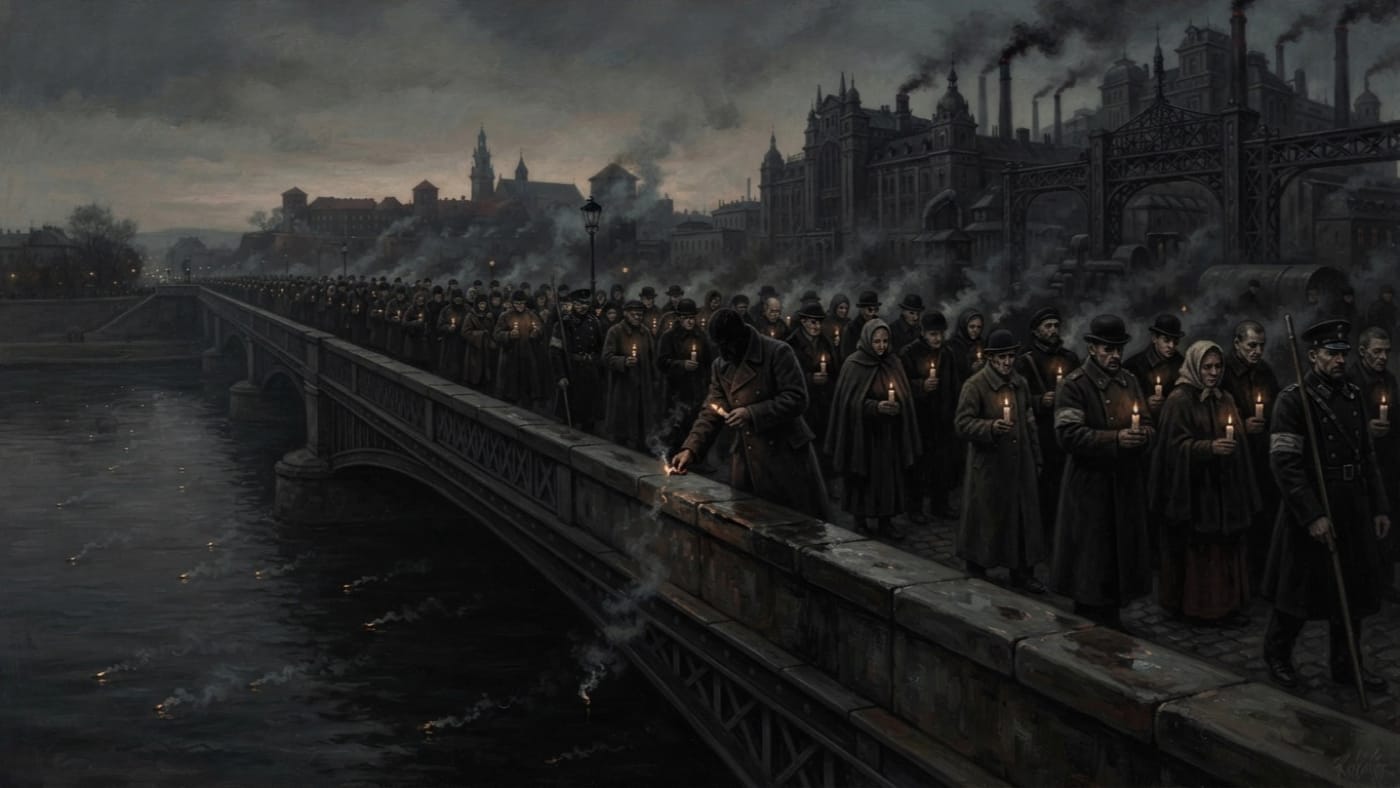
The procession forms below Wawel Hill, climbs to the Cathedral and the Chapel of the Drowned Priests, comes down by the Grodzka Gate and makes for the Dębnicki Bridge. The route belongs to the Vigil itself. I give it here only so the reader knows where the candles are when the form takes hold of them.
At the midpoint of the span the forty-seven candles are put out one at a time, and each smoking wick is dropped over the parapet into the Vistula. The record says one by one, which rules out a handful, a basket, or a clerk tipping the lot over in a single tidy motion. There are forty-seven extinguishings and forty-seven small falls of thread and smoke.
This is why a beginning needs permission at all. When the candles go out singly, the sequence is the one thing on the span that people watch because they cannot hear it. A bell would have marked the time. The Vigil has taken the bells away and handed the counting to fingers, which pinch and lift and release while the river makes the only sound it is allowed to make.
The wicks drift downstream toward Sandomierz, where fishermen gather them. That collection has its own keepers and its own register. As far as the surviving evidence shows, Form 17-K claims no authority over it. The form's interest ends where the candle's does, at the parapet, in smoke.
#On Permitted Sound
The stamp is a compliance abstract. It records what the Bureau will tolerate and what it will punish within one district for one hour. It is not a blank form, and I decline to rebuild one around it. No signature line survives, no box for a parish name, no space for a tower-master's mark. Clerks will want to draw them in. Clerks always want to draw them in.
Four sounds are allowed. Footsteps are allowed because a procession that does not walk is only a crowd. Water is allowed because no stamp can serve the Vistula, and the Bureau has the sense not to try. Accidental weeping is allowed, and the adjective does the legislating. A mourner who breaks down on the span is within the stamp. A parish that schedules its lament or rehearses its sobbing on the way down from Grodzka Gate has crossed from grief into performance, and the hour exists to exclude performance. Authorized command whispers are allowed as well. A marshal may tell a candle-bearer to step forward, but he may not tell her about his sister's lungs. The whisper is licensed for its office and nothing else.
The forbidden list runs from bells, chimes and handbells through market gongs and choir intervention to the parish flute. It starts with the Bureau's own instruments, passes through the instruments of trade, ends with the instruments of piety, and names a single woodwind with the precision of a grudge. On dogs, cart-axles and coughs the stamp says nothing. This survey will not legislate where the stamp declined to.
Up on Wawel, in the Chapel of the Drowned Priests, hang forty-seven low throat-bells. They were cast after the A.S. 148 ratification and tuned so low that a visitor feels them in the teeth before hearing them. Through the hour they hang mute. The forbidden list opens with the word bell, and the chapel built for these dead claims no exception for itself. For that hour their obedience is the only sound they make, which is to say none.
#On Censure and Authority
The stamp names three consequences. The first is a schedule-suspension review. The Bureau wrote the word "review", and I will not let enthusiasts delete it. A review may end in suspension, but the stamp does not say how a review begins, who sits on it, or what it must find. The second is tower-master censure, which falls on the man whose tower should have held its tongue. The third applies to repeated offences, which go to the Bureau of Doctrine. At that point an acoustic failure becomes a theological one.
The stamp does not say how many offences make a repetition. It mentions no fines, no confiscated clappers, no prison and no appeal. Readers who need the machinery finished may finish it in their own heads, where it will carry exactly the authority of their heads.
The question of authority needs a plainer answer. The Bureau of Bells is the attested compliance authority for Form 17-K, because its name heads the stamp. That establishes who enforces the form. It does not establish who wrote it. The wider Vigil also involves the Bureau of Doctrine, which certifies the observance, and the Bureau of Festivals, which shares in keeping it. Nothing shows that either one wrote or first issued this form. The river-and-wire seal is the Vigil's emblem, and Doctrine's certification belongs to the Vigil as well. Form 17-K has a compliance stamp and an unknown father.
#On the Surveyed Instrument
As surveyed in A.S. 201, Form 17-K does its two attested jobs within the Kraków Processional District. It lets a parish begin with the novice or with the old priest of Saint Anne's. It tells the city which sounds it may make while forty-seven wicks go into the river, and what happens to a tower-master who disagrees. Its reach goes as far as its stamp names and no further. I find no ground for extending it to Sandomierz, to affiliated chapels elsewhere, or to the Church at large.
Its original issue, first printing and adoption are unknown. The gap is in the record, and I have entered it as a gap, which is more than most of my colleagues manage for their own birthdays. The murders are dated, and so is the Vigil's ratification. This survey carries a date as well. The form's own beginnings remain blank.